Trauma response test: Free template for clinicians
A trauma response test is a structured screening questionnaire that helps clinic...

3
Last Updated: Oct 15, 2026
The Childhood Trauma Questionnaire (CTQ) is a standardized self-report instrument that measures a person’s history of childhood abuse and neglect. It scores five dimensions: emotional abuse, physical abuse, sexual abuse, emotional neglect, and physical neglect. Most practices use the 28-item short form (CTQ-SF), which takes about five minutes and includes three items that flag possible under-reporting.
Each subscale produces a raw score from 5 to 25, which you read against published severity bands from none/minimal to severe-to-extreme. Therapists, psychiatrists, and researchers use the scores at intake, in PTSD assessment, and to track outcomes. The CTQ itself is licensed through Pearson, so the free worksheet below helps you record and interpret scores without reproducing any items.
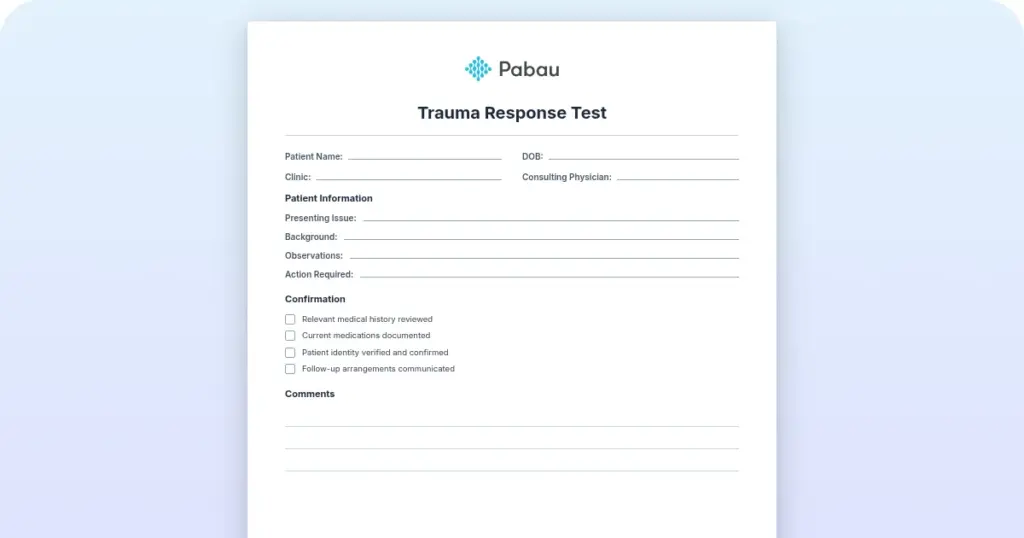
A companion worksheet for use alongside your licensed Pearson CTQ-SF. It includes a trauma-informed pre-session checklist, subscale score boxes with severity bands, a Minimization/Denial flag, and follow-up notes. It does not contain the questionnaire items.
Download template
The CTQ-SF has 28 items rated on a 5-point scale: 25 cover five maltreatment subscales, and three form a Minimization/Denial validity scale.
Each subscale scores 5 to 25 and has its own severity cut-points, so the same raw score can mean different severity on different subscales.
Internal consistency is good on most subscales (Cronbach’s alpha usually above 0.70), but Physical Neglect often scores lower, at about 0.61 in the 2003 validation.
The CTQ is licensed through Pearson. Its items revisit traumatic memories, so arrange consent and grounding support before a patient starts.
Practice management software like Pabau lets licensed practices send the CTQ-SF as a secure digital form and keep scores in the patient record.
The CTQ is a retrospective self-report instrument that measures the severity of five types of childhood maltreatment. Respondents rate each item, 70 in the original and 28 in the short form, from 1 (never true) to 5 (very often true). They report on their own early-life experiences, and the answers become scores you can compare across patients and over time.
That makes the CTQ useful in trauma-informed care workflows, where a patient’s history shapes safety planning and treatment goals. Bernstein and Fink’s 1998 manual, published by The Psychological Corporation, standardized how the CTQ is scored and set its severity norms. The CTQ has since been translated into 30+ languages and validated across 50+ peer-reviewed studies in PubMed Central.
Use the CTQ-SF, the 28-item short form that is also called the CTQ-28. It is an abbreviated version of the original 70-item CTQ, which Bernstein and colleagues published in 1994. In 2003, Bernstein et al. used factor analysis to reduce the original to 25 clinical items, five per subscale. They then added three Minimization/Denial items that flag possible under-reporting. Both versions measure the same five types of maltreatment on the same 5-point Likert scale.
Most practices and research teams choose the CTQ-SF. It covers the same five dimensions with 42 fewer items, so patients finish it faster and tire less. The Minimization/Denial items also help you judge whether an unusually low score is credible. That brevity suits high-volume mental health practice workflows. You will mainly meet the 70-item original when reading older studies that report scores from it.
The CTQ-SF measures maltreatment across five empirically derived dimensions, each with five items rated on the 5-point scale. A three-item validity scale sits alongside them:
Each subscale yields a raw score (sum of items). Severity is then interpreted against published thresholds.
Scoring the CTQ-SF takes five steps:
Secure digital forms keep the subscale scores, the validity flag, and your interpretation together in one record. Paper charts work too, as long as they get the usual HIPAA safeguards.

These cut-scores come from the Bernstein and Fink 1998 manual. Check a recent validation study for population-specific norms, because thresholds can vary by demographic group.
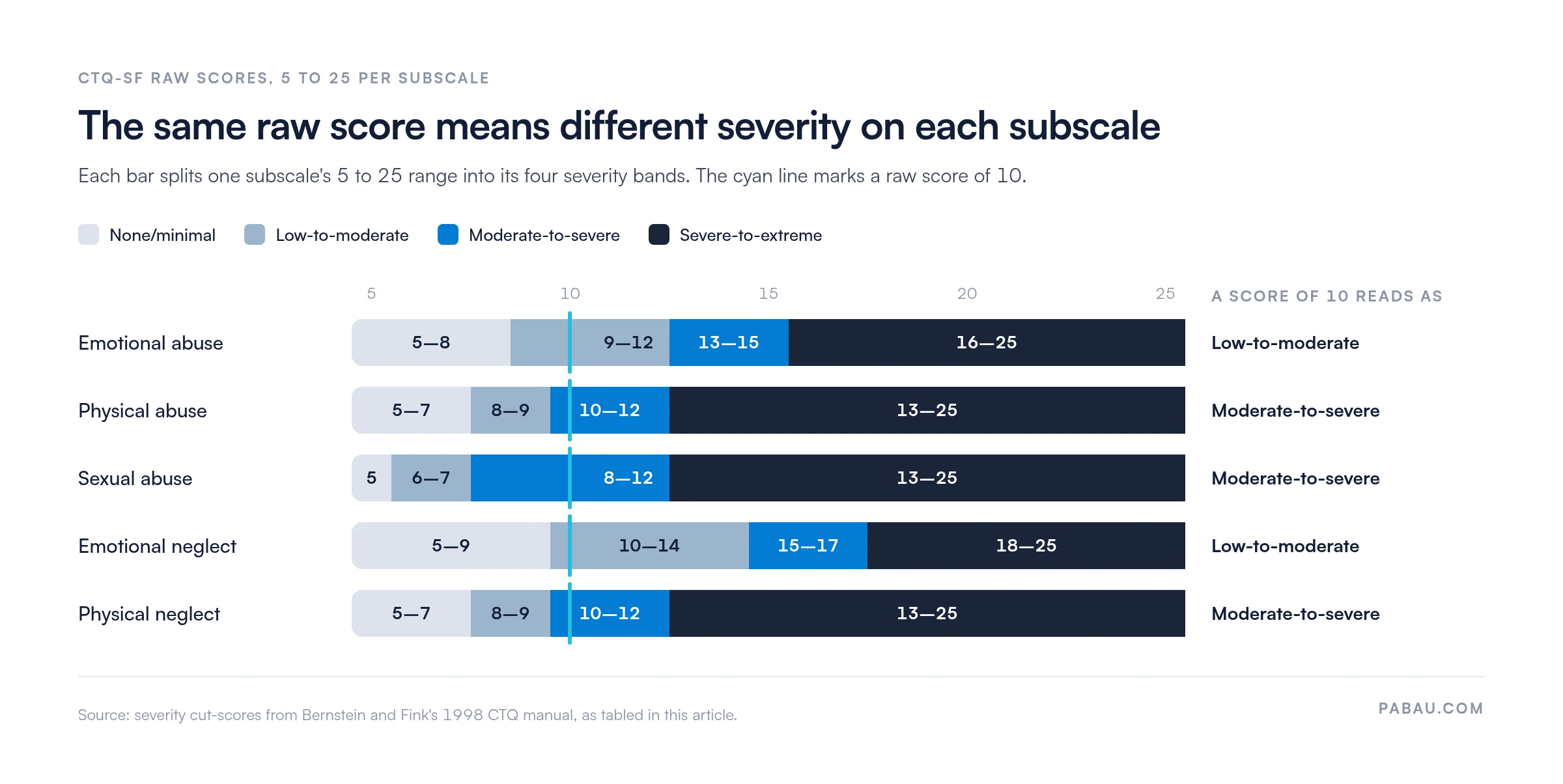
Because each subscale has its own bands, the same raw score can land in different severity categories. A score of 10 is moderate-to-severe for physical abuse, sexual abuse, and physical neglect. On emotional abuse and emotional neglect, the same 10 is only low-to-moderate. The chart below lines the bands up so you can see where each one shifts.
Validation studies support the CTQ’s reliability across clinical and community samples. Internal consistency (Cronbach’s alpha) typically exceeds 0.70 on four of the five subscales, in samples of 200 to 3,000 participants. Physical Neglect is the exception. Its alpha was about 0.61 in Bernstein et al.’s 2003 validation, and it often falls below 0.70 in community samples. Interpret that subscale with more caution.
Test-retest reliability holds over several months. The original validation studies retested respondents after 1.6 to 5.6 months, about 3.6 months on average. They reported intraclass correlations of roughly 0.79 to 0.86, which fits a measure of past experiences that shouldn’t change between administrations.
Construct validity is supported by strong correlations with other trauma and adverse experience measures. The CTQ also separates trauma-affected groups from comparison groups. Studies in French-, German-, Spanish-, and Portuguese-speaking cohorts confirm the same factor structure outside English-speaking samples.
Mental health practitioners build the CTQ into clinical workflows for three main purposes:
Safe administration starts with informed consent and a safety plan agreed before the patient begins. Keep grounding techniques ready, because CTQ items address traumatic content directly and can trigger emotional activation partway through.
The CTQ is often confused with the Adverse Childhood Experiences (ACE) Questionnaire, a related but distinct screening tool. The ACE Questionnaire came out of CDC research in the 1990s. It asks yes/no questions about 10 categories of childhood adversity, covering abuse, neglect, and household dysfunction, and yields a single 0-10 score.
The CTQ, by contrast, rates five specific maltreatment types on a 5-point scale and produces five separate severity scores. That granularity suits individual clinical assessment. The ACE is epidemiological and better suited to population screening.
The CTQ is a proprietary instrument published by Pearson and registered with the APA PsycNET test registry. Clinical and research users must obtain a license through Pearson, and fees vary by volume and organization type. The 28-item CTQ-SF item set can’t be reproduced in print or digital form without a license agreement.
That’s why the free Pabau worksheet on this page contains no CTQ-SF items. It’s a companion for recording scores from your licensed Pearson forms.
The main free alternative is the CDC’s public-domain ACE Questionnaire, which suits population-level screening. The Early Trauma Inventory (ETI) covers similar ground to the CTQ. It is also copyrighted, though, so you need permission from its publisher before using it.
For researchers with limited budgets, some universities hold standing CTQ site licenses through their library or psychology department. Confirm licensing status with your compliance officer before you administer any of these instruments.
Many mental health practices still hand patients a paper questionnaire, tally the subscales by hand, and scan the sheet into the chart. That takes time, and it leaves sensitive trauma history on paper at the front desk.
For therapy and counseling practices, practice management software like Pabau turns a licensed CTQ-SF into a secure digital intake form. Responses land in encrypted, HIPAA-compliant patient records, so only authorized clinicians can see them.
Where your trauma-informed protocol allows remote completion, patients can fill in the form through the Client Portal before the session. You then spend the appointment discussing the results rather than waiting while the patient completes paperwork.
Pabau Scribe, our AI scribe, drafts the session note as you talk the results through with the patient. That keeps your attention on the person in the room, which is a core principle of trauma-informed care.
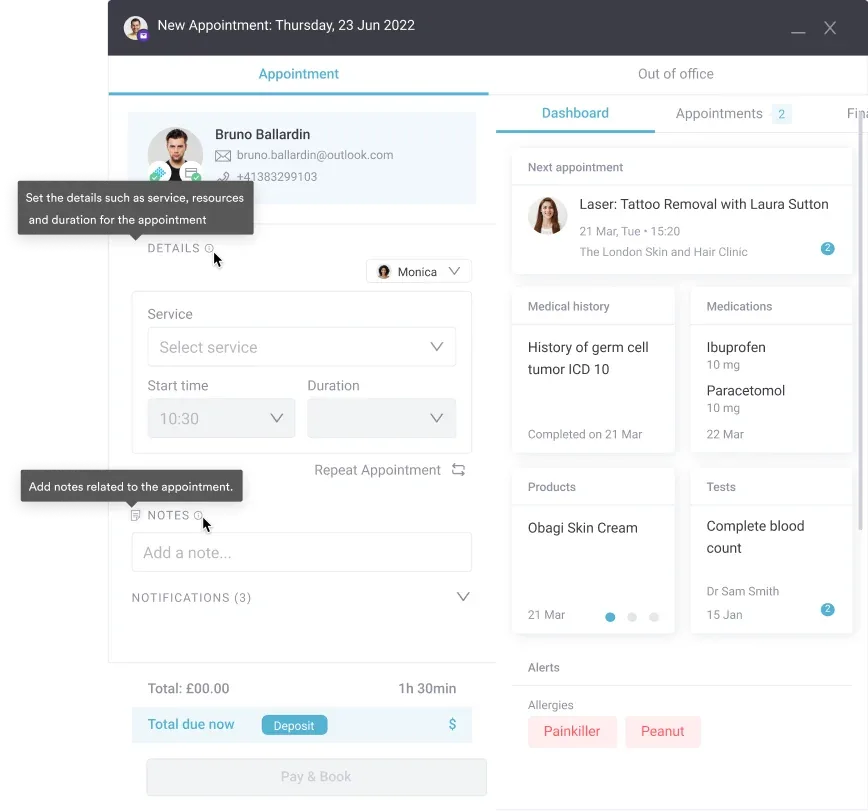

Send licensed instruments like the CTQ-SF as secure digital forms and keep scores in HIPAA-compliant patient records. Pabau Scribe drafts the session note while you talk.

Start with the CTQ-SF unless you need to compare against older studies that used the 70-item original. Read each subscale against its own cut-points rather than one overall threshold. Give Physical Neglect scores extra scrutiny, since that subscale is the least reliable of the five.
Before the first administration, secure a Pearson license and agree a safety plan with the patient. Then use the free worksheet above to record the scores, the Minimization/Denial flag, and your follow-up notes in one place.
Book a demo to see how Pabau keeps CTQ-SF results, session notes, and follow-up appointments together in one secure patient record.

Need a platform built around therapy workflows? Therapy practice management software brings intake forms, session notes, and scheduling for counseling practices into one system.
Screening for PTSD symptoms after a high CTQ score? The PCL-5 template measures current PTSD symptoms against the DSM-5 criteria.
Assessing complex PTSD as well? The International Trauma Questionnaire screens for PTSD and complex PTSD using ICD-11 criteria.
Seeing dissociative symptoms alongside trauma history? The Dissociative Experiences Scale measures how often patients experience dissociation in daily life.
Choosing an EHR for trauma-informed care? The best EHR software for mental health compares the leading options for therapy and psychiatry practices.
The CTQ is a retrospective self-report instrument that measures five types of childhood maltreatment on a 5-point Likert scale. They are emotional, physical, and sexual abuse, plus emotional and physical neglect. Bernstein and colleagues published the 70-item original in 1994, and the 28-item short form (CTQ-SF) followed in 2003.
Add up the item responses (1 to 5) within each subscale to get five raw scores from 5 to 25. Compare each score with that subscale’s own severity cut-points, from none/minimal to severe-to-extreme. Score the three Minimization/Denial items separately to flag possible under-reporting.
Emotional Abuse, Physical Abuse, Sexual Abuse, Emotional Neglect, and Physical Neglect each have five items in the 28-item CTQ-SF. Each subscale measures a distinct form of childhood maltreatment on the 5-point Likert scale.
The CTQ uses 28 Likert-scale items yielding five severity subscales, designed for detailed clinical assessment. The ACE Questionnaire uses 10 yes/no items yielding a single score, designed for population-level epidemiological screening. Clinicians tend to prefer the CTQ for individual assessment, while the ACE suits public health surveillance.