GLP-1 diet plan
A GLP-1 diet plan is a structured eating framework for patients taking semagluti...

2
Last Updated: Oct 13, 2026
A diagnostic assessment is a structured clinical evaluation that a therapist, psychologist, or physician uses to identify and classify a patient’s condition.
It combines an interview, direct observation, standardized screening, and clinical judgment. What comes out is a working diagnosis that the treatment plan is built on.
For mental health practitioners, the assessment is the first permanent entry in a patient’s clinical record. It captures the presenting concern, personal and family history, mental status findings, risk factors, and a provisional diagnosis. That structure is what makes the record usable for clinical continuity and for insurance review.
Below you can download a ready-to-use template. The sections that follow explain what belongs in each part of it, and how to complete one in a single session.
A ready-to-use clinical form covering chief complaint, personal and family history, mental status examination, and risk and safety screening. The closing section leaves space for a provisional diagnosis with DSM-5-TR and ICD-10-CM codes.
Download template
A diagnostic assessment is a structured clinical evaluation combining history, mental status examination, risk screening, and a working diagnosis.
The core sections are chief complaint, history, substance use and trauma, mental status examination, risk screening, and a provisional DSM-5-TR or ICD-10-CM diagnosis.
A standardized form keeps every clinician in the practice recording the same sections, which makes supervision, audit, and handover far simpler.
Risk documentation carries the most legal weight, so the safety plan and the level of care both belong in the record.
Practice management software like Pabau stores completed assessments against the patient record, so the next clinician can find them in seconds.
A diagnostic assessment is the process by which a qualified clinician evaluates a patient’s presenting concerns, history, functioning, and risk to reach a diagnosis. A screening tool tells you that a disorder may be present. The assessment confirms it, rules out the alternatives, and gives you enough detail to plan treatment and prescribe.
The criteria come from two standards. The American Psychiatric Association publishes the DSM-5-TR, and the CDC’s National Center for Health Statistics maintains ICD-10-CM under authorization from the World Health Organization. A thorough assessment does all of the following:
In psychology practices and mental health services, the assessment is the patient’s intake foundation. It becomes part of the permanent clinical record, and it supports insurance claims, clinical continuity, and regulatory compliance.
The sections below align with DSM-5-TR assessment standards and with what payers expect to see documented. Leaving one of them blank is the most common reason an assessment gets sent back.
The mental status examination is the one section built from what you observe rather than what the patient reports. It records presentation, thought process, and cognitive function. No history form can produce those findings.
A structured MSE covers appearance and behavior, mood and affect, speech, thought form and content, perception, cognition, insight, and judgment. Our guide to the mental status examination walks through each domain in turn. This psychiatric evaluation template shows how those findings sit inside a full write-up.
Every assessment must address imminent risk. Screen for suicidal ideation and intent, homicidal ideation, self-harm, substance use, and access to means. Where risk is present, the record needs a safety plan. That means the steps the patient will take in a crisis, their emergency contacts, and the level of care you have set.
Risk documentation carries more legal weight than any other section. A thorough write-up demonstrates due diligence and protects both the patient and the clinician if the case is later reviewed. A structured suicide risk assessment keeps the screening consistent from clinician to clinician.
The template runs the sections in a logical order. Work through them in one sitting where the patient’s stamina allows it.
The five steps and the documented sections are not the same list, which is where clinicians new to the form lose time. One step closes four sections at once, and the last one cannot be started until two earlier steps are finished.
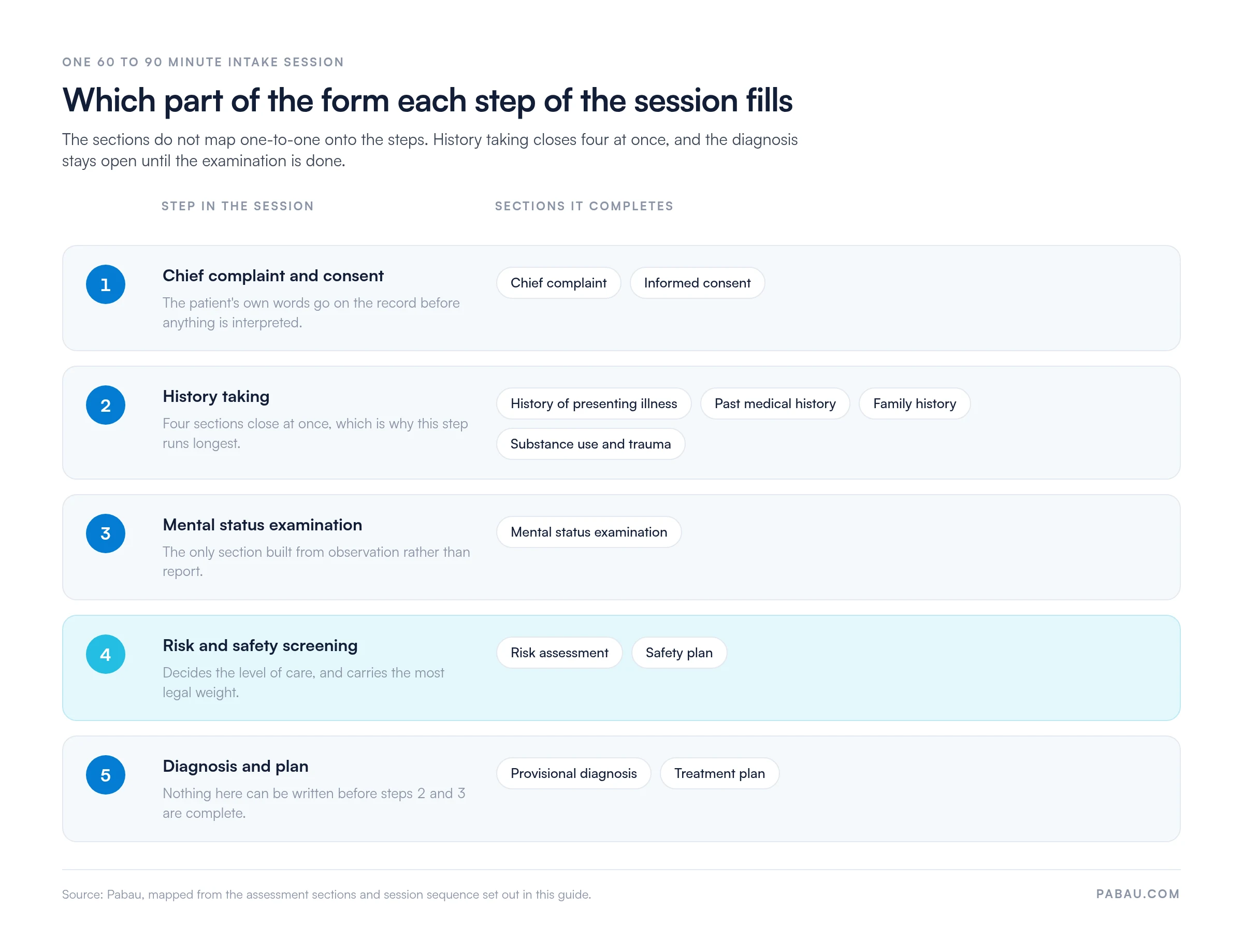
Complete the assessment in a single session where you can. A picture assembled across three appointments rarely reads as one coherent formulation.
Validated instruments put a number next to clinical judgment, and they give you a baseline to measure progress against. These are the ones that turn up most often in mental health intake.
Scores from different instruments are not interchangeable, so always record the instrument name next to the number. A score of 15 means something very different on the PHQ-9 than it does on the PCL-5. This PHQ-9 and GAD-7 form keeps both scales on one page for intake.
The form earns its place wherever a clinician has to establish a diagnosis before planning treatment. The main users are:
Any service treating patients with mental health or behavioral concerns benefits from a standard form. Most now run it inside their therapy practice management software, so the finished assessment lands in the patient record instead of a filing cabinet.
The operational case for standardizing is stronger than the clinical one, and it shows up quickly:
None of that survives if each clinician keeps a private version of the form. Agree on one, and review it as a team rather than in isolation.
Moving the assessment off paper improves security, accessibility, and how quickly anyone can find it again. The workflow below is what most electronic medical record systems support.
The advantage is not only speed. A digital form can refuse to submit while a required section is empty, which is a check no paper form has ever performed.
The core structure holds across every population, but what you probe and what you rule out both shift with age.
Many practices keep a separate version of the form for each population rather than one form with sections that get skipped. It is easier to audit, and easier for a new clinician to pick up.
In most practices the assessment is typed into a document, printed for a signature, then scanned back in. The finished file sits in a folder that only opens if someone remembers the patient’s name and roughly when they were seen.
Practice management software like Pabau rebuilds the form as a digital intake form, so the clinician completes it on a tablet during the session. Pabau Scribe, our AI scribe, can transcribe spoken observations straight into the mental status fields. The completed assessment saves against the patient’s Client record, where it is searchable by diagnosis, by clinician, or by date.
Role-based permissions keep the risk section visible only to the clinicians who need it, and every view is logged for audit. Every Pabau subscription includes the forms, the records, and the audit trail, so none of it is a paid extra.

Pabau’s digital intake forms, AI scribe, and secure records let your team complete a diagnostic assessment in session. The finished document files itself against the patient and stays audit-ready.

The part of this form that gets read back to you years later is the risk section. The other sections support the diagnosis. The risk write-up is what a reviewer or a lawyer looks for first, and it is the one worth slowing down for.
So pick one template, get the whole team onto it, and stop letting each clinician redesign it. Consistency is what makes an assessment defensible, comparable across a caseload, and quick to hand over.
The trade-off worth remembering is time. A complete assessment takes an hour or more, and shortening it is almost always a decision to document less. Book a demo to see how Pabau captures the whole assessment in session and files it against the patient record.

Need the intake paperwork that comes before the assessment? Mental health intake form collects demographics, consent and presenting concerns before the session starts.
Want the social and developmental context in one place? Biopsychosocial assessment explains how to gather history across biological, psychological and social domains.
Ready to write the plan the diagnosis points to? Psychology treatment plan template turns goals and interventions into a document a payer will accept.
Need a safety plan for a patient screening at risk? Mental health safety plan sets out warning signs, coping steps and emergency contacts in a usable format.
Checking for physical symptoms across body systems? Psychiatric review of systems helps you rule out medical causes before settling on a psychiatric diagnosis.
A diagnostic assessment is a comprehensive clinical evaluation carried out by a mental health professional. It combines an interview, direct observation of the patient’s presentation, and standardized testing to reach an accurate diagnosis. It covers history, mental status examination, risk screening, and DSM-5-TR or ICD-10-CM codes that guide treatment and insurance authorization.
A complete template covers the chief complaint, personal and family history, medical and psychiatric history, and substance use and trauma history. It then records the mental status examination, covering appearance, mood, thought process, cognition and insight. It closes with risk assessment, a provisional diagnosis carrying DSM-5-TR or ICD-10-CM codes, and a treatment plan.
Screening is a brief, standardized tool such as the PHQ-9 or GAD-7 that flags whether a disorder may be present. A diagnostic assessment is the comprehensive evaluation that confirms or rules out a specific diagnosis, explores severity and functional impact, and informs treatment. Screening is usually the first step, and the assessment is the full workup.
Document the assessment in the patient record immediately after the session, using a standardized form. Record the date, the clinician’s name, every required section, the reasoning behind the diagnosis, and any safety planning. Use DSM-5-TR or ICD-10-CM codes. Store the completed file in a secure record that only authorized clinicians and billing staff can open.
The instruments that appear most often are the PHQ-9 for depression and the GAD-7 for anxiety. Beyond those, clinicians reach for the PCL-5 for PTSD, the AUDIT for alcohol use, and the MoCA for cognitive screening. Clinicians choose them based on the presenting concern. The scores give the formulation an objective anchor, but they never replace the interview.
A thorough assessment usually takes 60 to 90 minutes for an adult first appointment. Children and adolescents often need 90 to 120 minutes, because of developmental considerations and collateral interviews with parents or teachers. Experienced clinicians working with a familiar population can move faster without losing quality.