Maja Popovska

Support system worksheet: Free PDF and session guide
Download your free support system worksheet A ready-to-use assessment form for m...

1
Last Updated: Nov 9, 2026
Free PDF 2 pages, print-ready Clinician-reviewed
The Ramsay Sedation Scale is a six-level bedside rating of sedation depth, from anxious and agitated at level 1 to no response at level 6. Levels 1 to 3 describe an awake patient. Levels 4 to 6 grade a sleeping patient's response to a light glabellar tap or loud noise. ICU, anesthesia and recovery teams use it to keep sedation close to an agreed target. The free PDF pairs the scoring table with bedside steps and an observation record.
A two-page PDF with the six Ramsay levels, bedside scoring steps and 11 observation rows for score, target, agent and dose changes. It closes with a Ramsay vs RASS note and a sedation hold and weaning plan box.
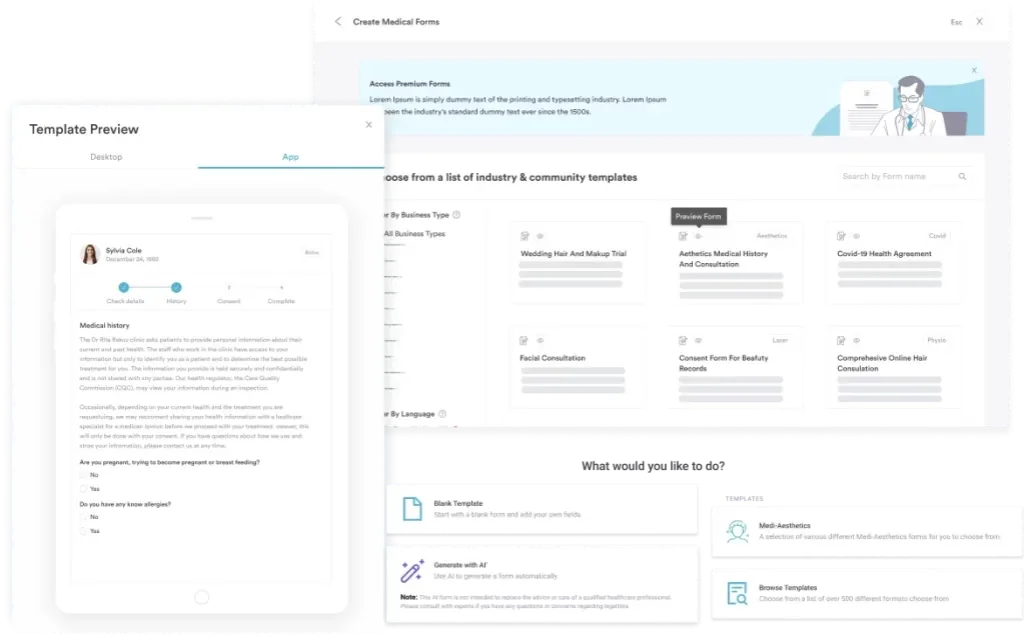
Start from scratch, or upload this PDF or any form you already use, and Pabau's AI Form rebuilds it with tick boxes, text fields and a signature. Attach it to the treatment once, and every patient gets it on time.
AI Form rebuilds the consent, history and aftercare forms you already use. You review each one, then publish.
Patients complete forms on their phone before they arrive, so the front desk stops retyping paper.
Every signed form is versioned and attached to the treatment record, ready when you need it.
Set how long a consent stays valid. Returning patients skip forms they have already signed.
Supports HIPAA and GDPR compliance AES-256 encryption 4.8 on G2 4.7 on Capterra Trusted by 4,000+ practices worldwide

The Ramsay Sedation Scale grades sedation depth on six levels, from anxious and agitated at 1 to no response at 6.
Levels 1 to 3 describe an awake patient, and levels 4 to 6 grade a sleeping patient’s response to a glabellar tap or loud noise.
Agree a target level before you titrate, then record the score, target, agent and any dose change together.
Agitation gets a single level on this scale, so many US ICUs chart RASS instead. The two scores are not interchangeable.
A score taken during neuromuscular blockade or natural sleep can mislead, so note the context beside the number.
Ramsay and colleagues published the scale in 1974 in the British Medical Journal, in a study of controlled sedation with alphaxalone-alphadolone. The drug has long left clinical use, but the scale is still one of the most widely recognized sedation tools.
Each level describes what the patient looks like and how they respond. Two clinicians looking at the same patient should land on the same score.
Levels 2 and 3 describe a calm patient who responds to voice. Levels 4 to 6 describe a progressively weaker response to a tap or a loud noise. Agitation gets one level only, so the scale cannot separate a restless patient from a combative one the way RASS does.
To use the Ramsay Sedation Scale, observe the patient first, then add stimulus only until one descriptor matches the response. Whether the patient is awake or asleep decides which three levels are in play, as the flow after these steps shows.
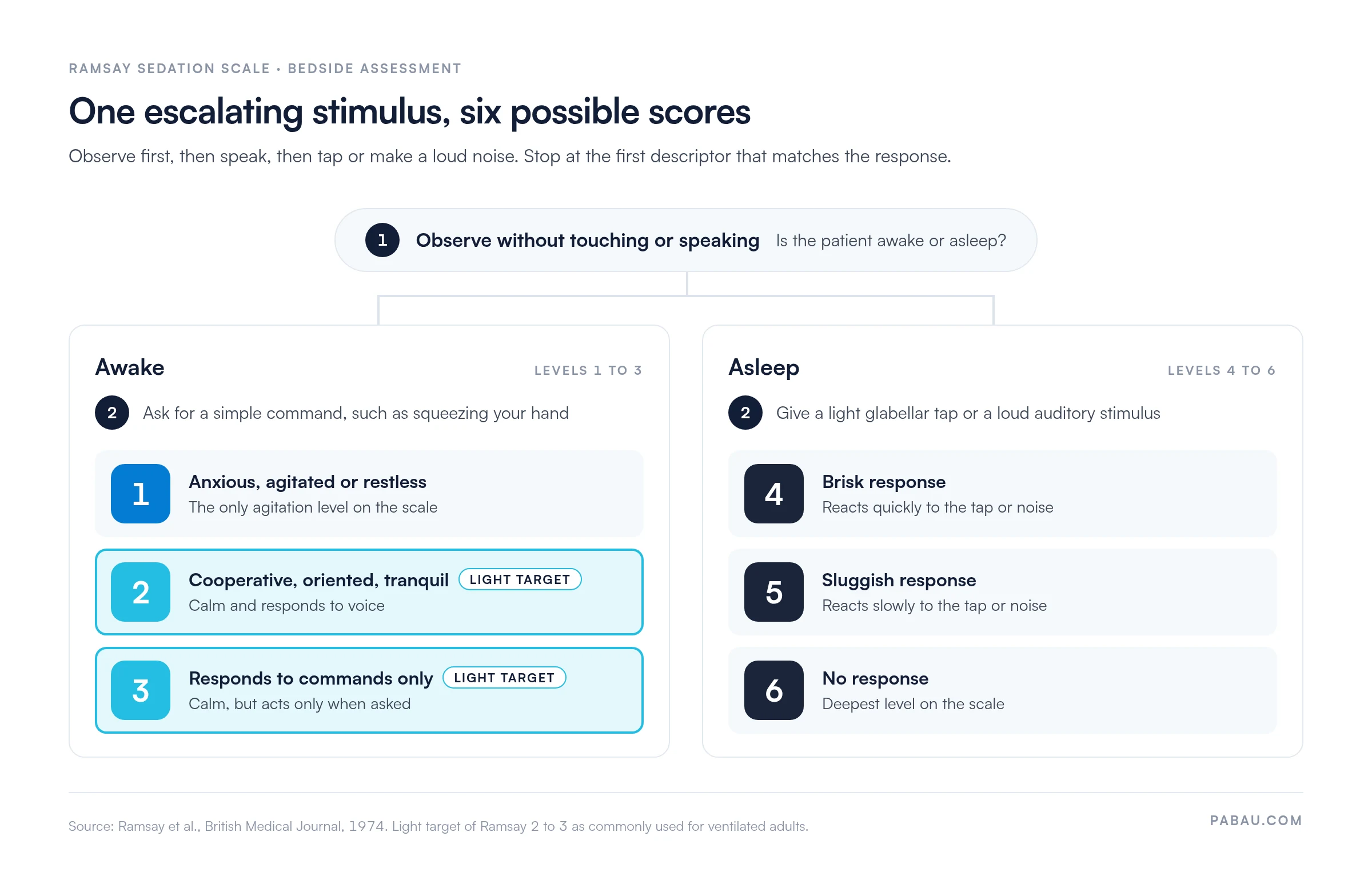
A score means little without a target to compare it against. Agree the target level with the prescriber, then titrate toward it. Many ventilated adults are kept at a light level, commonly Ramsay 2 to 3, unless deeper sedation is clinically indicated.
That default follows the evidence. The 2018 PADIS guideline from the Society of Critical Care Medicine suggests light rather than deep sedation for critically ill, mechanically ventilated adults. It also recommends a behavioral pain tool, such as the CPOT pain scale, for patients who cannot report pain. Rule out pain before you raise a sedative dose.
Each row of the template’s observation record holds the time, the Ramsay score, the target, and the agent and rate. Two more fields record any change made and the initials of whoever made it. Reading down the rows shows whether the patient drifted from target and what the team did about it.
Score the same way on every shift, because one reading at admission says little about the trend. You can also rebuild the scale in Pabau, the practice management platform we build, as one of its digital forms. Every entry then lands in the same fields.
The Ramsay Sedation Scale is most useful for adult patients in intensive care, procedural sedation and recovery areas.
The American Society of Anesthesiologists describes sedation as a continuum rather than a yes-or-no state. That framing explains why teams grade depth instead of ticking a single box.
Pediatric teams should take more care. Ramsay’s original study enrolled adults, so many pediatric units use a scale validated in children instead, such as the COMFORT-B scale.
A Ramsay score is only as reliable as the response it reads. Four situations distort that response, so record the context beside the number whenever one applies.
When reduced responsiveness may have a cause other than sedation, a broader level of consciousness assessment is the better tool. The template’s daily sedation hold, delirium screening and weaning plan box keeps those checks next to the score they explain.
A shared scale means every nurse records depth the same way, so handovers and clinical reviews read consistently.
Missing details tend to surface at review. The template keeps the score, the time, the target and the stimulus on one line, so none of them is recorded without the others.
Audits get faster too. When every row shows the target and the change made, a reviewer can check whether titration followed protocol without cross-referencing the medication chart.
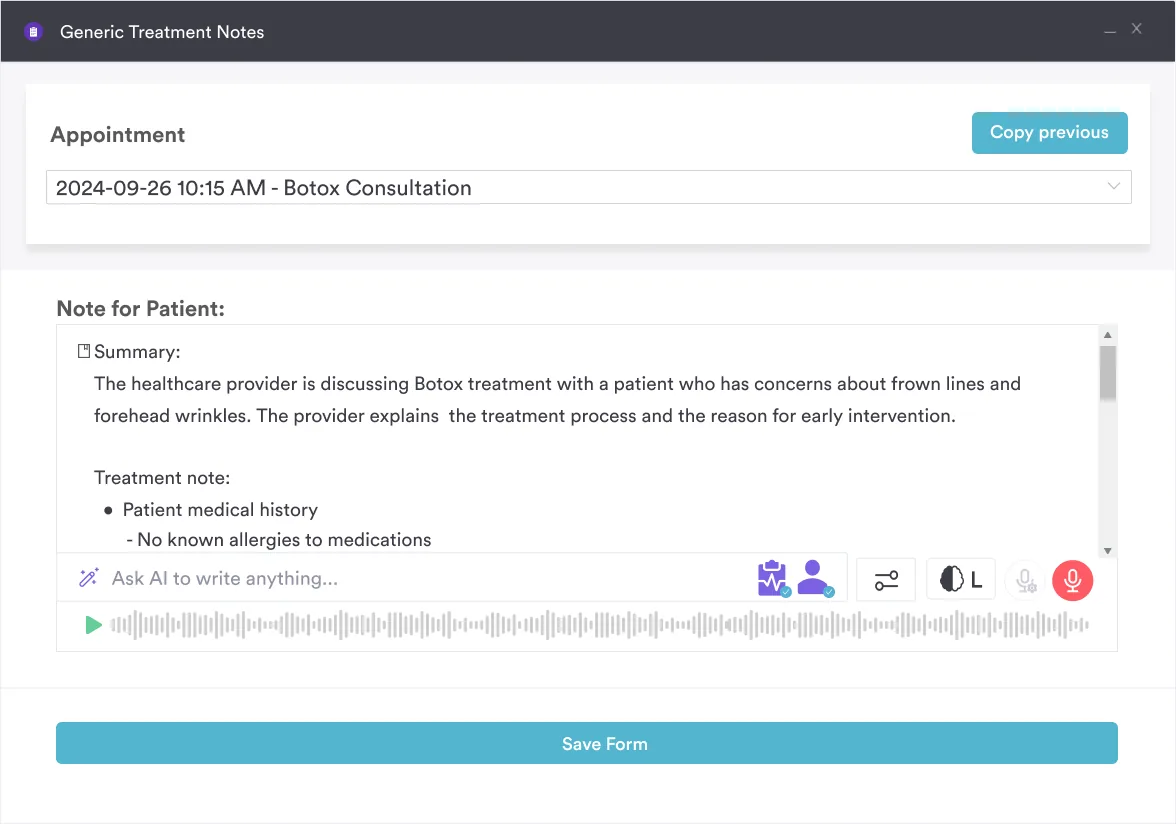
Teams already using Pabau Scribe, our AI scribe, for clinical notes can keep the score beside the rest of the note.
Set your reassessment interval in the protocol, then print it on the form. Record the time beside every score so the trend is visible at a glance. Flag any change in level for the charge nurse to review.
The Richmond Agitation-Sedation Scale (RASS) is the more common choice in US ICUs, because it grades agitation and sedation on either side of zero. The Ramsay Sedation Scale is quicker to learn and suits units that mainly need to track sedation depth.
The RASS validation study tested the scale in adult ICU patients, which is part of why critical care teams adopted it. The Ramsay scale’s single agitation level is its main weakness in that setting.
The two scales are not interchangeable, and the template says so. Pick one per unit and keep to it, because a chart that switches scales mid-stay loses its trend. When a patient moves from a Ramsay unit to a RASS unit, chart a fresh baseline rather than converting the last score.
On paper, the Ramsay chart sits at the bedside while dose changes are written somewhere else. A reviewer then has to line the two up by time, and a missing set of initials stalls the review.
In Pabau, the scale becomes a digital form with fixed fields for the score, target, agent and rate, change made and initials. Each completed form saves to the patient record, so the whole trend sits in one place.
Forms and patient records are core features in every Pabau plan. Structured onboarding helps your team build the form to match your unit’s sedation protocol.

Pabau turns the Ramsay Sedation Scale into a structured digital form, so every score, target and dose change saves to the patient record. Reviewers see the trend without chasing paper charts.

The Ramsay Sedation Scale earns its place through speed. Six levels and one escalating stimulus make it easy to repeat on every round, by any member of the team.
Its limits are well known, so plan around them. Set a target before you titrate, note anything that distorts the response, and pair the score with a delirium screen. If your unit already charts RASS, stay with RASS, because a mixed chart is harder to read than either scale alone.
Download the template, agree your target and reassessment interval, and use the same form on every shift. Book a demo to see how Pabau keeps sedation scores, targets and dose changes together in one patient record.

Handing over a sedated patient at shift change? SBAR nursing handoff template gives you a structured way to pass on sedation targets and recent dose changes.
Tracking several ventilated patients on one shift? ICU report sheet keeps each patient’s key details and handoff checklist on one page.
Writing up the daily review for a critically ill patient? ICU note template shows how to structure a systems-based progress note.
Need a fuller picture when responsiveness drops? Level of consciousness assessment covers the tools to use when sedation may not be the only cause.
The Ramsay Sedation Scale is a six-level bedside rating of sedation depth. Level 1 is anxious and agitated, and level 6 is no response to a light glabellar tap or loud noise. Ramsay and colleagues published it in the British Medical Journal in 1974.
There is no single good score, because the target depends on the patient. Many ventilated adults are kept at Ramsay 2 to 3 unless deeper sedation is clinically indicated. Agree the target with the prescriber and record it beside each score.
A Ramsay score of 6 means the patient shows no response to a light glabellar tap or loud auditory stimulus. It is the deepest level on the scale. Check for oversedation and neuromuscular blockade, then escalate according to your unit’s protocol.
Record a score at the interval your unit’s protocol sets, and again after every dose change. One score at admission says little about the trend. The template’s observation record has 11 timed rows for repeat checks.
The Ramsay Sedation Scale has six levels and gives agitation a single level. RASS has ten levels, from +4 (combative) to -5 (unarousable), with 0 as alert and calm. The scores are not interchangeable, so each unit should chart one scale consistently.
Use it with caution, because Ramsay’s original study enrolled adults. Many pediatric units prefer a scale validated in children, such as the COMFORT-B scale. Follow your unit’s protocol for pediatric sedation scoring.