GLP-1 diet plan
A GLP-1 diet plan is a structured eating framework for patients taking semagluti...

2
Last Updated: Oct 13, 2026
The CPOT pain scale is a validated behavioral assessment tool that measures pain in non-verbal intensive care unit (ICU) patients who cannot report it themselves. It scores four observable indicators, each from 0 to 2, for a total between 0 and 8. A total of 2 or higher usually means the patient needs pain relief.
Critically ill patients on sedation or mechanical ventilation cannot tell you where it hurts. The CPOT turns what you can see at the bedside into a number your pain protocol can act on. The Society of Critical Care Medicine (SCCM) endorses it in the 2018 PADIS guidelines, which cover pain, agitation and sedation, delirium, immobility and sleep disruption.
This guide covers the four domains, the scoring anchors, the thresholds that trigger analgesia, and how to get a whole unit scoring the same way. The template below is the form to score from.
A structured behavioral pain assessment template covering facial expression, body movements, muscle tension, and ventilator compliance, with a 0-8 scoring rubric and clinical interpretation thresholds. It also carries fields for the assessment time, the clinician’s name, the total score, and the action taken.
Download template
The CPOT pain scale scores four behavioral domains from 0 to 2 each, giving a total between 0 and 8.
A score of 2 or higher usually signals pain that needs analgesia, though each unit sets its own threshold.
Muscle tension is assessed by passive flexion and extension of the upper limb, not by squeezing the muscle.
The fourth domain switches from ventilator compliance to vocalization once the patient is extubated.
Pabau’s digital forms file each score against the patient record, so the next shift sees the number and the action taken.
The CPOT pain scale is a behavioral observation tool for non-communicative, sedated, or mechanically ventilated patients in critical care. Verbal scales such as the 0-10 numerical rating scale need an answer from the patient. The CPOT instead measures pain behaviors a clinician can see and test at the bedside in about a minute.
The full name is Critical-Care Pain Observation Tool. Céline Gélinas and colleagues first validated it in 2006 in a sample of mechanically ventilated ICU patients. It has been a standard of behavioral pain assessment in critical care ever since.
Uncontrolled pain in critically ill patients drives a physiological cascade. Heart rate and blood pressure rise, stress hormones climb, immune response suffers, and time on the ventilator stretches out.
Pain still goes unrecognized in sedated patients, because a self-report scale needs an answer nobody can give. Behavioral scoring works around that problem. When a clinician sees grimacing, tension and resistance to care, the CPOT attaches a number and a clinical meaning to what they saw.
The CPOT evaluates four observable domains, each scored on a scale of 0 to 2. The total score is the sum of all four domains. Accurate bedside scoring depends on knowing what each anchor describes.
Four domains, three possible scores each, and three action bands. The diagram below shows how the parts add up to a total your protocol can act on.
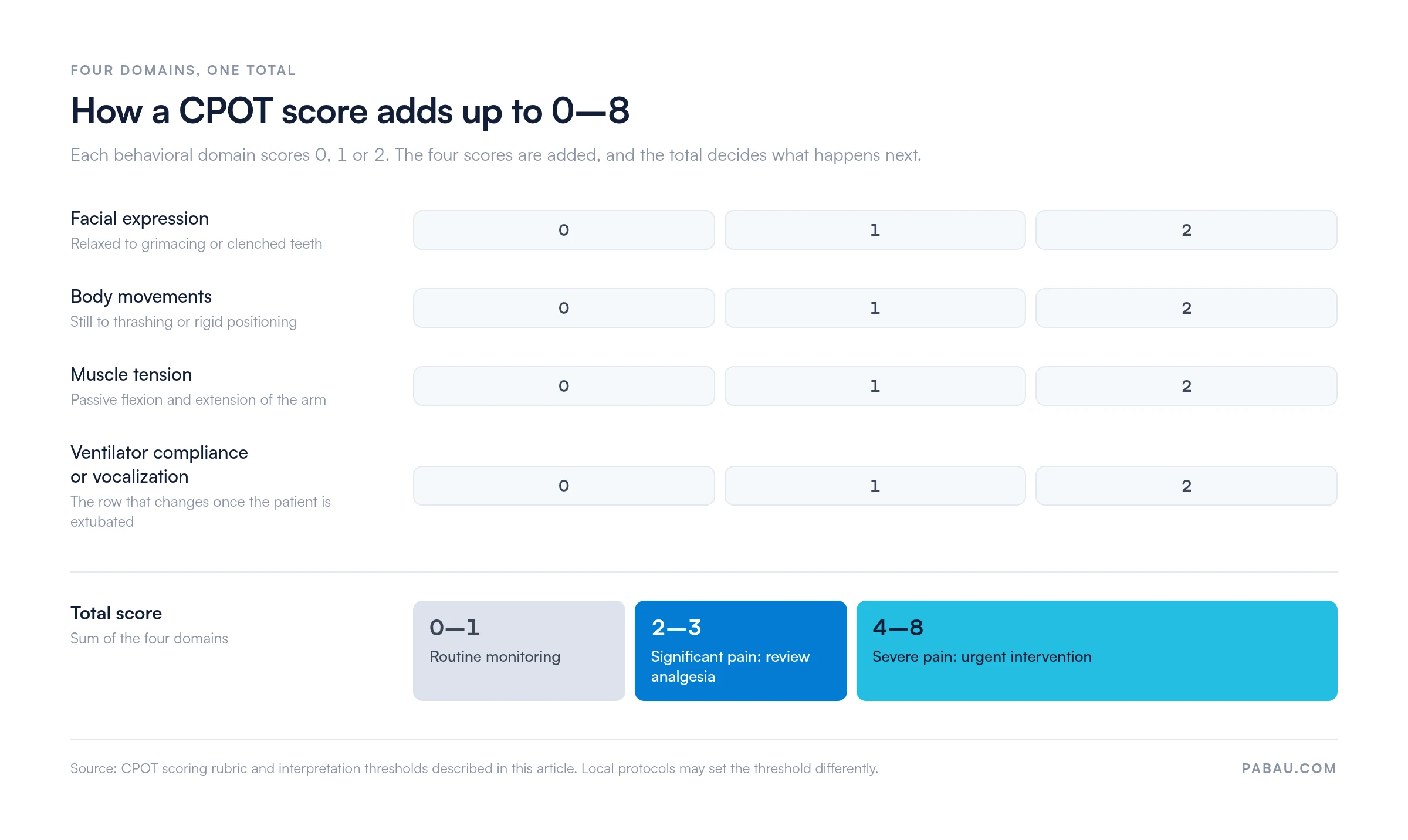
Each domain anchors observation to specific behavioral descriptors, so scoring stays consistent between clinicians. Record the behaviors you observed next to the number. The score tells the next shift how much pain there was, and the behaviors tell them what it looked like.
The score range is 0 to 8. A score of 0 means no pain-related behavioral indicators, and a score of 8 means severe pain. Most units set the threshold for analgesic intervention at 2, though this varies by institutional protocol.
The SCCM PADIS guidelines recommend assessing pain regularly, typically every four hours and after procedures. Titrate analgesia to keep the score under your unit’s threshold. Document the score, the time, and the action taken, because that record becomes part of the patient’s permanent chart.
A bedside assessment takes one to two minutes and needs no equipment. Here is the step-by-step process:
The Behavioral Pain Scale (BPS) is the other leading behavioral pain assessment tool for non-verbal ICU patients. Both are SCCM-endorsed, and they differ mainly in scope and applicability.
Both tools are valid, and many units use whichever fits their patient mix and clinical preference. The CPOT has a slight edge for flexibility. It applies to intubated and extubated patients alike, and it has been validated in pediatric ICU populations.
The CPOT is one of the most extensively studied behavioral pain assessment tools. Its evidence base spans multiple ICU populations and clinical settings.
Those reliability figures come from studies where the raters were trained together. Consistency is a documentation problem as much as a clinical one. A form that every clinician completes the same way is what keeps the numbers comparable from shift to shift.
The pediatric CPOT (pCPOT) adapts the four domains for developmental differences in children. Facial expressions and body movements can be more pronounced in young children, and the timing may need adjusting for age-appropriate sedation levels. Pediatric ICU studies support the pCPOT’s reliability, though the evidence base is smaller than it is in adults.
Adoption takes more than knowing the scoring criteria. It needs team alignment, somewhere reliable to record the score, and a protocol that says what a high score triggers.
Most teams score pain on paper, then copy the number into the record hours later. The behaviors behind the score rarely survive the trip. The next clinician sees a 3 and has no idea what it looked like.
Practice management software like Pabau keeps the form and the patient record in one place. You can build the four CPOT domains as a digital form, so each domain is a field rather than a scribble in a margin. The completed assessment files itself against the patient record, with the time and the clinician already attached.
Reassessment is where most protocols slip. Automated reminders prompt the next check at the interval your protocol sets, and reporting shows how many assessments were completed and what the scores were. That turns a monthly audit into a filter rather than a paper chase.
The same discipline applies well beyond the ICU. Post-anesthesia recovery, pain management practices, and rehabilitation teams all score patients at every visit. Each of them needs those scores to reach the record intact.

Pabau’s digital forms capture each CPOT domain in its own field and file the assessment against the patient record. Reminders prompt the next reassessment on time, so nobody has to chase the paperwork.

The CPOT works because it is fast, and because two clinicians usually land on the same number. That agreement depends on the unit scoring it the same way every time. Use the same anchors, test muscle tone the same way, and reassess at the same interval.
Before you roll it out, print the template and score one patient alongside a colleague. Compare your totals, and talk through any domain where you disagreed. Fifteen minutes of disagreement at the bedside is cheaper than three months of scores nobody trusts.
Then decide where the score is going to live before the first shift uses the form. Book a demo to see how Pabau files each assessment against the patient record and prompts the next one on time.

Assessing a patient who just arrived from the emergency department? Emergency nursing assessment template covers the full admission workup that the first pain score sits inside.
Need a faster check on responsiveness? AVPU scale template gives you a four-level consciousness check that pairs with behavioral pain scoring.
Losing detail at handover? Bedside shift report template structures what moves between shifts, including the last score and the action taken.
Still typing scores in twice? Clinical notes software explains what to look for in a system that records assessments against the patient record.
CPOT stands for Critical-Care Pain Observation Tool. It is a behavioral pain assessment scale designed to measure pain in non-verbal or mechanically ventilated intensive care unit patients.
A CPOT score of 2 or higher indicates significant pain that typically warrants analgesic intervention or investigation of the pain source. Institutional protocols may define thresholds slightly differently.
Yes. The pediatric CPOT (pCPOT) has been validated in pediatric ICU populations and shows acceptable inter-rater reliability, though the evidence base is smaller than for adults.
The CPOT assesses four domains (facial expression, body movements, muscle tension, compliance/vocalization) for a score range of 0-8. The BPS assesses three domains (facial expression, upper limb movement, ventilator compliance) for a score range of 3-12. Both are SCCM-endorsed, and the CPOT is more flexible for extubated patients.
Muscle tension is scored by passively flexing and extending the patient’s upper limb and noting the resistance. Palpating or squeezing the muscle is a different test and is not part of the CPOT method.
Yes. Reported inter-rater reliability is strong, with intraclass correlation coefficients of roughly 0.78 to 0.91. The Society of Critical Care Medicine endorses the CPOT in its 2018 PADIS guidelines as a first-line behavioral pain assessment tool for sedated ICU patients.
Pain should be assessed regularly as a vital sign, typically every 4 hours during routine care and after procedures or interventions. Reassess whenever the patient’s condition changes.