Anemia nursing care plan
An anemia nursing care plan is a structured document that guides a nurse from as...

1
Last Updated: Oct 9, 2026
An ICU report sheet is the one-page worksheet a critical care nurse carries through a shift. It holds drips, vent settings, lines, neuro scores, fluid balance and pending labs, each in a fixed spot. Nurses often call it a brain sheet. Its main job is the handoff, where the next nurse needs the norepinephrine rate or the last sedation score in seconds.
Getting it right matters because ICU patients change by the hour. A stale drip rate or an untimed fluid total hands the next nurse the wrong picture at the worst moment.
The free template below gives you the structure. The rest of this page shows how experienced ICU nurses keep it accurate from one report to the next.
A printable sheet with fields for patient information, vital signs and GCS, oxygenation, ventilator settings, medications and lab results. It also leaves space for procedures, special considerations, care requirements and upcoming plans.
Download template
An ICU report sheet puts drips, vent settings, lines, neuro scores, fluid balance and labs on one page for a fast handoff.
Brain sheet, report sheet and shift organizer are three names for the same tool.
Update the sheet at least hourly, and every 15 to 30 minutes for unstable, post-op or high-dose vasopressor patients.
Write every drip with its dose and concentration, and give every I&O total a start time.
SBAR turns the sheet’s data into a handoff the next nurse can act on.
The sheet is a scannable summary of the patient as they are right now. It sits alongside the EHR rather than replacing it. The chart holds the legal record, while the sheet holds what you need in the next five minutes.
That difference matters more in critical care than on a medical-surgical floor. ICU patients change hour to hour. Blood pressure drops, lactate rises, a sedation score climbs, or a drain passes its threshold.
Floor nurses can track those changes in note entries. In the ICU, you need them on one page, next to the interventions running at that moment.
There’s no clinical difference. “Brain sheet,” “report sheet” and “shift organizer” all describe the same tool. The nickname comes from what the sheet does. It holds the data, so the nurse’s head stays free for clinical decisions.
What changes between units is the depth. A general nursing brain sheet covers more patients with fewer fields. The ICU version covers one or two patients in far more detail.
A good sheet puts each section in the same spot every time. That way you find data by location instead of by reading. These are the sections most ICUs use, in roughly the order a nurse reads them during report.
Start with name, age, admitting diagnosis, code status, allergies and isolation precautions. Add the attending provider and the main family contact. These rarely change during a shift, yet a rapid response team asks for them first.
Track heart rate, blood pressure with MAP, respiratory rate, SpO₂ and temperature. Where monitored, add central venous pressure (CVP), pulmonary artery pressure (PAP), cardiac output and the lactate trend. Leave room for a small trend column. A MAP of 65 reads very differently after three hours at 80.
List every continuous infusion, such as norepinephrine, propofol, fentanyl, insulin or heparin. Write the dose, the pump rate and the bag concentration side by side. Then add PRN medications, last administration times and any titration during the shift. Vasopressors get the top line, since they drive hemodynamic stability minute to minute.
Record the mode (AC/VC, SIMV, PSV or CPAP), set rate, tidal volume, FiO₂, PEEP and peak pressure. Note compliance or resistance trends and the time of the last arterial blood gas. For high-flow nasal cannula or non-invasive ventilation, write the device, the flow in L/min and the FiO₂.
Mark each peripheral IV, central line (subclavian, internal jugular or femoral), arterial line, PICC, Foley catheter, chest tube and JP drain. Include insertion date, last dressing change, site appearance and output volumes.
Two infection bundles lean on this section. One targets central line-associated bloodstream infection (CLABSI), the other catheter-associated urinary tract infection (CAUTI). Dressing integrity directly affects CLABSI prevention, and securement and necessity checks drive CAUTI prevention.
Document Glasgow Coma Scale (GCS) and, for sedated patients, RASS score. RASS is the Richmond Agitation-Sedation Scale. Add the CAM-ICU delirium screen, pupil size and reactivity, and any change from baseline. These fields catch neurological decline early and guide sedation titration.
Track intake from IV fluids, medication volumes and enteral feeds. Track output from urine, drains and gastrointestinal losses. Then record the net balance with its start time, such as “since 0700.” A cumulative positive or negative balance guides diuretic and fluid resuscitation decisions.
Record the arterial blood gas (pH, PaCO₂, PaO₂, HCO₃, lactate) and the basic metabolic panel (sodium, potassium, creatinine, BUN, glucose). Add the complete blood count, liver function, coagulation studies (PT, PTT, INR), troponin and pending cultures. An up or down arrow beside each value flags acute changes faster than a column of numbers.
Once the sections are in place, the sheet becomes a working document that changes as often as the patient does. The flow below shows when each part gets touched, from one report to the next.
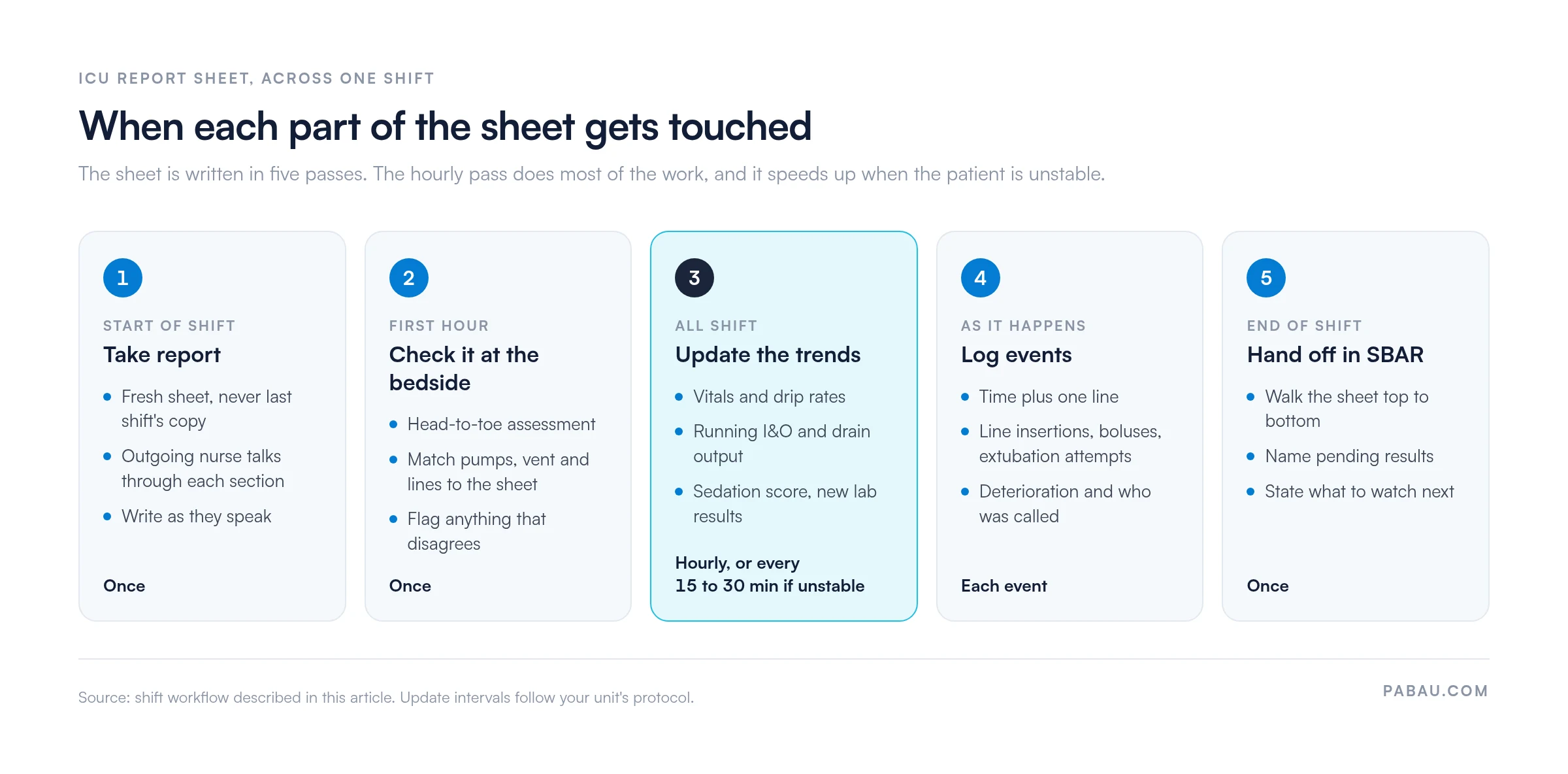
Report works best at the bedside, where both nurses can see the pumps and the patient. A bedside shift report template formalizes that step if your unit doesn’t have one yet.
SBAR stands for Situation, Background, Assessment, Recommendation. It’s a clinical communication framework promoted by the Institute for Healthcare Improvement (IHI) and recognized by The Joint Commission as a handoff approach. Your sheet holds the data, and SBAR puts it in an order the next nurse can follow. Here’s one patient, walked through all four parts.
Situation: Give the patient’s name, age, primary diagnosis and current status in one sentence. Example: “Mr. Chen is 68, two days after coronary artery bypass graft (CABG) surgery, stable on one vasopressor and ready for a weaning assessment.”
Background: Recap why the patient is in the ICU, the relevant comorbidities and what has happened since admission. Pull the key dates and events from the sheet’s event log.
Assessment: State your clinical impression from vitals, trends, exam findings and labs. Example: “Lactate is down to 2.2 from 3.8 yesterday. Urine output is adequate at 0.8 mL/kg/hr, with no new arrhythmias. RASS is -1, which fits post-op day 2.”
Recommendation: Suggest the next actions and escalation points. Example: “Continue current vent settings and try to wean one vasopressor after the 0600 labs. Watch for signs of sepsis, and call the provider if lactate rises again.”
For more scripts, the SBAR nursing handoff template walks through other patient types. Presenting the same patient on rounds follows a slightly different structure, covered in our guide to the ICU presentation.
Give the sheet one last pass before the incoming nurse arrives. Each line below answers a question they would otherwise have to ask you.
Even a well-designed sheet fails if the habits around it slip. Each of these is easy to fix once you know to look for it.
Handle the sheet as protected health information (PHI) as well. It’s a working tool, and the chart remains the medical record. Shred it per unit policy and never take it home. Our guide to nursing documentation covers what belongs in the chart instead.
Specialty units keep the same backbone but swap fields to match their patients.
Neonatal units record gestational and corrected age, birth weight, current weight and isolette temperature settings. They add phototherapy, bilirubin levels, fontanelle assessment and the feeding plan, whether breast milk, formula or total parenteral nutrition (TPN). Medications are dosed by weight, and fluids are tracked per kilogram rather than in absolute volumes.
Our NICU report sheet template is built around those fields.
Post-op sheets emphasize the surgical site, dressing integrity, drain output and character, and pain on a validated scale. Record the procedure, its date and the surgeon. Then track recovery milestones, such as advancing diet, removing an epidural or pulling drains.
Trauma sheets add the mechanism of injury and the injury severity score (ISS). They also note which injuries are managed operatively and which are managed expectantly.
Many units print a bundle checklist on the sheet, so each shift confirms compliance in the same place. Common lines include the following.
The download covers patient information, vitals, oxygenation, vent settings, medications and labs. Most ICUs add lines and drains, fluid balance, sedation scores and a bundle checklist on top. The sheets that stick are shaped by the unit using them, so plan on five steps.
On paper, a report sheet lives for 12 hours and then goes in the shred bin. Each new version of the template means a reprint, and someone still has to read a colleague’s handwriting at 0700.
Pabau, the practice management platform we build, includes digital forms software for structured documents like this one. Private practices, surgical centers and recovery units can rebuild the sheet’s sections as a form. Staff complete it on a tablet or desktop, and the finished form is saved to the patient’s record.
When the unit changes a field, you edit the form template once. Every new sheet then uses the current version, so nobody works from an outdated printout.

Pabau’s digital forms replace paper sheets with structured, easy-to-update documentation, saved to each patient’s record.

A report sheet proves its worth at the first handoff. If the incoming nurse can read the drips, the lines and the last neuro check without asking you, the sheet did its job.
So start with the template, then let your unit reshape it. The setup costs a short survey and a two-week pilot. In return, handoffs stop depending on one nurse’s memory, and the pre-handoff check becomes a habit instead of a scramble.
Book a demo to see how Pabau’s digital forms replace paper sheets with structured, easy-to-update documentation.

Need a broader handoff format? Nursing handoff report gives you a template for passing care between nurses on any unit.
Looking to reduce manual data entry? Digital forms software turns paper worksheets into structured forms your team completes on a tablet.
Want handoff notes in one place? Medical records management keeps forms, notes and documents together in each patient’s record.
Working a floor unit instead? Nursing shift report template covers the fields a medical-surgical nurse tracks across a shift.
Want more SBAR scripts? SBAR examples shows the framework applied to common clinical scenarios.
Yes. Students use report sheets on clinical rotations to organize assessments and prepare for handoff. Follow your program’s rules on patient identifiers, and use initials or room numbers if names aren’t allowed.
One patient per page works best in the ICU. Nurses there usually care for one or two critically ill patients, and separate pages stop data from mixing between rooms.
A Kardex is an older card-file summary of a patient’s care plan and orders, kept at the nurses’ station. A report sheet is the nurse’s personal working copy for one shift, updated as the patient changes.
Yes, briefly. Note the main family contact, the time of their last update, and any visiting limits or language needs. These details save the next nurse from calling the wrong relative.
They help most there. A travel nurse can bring a familiar layout to each new unit, then adjust the fields to match local protocols and bundle checklists.