List of vitamins: All 13 with RDAs and deficiency signs
A list of vitamins names the 13 essential vitamins the body needs from food or s...

12
Last Updated: Oct 8, 2026

This free template is a new patient note for thyroidology, so it covers one visit type rather than every note a practice writes.
It opens with the chief complaint, the history of present illness, and a three wishes for health field for the patient’s own goals.
The review of systems is built around thyroid, adrenal, and glucose or insulin symptoms, with stress history and food history alongside them.
Family history is asked three times over: general family history, thyroid family history, and GYN family history each get their own field.
The last two pages hold the physical exam, a review of outside records, and a single closing assessment and plan.
A five-page intake note for a first thyroid or functional medicine consultation. It covers the chief complaint, three wishes for health, medications and supplements, and medical, surgical, OB/GYN, family and social history. The later pages carry a thyroid, adrenal and glucose review of systems, a physical exam, a review of outside records, and the assessment and plan.
Download templateThis template is a new patient note for a thyroidology or functional medicine practice. It gives you one form for a first consultation, from the chief complaint through to the assessment and plan. The fields assume a patient whose main concern is thyroid, adrenal, or blood sugar related.
It is a single-visit, single-specialty note rather than a general documentation form. That is why the history runs long and the review of systems narrows down to three endocrine areas. Print it for a paper chart, or use the field list as the specification for a digital intake form.
The whole file runs to five pages. The sections below map what sits on each band of the form. They also cover why a thyroid intake asks questions a general note skips, and how to fill the harder fields during a live visit.
The form is organized into five labeled bands, and they run in the order you would work through a first visit. Here is what each band asks for.
Every field is free text apart from the date and the four measurements. No field is a checkbox or a scored scale, so the note reads as a narrative rather than a checklist.
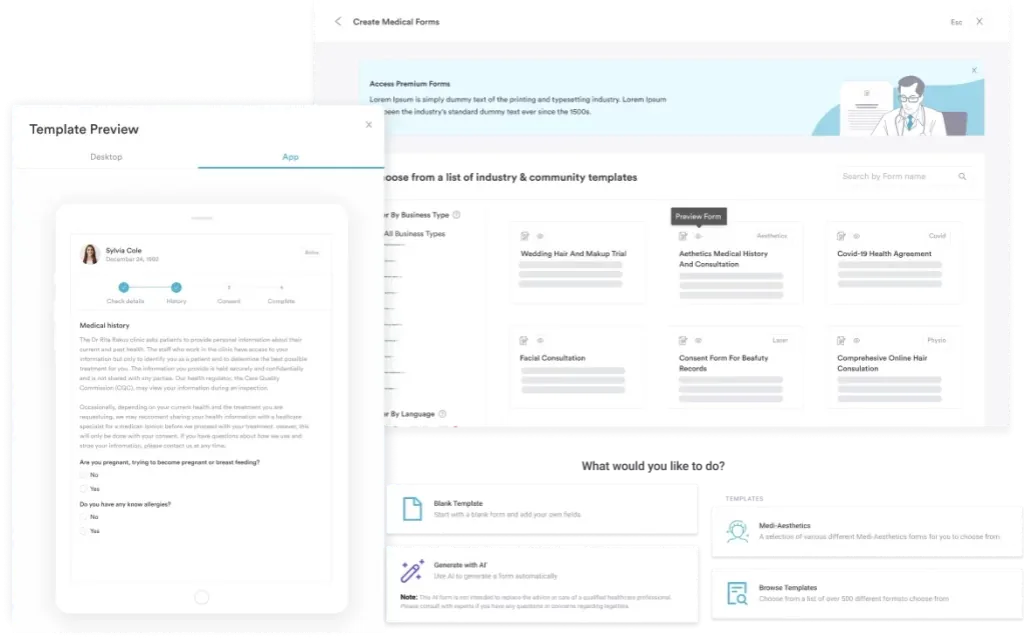
A general note would stop at history, exam, assessment, and plan. This one keeps going, and the extra fields are the point of using it. Five of them do most of the work.
The trade-off is scope. A patient presenting with something outside these three areas will need a different note, because this one has no space for other systems.
The form works front to back, but a few sections are easier to fill in out of order. This sequence keeps the visit moving.
Finish the note in the visit or immediately after it. A note written from memory days later is less accurate and harder to defend if it is ever reviewed.
The three endocrine bands are where the note earns its length. Each area has a symptom field and a history field, and each one collects different information. The grid below shows what belongs where.
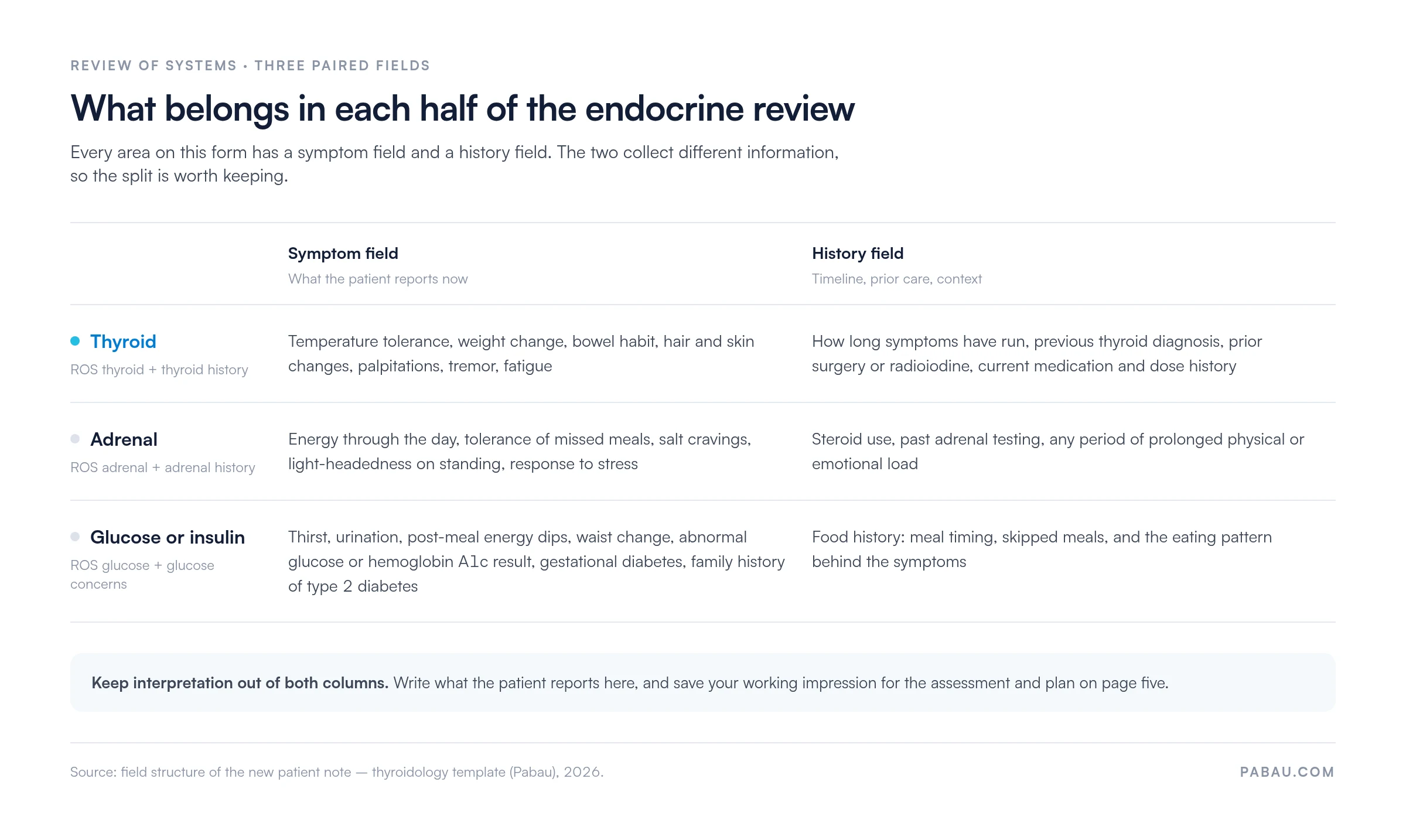
In the symptom field, record temperature tolerance, weight change, bowel habit, hair and skin changes, palpitations, tremor, and fatigue. The history field takes the timeline. Record how long symptoms have run, any previous thyroid diagnosis, prior thyroid surgery or radioiodine, and current thyroid medication with its dose history.
Record how energy moves through the day, tolerance of missed meals, salt cravings, light-headedness on standing, and how the patient responds to stress. The history field is where steroid use, past adrenal testing, and any period of prolonged physical or emotional load belong.
Record thirst, urination, post-meal energy dips, waist change, and any known abnormal glucose or hemoglobin A1c result. Note gestational diabetes and family history of type 2 diabetes here as well. Food history then gives you the pattern behind those symptoms, including meal timing and skipped meals.
Write what the patient reports in these fields, and keep your interpretation for the assessment. That split is what makes the note readable at a follow-up visit.
Once a patient fills the form in, it becomes part of the medical record and inherits the same obligations as any other clinical note. Four of them apply directly to an intake form like this one.
Retention and safeguarding. The HIPAA Privacy Rule governs the protected health information on the completed sheet, and state law sets how long you keep it. A paper form needs a locked location and a retrieval process that works when someone asks for the record.
Attribution and timing. The note should show who wrote it and when. A printed form has no timestamp of its own, so date and sign it at the visit rather than at the end of the week.
Amendments, not edits. If information arrives after the note is signed, add a dated addendum instead of altering the original entry. Overwriting a signed note damages the integrity of the record.
Patient access. The information blocking rules of the 21st Century Cures Act apply here. Clinical notes must be available to patients through their electronic health record without unnecessary delay. Write the assessment in language a patient can follow. Research from OpenNotes links reading your own notes to better medication adherence and stronger engagement in care.
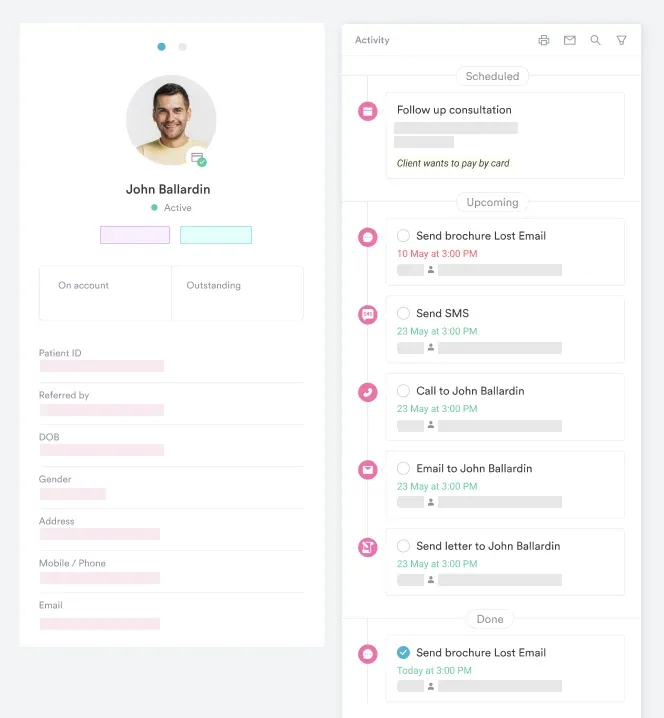
A PDF is a good starting point and a poor system of record. It arrives as a scan or a filed sheet, so the medications, supplements, and family history on it never reach the patient’s chart as data. Staff retype the parts they need, and the rest sits in an attachment nobody opens.
Thyroid and functional medicine intake is long by design, which is why longevity clinic software treats history as structured fields rather than an attachment.
Practice management software like Pabau removes that step. You can rebuild the five bands of this form as a digital intake form the patient completes before the appointment. The answers land in the chart already structured. Medications and allergies populate the patient’s record rather than a separate document.
From there the note stays with everything else the practice holds on that patient. Structured patient records keep the intake note, later visit notes, labs, and consent forms in one timeline. Each entry is dated and attributed to the clinician who wrote it. Anyone on the care team can open the note without a file request.
For the parts of the visit that stay conversational, Pabau Scribe, our AI medical scribe, drafts the narrative fields from the consultation itself. You review and sign the note instead of typing it, which is where most of the post-visit time goes on a form this long.
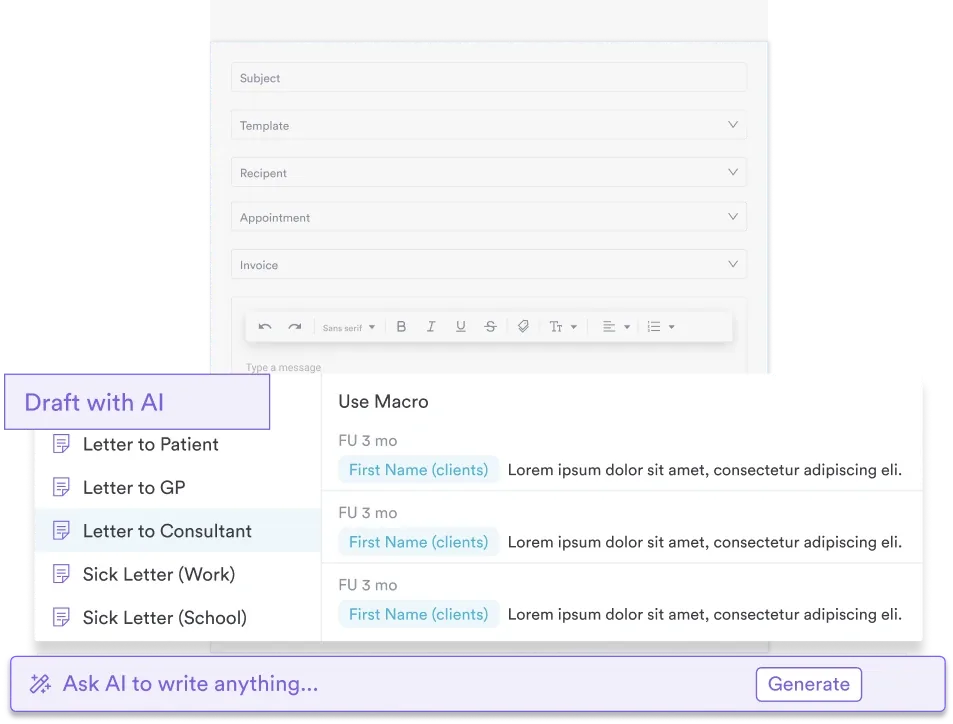

Rebuild this new patient note as a digital form in Pabau. History, supplements and endocrine symptoms land in the patient record before the consultation starts. Your team documents the visit instead of retyping it.

Use this note when a new patient’s presenting problem is thyroid, adrenal, or blood sugar related. The depth it asks for is the reason to choose it, and the reason not to use it for anything else. A general new patient form will be faster and will miss the detail that changes a thyroid plan.
The fields worth protecting when the visit runs short are three wishes for health, the supplement list, and the three paired endocrine reviews. Those fields carry the clinical value of the form. Everything else on the sheet can be completed by the patient before they arrive.
Once the form is working for you, the next gain is getting it off paper so the answers stay searchable. Book a demo to see how Pabau captures thyroid intake as structured data and keeps every note in the patient’s record.

Seeing functional medicine patients more broadly? Functional medicine intake form covers the wider history this thyroid note narrows down.
Mapping findings to root causes? Functional medicine matrix organizes the history you just collected into contributing factors.
Reading the labs this note leads to? Interpreting biomarkers without overpromising covers how to explain thyroid and metabolic results to a patient.
Following up on the food history? AIP diet plan template gives you a structured elimination plan for autoimmune thyroid patients.
It is a five-page intake note for a first consultation in a thyroidology or functional medicine practice. It records history, medications and supplements, plus a thyroid, adrenal and glucose review of systems. A physical exam, a review of outside records, and the assessment and plan close the form.
It asks the patient to write what they most want from their care, in their own words. You get a stated goal to build the plan around, and something concrete to review at the next visit.
Autoimmune thyroid disease runs in families, and thyroid dysfunction often shows up in menstrual and fertility history. Giving each its own field stops either from being buried inside the general family history answer.
It is designed for the first visit, where the full history is taken once. For follow-ups, a shorter note covering interval symptoms, energy, sleep, weight, blood pressure and plan changes is a better fit.
Not well. The review of systems only covers thyroid, adrenal and glucose or insulin symptoms, so other systems have no space. Use a general new patient form when the presenting complaint sits elsewhere.