GLP-1 diet plan
A GLP-1 diet plan is a structured eating framework for patients taking semagluti...

2
Last Updated: Oct 13, 2026
A gene test is a laboratory analysis of your DNA, chromosomes, or proteins that looks for inherited variants linked to disease.
According to the Centers for Disease Control and Prevention (CDC), a result can confirm or rule out a suspected genetic condition. It can also estimate the chance of developing a disorder or passing one on. Six test categories are in routine use, and every result comes back as one of three classes: positive, negative, or a variant of uncertain significance.
What follows is the practical version for clinicians. Which test answers which question, how a sample becomes a report, what each result class obliges you to do, and where the limits sit.

A gene test examines DNA, chromosomes, or proteins for inherited variants that cause disease or raise the risk of it.
Six test types are in routine use: diagnostic, predictive, carrier, prenatal, newborn screening, and pharmacogenomic. Each answers a different clinical question.
Results come back positive, negative, or as a variant of uncertain significance. A VUS should not drive clinical decisions.
GINA blocks genetic discrimination in employment and health insurance, but not in life, disability, or long-term care coverage.
Practice management software like Pabau keeps pre-test consent, the result, and the follow-up plan in one patient file.
A gene test looks for changes in a person’s DNA, chromosomes, or proteins that are linked to inherited conditions or health risks. What gets examined depends on the clinical question. Some tests sequence specific gene regions, others analyze whole chromosomes for structural abnormalities, and protein-based tests look for the downstream effects of a genetic change.
Clinicians ordering a gene test are usually asking one of three questions. Does this patient have a specific genetic condition? Are they at elevated risk for one? Do their genes change how they metabolize a medication?
Gene tests do not diagnose every condition. Many variants are common in the population and carry no clinical weight. Others sit in uncertain territory until more data accumulates. Knowing what each category is designed to detect is the starting point for ordering well.
“Genetic testing” covers six distinct test types, each built to answer a specific clinical question. Choosing the right category matters as much as choosing the right lab. Integrative and preventive practices often order several at once. That is why functional medicine software tends to track lab orders and results against one patient record. The table below maps each category to the question it settles.
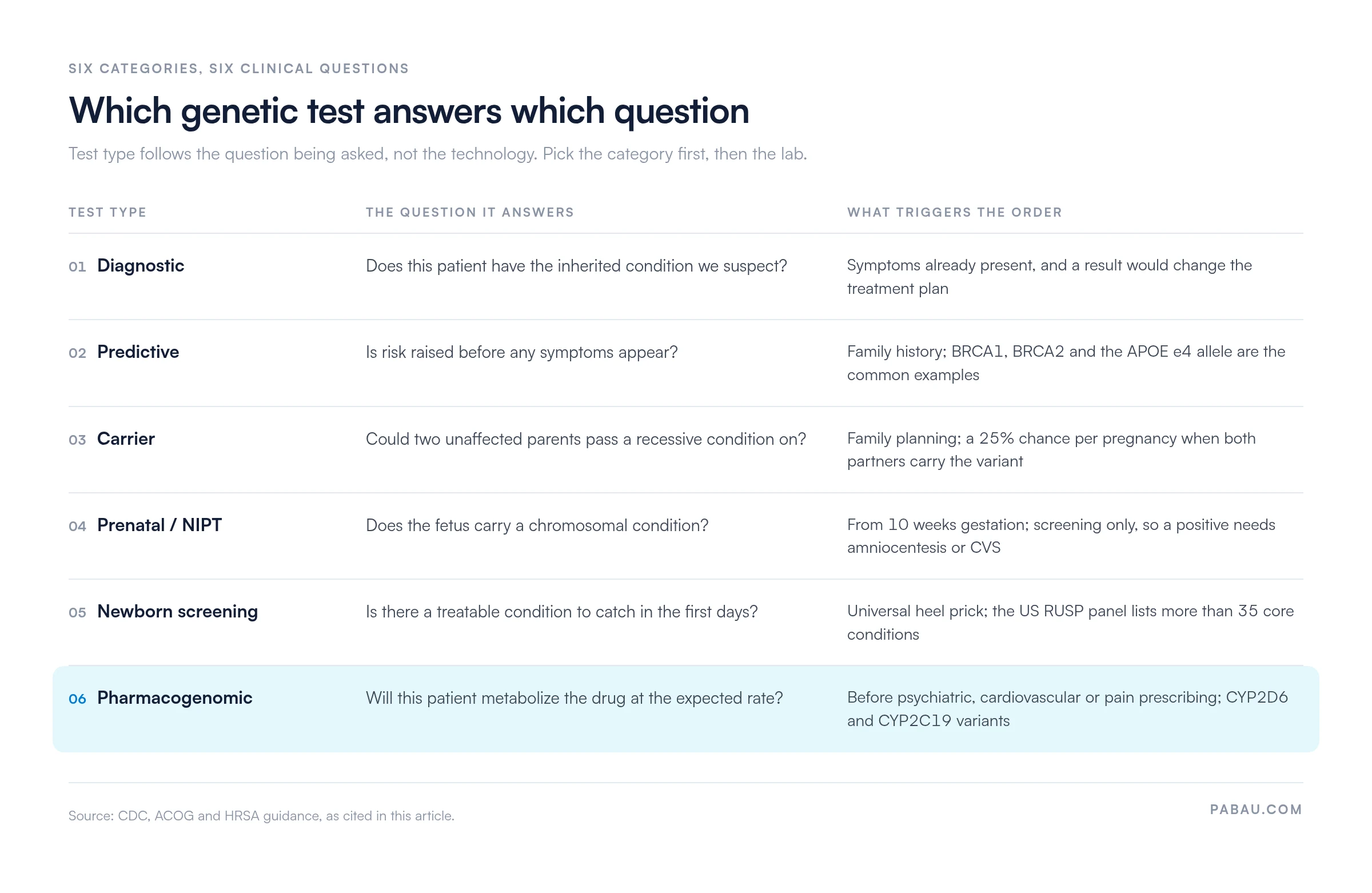
Diagnostic genetic testing confirms or rules out a suspected inherited condition in a patient who already has symptoms. A clinician might order it when a patient presents with features of a hereditary disorder, such as early-onset cardiomyopathy or a connective tissue disorder. The test earns its place when a positive result changes the treatment plan or triggers family screening.
Predictive testing identifies gene variants that raise disease risk before any symptoms appear. BRCA1 and BRCA2 are the most widely recognized examples. Carriers face a significantly elevated lifetime risk of breast and ovarian cancer, according to NCI data. The APOE e4 allele is another, associated with increased Alzheimer’s risk. A positive predictive result does not make disease inevitable. It informs surveillance and preventive strategy.
Carrier testing identifies people who carry one copy of a recessive gene variant without being affected themselves. It matters most in family planning. Where both partners carry the same recessive variant, each pregnancy has a 25% chance of an affected child. Cystic fibrosis, sickle cell disease, and spinal muscular atrophy are the conditions screened most often.
Prenatal gene testing assesses the genetic health of a developing fetus. Non-invasive prenatal testing (NIPT) analyzes cell-free fetal DNA circulating in maternal blood, typically from 10 weeks gestation. It screens for chromosomal conditions such as trisomy 21 (Down syndrome), trisomy 18, and trisomy 13.
NIPT screens rather than diagnoses. A positive result requires confirmation by amniocentesis or chorionic villus sampling (CVS), per ACOG practice bulletins. Say so plainly when you hand the result over, because patients routinely read a screen as a diagnosis.
Newborn screening is a population-level program. Infants are tested shortly after birth, usually by heel-prick blood sample, for conditions where early intervention changes the outcome sharply. In the US, the HRSA Recommended Uniform Screening Panel (RUSP) lists more than 35 core conditions. Phenylketonuria (PKU), congenital hypothyroidism, and sickle cell disease are among them. Unlike the other five categories, newborn screening is offered universally rather than ordered on clinical suspicion.
Pharmacogenomic testing analyzes how a person’s genes affect drug metabolism. Variations in CYP450 enzyme genes, such as CYP2D6 and CYP2C19, determine whether a patient is a poor, intermediate, normal, or ultra-rapid metabolizer of certain medications. Clinicians use these results to guide prescribing choices and dosage, particularly for psychiatric, cardiovascular, and pain medications. GeneSight is one widely used panel covering genes relevant to psychiatric medication metabolism.

Hereditary cancer gene panels test many genes at once for variants that raise cancer risk. The most widely ordered cover BRCA1, BRCA2, PALB2, ATM, and CHEK2. They also cover the Lynch syndrome genes (MLH1, MSH2, MSH6, PMS2), which carry colorectal and endometrial cancer risk.
Who should consider one? Guidance from the American College of Medical Genetics and Genomics (ACMG) points to three groups. People with a strong family history of cancer, people whose relatives had early-onset cancers, and people with cancer types tied to a known hereditary syndrome.
A positive panel result does not make cancer certain. It opens a conversation about evidence-based surveillance, such as annual MRI for BRCA carriers, and about preventive options. A negative result does not clear the patient either, because sporadic cancers have nothing to do with inherited variants.
Gene methylation testing sits between genetics and epigenetics. Standard gene tests look for sequence variants in the DNA itself. Methylation testing instead examines the chemical tags, called methyl groups, that regulate gene expression without altering the underlying sequence.
MTHFR is the gene tested most often. Its variants affect how the body processes folate and produces methionine, with knock-on effects on homocysteine levels. Longevity and functional medicine practices drove most of the interest in MTHFR and broader methylation panels. A practice coordinating that volume of testing usually runs it through dedicated longevity clinic software rather than a shared spreadsheet.
One clinical caveat deserves stating plainly. The ACMG has said that MTHFR variants are among the most common in the population, and that their clinical significance is usually limited. Ordering MTHFR testing outside specific contexts, such as elevated homocysteine or recurrent pregnancy loss under investigation, is not supported by current guidance. That bites hardest in practices selling consumer-facing panels, where patient expectations run ahead of the evidence.
Genetic testing follows a defined workflow from referral to result. The steps differ between a clinical pathway ordered by a clinician and a direct-to-consumer (DTC) kit bought online. The laboratory stage is broadly similar in both.
Sample type follows the test. Blood draws yield the most DNA for comprehensive sequencing. Saliva and cheek swabs are enough for most genotyping applications. Biopsies are required for tumor genetic testing. Turnaround on clinical tests usually runs 2 to 6 weeks, depending on test complexity and lab workload.
Genetic test results fall into three classes, each with different clinical implications. Explaining all three clearly is a core skill for any clinician ordering a gene test. Our guide to interpreting biomarkers covers the same communication problem across other test categories.
Clinical laboratories report against the ACMG five-tier system: pathogenic, likely pathogenic, VUS, likely benign, and benign. Patients often need help seeing why “uncertain” and “negative” are not the same answer.
Genetic counseling supports patients before and after a gene test. A counselor explains what the test can and cannot tell them, and what a result means for the decisions in front of them. They review personal and family history, advise on which tests fit, and interpret results against the patient’s overall risk profile.
Pre-test counseling matters most for predictive and cancer gene testing, where a positive result carries psychological and practical weight. Post-test counseling handles what happens next. That might be a specialist referral, a conversation about family screening, or an explanation of why no further action is needed.
The National Society of Genetic Counselors (NSGC) recommends counseling before any test that may reveal hereditary cancer risk or conditions with significant reproductive implications.
Genetic testing pays off clinically in the right context. It also carries limits and risks that belong in the conversation before you order. Capturing that discussion on patient intake forms protects the patient and the practice alike.
The insurance limit catches people out. GINA, the Genetic Information Nondiscrimination Act, blocks discrimination in employment and health insurance. It does not extend to life insurance, disability insurance, or long-term care insurance. Raise that before a patient undergoes predictive testing, per the National Human Genome Research Institute (NHGRI).

Before a patient undergoes predictive genetic testing, document the pre-test counseling discussion in their record. Note specifically that GINA protections do not extend to life, disability, or long-term care insurance. A signed consent form capturing that disclosure protects the patient and the practice.
A gene test result is only worth ordering if it connects to a clinical action. The result arrives, the clinician reads it, and then the downstream workflow is often improvised. Three pathways turn a report into practice.
Treatment planning: A BRCA1-positive result in a patient with no current cancer diagnosis triggers referral to a clinical geneticist or oncologist. From there it opens a discussion of risk-reducing surgery and enrollment in an enhanced surveillance program. A functional medicine EMR is where most practices record those referrals and tie the genetic finding to ongoing treatment notes.

Medication adjustments: A pharmacogenomic result showing a CYP2D6 poor metabolizer changes how codeine behaves. Standard doses convert to morphine at a fraction of the expected rate. The prescriber needs that at the point of prescribing, not buried in a PDF from six months ago. Building the finding into the active record is what makes it show up on time.
Family cascade testing: Once a hereditary variant is identified in one family member, guidelines recommend offering testing to first-degree relatives. Coordinating that across a practice takes systematic tracking, because the relatives are rarely your patients yet. A named owner and a recall date beat a note in the chart.
DTC genetic tests such as 23andMe and AncestryDNA use the same underlying DNA biology as clinical tests, but they are different products. The distinction matters because patients bring DTC results to their clinician expecting clinical interpretation. Four differences decide what you can do with one.
In most practices, a gene test leaves a trail across four systems. The consent form sits in a filing cabinet and the lab report arrives by email. The referral goes out as a letter, and the cascade-testing reminder lives in someone’s head. When the patient returns 18 months later, reassembling that history takes longer than the consultation.
Pabau, our practice management software, keeps the whole sequence on one patient record. Digital forms capture pre-test consent with a signature and a timestamp, including the GINA disclosure. The lab report attaches to the same record. Treatment notes, referrals, and recall dates for cascade testing all hang off it.
That changes two things for the reader of this article. A prescriber opening the chart sees the CYP2D6 finding before choosing a dose. And nobody has to remember, unaided, that three siblings were owed an offer of testing after a Lynch syndrome result last spring.

Pabau captures pre-test consent, attaches the lab report, and holds referrals and cascade-testing recalls on the same record. Your team stops reassembling the history from four systems.

The hard part of a gene test is rarely the test. Picking the category that answers your actual clinical question does most of the work, and the three result classes decide what happens next. A VUS is the one that costs the most time, because it obliges a conversation without authorizing an action.
The trade-off worth remembering is scope. A broader panel finds more variants, and more of them will be uncertain. Order the narrowest test that answers the question, and counsel before rather than after. Write the GINA limitation into your consent form now, not the week a patient asks about life insurance.
If your practice orders, coordinates, or documents genetic testing, the workflow around the result is where the value leaks. Book a demo to see how Pabau keeps consent, results, and cascade referrals on one patient record.

Need to communicate uncertain findings without overpromising? Interpreting biomarkers without overpromising gives you a framework for explaining a nuanced result to a patient who wants a yes or no.
Running other specialist diagnostics alongside genetic panels? Autonomic testing walks through the protocol, the interpretation, and the documentation a practice needs on file.
Ordering nutrient panels as part of the same workup? Vitamin deficiency test covers which markers are worth running and how to read the results against symptoms.
Building the paperwork for a new testing service? Functional medicine intake form is a ready-made template you can adapt for pre-test history and consent.
A gene test is a laboratory analysis of DNA, chromosomes, or proteins that detects inherited variants linked to disease risk. A sample of blood, saliva, or tissue is collected and processed in a certified laboratory using sequencing or genotyping. The findings are then classified against established databases of known variants to produce a clinical report.
A positive result means a pathogenic or likely pathogenic variant was identified in the genes tested. On a predictive test this raises the probability of developing a condition without guaranteeing it. The clinical response depends on the gene and the condition. Options include enhanced surveillance, preventive intervention, specialist referral, or family cascade testing.
Clinical genetic testing runs from roughly $100 for a targeted single-gene test to $500-$5,000 or more for a comprehensive multi-gene panel. The range depends on the lab and the genes included. Insurance coverage varies: hereditary cancer panels are often covered when clinical criteria are met, while pharmacogenomic and consumer health tests are less consistently covered. Prior authorization may be required.
Clinical genetic tests run in CLIA-certified laboratories have high analytical accuracy for the variants they cover. The usual limitation is completeness rather than accuracy, because no panel tests every possible variant and VUS findings add uncertainty. DTC tests cover a narrower set of variants and should not be treated as clinically equivalent.
Yes, for any gene test with significant clinical implications. That covers predictive cancer gene testing, carrier testing for family planning, and any test where a positive result would change clinical management. The National Society of Genetic Counselors recommends pre-test counseling so patients understand what the test can detect and how a result might affect their family.
Pharmacogenomic testing analyzes gene variants that affect how the body metabolizes specific medications. It is most useful before starting psychiatric medications, pain management regimens, or cardiovascular drugs, where dose-response varies sharply by CYP450 enzyme activity. Clinicians use the results to select medications and set doses instead of relying on trial and error.