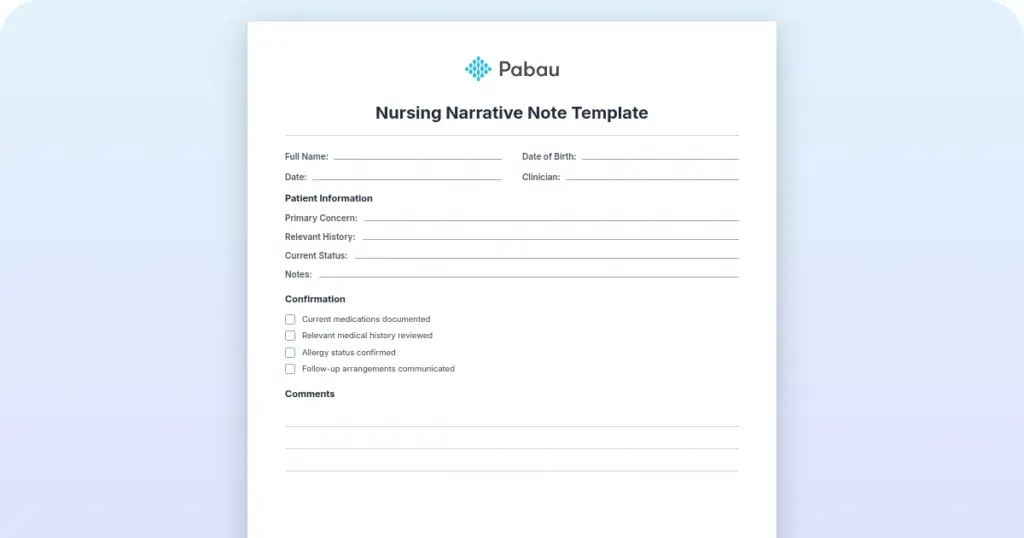
Nursing narrative note template
A nursing narrative note template is a structured PDF that guides you through re...

3
Last Updated: Oct 21, 2026

A pain scale for giving birth records labor pain intensity from 0 to 10, so clinicians can document it and act on it.
Pain typically scores 1 to 3 in early labor, 4 to 7 in active labor, and 8 to 10 in transition.
The free template on this page is a one-page numeric rating form. It records current pain plus usual, best, and worst pain over the past week.
It carries no coping score and no stage-by-stage tracker, so use it for single readings and write the labor context in its notes field.
Practice management software like Pabau stores each score in the patient record, so the numbers stay with the birth notes.
A one-page numeric pain scale assessment form for scoring pain from 0 to 10. It captures pain right now, then the usual, best, and worst pain of the last week, with an average score line and a notes field.
Download templateA pain scale for giving birth records labor pain from 0 to 10. Most women score 1 to 3 in early labor, 4 to 7 once labor is active, and 8 to 10 through transition.
Intensity alone still does not decide the response. A patient at 8 out of 10 who is breathing through contractions is coping. One who scores 6 and feels overwhelmed is not. So the sections below pair each score band with the stage of labor, the coping question, and the pain relief that fits.
The template is a single-page numeric pain scale assessment form. It carries the patient’s name, the date, one line of instructions, and four rating prompts scored 0 to 10.
The instruction line tells the patient that 0 means no pain at all, and 10 means the worst pain imaginable. Below it sit the four prompts:
Two fields sit below the prompts. One is an average score based on prompts two to four. The other is an open additional notes box.
That structure decides how you can use it. Three of the four prompts ask the patient to look back over a week, so the form records recall as much as current pain. There is no coping field, no dilation column, and no row for each reassessment. The page never mentions labor, stages, or an epidural.
So treat it as a general pain diary that suits a maternity setting rather than an intrapartum chart. For a minute-by-minute picture of labor you still need your unit’s partogram or its electronic intrapartum record.
Four tools show up in obstetric practice, and only two are quick enough to repeat while a patient is in active labor.
The NRS is the default in most labor units because it takes seconds and repeats well. Some units pair it with a coping question, which stops a high number alone from driving the decision.
Labor pain follows a fairly predictable curve, tied to cervical dilation and to the length and strength of the contractions. Knowing the pattern lets you anticipate the next score and act before the patient is overwhelmed.
The chart below sets the score band, the contraction pattern, and the first relief to offer side by side.
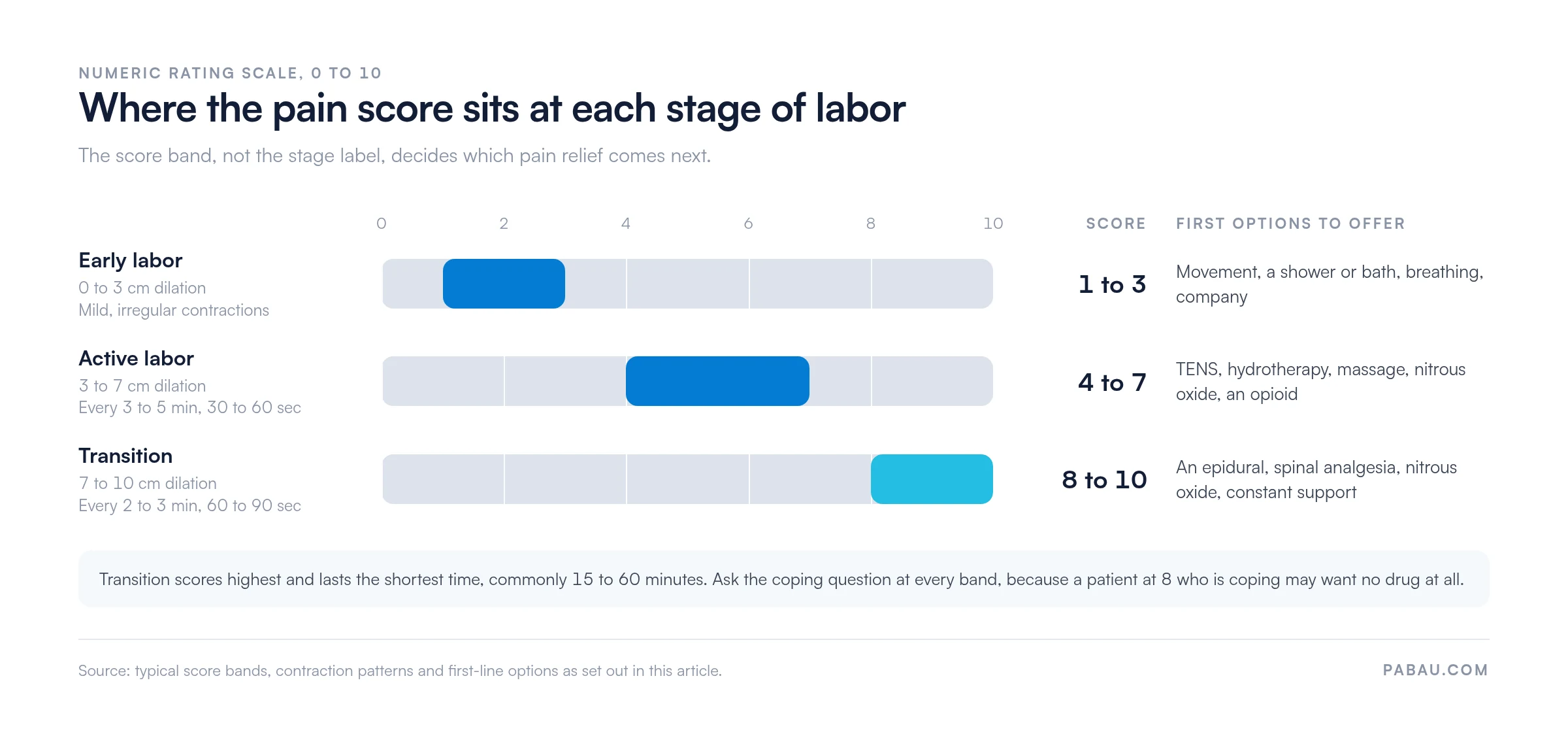
Contractions are mild and irregular, and pain scores usually sit at 1 to 3 out of 10. Patients often walk, eat, and talk through them. Movement, a shower or bath, and reassurance are normally enough, so many patients stay at home through this phase.
Contractions become regular at every three to five minutes, last 30 to 60 seconds, and hit harder. Scores rise to 4 to 7 out of 10, and the patient needs continuous support.
Take the score again after each method you try, and note what you offered. Hold at non-pharmacological methods while scores stay at 4 to 6. Once they climb past 7, open the conversation about nitrous oxide, an opioid, or an epidural.
Contractions peak here, at two to three minutes apart and 60 to 90 seconds long. Scores reach 8 to 10 out of 10, and patients often say they feel out of control or exhausted. The phase is short, commonly 15 to 60 minutes.
Most patients ask for an epidural or nitrous oxide by now if they are not already using it. Saying plainly that transition is nearly over helps more than it sounds like it should.
Two patients at the same dilation can report scores three points apart, because physiology is only part of what sets the number.
The coping question asks how well the patient is managing, rather than how much it hurts. Those two answers move independently, which is why an intensity score alone can point you the wrong way.
NICE intrapartum care guidance asks teams to offer both pharmacological and non-pharmacological options, with the patient leading the choice. A birth plan template filled in beforehand tells you which of those options she wants before the score climbs.
The form on this page records the pain number only. Write the coping answer in its notes field if you want both on one sheet.
Score thresholds guide the timing, while patient preference and what the unit can offer settle the final choice. The bands below are decision thresholds rather than stage labels, which is why 7 sits at the bottom of the top band.
This mapping reflects common practice in maternity units, and it lines up with NHS pain relief guidance.
Recording the score next to the decision it drove leaves a trail you can audit and hand over. On a labor and delivery care plan, that trail becomes the evaluation for the acute pain diagnosis. Digital patient intake forms inside the record keep that trail current without a paper chase.
The form holds one set of answers per sheet, so treat it as a snapshot rather than a chart. These five steps keep it useful in a maternity setting.
Midwives, obstetric nurses, and doulas can use it for a quick pain reading at triage or on a postnatal ward round.
Antenatal clinics get more from the recall prompts, which suit a booking appointment or a review of a pain problem that predates the pregnancy. On the postnatal side, the same recall answers feed the postpartum care plan you set at discharge.
The form is generic, so it travels well outside maternity care. Physical therapy, pain services, and general practice can use the same sheet without changing a field.
One job it does not fit is continuous intrapartum tracking. A unit that wants a score against every contraction should stay with its partogram or its electronic intrapartum record.
Asking about pain and coping, then writing the answers down, gives the patient a say in what happens next. Women who feel heard about their pain report more satisfaction with the birth, whichever pain relief they end up using.
The alternative is guesswork. With no number on the chart, the team offers analgesia on the strength of how loud the room is. The quietly struggling patient then slips past.
A paper pain scale has one common failure. The sheet ends up in a folder, and the score never reaches the record the next clinician opens.
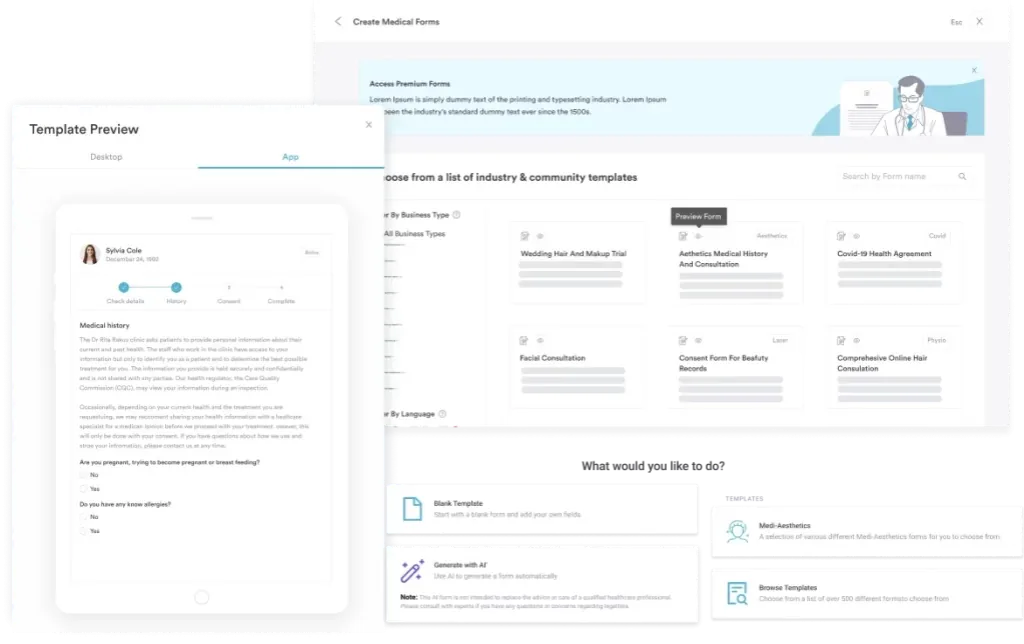
Practice management software like Pabau turns the same four prompts into a digital form on a tablet. The score saves into the patient’s chart with a timestamp and the name of whoever recorded it. At handover, the next shift reads the trend without hunting for paper.
You build the form once as a template, so every clinician and every site asks the same questions. Because it lives in the chart, the pain scores, the birth notes, and the postnatal follow-up all sit together. A pain management audit then runs off records you already hold.
Maternity care often sits inside a wider women’s health service. Pabau’s fertility clinic software runs on the same patient record, so earlier treatment history sits next to the birth notes.

Pabau’s digital forms put the pain scale on a tablet and save each score into the patient’s chart. The next clinician reads the trend without chasing paper.

A 0 to 10 score is only worth collecting if it changes what happens next. Ask the coping question alongside it, act on the pair, and write both down.
The template on this page does the simple part well. It captures a number the patient chose, on one page, with space for the context around it. Keep your partogram for the minute-by-minute picture, and use this form for the readings you want on the record.
Book a demo to see how Pabau keeps pain scores, birth notes, and postnatal follow-up in one patient record.

Planning a birth after a cesarean? VBAC birth plan template sets out the preferences and safety checks to agree before labor starts.
Monitoring the baby while you score the pain? Normal fetal heart rate template gives you the reference ranges to chart alongside each reading.
Scoring the newborn minutes after the birth? Apgar score template covers the five signs and how to record them at one and five minutes.
Tracking blood pressure through the pregnancy? Blood pressure pregnancy chart records the readings that flag hypertension before labor.
Want obstetric records in one place? OB/GYN EMR software covers how pain tracking, birth notes, and postnatal follow-up sit in one chart.
Women often compare it to strong period cramps, kidney stones, or a broken bone. The pain comes from uterine contractions, cervical dilation, and pressure on nearby organs. One feature sets it apart. Labor pain arrives in waves, with a break between them.
Early labor often feels like low back ache or period cramps. In active labor the pain sits in the lower abdomen and back, and many women describe a squeezing band around the sides. Transition brings heavy pressure, with relief in each pause.
Yes. A working epidural usually brings a score of 8 to 10 down to 2 to 4 within 10 to 20 minutes. Coverage is sometimes patchy, and reduced mobility changes how the rest of labor feels.
Use a faces scale, such as Wong-Baker FACES, and ask her to point to the expression that matches her pain. For a patient who cannot respond at all, score observed behavior instead, using breathing, movement, and facial signs.
They track together, but they are not interchangeable, so record which tool you used. The VAS runs along a 10 cm line and picks up smaller shifts, which suits audit. On both, a drop of about two points out of 10 counts as a meaningful improvement.