Sulcus Test: Shoulder Instability Assessment
The sulcus test is an orthopedic special test that checks for inferior glenohume...

3
Last Updated: Oct 22, 2026
Outcome measures are standardized tools that turn a patient’s pain, function or quality of life into a score you can compare from visit to visit. Without one, “she’s moving better” is an opinion. With one, it’s evidence you can show a payer, a referring physician or the patient.
The most useful habit is also the simplest. Score the same measure at baseline and again at discharge, under the same conditions. Get that right and your notes support reimbursement, your treatment decisions sharpen, and patients can see their own progress.
Below, you’ll find a free form, a quick way to choose a validated tool, and a plan for scoring and tracking results.
A two-page patient self-report form with patient details, a consultation date and 10 statements rated from strongly disagree (1) to strongly agree (5). It closes with fields for the total score, your interpretation, a recommendation and a conclusion.
Download template
Outcome measures are validated tools that score pain, function or quality of life, so progress can be compared between visits.
Score the same measure at baseline, at set intervals and at discharge, under the same conditions each time.
Choose a measure by what it captures, how valid, reliable and responsive it is, and how long patients need to complete it.
The free form words its pain and fatigue statements negatively, so reverse-score them before you add up the total.
Pair the quick global form with one validated, condition-specific tool, such as the Oswestry Disability Index for low back pain.
An outcome measure is a validated instrument that scores health status, function, symptom severity or response to treatment with a fixed method. Because the scoring rules never change, a baseline score can be compared fairly with a discharge score.
Three properties decide whether a measure is worth your time:
A tool can be valid and still miss change in your population, so responsiveness deserves the closest look. It also helps to know what an outcome measure isn’t.
Process measures track how care was delivered, and structure measures track what a practice has in place. Only outcome measures capture the result of care, which is the change in the patient.
Each type answers a different question about the patient. That’s why most practices end up using more than one.
A PROM asks the patient directly. Instead of a clinician judging whether walking has improved, the form asks, “How much difficulty do you have walking?” That matters because relief the patient can feel is the point of most treatment plans. Payers and quality programs increasingly ask for it, too.
The Patient-Reported Outcomes Measurement Information System (PROMIS) is one of the most widely used PROM toolkits.
The National Institutes of Health funded its original development, and HealthMeasures at Northwestern University now maintains it. PROMIS covers pain, fatigue, physical function, emotional distress and social participation.
Other common PROMs include the DASH for arm and hand function and the PHQ-9 for depression screening. Each one prioritizes what the patient experiences, rather than only what the clinician observes.
Outcome measures show whether the patient improved. Process measures show whether care followed the plan. Here’s how the two compare side by side.
Use both. Outcome measures show why your care works, while process measures show how consistently you deliver it.
Most physical therapy practices draw on a core set of validated measures, grouped by clinical domain. The American Physical Therapy Association (APTA) recommends routine use of standardized measures to support evidence-based practice.
Each of these has published data on validity, floor and ceiling effects, and minimal clinically important difference (MCID). The MCID is the smallest score change patients notice as meaningful. For fall-risk screening, the Berg Balance Scale is a well-studied place to start.
On the neurological side, the UPDRS motor section is the most detailed to score. Its finger tapping and hand movement items make up the bradykinesia test, each rated from 0 to 4.
For other domains, the Shirley Ryan AbilityLab database summarizes the evidence measure by measure.
Before you add a measure to your intake, run it through this checklist. A tool that fails any one of these checks tends to get skipped or scored inconsistently.
The downloadable template is a quick global self-report form, not a published, validated instrument. It opens with patient details and the consultation date. Next come 10 statements, each rated from 1 (strongly disagree) to 5 (strongly agree).
Finally, there are fields for the total score, your interpretation, a recommendation and a conclusion. The breakdown below shows what the statements cover.
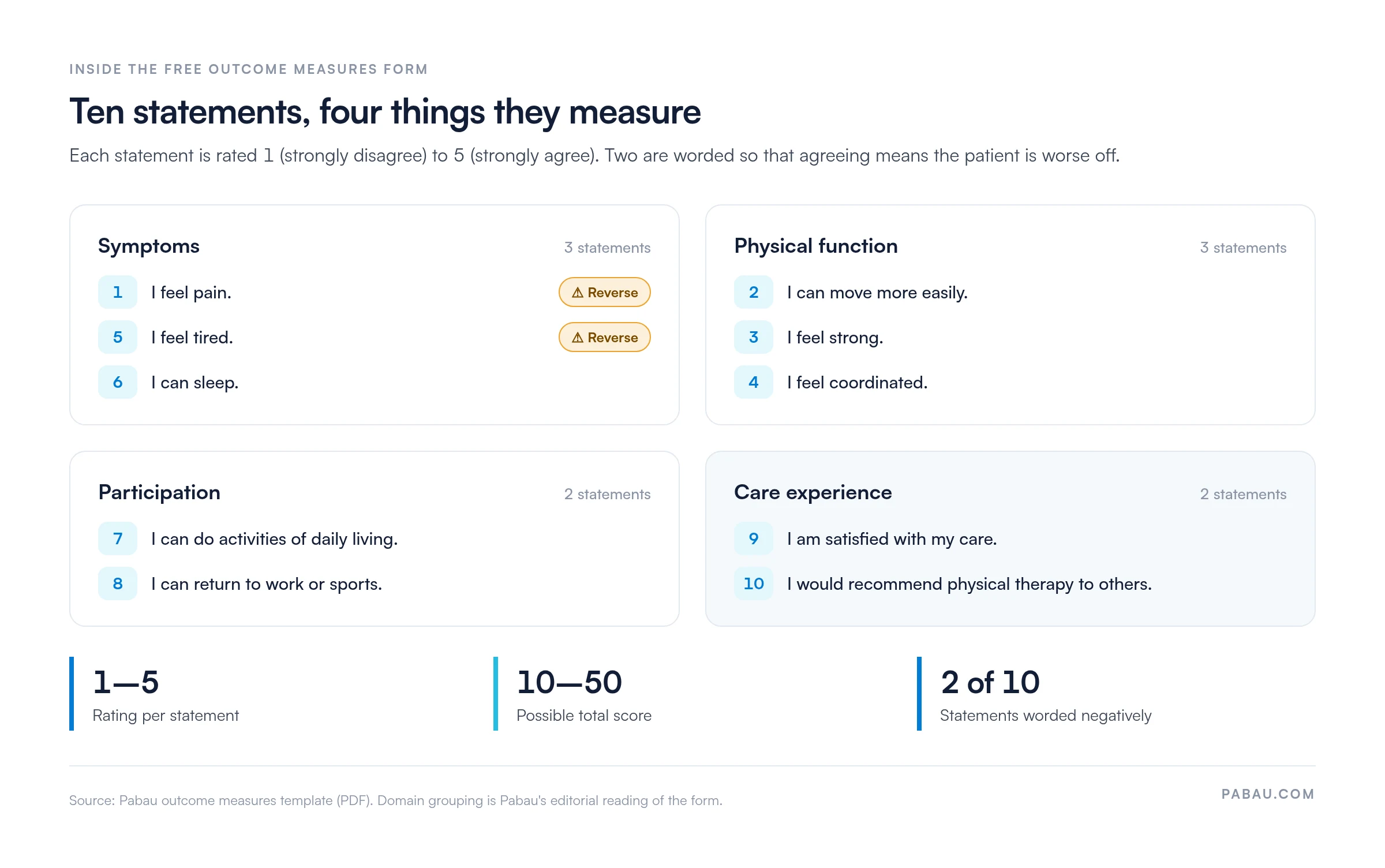
Two details change how you read the total. First, “I feel pain” and “I feel tired” are worded negatively. On those two, a 5 means the patient is worse off, while on the other eight a 5 means better. Reverse-score them (5 becomes 1, 4 becomes 2) before adding up, so a higher total always means a better outcome.
Second, the last two statements rate satisfaction with care rather than the patient’s condition. Consider noting them separately. Otherwise, a happy patient with no functional change can look like a clinical success.
The form also has a single date field, so use a fresh copy at each assessment and file it against that visit. Because it has no published MCID, pair it with one validated tool for the main complaint. For low back pain, the Oswestry Disability Index is the usual partner.
Consistent timing matters more than any other tracking habit. Decide when you’ll reassess before the first session, then stick to it. Here’s how that could look for a patient with low back pain on an eight-week plan:
Shorter courses of care follow the same logic. A structured six-week exercise plan changes phase at weeks two, four and six, so those transitions double as reassessment points.
Keep every score and date in one place, rather than a spreadsheet on someone’s laptop. A physical therapy EMR can hold scores next to the treatment notes they relate to. From there, automated workflows can remind clinicians when a reassessment is due.
Once a year, look across your whole caseload. Which measures change most in your population? Do some diagnoses or age groups improve less? That view supports payer conversations and shows referring physicians what your practice delivers.
No tool is perfect, but the common problems have well-known fixes. Here are the five that come up most, with the fix for each.
What if the patient already scores near the top? That’s a ceiling effect. A balance scale that tops out at 56 can’t show further gains in a high-functioning adult. Switch to a harder or condition-specific tool.
What if the patient struggles to read the form? Read the questions aloud or use a translated version. You can also pair the self-report with a performance-based test.
What if the measure was built for a different population? Look for a culturally validated version and check published studies in your patient group. Where scores seem off, add a line of qualitative feedback.
What if clinicians keep skipping it? Long forms get skipped. Choose brief tools, let patients complete them digitally before the visit, and build the time into the appointment length.
What if scores vary between clinicians? Write standard instructions into your protocol and train every staff member. Then give the measure at the same point in each visit.
Outcome tracking usually breaks down in the admin, not the treatment room. Paper forms go missing, scores end up in separate spreadsheets, and a skipped reassessment often goes unnoticed until discharge.
Practice management software like Pabau keeps the forms, the scores and the reminders in one system. Patients can complete outcome questionnaires digitally before their visit, and the answers go straight into their record.
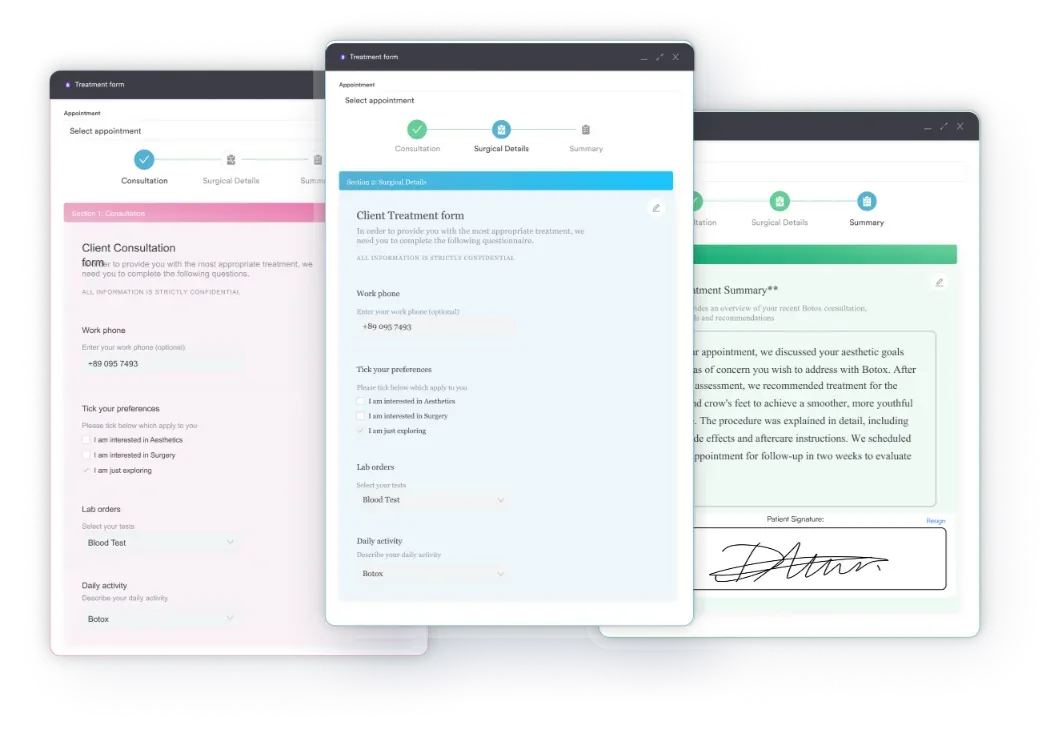
Each completed form sits in the patient’s Client record, next to the treatment notes. Pabau’s outcome measurement software then tracks each score across visits, so you can compare baseline and discharge without copying numbers by hand.
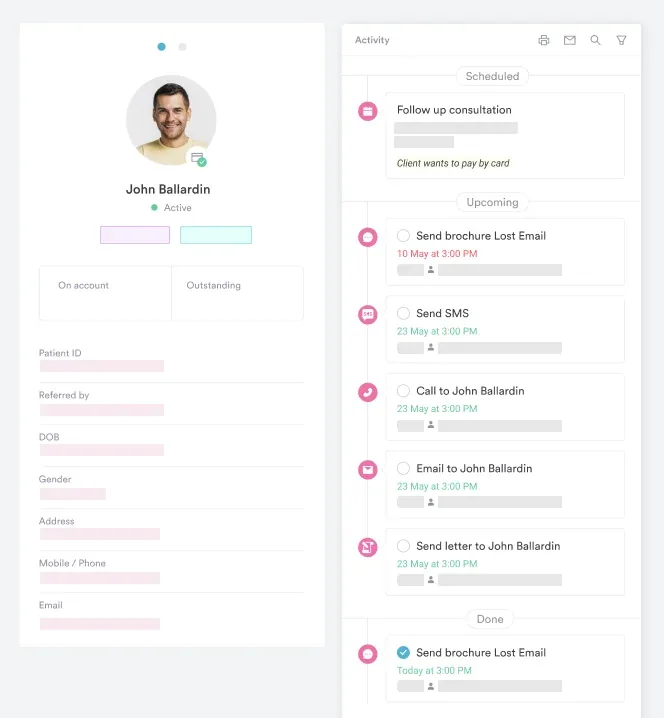
Reassessments go on the calendar at the start of the plan, too. Booking the week-four and discharge visits up front keeps the interval schedule on track.
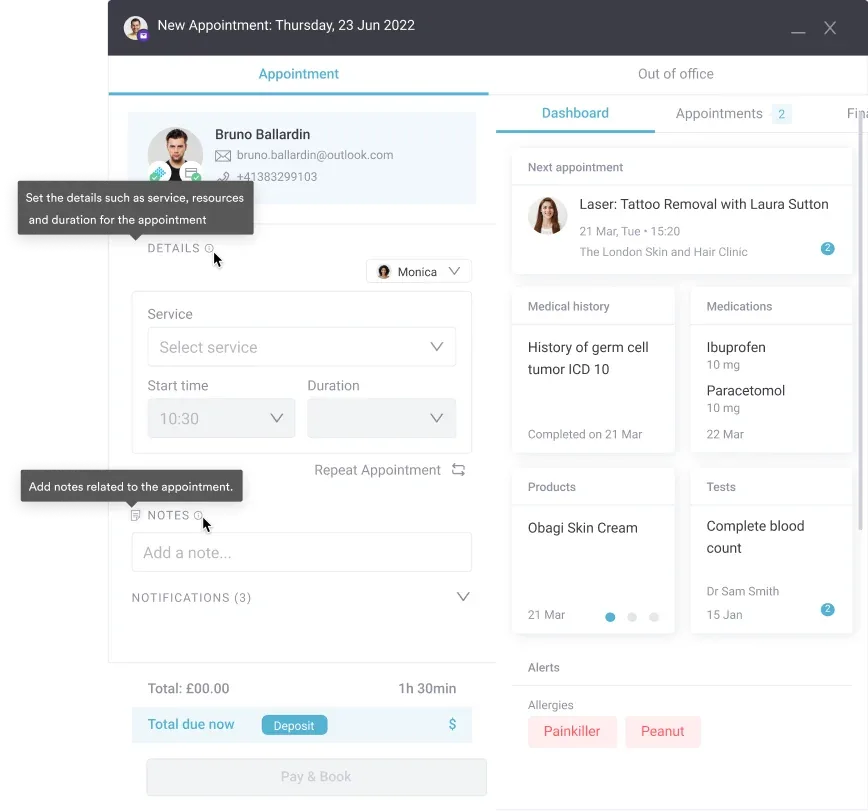

Pabau collects outcome questionnaires digitally, stores every score in the patient record and books reassessments in advance. You get a clear progress history for every patient.

An outcome measure only earns its place if you use it the same way every time. So start small. Pick one validated tool for your most common diagnosis, pair it with the free form, and score your next 10 patients at baseline and discharge.
Those 10 score pairs will tell you more about your care than a satisfaction survey can. You’ll see who improves past the MCID, who plateaus, and where your plan needs adjusting. The cost is a few minutes per visit, and the return is proof that your treatment works.
Paper works for a pilot, but it gets harder to manage as your caseload grows. Book a demo to see how Pabau collects, stores and schedules outcome measures for your practice.

Treating shoulder, arm or hand problems? QuickDASH outcome measure gives you an 11-item upper-limb disability score you can repeat at every reassessment.
Need a fast pain score for every visit? Numeric pain rating scale records pain on a 0 to 10 scale in under a minute.
Working with knee, hip or ankle patients? Lower extremity functional scale scores lower-limb function with a self-report questionnaire patients can finish before the session.
Screening older patients for fall risk? Timed Up and Go test explains how to run and interpret the quick mobility test.
Measuring endurance over a course of care? Six-minute walk test covers the setup, scoring and reference values for this endurance measure.
The minimal detectable change (MDC) is the smallest score change that goes beyond measurement error. The minimal clinically important difference (MCID) is the smallest change patients notice as meaningful. A change should clear the MDC before you count it as progress.
Subtract the follow-up score from the baseline, divide by the baseline, then multiply by 100. That works when lower scores mean better, as on the Oswestry Disability Index. Where higher scores mean better, subtract the baseline from the follow-up instead.
Yes, most self-report measures work well online before the visit. Keep the method consistent, though. A patient who scores at home at baseline and in the waiting room at discharge may answer differently for reasons unrelated to treatment.
Occupational therapists often use the Canadian Occupational Performance Measure (COPM). Patients name the daily activities that matter most to them, then rate their performance and satisfaction on a 1 to 10 scale. The Barthel Index and the FIM are also common.