Sulcus Test: Shoulder Instability Assessment
The sulcus test is an orthopedic special test that checks for inferior glenohume...

3
Last Updated: Oct 22, 2026
A 6 week exercise plan is a progressive training program that runs for 42 days in three two-week phases, called foundation, build, and peak. Each phase raises the load a step, so beginners move from bodyweight form work to heavier lifts and a final test day.
You train three or four days a week in 30-40 minute sessions, with at least one full rest day. The same plan works at home or in a gym, and practitioners can assign it to patients returning from injury.
A printable plan form with fields for patient details, the reason for the plan, and up to five goals with measures and target dates. It also covers actions with owners, a support checklist, warning signs, a review record, and signature lines.
Download template
A 6 week exercise plan runs for 42 days in three two-week phases, and each phase raises load or intensity before the next one starts.
Weeks 1-2 build form with bodyweight work, weeks 3-4 add external load, and weeks 5-6 push toward heavier lifts and a test day.
Bodyweight, band, and dumbbell variants let the same plan run at home or in a gym.
The CDC recommends muscle-strengthening activity on two or more days a week, and this plan schedules three or four.
Practitioners can use digital forms to deliver the plan, collect progress, and keep each review in the patient record.
A 6 week exercise plan is a progression framework that spans 42 consecutive days, with each week tied to a specific adaptation target. Weeks 1-2 establish movement quality and muscular endurance. Weeks 3-4 introduce resistance and more complex compound movements. Weeks 5-6 push toward strength and power.
Physical therapy practitioners, coaches, and people returning from injury use this framework for two reasons. The fixed 42-day window creates accountability you can measure, and the three phases follow the order in which the body adapts to training.
This plan suits:
According to the CDC physical activity guidelines, adults should do muscle-strengthening activity on two or more days a week. This plan meets that guideline with three or four sessions a week. Practitioners can assign it to patients, and individuals can follow it on their own.
The plan follows a three-phase model built on progressive overload, the principle that muscles adapt and grow stronger only when the workload gradually increases. Each phase lasts two weeks and builds on the movement foundations of the one before it.
The first two weeks teach movement quality. Exercises emphasize bodyweight control, good form, and full range of motion. You perform three full-body sessions per week, each lasting 30-40 minutes, with a rest day between sessions (for example Monday, Wednesday, and Friday).
Each session opens with a 5-10 minute dynamic warm-up of leg swings, arm circles, and light mobility work. Then complete six to eight core exercises at three sets of 8-12 reps, resting 60-90 seconds between sets. Finish with a five-minute cool-down of static stretching.
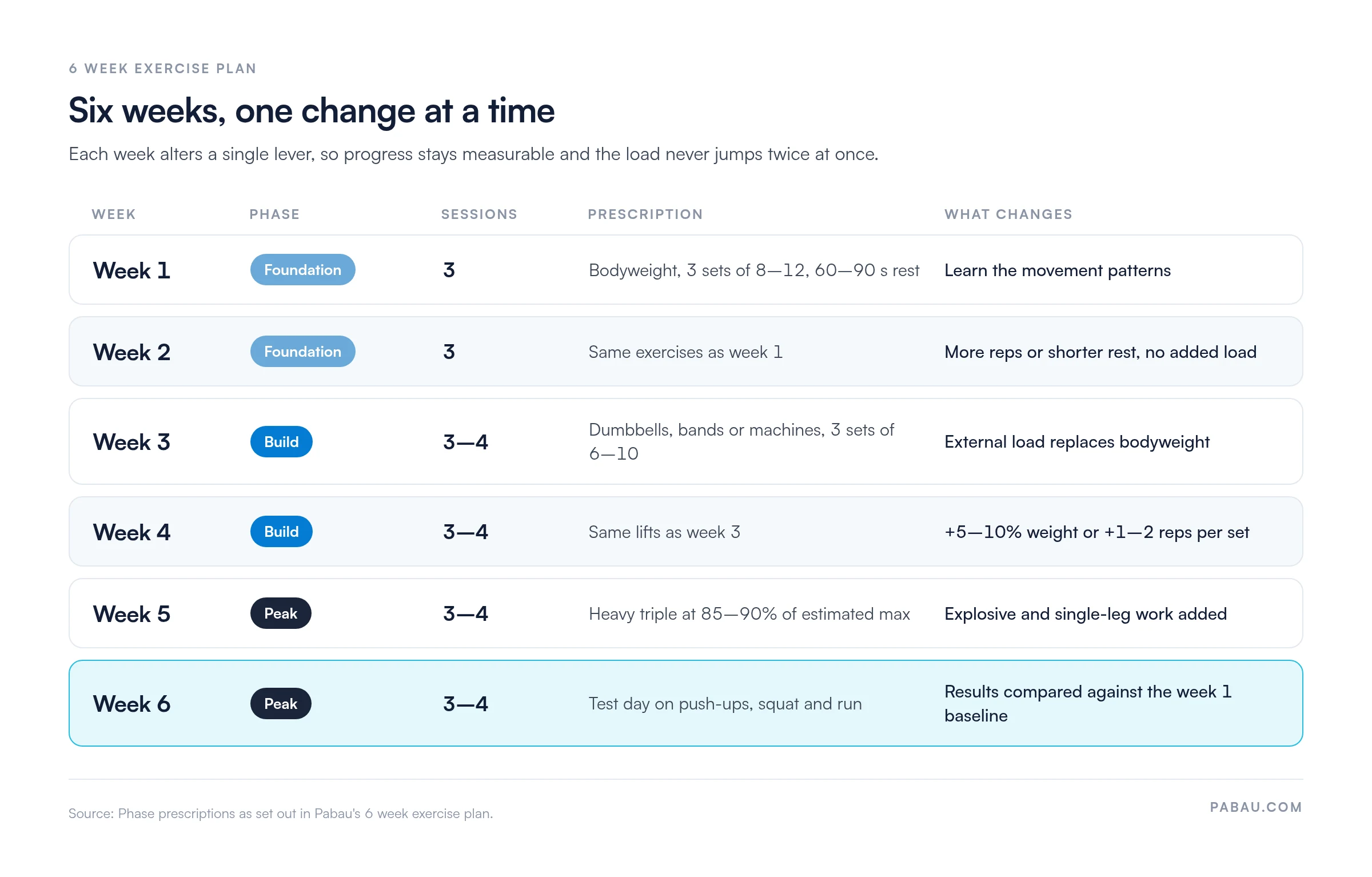
Bodyweight squats, glute bridges, push-up variations, and planks dominate week 1. Week 2 repeats the same exercises but adds reps or shortens rest periods, which drives adaptation without adding load.
Weeks 3-4 introduce external resistance from dumbbells, bands, or machines, and you train three to four days per week. Goblet squats replace bodyweight squats. Dumbbell bench presses and rows replace push-up progressions, and single-leg exercises challenge stability.
Sets stay at three per exercise, but reps drop to 6-10 to accommodate heavier loads. You also add one cardio session of 20-30 minutes at moderate intensity, such as running, cycling, or rowing. In week 4, either raise the weight by 5-10% or add one to two reps per set.
The final two weeks push toward strength and power, still at three to four sessions per week. Exercises bring in heavier loads, explosive movements such as box jumps and medicine ball throws, and harder single-leg work.
Each session opens with a heavy triple on a primary lift. That means three reps at 85-90% of your estimated max, followed by accessory work at moderate loads. Week 6 ends with a test day that measures your push-ups, your squat, and how far you can run without stopping.
The test only works because each week changes a single variable, as the ladder below shows.
Many women prioritize lower-body and glute development, and the plan accommodates that through exercise selection and accessory work. It doesn’t reduce weight or volume by sex, because strength adaptation works the same way in men and women.
To shift the emphasis, add more glute bridges and hip thrusts in weeks 1-2. Add lateral lunges and single-leg deadlifts in weeks 3-4, then Bulgarian split squats and Nordic curls in weeks 5-6.
On heavy-flow days of your cycle, trim volume slightly (for example nine reps instead of 12) while keeping intensity steady. Take at least one full rest day per week, plus one active recovery day of light walking, yoga, or mobility work.
The plan adapts fully to home training with bodyweight and, optionally, resistance bands or a pull-up bar. Progress comes from more reps, shorter rest, and harder movement variants, so you don’t need a rack of weights to apply progressive overload.
If you own resistance bands or a pull-up bar, add banded rows, pull-ups, and band-resisted squats from week 3 onward for extra load.
Weight loss needs a calorie deficit alongside structured exercise. Strength training preserves muscle and metabolic rate while you lose fat, and cardio adds to the deficit. The plan combines the two in a set order.
Pair this with a modest deficit of 300-500 calories below maintenance and 0.7-1 g of protein per pound of body weight daily. Results depend on your starting point, diet, and consistency. Disciplined participants typically lose 4-8 pounds of fat and gain visible strength.
The downloadable PDF is the plan agreement. It records patient details, the reason for the plan, up to five goals with measures and target dates, actions with owners, and a review record. Use it alongside the weekly guidance in this article.
If soreness is severe or energy drops, repeat the same weight for one more session before progressing. Practitioners can deliver the form through a patient portal, so patients complete it digitally and return it for review.
Five movement families carry the plan. Each one below comes with the cue that matters most and an easier option for patients who aren’t ready.
Form matters more than load in the first weeks. Sports medicine practitioners often teach each movement in person before a patient trains alone.
Results depend on three factors, which are consistency, nutrition, and starting fitness. Picture someone who attends 90% or more of sessions and sleeps seven to nine hours. If they also eat 0.7-1 g of protein per pound of body weight, they typically see:
Beginners see larger percentage gains than experienced lifters. Those combining the plan with a calorie deficit may lose 4-8 pounds of fat if nutrition is strict. Someone training hard while eating in excess may gain muscle and scale weight without visible fat loss.
Measurement tracking of the upper arm, waist, hips, and thighs often shows progress better than the scale. Many people repeat the plan a second or third time, using their week 6 results as the new baseline.
Six weeks is short enough to stay focused but long enough to test your discipline. These habits keep most people moving through to test day.
Eat 3-5 g of carbohydrate per kilogram of body weight daily, more on high-cardio weeks, plus the protein target above. Drink 0.5-1 ounce of water per pound of body weight daily. If you feel flat after week 2, check your sleep and your total food intake first.
Adherence improves when practitioners send weekly check-in messages, celebrate small wins, and adjust exercises if pain (rather than normal soreness) appears.
A printed plan leaves the building with the patient, and the practitioner often gets no update until the next visit. Missed sessions and stalled progress only come to light in the treatment room, when two weeks have already gone.
Practice management software like Pabau works as a physical therapy EMR that keeps the plan inside the patient record. You send the goal-setting form as a digital form at the end of the visit. Automated reminders go out on training days, and a task prompts you to review logged progress each Friday.
At weeks 3 and 6, book a check-in to compare results against the baseline and adjust the load. Session logs, measurements, and the signed review record sit together, so the outcome record is ready for insurance or a discharge summary.
If you’re still comparing systems, our guide to the best physical therapy software sets out how the main options differ.

Pabau sends the plan as a digital form, reminds patients on training days, and keeps progress notes and measurements in the patient record.

Start with the baseline. The week 6 test only means something if you recorded where you or your patient began, so measure before the first session.
Hold the progression rules even when week 2 feels easy. Adding load early is the quickest route to the soreness and missed sessions that stall a program.
For practitioners, the trade-off is follow-up time. A plan checked at weeks 3 and 6 gives you two chances to catch a stalled patient before the program ends.
Book a demo to see how Pabau keeps exercise plans, reminders, and progress reviews in the same patient record.

Building a longer program for a patient? Home exercise program template gives you a structure for prescribing and tracking exercises between visits.
Need a baseline before week one? Physical therapy intake form captures history, symptoms, and goals at the first visit.
Testing aerobic fitness before a program? Cardiopulmonary exercise testing explains how the test works and what its results tell you.
Working with older patients? Balance exercises for seniors covers safe progressions that support fall prevention.
Yes. The plan starts with foundation-phase bodyweight work in weeks 1-2, designed to teach movement patterns before any resistance is added. Beginners do best when they prioritize form over weight, take full rest days, and add reps rather than weight in the first two weeks.
Three days per week is the minimum and suits beginners. Four days per week works well if you have the equipment and the time. Five or more days raises the risk of overuse injury in a fixed six-week window, because adaptation happens on rest days.
Do both. Strength training three to four days per week is the anchor. Add one 20-30 minute steady cardio session at conversational pace in weeks 1-2, then switch to one HIIT session in weeks 3-4. Add a second cardio session in weeks 5-6 if weight loss is the goal. Cardio supports heart health and the calorie deficit, while strength work prevents muscle loss.
Yes, if you pair it with a calorie deficit. The plan preserves muscle during fat loss better than cardio alone. Combine it with a 300-500 calorie daily deficit, adequate protein, and consistent cardio to lose 4-8 pounds of fat over six weeks. Results vary widely with your starting point and how closely you follow the diet.
Yes. The plan includes no-equipment bodyweight variants for all six weeks. Progression comes from more reps, shorter rest periods, and harder movement variants such as archer push-ups, pistol squat progressions, and single-leg deadlifts. Resistance bands and a pull-up bar add options, but you don’t need them.
A structured plan covers a baseline fitness assessment, week-by-week progression, exercise descriptions with form cues, and set, rep, and rest prescriptions for each phase. It also needs warm-up and cool-down guidance, planned rest days, and a way to record goals and progress. This article supplies the training guidance, and the downloadable form records goals, actions, and reviews.
Yes. Strength gains usually show by weeks 4-5, and movement quality and confidence improve throughout. Muscle definition becomes noticeable by weeks 5-6 if nutrition is adequate. A first-time lifter may gain 10-15% in strength, while experienced lifters see 3-5%. Fat loss needs a calorie deficit and typically reaches 4-8 pounds in six weeks with consistent effort.