GLP-1 diet plan
A GLP-1 diet plan is a structured eating framework for patients taking semagluti...

2
Last Updated: Oct 13, 2026
The six-minute walk test measures how far a patient walks on a flat, hard surface in six minutes. That distance, the 6MWD, stands in for functional exercise capacity across COPD, heart failure, and pulmonary rehabilitation.
One number does the work of a much larger exercise lab, but only if the test is run identically every time. Corridor length, the words you say at each minute, and rest stops all shift the result. Each can move it further than the change you are trying to detect.
The protocol below matters as much as the interpretation that follows it.

The six-minute walk test reports one number, the distance walked in six minutes, as a proxy for functional exercise capacity.
The ATS 2002 protocol fixes the corridor at 30 m and scripts the encouragement, because both change the distance on their own.
MCID differs by condition: 14 to 25 m in COPD, 33 m in PAH, and 43 m in heart failure.
Run the test twice at the first visit and record the higher distance, since patients pace themselves better on the second attempt.
Structured digital forms keep every 6MWD, SpO2 reading, and Borg score in the patient record, so the next re-test compares cleanly.
The 6MWD is the distance a patient covers in six minutes. It reflects the combined response of the lungs, the heart, and the legs under moderate exertion.
Resting spirometry describes airflow, and an echocardiogram describes the heart. Neither tells you whether the patient can manage a supermarket aisle without stopping.
Patients set their own pace and may rest, so the distance tracks day-to-day function more closely than a forced-maximum protocol does. That is why it anchors pulmonary rehabilitation, transplant assessment, and PAH drug trials. It costs little to run, it repeats well, and patients with moderate-to-severe disease tolerate it.
The trade-off is precision. You will not get a VO2 max from it, and it will not separate a cardiac limitation from a pulmonary one. What you get is how far the patient walked, and how hard it felt.
Reach for the six-minute walk test when you need a field measure of functional exercise capacity. It works as a baseline and as a way to track response to treatment. The Physiopedia clinical reference sets out the settings where it carries the most weight.
Skip it when the question is maximal aerobic capacity, because only a cardiopulmonary exercise test answers that. Fit patients run into a ceiling too. A healthy 40-year-old can walk a corridor comfortably for six minutes and still have plenty left, which flattens any difference you were hoping to see.
The American Thoracic Society published the standard protocol in 2002, and it is still the reference every center works from.
Follow it closely and results stay comparable between visits and between sites. Drift on any step and that comparability goes. The full procedure is set out in the NCBI StatPearls chapter on the six-minute walk test.
Monitoring runs alongside the walk rather than after it, so a deteriorating patient is spotted early. The table sets out what to measure, when to measure it, and the threshold that ends the test.
Stop the walk immediately if any of the following appears. These criteria follow the ATS 2002 guidelines as applied in pulmonary rehabilitation programs.
After an early stop, record the distance covered to that point, the elapsed time, and the clinical reason. Keep a defibrillator accessible, and make sure whoever runs the test holds a current basic life support certificate.
Emergency preparedness standards vary by jurisdiction, so check your local clinical governance rules before anyone administers the test unsupervised.
Ten variables go on every test form, and each one is recorded at the moment it is taken. Reconstructing them from memory after the patient leaves is where re-test comparability starts to break down.

Attach the completed record to the patient’s longitudinal file rather than a separate outcome-measures folder. A physical therapy EMR that stores each variable as its own field puts the previous 6MWD one click away. Paper forms transcribed into the record later add a step, and every extra step adds errors.
Interpretation runs in three questions, in order. How does the raw 6MWD compare with a population-matched predicted value? Does the change since the last test clear the MCID? And what does the patient’s clinical picture say about both answers?
A 6MWD of 450 m reads very differently for a healthy 65-year-old and for a 50-year-old with severe PAH.
There is no universal normal distance. Predicted values depend on age, sex, height, and weight, and the published equations disagree with one another. The Shirley Ryan AbilityLab RehabMeasures Database collects the ones cited most often.
Express the result as a percentage of predicted, using whichever equation best matches the patient’s population. Below 80% of predicted usually signals meaningful functional impairment.
For older adults, the Steffen figures tend to set a more realistic bar than Enright, whose sample was comparatively active.
The minimal clinically important difference, or MCID, is the smallest change in 6MWD a patient would notice. It differs from the minimal detectable change, the MDC, which is the statistical threshold for ruling out measurement error.
Check both. A change below the MDC may be noise, while a change above the MDC but under the MCID is measurable without mattering to the patient. The chart below shows how far apart the condition thresholds sit.
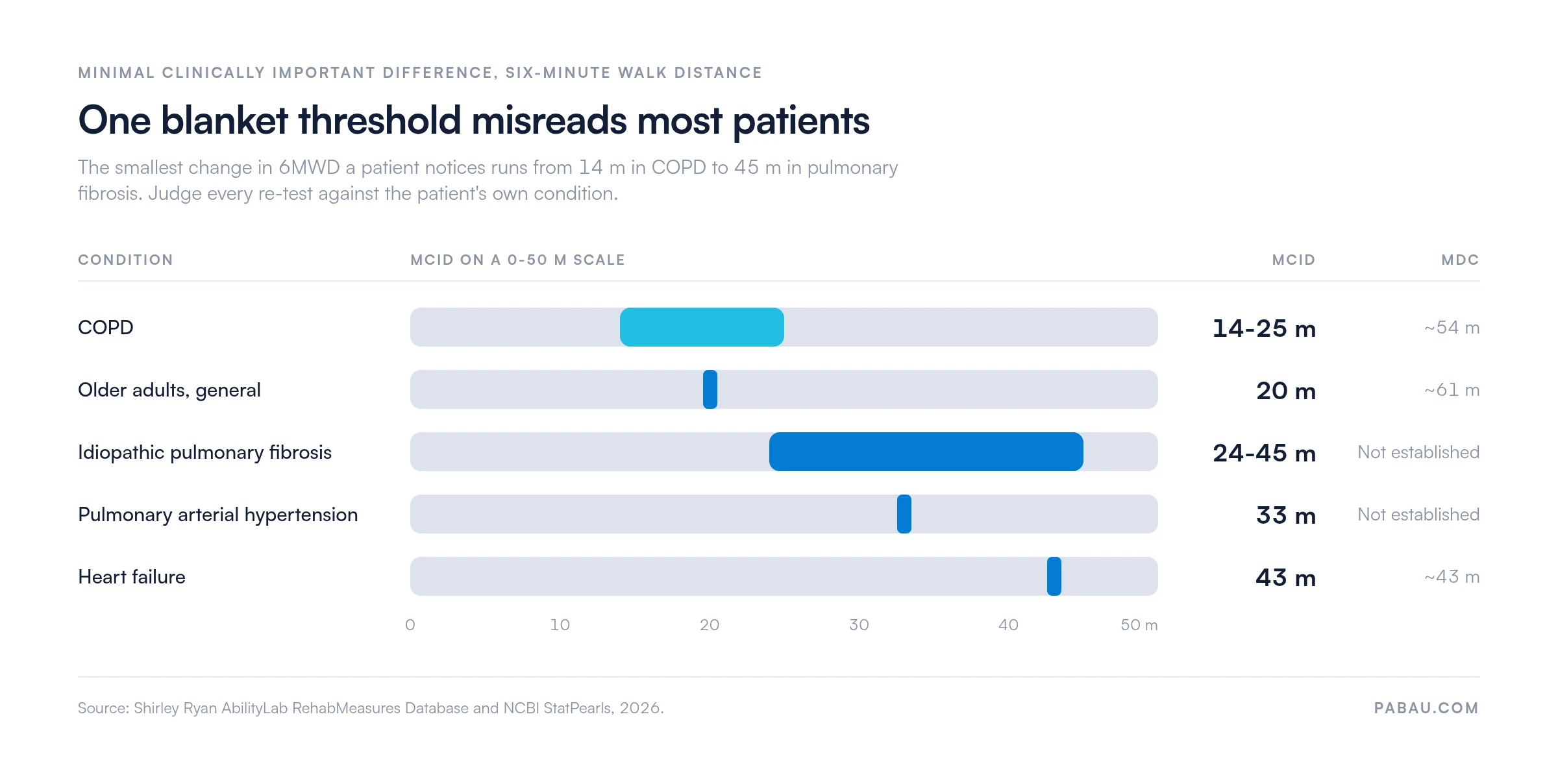
The COPD figure of 14 to 25 m depends on the method used, with anchor-based studies landing lower than distribution-based ones. Values here come from the RehabMeasures Database and NCBI StatPearls.
Run the test twice on the first visit and take the higher distance as your baseline. The ATS guidelines describe a well-documented practice effect. Patients walk further on the second attempt because they have learned to pace themselves. Using the lower first-visit score as the baseline inflates apparent improvement at follow-up, and that makes a treatment look more effective than it was.
Most protocol drift starts before the patient stands up. Run through this list at the door, and the distance you record will compare cleanly with the last one.
Two items cause most of the trouble in a busy practice. A corridor that doubles as a waiting area produces a slower walk on a busy morning. A different tester using warmer encouragement produces a faster one.
Neither result reflects a change in the patient, so both are worth heading off before the stopwatch starts.
Test-retest reliability is strong in COPD and heart failure populations, with intraclass correlation coefficients above 0.90 when the protocol is followed closely.
Validity holds up as well, through moderate-to-strong correlations with peak VO2 in COPD and PAH. The weak points are procedural rather than statistical.
None of these are reasons to drop the test. They are reasons to write the conditions down next to the distance, so the next clinician reading the file knows what produced the number.
Most physical therapy and respiratory teams run this test often and record it inconsistently. The form sits in one folder and the clinical notes sit in another, so the previous 6MWD takes a few minutes to find. By the time it turns up, the reassessment has already started.
Practice management software like Pabau closes that loop. Its outcome measurements tracking holds the 6MWD, Borg score, SpO2, and rest stops as structured fields inside the patient record. Each result lands on a timeline beside the rest of the clinical picture, so the previous figure is on screen before the patient sits down.
Teams running pulmonary rehabilitation can build their own version of the ATS sheet with digital clinical forms, capturing every variable without paper.
At the 6-week re-test the clinician opens the same form, enters the new distance, and the comparison against the MCID is already made. Automated reminders cover the follow-up interval too, so no patient waits because the prompt sat with a colleague who was on leave.
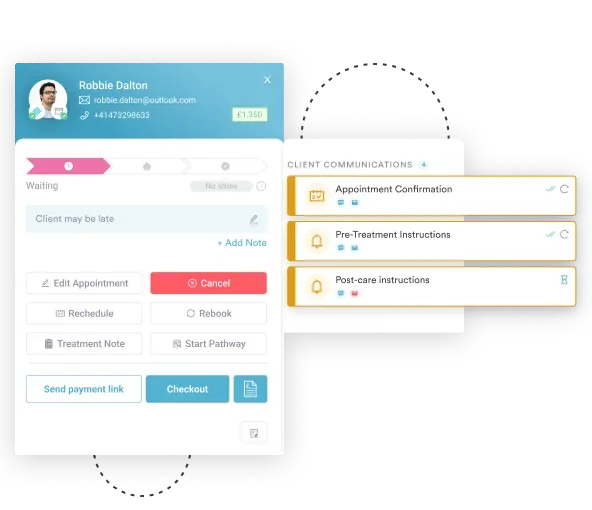

Pabau’s digital forms capture the 6MWD, SpO2, Borg score, and rest stops as structured fields, then track functional change across appointments automatically. Your next reassessment opens with the last result already on screen.

The six-minute walk test is only as good as the consistency behind it. Two testers who follow the ATS script and use the same corridor produce numbers you can compare. Two who improvise produce a trend line shaped by the staff schedule rather than the patient.
So fix the conditions first, then worry about the interpretation. Write the corridor length, the oxygen flow, and the assistive device on the form every time. Compare each re-test against a population-matched predicted value and the MCID for that patient’s condition, never a single blanket threshold.
All of that is easier to sustain when the previous result is already on screen. Book a demo to see how Pabau keeps outcome measures like the 6MWD in the patient record, ready for the next re-test.

Need a short-distance measure as well? 10 meter walk test sets out the gait speed protocol that pairs neatly with the 6MWD.
Assessing lower-limb strength? 30 second chair stand test gives you a seated option for patients who cannot manage a corridor.
Screening the same caseload for falls risk? 4 stage balance test scores static balance across four positions in under two minutes.
Tracking recovery after exertion? Heart rate recovery chart by age shows the normal one-minute drop by age band.
Running a multi-practitioner therapy practice? Physiotherapy clinic management software compares the systems that keep outcome data in one record.
The ATS lists two absolute contraindications: unstable angina in the previous month, and myocardial infarction in the previous month. Relative contraindications include a resting heart rate above 120 bpm, systolic blood pressure above 180 mmHg, or diastolic above 100 mmHg. Each relative one is a clinical judgment call on the day.
For a healthy 60-year-old, published equations put women between 494 and 562 m and men between 576 and 631 m. The figure depends on age, sex, height, and weight, so compare against a population-matched predicted value. Below 80% of predicted suggests meaningful functional impairment.
CPT code 94618 appears in community clinical references for pulmonary stress testing, which includes the six-minute walk test. Verify it against the current AMA CPT codebook before billing, since codes change annually and payer policies differ. Your billing team or clearinghouse can confirm coverage.
No. The ATS protocol specifies a flat, hard, indoor corridor, because wind, gradient, and surface all change the distance. A treadmill sets the pace for the patient, which removes the self-pacing that makes the result meaningful. Use the standard corridor, or record the deviation on the form.
Yes. The test is used to assess exertional desaturation and to set supplemental oxygen flow rates in COPD and interstitial lung disease. SpO2 is monitored throughout, and the flow rate is adjusted when saturation drops below the prescribing threshold, typically 88 to 90%. Continuous oximetry and oxygen equipment are required.