Professional development record
A professional development record is a structured log of a healthcare practition...

8
Last Updated: Oct 8, 2026
A medical spa before and after photo consent form has to be a HIPAA authorization, not a photo release. HIPAA compliance for the software that stores before-and-after photos is one of the topics in our ranking of medical spa systems. The HIPAA-versus-photo-release distinction decides whether your before-and-after gallery is lawful. A compliant patient photo consent form carries six core elements, three required statements, and a separate opt-in for each purpose.
A clause-by-clause photo and video consent form covering the six HIPAA core elements, the three required statements, a named-channel list, and a three-tier initialed opt-in. It includes the expiration, revocation, and guardian-signature blocks that published forms leave out. Have a healthcare attorney in your state review it before use.
Download templateWe checked the med spa marketing release forms published on practice websites against that standard. Clauses were missing on every form we reviewed. This guide walks the requirements clause by clause, then hands you a copy-ready template built to the standard those forms miss.
Two sections go past the form itself. One maps consent against each channel you post on, from organic Instagram to a printed brochure. The other names the mistakes that draw enforcement, and what each one costs.
Practice management software like Pabau can collect and store these authorizations digitally. The form still has to be right first, so that is where this starts.

A medical spa treatment consent form does not authorize marketing use of patient photos, which needs a separate HIPAA authorization.
A valid authorization under 45 CFR §164.508 carries six core elements plus three required statements, and all nine are mandatory.
Use a three-tier opt-in: medical record only, internal training, or external marketing, each initialed separately.
Name each channel on the form, because Meta ads, Google Ads, and print each add rules HIPAA never mentions.
One dental practice settled with federal regulators for $10,000 over patient information disclosed in replies on social media.
The published med spa forms we reviewed omit an expiration date, a written revocation procedure, and a not-conditioned-on-treatment statement.
A before-and-after photo consent form is a written authorization that lets your practice use identifiable images of a patient beyond their medical record. A general treatment consent form does not grant that permission. Informed consent to a chemical peel says nothing about the photos of the result appearing in an ad.
A patient photo can serve three purposes: clinical documentation, internal training, and external marketing. Only the first sits inside ordinary treatment consent, because photos in the patient chart are part of care. The other two are separate uses that need their own permission. Neither belongs buried inside your medical spa client intake form, either.
Photos of a patient’s face or body tied to a treatment are protected health information, known as PHI. That is what pulls medical spa consent forms under HIPAA rather than ordinary model-release law. A covered entity that publishes PHI without a valid authorization has disclosed it unlawfully, however polished the release language looks.
At a glance
The six core elements, where they sit on the form
Photo & Video Consent Authorization
[Practice name] · HIPAA authorization under 45 CFR §164.508
Description of the information
“Photographs and video of my face and treatment area taken before and after treatment”
Who may disclose
“[Practice name] and its clinical and marketing staff”
Who receives the images
“Visitors to our website, Instagram, and Facebook pages”
Purpose of each use
“To document my care, train staff, or promote the practice’s services, as I initial below”
Expiration date or event
“This authorization expires three years from the date signed”
Signature and date
Patient or personal representative signs and dates, with a description of the representative’s authority
One signature cannot cover all three purposes. HIPAA requires the form to describe each purpose, and patients routinely agree to one and refuse another. Purpose limitation is the whole point of the authorization.
The practical consequence is simple. A patient who consents to clinical documentation only still gets photographed, but the images never leave the chart. The better published forms already work this way. They offer initialed options for advertising, in-office training only, or medical record only, and the patient picks one.
None of your other medical spa consent forms covers marketing use of a patient’s photos, so the photo authorization has to stand on its own.
A med spa collects four or five documents before treatment, and each authorizes something narrow. A botox consent form covers the risks and benefits of the injection. A spa client consent form covers history, contraindications, and the terms of the visit. Neither one mentions Instagram.
What ties them together is cross-referencing. Your Notice of Privacy Practices should point to the authorization used for marketing, and the photo authorization should name the record the images live in.
| Form | What it authorizes | Does it cover marketing photos? | What it must cross-reference |
|---|---|---|---|
| Treatment consent form, such as a botox consent form | Risks, benefits, and the patient’s agreement to the treatment | No | The photo authorization, for any image used beyond the chart |
| HIPAA Notice of Privacy Practices | How the practice uses PHI for care, payment, and operations | No, because it notifies rather than authorizes | The §164.508 authorization required for marketing uses |
| Spa client consent form or intake form | Medical history, contraindications, and the terms of the visit | No | The treatment consent and the photo authorization |
| Financial and cancellation policy | Deposits, payment terms, and no-show charges | No, and it should carry no photo language at all | Nothing on photos, so the two never get confused |
| Photo and marketing authorization | Documentation, training, or marketing use of named images on named channels | Yes, once it meets all nine §164.508 requirements | The patient record number and the treatment consent |
A valid form carries six core elements in this order: the photos described, who discloses, who receives, the purpose, an expiration date, and a signature.
Three required statements complete it. The right to revoke, the promise that treatment is not conditioned on signing, and a warning about redisclosure.
HIPAA and photographs sit awkwardly together, because the Privacy Rule was drafted for records rather than images. A treatment photo counts as protected health information whenever it can identify the person in it.
The table below translates each requirement into the line of form copy that satisfies it. The last column previews what we found when we scored published med spa forms against the rule.
| Requirement (§164.508) | What it means for photos | Form wording that satisfies it | On the forms we checked? |
|---|---|---|---|
| Description of the information (c)(1)(i) | Name the photos in a specific and meaningful fashion | “Photographs and video of my face and treatment area taken before and after treatment” | Partial |
| Who may disclose (c)(1)(ii) | Name the practice and staff authorized to use the images | “[Practice name] and its clinical and marketing staff” | Yes |
| Who receives them (c)(1)(iii) | Name the recipients or platforms | “Visitors to our website, Instagram, and Facebook pages” | Partial |
| Purpose of each use (c)(1)(iv) | State why, per tier | “To document my care, train staff, or promote the practice’s services, as I initial below” | Yes |
| Expiration date or event (c)(1)(v) | Say when the permission ends | “This authorization expires three years from the date signed” | No |
| Signature and date (c)(1)(vi) | Patient or personal representative signs and dates | Signature block with date field and authority description | Yes |
| Right to revoke (c)(2)(i) | Explain written revocation and its procedure | “I may revoke this authorization in writing to the practice manager” | No |
| No conditioning of treatment (c)(2)(ii) | Say treatment does not depend on signing | “My treatment does not depend on signing this form” | No |
| Redisclosure risk (c)(2)(iii) | Warn that published images may be reshared | “Once published, images may be reshared and no longer protected by the Privacy Rule” | Partial |
Two duties sit alongside the nine requirements. The practice must give the patient a copy of the signed authorization. And where a third party pays the practice to feature results, the marketing authorization must disclose that financial remuneration.
45 CFR §164.508
Six core elements + three statements = a valid authorization
All nine are mandatory. Miss one and the authorization is defective, so every use under it is an unauthorized disclosure.
Six core elements — §164.508(c)(1)
1. Description of the photos
Named in a specific, meaningful fashion
2. Who may disclose
The practice and authorized staff
3. Who receives the images
Named recipients or platforms
4. Purpose of each use
Documentation, training, or marketing
5. Expiration date or event
When the permission ends
⚠ Missing from every form we checked
6. Signature and date
Patient or personal representative
Three required statements — §164.508(c)(2)
7. Right to revoke
In writing, with a named procedure
⚠ Missing from every form we checked
8. No conditioning of treatment
Care does not depend on signing
⚠ Missing from every form we checked
9. Redisclosure risk
Published images may be reshared
⚠ Missing from most forms we checked
Posting a patient’s before-and-after photo to promote your services is marketing under HIPAA, so it needs an authorization unless a narrow exception applies. The exceptions that come up in a med spa are face-to-face communication with the patient and promotional gifts of nominal value. Neither covers an Instagram post, a website gallery, or a paid ad.
Watch the remuneration rule. Suppose a dermal filler or neurotoxin manufacturer pays your practice to feature results achieved with their product. The authorization must then say the practice is being paid. A product-specific disclosure sentence handles it.
We pulled the photo consent forms med spas and dermatology practices publish on their own websites. These are the same documents that rank on page one for this query. Then we scored each against the nine §164.508 requirements above. The pattern was consistent enough to plan a form around.
| §164.508 requirement | On the forms we reviewed | What the omission exposes you to |
|---|---|---|
| Tiered, initialed opt-in by purpose | Present and handled well | — |
| Parent or guardian signature line | Present on every form | — |
| Redisclosure warning | Appeared on some forms | A patient who never learned the risk has a stronger complaint |
| Expiration date or event | Absent from every form we reviewed | The authorization is defective, so every use under it is unauthorized disclosure |
| Written revocation procedure | Absent from every form we reviewed | Disputed withdrawals, and no proof of when use should have stopped |
| Not-conditioned-on-treatment statement | Absent from every form we reviewed | An argument that consent was coerced, which undermines the whole form |
Several forms instead carry aggressive terms that have nothing to do with HIPAA. A patient could reasonably refuse each of these:
Note what this adds up to. A form can be legally aggressive and still non-compliant, because the two do different jobs. The release language protects the practice’s use of an image. The authorization is what makes the use lawful in the first place.
This section builds the form clause by clause, in the order the clauses appear on the page. For each one you get the requirement, the wording that satisfies it, and the consequence at the front desk. The downloadable template above matches this build exactly.
The finished form
All 11 clauses, in the order the patient reads them
Photo & Video Consent Authorization
1 · Patient identifiers
2 · Purpose statement
3 · Named channels
4 · Three-tier initialed opt-in
5 · Expiration date
6 · Revocation paragraph7 · Not conditioned on treatment
8 · Redisclosure warning9 · Cropping and identity options
10 · Ownership and no-compensation terms
11 · Signature block
HIPAA wants the information and purpose described in a specific and meaningful fashion, and “advertising” is neither. List the channels by name: the practice website, Instagram and Facebook, printed materials, email newsletters, paid ads, third-party review sites, and conference presentations.
Make the list checkboxes rather than prose. Adding a channel later needs fresh consent, and checkboxes let a returning patient extend their consent in one visit instead of re-signing the whole form. The channel matrix further down shows what each of those places adds on top of the authorization.
This is the structure we recommend, drawn from the better forms in our review and tightened:
The patient initials one tier, and declining tier three changes nothing about the treatment they receive. Separate initials beat a single signature for one reason: they evidence which permission was given if it is ever questioned. A signature at the bottom of a page proves far less than an initial beside a choice.
The form is invalid without an expiration date or expiration event, and it must tell the patient how to revoke. Workable options include a fixed period, such as three years, or an event tied to the purpose. “Until the end of this campaign” and “until my care at the practice ends” both qualify.
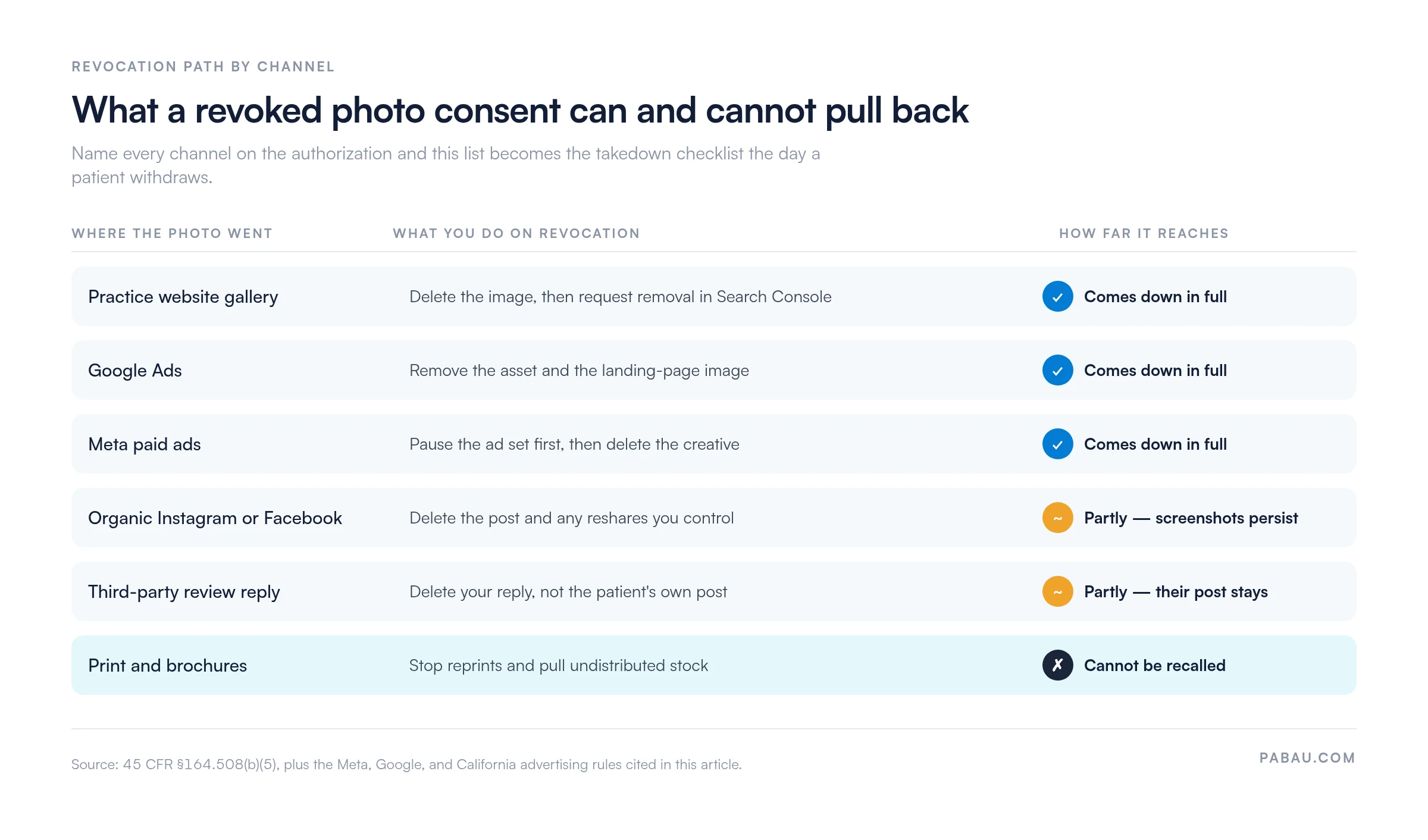
The revocation clause names a role: “written notice to the practice manager.” On receipt, the practice stops future use and logs the withdrawal. Be honest about the limit. Revocation stops new use but cannot pull back a printed brochure or a screenshotted post.
One operational rule makes the clause work. Revocation is worthless unless someone owns the task of removing the images. Assign it to a named role, and have that person confirm removal in the patient’s record.
The practice normally owns the copyright in photos its staff take, but owning the image does not let you publish the person in it. Three rights overlap here. Copyright in the photograph usually sits with the practice, as the employer of the photographer. The patient keeps a right of publicity in their own likeness. And HIPAA adds its separate authorization requirement on top.
The med spa owner threads on page one keep asking this question, and the answer cuts both ways. Yes, the images are yours. No, that alone does not make the Instagram post lawful.
The follow-on question is whether a patient can demand copies of their own photos. Usually yes. Clinical photos are part of the designated record set, so the HIPAA right of access reaches them.
Cropping the frame and blurring the eyes are risk reduction, not an exemption. A photo can still identify someone through a tattoo, a birthmark, jewelry, scarring, or an unusual feature. HIPAA’s de-identification standard is demanding, and a blurred eye line rarely meets it.
The practical rule: treat every clinical photo as identifiable, get the authorization, then crop as well. Give the patient granular options, such as obstructing areas of the face or body. A patient may consent to a cropped image but not a full-face one, which is one more reason for initialed choices.
Three clauses sit outside HIPAA but appear on nearly every published form. The no-compensation statement says the patient is not paid for the use, which prevents a later claim to royalties. The waiver of claims releases the practice from liability arising from its agreed use of the images. The inspection waiver says the patient will not review the advertising before it runs.
Our position: a perpetual, unlimited, unreviewable grant is more than most practices need. Asking for less makes the form easier to get signed. A defined term, a named channel list, and a right to request removal cost you little and read as respect.
The patient’s signature and the date are both core elements, so an undated signature is a defective authorization. A personal representative who signs must also describe their authority to act, such as parent or healthcare proxy.
Then the step paper forms skip most often: HIPAA requires you to give the patient a copy of the signed authorization. Keep the original retrievable alongside the photos it authorizes. An electronic signature with a timestamp satisfies the requirement and makes the record easier to produce later.
Posting to social media is the highest-risk use of a patient photo. It needs the channel named on the authorization, plus a workflow that can prove consent existed before the post went live. Social adds hazards the paper form cannot see. Comments and tags can expose a patient’s identity even when the image is cropped. A screenshot outlives any delete. Staff sometimes post from personal accounts, outside every control you built.
Run this check before every post:
One more trap: a patient posting their own results does not authorize you to repost them. Their account is theirs. Reposting to the practice account is a new disclosure by a covered entity, and it needs the same authorization as an original post.
Your authorization must name each channel individually. A single “social media” line does not cover a paid ad, a website gallery, a print brochure, or a review reply.
Each channel then adds rules of its own, and they are not HIPAA rules. Meta sets an age floor on cosmetic-procedure ads. Google blocks the audience tools you would use to retarget patients. Print cannot be taken back once it leaves the building.
| Where you post | What the authorization must name | What the platform’s own policy adds | What happens when consent is revoked |
|---|---|---|---|
| Organic Instagram or Facebook | Each platform by name, plus the practice account that posts | Nothing extra while the post stays organic, though Meta’s ad standards apply the moment you boost it | Delete the post and any reshares you control, then log the removal |
| Meta paid ads | Paid advertising on Meta, named separately from organic posts | Cosmetic-procedure ads must target adults 18 and over, and must carry no statement of inferiority about appearance | Pause the ad set first, because a live ad keeps serving until you do |
| Google Ads | Paid search and display, plus the landing page the ad points to | Health ads cannot use Customer Match, your-data segments, lookalikes, or audience expansion | Remove the creative and the landing-page image, then confirm delivery stopped |
| Practice website gallery | The practice website, and any second site the gallery sits on | No platform rule, but search engines keep serving a cached copy for a while | Delete the image, then request removal in Google Search Console |
| Print and brochures | Printed materials, with a term short enough to reprint against | California requires the two views to be comparable, plus a statement that results may not occur for all patients | Stop reprints and pull undistributed stock, because printed copies cannot be recalled |
| Third-party review sites | Review platforms, including replies that reference the patient’s treatment | Platform terms add no protection, and federal regulators have settled cases over review replies | Delete your reply. The patient’s own post stays theirs to remove |
The platform rules above come from Meta’s Transparency Center advertising standards, Google’s personalized advertising policy, and California Business and Professions Code §651.
Naming the channel is also what makes a revocation workable. When a patient withdraws consent, the checklist on their form becomes your takedown list. A form that said only “marketing” leaves nobody able to say which posts to pull.
A “results may vary” line does not cure a misleading before-and-after. The Federal Trade Commission expects you to state the result a typical patient gets.
The rule sits at 16 CFR §255.2. An advertiser showing one patient’s outcome must hold substantiation that the outcome is representative. Where it is not, a “results not typical” disclaimer does not fix the impression. Disclose the generally expected result instead, including how many sessions it took.
Editing is the other half. Never retouch, filter, or reshape in a way that changes the apparent outcome. A change in lighting, angle, makeup, or posture does the same job as editing, and regulators read it the same way.
California is stricter than the FTC here. Its advertising statute requires the before and after views to be comparable in presentation, with a statement that results may not occur for all patients. It also requires any image of a model to say so, prominently.
The version that draws complaints is borrowed imagery. Posting a manufacturer’s or another practice’s before-and-after as your own is deception, however good your consent forms are.
A photo release covers the image and not the words beside it, so a testimonial needs its own authorization line.
Most med spa testimonials arrive with a photo attached, which is why the two get treated as one permission. They are not. A quote about a patient’s treatment is a separate disclosure of protected health information. The HIPAA compliant authorization has to name the words, the attribution, and whether a first name may appear.
The FTC adds a second duty on top of consent. Under 16 CFR §255.5, a material connection between your practice and the patient must be disclosed clearly and conspicuously. A discounted treatment, a free syringe, or a gift card in exchange for a testimonial is a material connection.
Resharing works the same way. If the patient was compensated for a review, the disclosure travels with the review into your marketing.
State advertising law reaches your before-and-after photos even when HIPAA is satisfied, and it is the medical director’s license at risk.
California is the clearest example. A knowing violation of its advertising statute can draw an administrative fine of up to $10,000 per event, and it is grounds for license discipline. New York treats use of a likeness for advertising as its own wrong, so written consent is needed on top of the HIPAA authorization.
The pattern matters more than the state list. Boards discipline the supervising physician rather than the med spa brand, and consumer-protection agencies pursue the business. Get the campaign reviewed in your own state before it runs.
Five mistakes generate almost all photo-related enforcement. Posting without a valid authorization, posting after a revocation, and marketing a documentation photo are three of them. Unsecured storage on a personal phone and staff sharing are the other two.
A HIPAA photo violations list only helps with the exposure attached, so the table below pairs each mistake with the rule it breaks. Penalties under 45 CFR §160.404 run in four tiers set by culpability, not by how many people saw the post.
The statutory floor is $100 per violation where a practice did not know, rising to $50,000 for willful neglect left uncorrected. Federal regulators adjust those figures annually for inflation and publish them at 45 CFR part 102.
HIPAA photos also leave a dated trail, which is what makes these complaints straightforward. A live post, a form with no expiration date, and an ignored takedown request tell the story between them.
| What went wrong | Which rule it breaks | Typical exposure | The form or workflow control that prevents it |
|---|---|---|---|
| You posted a before-and-after with no authorization on file | 45 CFR §164.502(a) and §164.508 | A civil money penalty in one of the four culpability tiers, plus a corrective action plan | A pre-post check that the tier-three initial and this channel are both on the form |
| You kept using an image after the patient revoked | §164.508(b)(5), which ends future use on revocation | The same tiers, and the dated post proves the timeline for the complainant | One named role owns takedown, and logs it in the patient record |
| A documentation photo was reused for marketing | §164.508(a)(3), the marketing authorization rule | An unauthorized disclosure, plus a state board advertising complaint | The three-tier initialed opt-in, so the purpose is recorded per patient |
| Photos sat on a personal phone or a consumer cloud drive | Security Rule §164.312 access control and encryption | Penalty exposure, and a reportable breach if the device goes missing | Capture straight into the patient record instead of the camera roll |
| Staff shared images in a group chat | §164.502(a), with the training duty at §164.530(b) | The practice answers for a disclosure by its own workforce | A written photo policy, plus training documented for each employee |
| A treatment was filmed for content without authorization | §164.508, which has no exception for a film crew | Unauthorized hospital filming settled at $2.2 million in 2016 | A signed authorization before the camera is switched on |
| The pair was edited, mismatched, or borrowed | FTC Act Section 5, with 16 CFR §255.2 | Deception exposure, and up to $10,000 per event under California’s advertising statute | Unedited pairs, matched lighting and angle, and the expected result stated |
Sources for the table are 45 CFR §§164.502, 164.508, 164.312 and 160.404. The FTC endorsement rules at 16 CFR part 255 supply the advertising half, alongside published federal resolution agreements.
Read the list as a workflow audit rather than a legal one. Four of the seven rows are prevented by a checkbox on a form and one named owner for takedowns.
A minor cannot authorize marketing use of their own images. The parent or legal guardian signs, and the form must capture their authority to do so. Three cases actually come up: teenage acne and laser treatment, a guardian for an adult patient, and a patient under a power of attorney.
Both live practice forms we reviewed include a parent or guardian signature line. It is the one minors-related clause practices reliably get right. The part they miss comes later. Consent given by a guardian does not survive the patient reaching the age of majority for ongoing marketing use. A long-running campaign built on images of a 17-year-old needs fresh consent at 18.
HIPAA sets the floor, and state law can require more. A form that satisfies §164.508 can still be non-compliant where you practice. Two layers vary by state. Medical records and privacy statutes can add consent or retention requirements. And medical board rules govern advertising by the supervising physician or medical director.
One structural point catches multi-entity practices. In states with corporate practice of medicine restrictions, the entity that owns the records also controls the photos. That entity may not be the med spa brand doing the marketing. The table below is a starting map for a handful of high-med-spa states, not legal advice. Have the form reviewed in your own state.
| State | What it adds for patient photos | Where the rule lives | What to change on the form |
|---|---|---|---|
| California | Written authorization for disclosing medical information, with its own validity requirements on format and signature | Confidentiality of Medical Information Act, Cal. Civ. Code §56.10–56.11 | Meet CMIA’s authorization format rules, not just HIPAA’s |
| Texas | Broader definition of covered entity than HIPAA, plus state training and consent duties | Texas Medical Records Privacy Act, Health and Safety Code Ch. 181 | Confirm marketing vendors also qualify as covered entities under Texas law |
| Florida | Patient records are confidential and leave the practice only with written authorization | Fla. Stat. §456.057 | Keep the signed authorization in the record before any image leaves it |
| New York | Written consent required to use a person’s likeness for advertising or trade | N.Y. Civil Rights Law §§50–51 | Keep consent written and channel-specific, so it covers publicity rights too |
| Illinois | Written consent and a retention schedule before collecting biometric identifiers, including facial geometry | Biometric Information Privacy Act, 740 ILCS 14 | Add a BIPA consent if your software applies facial recognition to patient photos |
The template in the download box above assembles every clause this article has covered, in the order it appears on the form. It is a starting point, not legal advice. Have a healthcare attorney in your state review it before use. The blocks, in order:
Keep the wording plain enough for a patient to understand at the front desk. A form nobody understands gets signed without being read, and that helps no one in a dispute.
Write the form as a photo and video consent from the start, because a photo-only authorization does not cover footage. Treatment video, reels, and testimonials raise the stakes. Voice makes de-identification far harder, and a testimonial adds an endorsement claim on top of the privacy question.
The strongest published form we reviewed handles this correctly: it is written as a photo and video utilization consent. Match that scope of media on day one rather than bolting video on later.
Store the photos and the signed authorization inside the patient record, encrypted, access-controlled, and logged like the rest of the chart. Both are medical records, so both need the same retrievability. Treatments with delayed results test that rule hardest. An ultrasound facial consent form gets pulled up beside photos taken three to six months apart. The failures that happen in practice are mundane. Images sit on a personal phone or a shared drive. No link exists between a photo and the consent that authorizes it. Nobody can answer “show me the consent for this post” months later.
Pairing discipline matters for the photos themselves. Same angle, same distance, same lighting, same background, consistent file naming. Good pairing serves clinical comparison and advertising honesty at once, because a mismatched pair overstates the result whether or not anyone intended it.
Three controls carry the weight here. Encrypt the images in transit and at rest, put role-based access in front of them, and keep an audit trail of who opened which image. The audit trail is what turns an access rule into evidence months later.
Staff training is the control that slips most often. Write the photo policy down: who takes photos, on which device, where they land, and who may post. Then train each person against it, and keep the record of that training.
The best medical spa software builds these controls in and links each photo to its consent. Any vendor that touches the images needs a business associate agreement, known as a BAA, before the first photo moves.
Keep the signed authorization for six years from the date it was created, or from the date it last was in effect, whichever is later. That is the HIPAA documentation rule at 45 CFR §164.530(j)(2), and it covers the authorization itself.
The photos are a separate question, because the clinical record’s lifespan is set by state law. Where the state period runs longer than six years, the longer period governs the images in the chart.
Longer figures circulate online, including retention measured in decades. Those come from state medical-records statutes rather than from HIPAA, so check your own state before you set a destruction schedule.
The practical rule: retire the images when the authorization expires, and log the retirement. An expired authorization with the photos still live on your website is exactly the finding an auditor looks for.
The reason to move photo consent off paper is provability. A digital authorization is timestamped, tied to the patient record, and retrievable in seconds when someone asks which post was approved. Paper can meet the rules. It just cannot prove it met them quickly.
With HIPAA compliant online forms in practice management software like Pabau, the authorization goes out with the pre-appointment paperwork. The patient signs electronically before they arrive, and the signed form lands on their record.
From there the photo and the authorization that covers it sit on one patient timeline. A withdrawal is logged against the record rather than remembered by whoever took the call. The front desk stops hunting for a signed page, and the audit trail shows who opened which image.
Photos taken chairside on Pabau GO, our iOS app, land in the same record, off personal camera rolls for good. Every subscription includes every feature, including forms, photos, and online booking. Setup runs through structured onboarding, so your consent forms are built properly before your first patient signs one.


Pabau sends your photo consent form with the pre-appointment paperwork, captures a timestamped electronic signature, and stores it beside the patient’s before-and-after photos. So when anyone asks which images were authorized, the answer takes seconds.

The forms most med spas use were written as photo releases. A release protects the practice’s use of an image, while an authorization is what makes the use lawful in the first place. Every omission our review found comes from borrowing a photographer’s document for a clinician’s job. The missing expiration date, revocation procedure, and conditioning statement all trace back to that.
The practices that get this right treat photo consent as part of the record rather than a piece of front-desk paperwork. The form gets signed before the camera comes out, lives beside the images it covers, and expires on a date someone actually tracks. Book a demo to see how Pabau ties photo consent, signatures, and before-and-after photos to one patient record.

Not sure where your practice stands on HIPAA overall? HIPAA compliance checklist for medical spas walks through every obligation beyond photo consent.
Want results photos that actually convert? The power of med spa before and after photos covers technique, pairing, and presentation.
Need a ready-made aftercare sheet for patients? Accent Prime aftercare instructions covers post-treatment care, recovery milestones, and when to contact your practice.
Treating patients with dermal filler or skin boosters? Apriline treatment aftercare instructions covers recovery expectations, side effect management, and when to contact your practitioner.
No. A photo release grants permission to publish an image, while a HIPAA authorization makes the medical disclosure lawful in the first place. A combined photo consent and release form does both jobs, which is why it should meet every §164.508 requirement.
Yes. A botox consent form covers the risks and benefits of the injection, not marketing use of your images. Keep the botox and filler consent form for treatment, and add a separate photo authorization for the before-and-after images.
Yes. Revocation works going forward, so take the post down promptly and stop all future use. It cannot undo disclosures already made, such as printed brochures or screenshots taken by others. Log the withdrawal and the removal in the patient record.
Usually, if it is a genuine HIPAA authorization. A plastic surgery photo consent form built on §164.508 covers the same nine requirements a med spa needs. Check the named channels, the expiration date, and the revocation procedure before adopting it.
A photo consent form PDF is legally sufficient when it contains all nine required elements. An online photo consent form adds a timestamped electronic signature and automatic storage against the patient record. That makes the consent far easier to prove months later.
The practice usually owns the copyright, because staff took the photos in the course of their work. The patient keeps the right of publicity in their own likeness. The images also sit in the designated record set, so the patient can request copies.