TLC diet food list
The TLC diet food list is the set of foods the National Heart, Lung, and Blood I...

1
Last Updated: Oct 19, 2026
An MCT food list ranks foods by how much medium-chain triglyceride (MCT) fat they naturally contain. Coconut oil (54-65%) and palm kernel oil (55-60%) lead, while butter, ghee and full-fat dairy supply smaller amounts.
MCTs travel straight to the liver, where they are burned quickly for energy or turned into ketones. As a result, they are useful in ketogenic, low-carb and metabolic-health diets.
This guide covers the foods, their approximate MCT content and how to introduce them to patients. Meanwhile, the free download is a blank, printable checklist you fill in for each patient.
First, the header takes the patient’s name, date of birth and MRN, plus who prepared it and the dates. In addition, each row has an item, a quantity, a who-is-bringing-it field and a confirmed tick.
A two-page blank checklist with fields for the patient’s name, date of birth, MRN, preparer and dates. Rows cover item, quantity, who is bringing it and a confirmed tick, with generic prefilled headings to overwrite and a notes page.
Download template
An MCT food list ranks natural sources of medium-chain triglycerides by MCT percentage, led by coconut oil (54-65%), palm kernel oil (55-60%) and butter (6-9%).
MCTs, especially C8 caprylic acid and C10 capric acid, convert to ketones more efficiently than long-chain fats, so MCT foods suit ketogenic diets.
Dairy products (ghee, full-fat milk, Greek yogurt, goat cheese) provide practical MCT sources for patients seeking whole-food alternatives to MCT oil supplements.
The free download is a blank checklist with patient header fields and rows for item, quantity, who brings it and a confirmed tick.
Pabau, the practice management platform we build, lets you rebuild the list as a digital form and keep each completed copy in the patient’s record.
Medium-chain triglycerides (MCTs) are fats built from fatty acids with carbon chains of 6-12 atoms. They are shorter than the long-chain triglycerides (LCTs) in most dietary fats, and that changes how the body handles them.
In addition, MCTs need less bile and lipase than long-chain fats to be digested. They are absorbed through the portal vein straight to the liver, where they are quickly burned for energy or converted to ketones.
The four MCT fatty acids are classified by chain length: caproic acid (C6), caprylic acid (C8), capric acid (C10) and lauric acid (C12). C8 and C10 convert to ketones most efficiently and are the primary targets in ketogenic diet protocols.
Lauric acid (C12) is chemically medium-chain, but the liver processes it more slowly. Some researchers group it with long-chain fats for that reason, a point worth explaining when patients compare product labels.
A useful MCT food list does three jobs. It ranks food sources by MCT percentage, so patients can see which ones deliver the most. It separates whole-food MCTs from isolated MCT oil, so the trade-offs are clear.
It also pairs each food with a realistic portion, so the plan fits everyday meals. In short, this guide supplies that content, and the blank template gives you a place to record it for each patient.
Coconut oil and palm kernel oil are the richest natural MCT sources, at 54-65% and 55-60% MCTs by weight respectively. Both are tropical oils rich in lauric acid (C12) and capric acid (C10). For this reason, the split matters to practitioners.
The C8 and C10 fractions convert to ketones fastest, while lauric acid is metabolized more slowly and releases energy over a longer period. The chart below shows how far ahead of dairy the two oils sit.
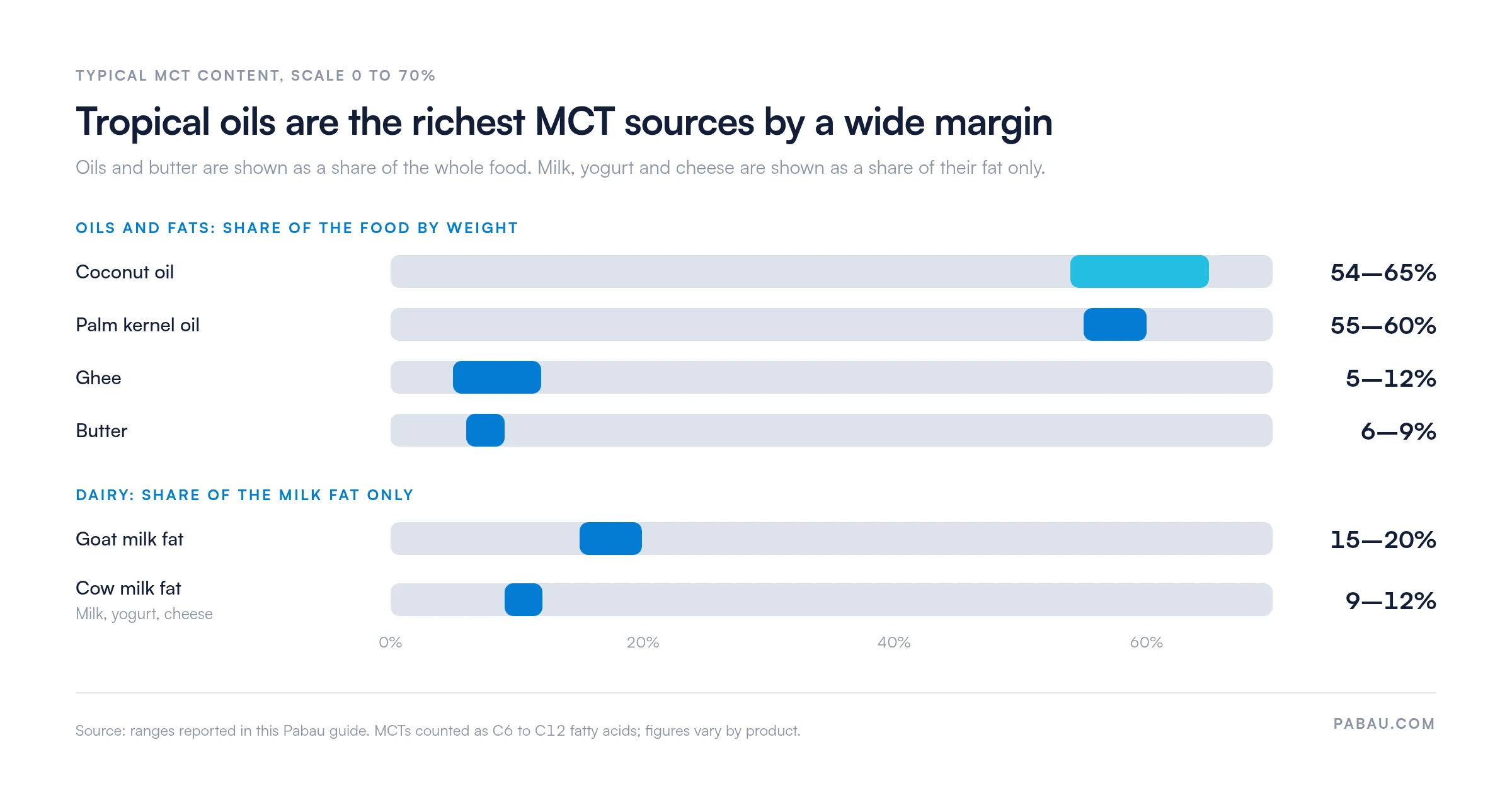
Dairy provides practical, familiar MCT sources for patients who tolerate lactose. In the table below, the milk, yogurt and cheese figures are shares of the milk fat, not of the whole food.
For comparison, cow’s milk fat is roughly 9-12% MCTs, and goat milk fat runs higher, at about 15-20%. Overall, these foods fit easily into everyday meals and carry protein and calcium alongside the fat.
Patients on a ketogenic diet gain the most from MCT foods. C8 and C10 convert to ketones quickly, which can speed the move into ketosis. When you build an MCT food list for keto patients, prioritize coconut oil, ghee and grass-fed butter as primary fats. Then layer in full-fat dairy and goat products for meal variety and nutrient density.
However, the list covers the fat side of the plan only. Pair it with a ketogenic diet plan so the fats sit inside a full day of meals. A low carb food list covers the carbohydrate side.
For example, a practical keto-adapted list starts with coconut oil for cooking and smoothies, building up to 2-3 tablespoons per day. Grass-fed butter and ghee serve as cooking fats and meal toppers. Full-fat Greek yogurt, cheese and heavy cream add protein and satiety, while goat milk or goat cheese adds variety.
In fact, variety is what keeps patients on the plan past the first few weeks. The 7-day keto meal plan shows these fats spread across a full week of recipes.
For most new patients, MCT foods are the better starting point, with MCT oil as a later add-on. MCT foods (coconut oil, butter, ghee, dairy) deliver MCTs alongside other fatty acids, and dairy adds protein and micronutrients.
In addition, they often improve satiety and meal satisfaction too. MCT oil supplements are isolated C8/C10 fractions that raise ketones quickly. They lack the whole-food context and can cause digestive distress if introduced too quickly.
In practice, start new patients on whole-food MCT sources (coconut oil, butter, dairy) so they build familiar eating patterns and tolerance. Reserve isolated MCT oil for established keto patients seeking to deepen ketosis, or for pre-workout energy. Many practices therefore blend both, with whole foods as the dietary foundation and MCT oil as an occasional boost.
The template is a blank checklist, so the clinical content comes from you. Start with the header: the patient’s name, date of birth and record or MRN number, plus who prepared the list and the dates. Then write one MCT food per row, using the sources above to pick foods that suit the patient’s diet and tolerances.
However, the form uses a generic checklist layout, so a few prefilled parts need adapting. Cross out or overwrite the Essentials, Documents and paperwork, and Useful but optional headings, along with their placeholder rows.
Next, skip the packing-style instruction to tick items as you gather them, and use the Anything else rows as your food list. The who-is-bringing-it field doesn’t apply to diet planning, so leave it blank or note who prepares the patient’s meals.
After that, use the quantity field for the amount you recommend, such as 1 tablespoon of coconut oil per day to start. Tick confirmed once the patient agrees to include that food. The notes page suits allergies, intolerances or a plan to raise intake every 3-5 days.
Finally, save a copy in the patient’s record and give them the printout to take home. At follow-up, review which listed foods they ate and which they avoided, then update the rows. That feedback shapes the next recommendation far better than generic advice.
MCT percentages vary by food processing, storage and source. USDA FoodData Central is the most authoritative source of nutrient composition data for individual foods. However, it doesn’t report an MCT total.
Therefore, add up the C6-C12 fatty acids it lists (6:0, 8:0, 10:0 and 12:0) before citing a figure to patients. For research on how MCTs are metabolized, PubMed indexes the peer-reviewed literature.
When a patient asks which dairy food has the most MCTs, USDA-based figures give you a precise answer to share. Still, remember that dairy figures quoted as a share of the fat look much larger than the amount in a serving.
Three clinical tips help patients stick with an MCT food list.
On paper, an MCT food list lives in a folder or the patient’s bag, and follow-up depends on someone finding it. Also, every change at a review means a new printout and another scan.
In Pabau, you rebuild the checklist once as a digital form. Each completed copy is saved to the patient’s file in Client records, beside their treatment notes and history. Practices running nutrition programs can use Pabau as weight loss clinic software, so food lists sit alongside appointments and progress notes.
With Care Pathways, patients are guided to complete their forms before the next appointment. As a result, their answers flow into the record automatically, so you start the follow-up with their latest list.

Pabau’s digital forms and Client records keep each patient’s MCT food list next to their clinical notes. Care Pathways prompts patients to update it before follow-up visits.

MCT foods work best when patients add them gradually to meals they already eat. Start with butter, ghee and full-fat dairy, add coconut oil slowly, and keep isolated MCT oil for patients already established on keto.
The free template is a blank checklist, so its value depends on what you write in it. Record specific foods and amounts, confirm each one with the patient, and revisit the rows at every follow-up. Book a demo to see how Pabau keeps nutrition forms and patient records together in one place.

Looking for a structured nutrition intake form? Metabolic health practice management integrates dietary assessment directly into patient workflows.
Need net carb counts alongside fat sources? List of keto friendly foods pairs keto staples with their net carbs in a printable PDF.
Want a week of meals built around ketosis? Meal plan for ketosis gives you a free 7-day template to adapt for each patient.
Helping patients shop for a keto plan? Keto grocery list template turns the plan into a printable shopping list.
It gives you a blank, printable checklist to record the MCT foods you recommend for one patient. The header takes the patient’s name, date of birth, MRN, the preparer and the dates. Each row has an item, a quantity, a who-is-bringing-it field and a confirmed tick, and page two is a notes area. The form also carries generic prefilled section headings, which you can overwrite. It has no preset foods, percentages or portion guidance, so you write those in from this guide.
Coconut oil is the easiest recommendation for most practices. It ties with palm kernel oil as the richest natural MCT source. Coconut oil is more widely available, more familiar to patients and carries fewer sustainability concerns. Both oils contain the full range of MCT chain lengths, from C6 to C12.
Yes. The template is blank, so you list only the sources each patient can eat. For a dairy allergy, the list can draw on coconut oil, palm kernel oil and MCT oil supplements. Ghee holds only traces of milk protein, but confirm the allergy type before you include it.
Always start with whole-food MCT sources (coconut oil, butter, dairy) so patients build sustainable eating habits. Reserve isolated MCT oil for established patients seeking to deepen ketosis or for pre-workout energy boosts. This sequencing improves long-term adherence because patients feel in control of familiar foods rather than dependent on supplements.