Emergency card template (free printable PDF)
An emergency card is a wallet-sized document that gives first responders and cli...

1
Last Updated: Oct 21, 2026
A massage therapy business plan is a written document that sets out how your practice will be structured, priced, staffed, marketed, and funded. Writing one makes you settle the decisions that shape the rest of the plan, from your business model to your rates. Whether you are starting out or formalizing a practice you already run, a clear plan lets you test your ideas before they cost you money.
The free template below gives you six headings to fill in: executive summary, business description, market analysis, marketing strategy, sales and operations, and financial plan. This guide covers the licensing, pricing, and startup-cost decisions that go under them, which the one-page form leaves to you.
A one-page form with six headings to fill in: executive summary, business description, market analysis, marketing strategy, sales and operations, and financial plan. It closes with a space for your conclusion.
Download template
Your business model shapes every other section of your plan.
Licensing rules vary by state, so check with your state board first.
Startup costs are easiest to estimate once your services and pricing are set.
Build revenue projections from booked hours, not the hours you hope to fill.
Write the executive summary last, once the other five headings are complete.
A massage therapy business plan is a working document that you revisit each time your prices, hours, or team change. Lenders and investors often ask for one, and writing it exposes weak spots in your numbers. The US Small Business Administration guide to writing a business plan is a useful starting point for structure.
The template follows the headings most business plans use:
The form is blank under each heading. The sections below cover what to write there, including your business structure, licensing, services, and pricing.
Fill in the template in the order below, and write the executive summary last. By then your numbers and decisions are settled, so the summary describes the practice accurately.
Keep your figures in one place so every section draws on the same numbers. The breakdown below shows what goes under each heading, including the closing conclusion line.
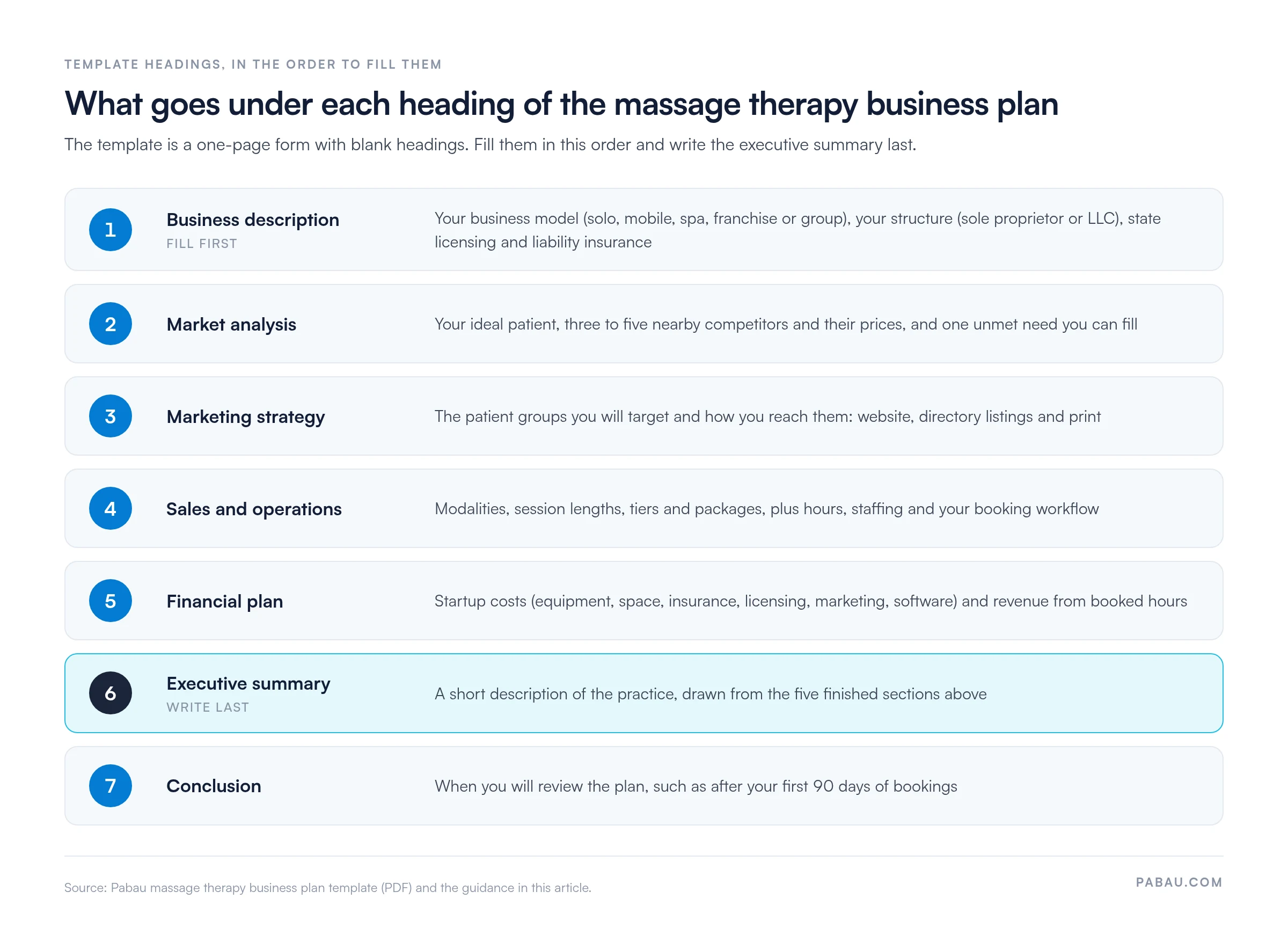
Your business model determines how you earn, how you schedule, and how much overhead you carry. Name one model in your plan before you draft the financial section, because every other figure depends on it.
If a spa offers you a room, the terms usually come as a flat rent or a share of each session. Our comparison of booth rental vs commission shows where each one leaves you better off.
Your business structure affects your liability and how you file taxes, so decide it before you register. Many solo therapists start as sole proprietors because that is the simplest setup. An LLC creates a separate legal entity, and the IRS small business guidance explains how business entities are classified for tax purposes.
Each state sets its own massage therapy licensing rules, so confirm the requirements where you plan to practice. Many states use the Massage and Bodywork Licensing Examination (MBLEx), which the Federation of State Massage Therapy Boards administers.
Professional liability insurance is strongly recommended, and many facilities require proof of it before you work on site. If you keep a massage intake form and treatment notes electronically, check whether HIPAA, the US health privacy law, applies to your practice. Do that before you make compliance claims in your plan.
Your market analysis should name who lives and works near your practice and which competitors already serve them. Describe your ideal patient in specific terms, such as office workers with desk-related tension or athletes training for weekend events.
List the modalities you offer, such as Swedish, deep tissue, prenatal, sports, and lymphatic work, and explain which ones you will lead with. Tiered pricing, session-length options, and package bundles each change your revenue, so model them before you publish a rate card.
Your operations section explains your hours, staffing, and how patients move from booking to follow-up. Describe the workflow the way you would explain it to a new hire, step by step.
In Pabau, the practice management platform we build, online booking lets patients reserve sessions directly. Digital intake forms let them complete their health history before they arrive.
Write down how you will keep session notes, too. A consistent format such as massage therapy SOAP notes makes progress easier to track between visits. AI note-taking tools can help structure those notes, though you remain responsible for the record.
Build your revenue projection from booked hours, not hoped-for hours. Start with the sessions you can realistically fill each week, multiply by your average session price, and subtract travel, rent, insurance, and software costs. Then compare the result with your personal income target. Revisit these figures after your first 90 days of bookings, and update the plan with the numbers you recorded.
Financial projections turn your services and pricing into a 12-month picture of income and costs. Start with startup costs, then layer on ongoing expenses.
We have not listed industry cost ranges here because they vary widely by location, model, and specialty. Use local quotes and your own figures instead.
Your operations section has to hold up on a busy Saturday with a full book. Many new practices start on a patchwork instead: bookings by text message, paper intake forms, and notes in a notebook.
Pabau’s spa software puts online booking, digital intake forms, and patient records in one system. Patients book and complete their health history before they arrive, and your session notes sit against the same record.
Every subscription includes every feature, so the software line in your financial table is one figure. The workflow you described in your plan becomes the one your practice runs each day.

See how Pabau runs booking, intake forms, and patient records once your business model is set.

A massage therapy business plan earns its keep in the months after you open. Your first 90 days of bookings will show which prices hold and which hours stay empty.
Settle your business model and licensing first, because those two decisions limit every number that follows. Then set a date to compare the plan with your booked hours, and change whatever the bookings contradict.
Book a demo to see how Pabau can run the booking and records side of your new massage practice.

Running skin treatments alongside massage? Esthetician business plan template applies the same planning structure to an esthetics business.
How will you record each session once you open? Massage log template gives you a session-by-session record of what was treated and how the patient responded.
Want a simple first offer for your marketing plan? Massage gift certificate template gives you a print-ready certificate with fields for the recipient, service, and value.
What will new patients fill in before their first session? Massage intake form covers health history, medications, and contraindications.
The template is a one-page form with six headings: executive summary, business description, market analysis, marketing strategy, sales and operations, and financial plan. This guide explains what to write under each one.
Not in every case, but a written plan is strongly recommended. Lenders and investors often ask for one, and writing it helps you test your pricing and costs before you commit money.
Yes, you can download the template free of charge using the link in this article.
No single model suits every therapist. Solo practice gives you control and lower overhead. Mobile massage suits patients who cannot travel, and spa employment suits therapists who want steady patient flow without running admin.
You apply through your state’s massage therapy licensing board, and requirements vary by state. Requirements typically include training and an exam such as the MBLEx, but the board sets the exact steps.