HIPAA compliant texting: What you can send patients & how to communicate securely
HIPAA compliant texting is possible when a text holds no protected health inform...

Last Updated: Oct 16, 2026
The booth rental vs commission decision turns on a single number. The crossover is the monthly service revenue at which a flat rent costs a practitioner less than a share of every ticket.
Booth rental charges each stylist or therapist a fixed fee for the space, and they keep the rest. A commission model makes them an employee and pays them a percentage of what they book.
Below that crossover, a commission split leaves the practitioner with more money, so a booth is a hard sell. Above it, booth rental pays them more. Every appointment past that point is worth more on rent than on a split.
The Booth-Rent Break-Even Point formula below finds that crossover from your own rent and your own split. Typical booth rents and the state rules that narrow your choice follow it.

Booth rental charges a flat fee for the space, while a commission model makes the practitioner an employee paid a percentage.
The Booth-Rent Break-Even Point is your monthly rent divided by the salon’s share of the split, written as a decimal.
Booth rent commonly runs $100 to $600 a week, depending on the market and what the station comes with.
Booth rental and independent contractor status are governed state by state, and misclassifying a renter is the owner’s liability.
A booth rental salon leases each chair, room or station to a self-employed practitioner for a flat fee, and they keep what they earn.
You provide the location, the utilities and usually the shared front-of-house space. The renter brings their own products, their own bookings and their own insurance. If you lease the premises yourself, renting out a private room can count as a sublease. A written subleasing agreement then sets out the rent, the deposit and your landlord’s consent.
The tax status is the part that carries the most weight. A booth renter is a 1099 independent contractor, not a W-2 employee. They file their own returns, pay their own self-employment tax, and set their own prices.
In a booth rental salon, your income is the rent roll rather than a share of service revenue. Here is how the arrangement usually works:
A commission-based model employs the practitioner and pays them an agreed percentage of every service they perform, with the salon covering the overhead.
Commission staff are W-2 employees, so you withhold their payroll taxes and cover the employer half of Social Security and Medicare. You also supply the products, the marketing and the bookings that keep their column full.
Commission hair salons usually land somewhere between 40% and 70% to the stylist. Experience, demand and how much of their own book they bring all move the number.
Payroll is the largest line item in any commission based salon. The mechanics break down like this:
Employees also expect benefits a booth renter has to fund alone. In practice that means health insurance, paid time off, retirement contributions and paid training days.
Booth rental gives you predictable income and far less to manage, at the cost of control over pricing, service standards and the client relationship.
The main disadvantages of booth renting are weaker control over service quality, no say over pricing, and renters competing for the same clients.
The trade is the mirror image. You take on the payroll and the overhead, and in return you keep control of the brand, the pricing and the client relationship.
Booth rent commonly runs between $100 and $600 a week in the US, with the median nearer $200 to $250 a week.
That is a wide band because rent follows the local property market first. The same chair can cost three times more in a major metro than in a small town.
Booth rental salon prices also move with what the station comes with. A private treatment room with its own sink prices differently from a chair on an open floor.
How many stations you can rent at all comes down to the floor. Mapping it out on a beauty salon floor plan shows you the rent roll a room can carry before you advertise a chair.
| Market | Typical weekly rent | Roughly per month | What usually comes with it |
|---|---|---|---|
| Small town or rural | $100 – $200 | $430 – $870 | Station, chair, utilities and the shared waiting area |
| Suburb or mid-size city | $150 – $350 | $650 – $1,500 | The above, plus premises insurance and building security |
| Major metro | $300 – $600+ | $1,300 – $2,600+ | The above, plus reception cover and a booking system |
Whatever the headline rent, it is not the renter’s whole cost. They buy their own color, back bar and tools, and they absorb the card processing fee on every payment they take.
They also owe self-employment tax on their net earnings. The IRS sets that at 15.3%, made up of 12.4% for Social Security and 2.9% for Medicare.
An employee on commission has 7.65% withheld instead, because you pay the other half. Say so when a stylist asks why the booth next door looks like a raise.
Booth rental starts paying more than commission once monthly service revenue passes the rent divided by the salon’s share of the split.
That is the Booth-Rent Break-Even Point, and it takes one line of arithmetic:
Break-even monthly revenue = monthly booth rent ÷ the salon’s share of the split, as a decimal
Booth rent replaces the cut you would otherwise have taken. The two models meet at the revenue level where that cut would have equaled the rent.
Take a $1,200 monthly booth rent and a 60/40 split, where the stylist keeps 60% and the salon keeps 40%. Divide $1,200 by 0.40 and the break-even lands at $3,000 a month in services.
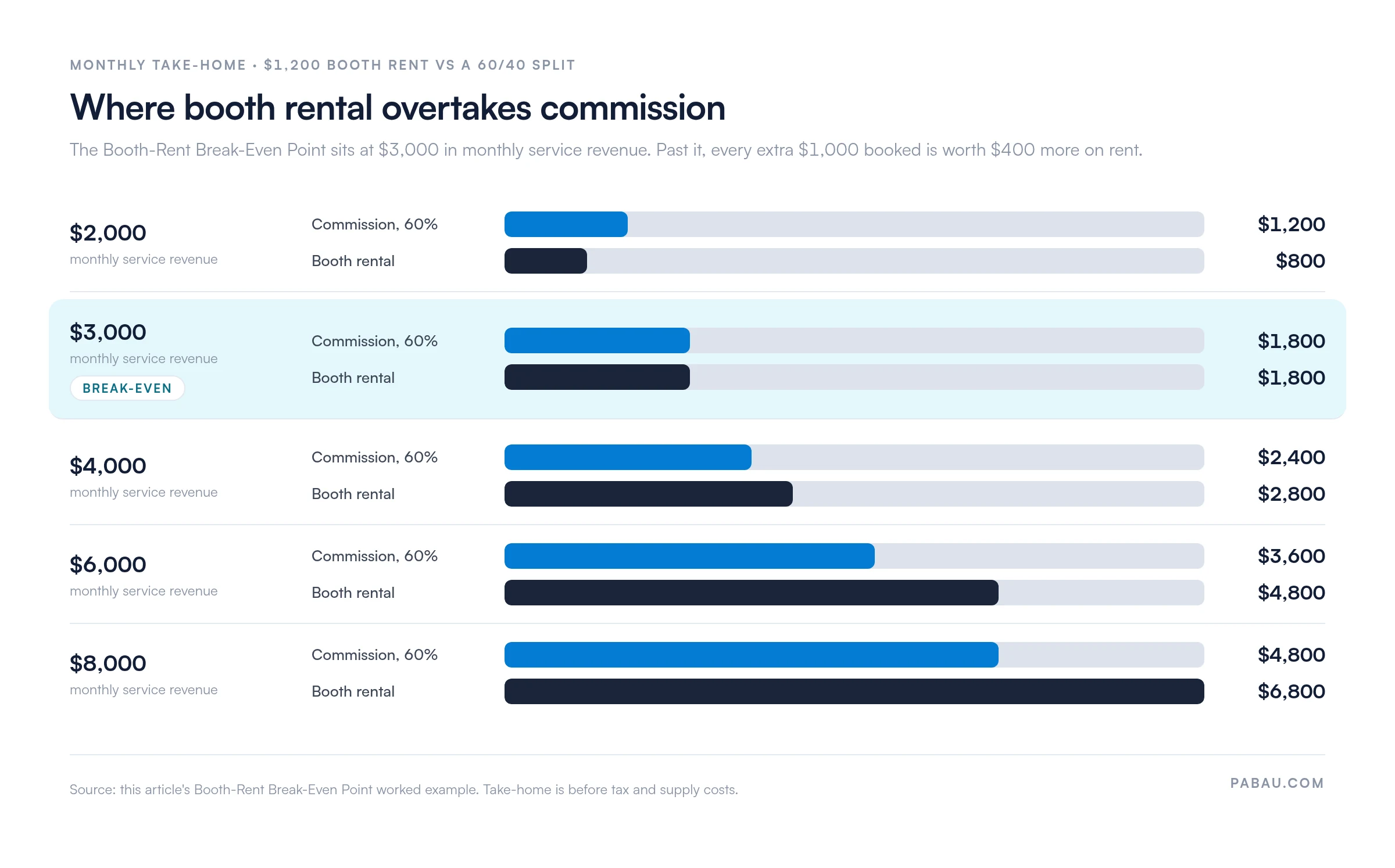
| Monthly service revenue | Take-home on a 60% commission | Take-home on a $1,200 booth rent | Who comes out ahead |
|---|---|---|---|
| $2,000 | $1,200 | $800 | Commission, by $400 |
| $3,000 | $1,800 | $1,800 | Break-even |
| $4,000 | $2,400 | $2,800 | Booth rental, by $400 |
| $6,000 | $3,600 | $4,800 | Booth rental, by $1,200 |
| $8,000 | $4,800 | $6,800 | Booth rental, by $2,000 |
Those figures come before tax and supplies, so treat the crossover as a floor rather than a verdict. Add the extra self-employment tax, the back bar, the card fees and the vacation nobody pays for, and the practical crossover sits higher.
Run the formula with your own rent and your own split and you get a number you can use in two directions. It tells a stylist which offer is worth more, and it tells you what a chair can carry.
Price a booth above what the break-even supports and your strongest earner will do the math and leave. Price it well below, and you are subsidizing a chair that could be paying you.
Compensation is the piece we most often find undocumented when we onboard a salon or spa. The split lives in the owner’s head, drifts person by person, and ends up different for two stylists hired the same year.
Booth rental is legal in most of the US, but the rules sit with each state’s cosmetology board rather than with federal law.
States license salons and practitioners differently. Some require the booth renter to hold their own establishment or shop license on top of their practitioner license. That changes what you have to provide and what you can charge for.
Read your state board’s rules before you sign a booth agreement, not after. A renewal inspection is an expensive place to discover that a chair was never licensed the way your state expects.
There is no national count, because no federal law covers booth rental and states do not license it as one thing.
Most states permit it in some form. What varies is the paperwork: who holds the establishment license, whether the booth is registered separately, and what the salon owner stays responsible for.
Your state cosmetology board publishes the rules that apply to a chair inside someone else’s salon. That page is the only answer that will hold up in an inspection.
Calling someone a booth renter does not make them one. The IRS applies a common-law test that looks at behavioral control, financial control and the type of relationship between you.
If you set their hours, set their prices, supply their products and take their bookings, an auditor will see an employee wearing a renter’s label. Back payroll taxes, penalties and unpaid overtime then land on the salon.
Three habits keep the line clean. Put the agreement in writing, collect current copies of their license and liability insurance, and stay out of their pricing and schedule.
The break-even number tells you what the money does. These five factors decide whether the model fits the business you want to run.
Start with the business you are trying to build. If you want a hands-off operation where practitioners run their own schedules and clients, booth rental gives you steady income with less involvement.
If you want a team culture and a service standard you control, commission is the model that lets you build one.
Booth rental gives you predictable income and very little downside risk. Commission asks you to carry payroll, supplies and marketing through the quiet months before the busy ones pay you back.
If you go the commission route, track product usage from day one. Back bar costs are the line that quietly erodes a healthy-looking service margin.
Commission gives you the final say on pricing, services and the experience a guest gets from the door to the rebooking. You decide what the brand stands for and how you market it.
Booth renters set their own prices and services. If a consistent guest experience is what you are selling, commission is the safer route.
Think about who walks through your door. Clients who follow a specific practitioner are well served by booth rental, because they are buying that person rather than the salon.
Clients who book the salon and take whoever is free want a consistent standard. Commission is what delivers that.
Consider what the people you want to hire are looking for. Practitioners with a full book and a strong following usually want the independence a booth gives them.
Newer practitioners generally want a guaranteed income, training and a calendar someone else fills. Run the break-even number for both groups and you will see why the same offer rarely suits them equally.
Whichever model you land on, the admin follows it. Booth rental means tracking rent, licenses and insurance certificates for people who never appear on your payroll.
Commission means calculating a percentage of every service and every retail sale, per person, every pay run. Do that in a spreadsheet and it will eventually disagree with a stylist’s own tally of what they sold.
Practice management software like Pabau keeps both jobs in the same system as your bookings. The numbers then come from what was delivered, not from a total someone rekeyed. Pabau is software built for spas and salons, not a generic scheduler.
Every Pabau subscription includes every feature, so none of this sits behind a higher tier. Onboarding is structured and hands-on, which matters when you are moving a compensation model that has lived in a spreadsheet for years.

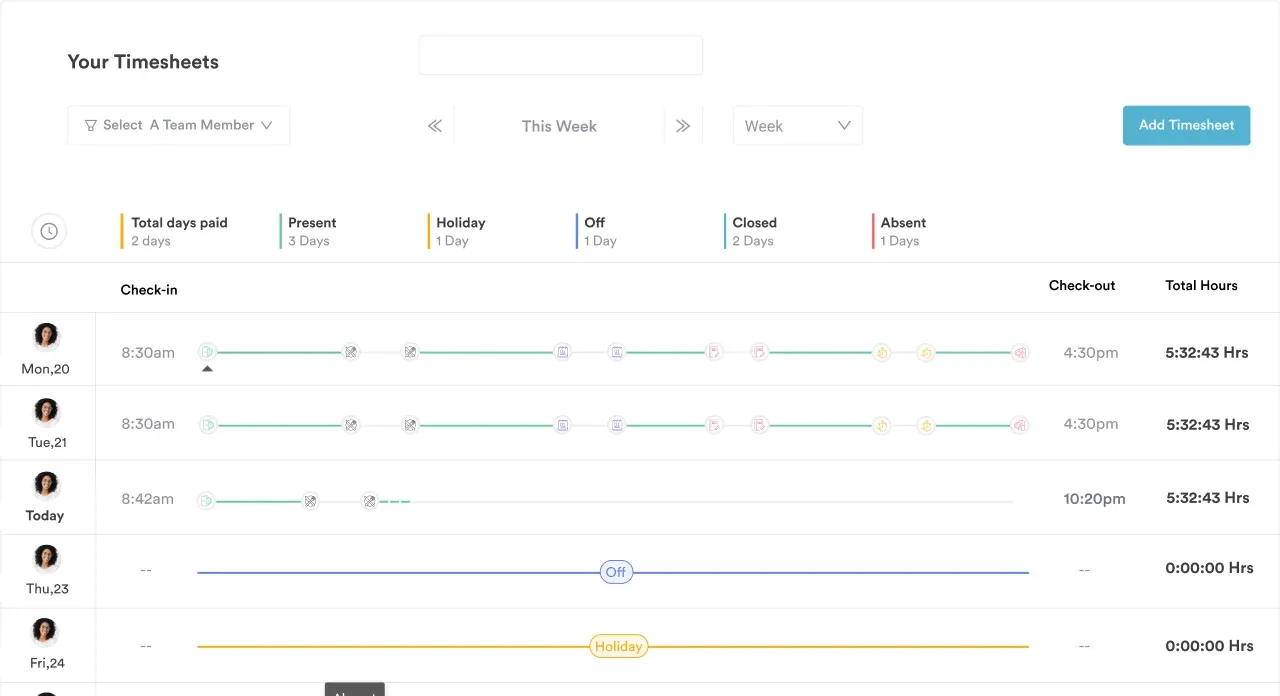
Pabau calculates commission on services, products and retail, tracks hours through timesheets, and stores every renter’s license and insurance certificate against their staff record. Your pay run and your compliance file come from the same bookings.

Run the number before you argue about the model. Your rent divided by your share of the split tells you which one your team is better off under.
The trade-off worth remembering is control. Booth rental buys you a predictable rent roll and hands away pricing, standards and the client relationship. Commission keeps all three and hands you the payroll risk.
Plenty of salons run both, with employees on the floor and one or two senior renters in private rooms. That works as long as the two groups sit on different terms, in writing.
Book a demo to see how Pabau handles commission, schedules and timesheets for a salon running either model, or both at once.

Still deciding what the business will look like? Esthetician business plan gives you a structure for the revenue, staffing and cost assumptions behind either model.
Comparing systems to run the salon on? Best software for spas walks through what each platform does for scheduling, payments and staff management.
Want renters and employees booking through one calendar? Beauty salon booking software in the US covers the options and what each one costs to run.
Chasing payouts and card settlements every month? Payment reconciliation integrations for spas shows how to match takings to the bookings that produced them.
It depends on monthly service revenue. Work out the Booth-Rent Break-Even Point by dividing the monthly rent by the salon’s share of the split. Below that revenue level, commission pays the practitioner more. Above it, booth rental does, and the further past it they book, the further ahead rent puts them.
For the salon owner, booth renting means less control over pricing, service standards and the client relationship. Renters can also compete with each other for the same walk-ins. For the renter, rent is due whether the chair is busy or empty, and they fund their own supplies, insurance and time off.
Rent paid to operate a business is generally a deductible business expense for whoever pays it. That is the booth renter, who is self-employed and reports the cost on Schedule C, rather than the salon owner receiving it. Confirm the specifics with a tax professional or IRS Publication 334.
There is no federal rule, so booth rental is governed by each state’s cosmetology licensing law. Most states permit it in some form, and some require the renter to hold their own establishment license. Check your state board’s rules before signing a booth agreement.
Hair stylist commission is commonly quoted between 40% and 70% of service revenue. Experience, demand and how much of their own book the stylist brings all move the number. Splits of 50/50 and 60/40 in the stylist’s favor come up most often.
Yes. Many salons employ a commission team on the main floor and rent private rooms or suites to senior practitioners. Keep the two sets of terms separate in writing, because a renter you schedule and price like an employee can be reclassified as one.