Mental health self-care checklist
A mental health self-care checklist is a structured daily tool for tracking the ...

5
Last Updated: Oct 20, 2026

The Marlowe-Crowne social desirability scale measures how strongly a respondent wants to be seen favorably.
The original questionnaire runs to 33 true/false items and scores 0 to 33, with higher totals flagging response bias.
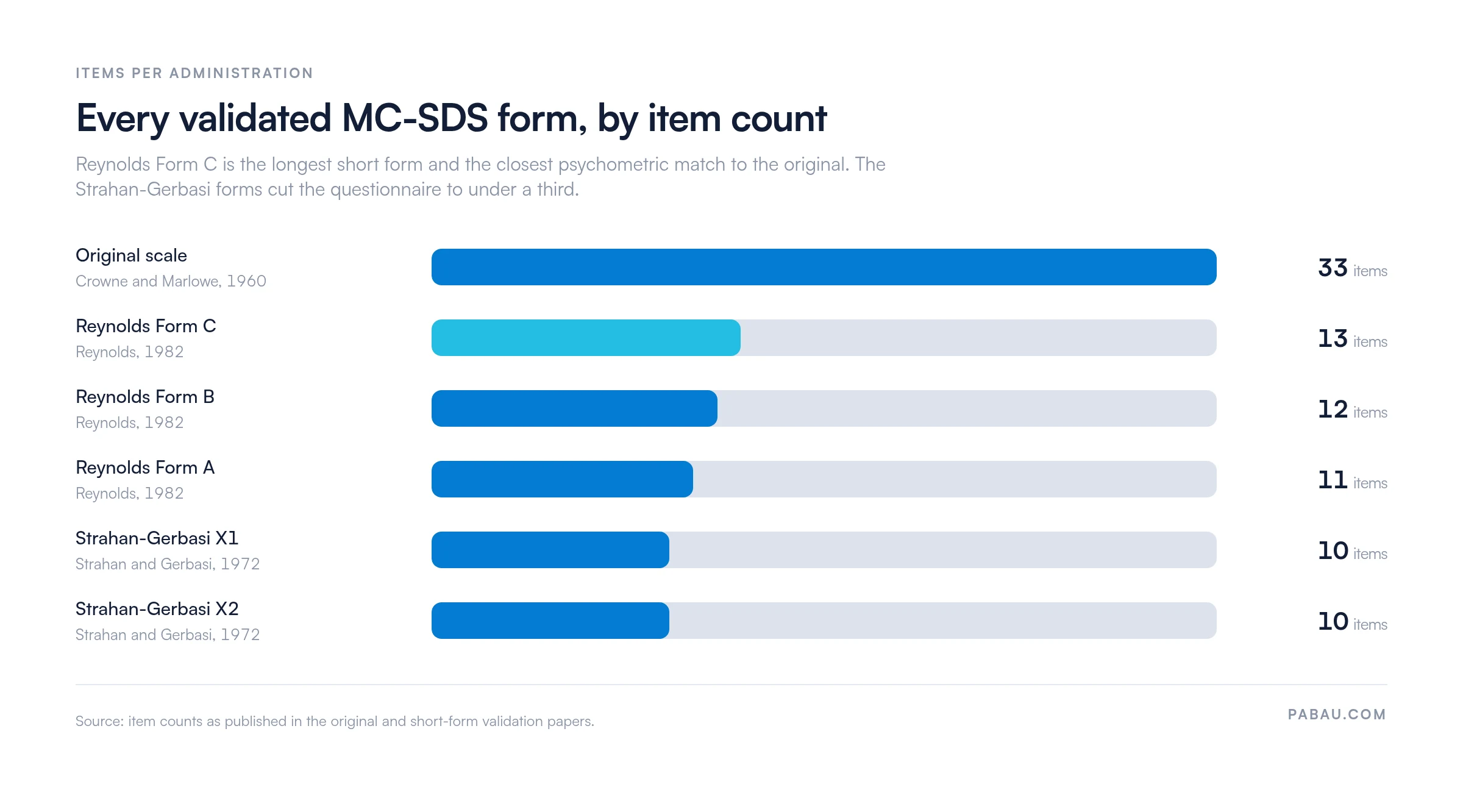
Reynolds Forms A, B and C carry 11, 12 and 13 items; the two Strahan-Gerbasi forms carry 10 each.
Crowne and Marlowe reported internal consistency of KR-20 0.80 to 0.88 and test-retest reliability near 0.88.
Practice management software like Pabau can hold the scale as a digital intake form and score it on submission.
The complete 33-item true/false questionnaire with its keyed scoring answer key. It also carries the validated short forms, the score band interpretations, and administration guidance for mental health professionals.
Download templateThe Marlowe-Crowne social desirability scale is a 33-item true/false questionnaire that measures how much a respondent wants to look good. Scores run from 0 to 33. A high total tells you to read the rest of the assessment battery with caution.
This guide gives you the scoring key, the score bands, and the validated short forms. It also shows how to run the scale inside your intake workflow instead of scoring it by hand between appointments.
The MC-SDS is a 33-item self-report questionnaire developed in 1960 by Douglas P. Crowne and David Marlowe. It measures a person’s tendency to answer in socially approved ways. The true/false format picks up two behaviors at once.
Crowne and Marlowe built the scale to control for response bias in personality and attitude research. It has since become a standard validity measure across clinical psychology, psychiatry, healthcare research, and organizational assessment.
Social desirability bias shows up when a patient answers based on what they think the clinician wants to hear. In a mental health evaluation that usually means minimizing depression, anxiety, or substance use. It can also mean overstating coping ability.
Skewed self-report data leads to a misdiagnosis, the wrong treatment recommendation, or an intervention that never had a chance. The MC-SDS puts a number on the bias. High scorers present themselves favorably, and low scorers answer more candidly.
Running the scale alongside your other measures lets practitioners in psychology practices adjust how they read the results. Treatment planning then reflects clinical need rather than impression management.
The full scale runs to 33 true/false items, each scored against a keyed direction. The wording of the items is deliberate. Some describe socially desirable but statistically uncommon behavior, such as never gossiping about other people.
Others describe undesirable but common behavior, such as feeling resentful when you do not get your way. A respondent high in approval motivation endorses the first type and denies the second. That pattern is the signal the scale is built to catch.
The downloadable PDF above carries all 33 items in a format ready for the clinic floor. Each item takes the standard true/false response, so it works on paper or on a tablet.

Scoring means identifying which items are keyed True and which are keyed False, then counting the responses that match. Totals run from 0 to 33. A higher total means a stronger pull toward socially desirable responding.
Treat the score as a validity indicator, not a diagnosis. When it comes back elevated, look harder at the mood, symptom, and personality measures the patient completed in the same sitting. Behavioral observation, a collateral informant, or a structured clinical interview usually shows what sits behind the favorable answers.
Several validated short forms exist for settings where assessment time is tight. They hold their internal consistency while cutting the administration burden, and they differ from each other mainly in length.
The psychometrics have held up across clinical and non-clinical populations for six decades. Crowne and Marlowe’s original 1960 validation study reported internal consistency of KR-20 0.80 to 0.88. One-month test-retest reliability came in around 0.88 to 0.89.
That stability matters in practice. It means an elevated score reflects a standing disposition toward approval seeking rather than the patient’s mood on the day you handed them the form.
Construct validity rests on correlations with related measures such as anxiety and defensiveness, plus divergent validity against unrelated constructs. The scale has been translated into more than 20 languages. It remains the reference measure for social desirability bias in psychology and healthcare research.
Administration is simple. Hand the respondent the 33 items and ask for a True or False on each statement. Reading level sits around seventh to eighth grade, so it works with most adult populations.
The workflow only holds if the score lands somewhere your team will actually see it. On paper that means a scored sheet in a folder. In joined-up therapy practice software the score sits on the patient record, next to the intake form it came from.

The MC-SDS is the most cited social desirability measure in psychological research. Six decades of continuous use means extensive normative data is available for comparison. Clinicians can cite the APA PsycNet record and DOI in scholarly work.
Its scoring is transparent and its interpretation carries across diagnostic contexts. That is why it survives in batteries where the instruments around it have been swapped out twice over. Anyone who already scores banded instruments will recognize the pattern from the Vanderbilt ADHD rating scale.
ScienceDirect’s topic overview synthesizes decades of reliability and application research on the scale. Treatment outcome research leans on it hardest, because participant self-report is often the only data source available there.
Most practices still run the scale on paper. Someone prints the 33 items, the patient fills them in at reception, and a clinician hand-counts the keyed responses between appointments. The score then gets typed into a note, or it gets lost.
Pabau, an all-in-one practice management system, holds the questionnaire as one of your digital intake forms. The patient completes it on the portal before the visit, or on a tablet at check-in. Scoring logic runs on submission, so the total and its score band land on the patient record automatically.

The clinician sees the approval motivation flag during the session rather than a week later. That changes the next question they ask, and it means the rest of the battery gets read in the right light. Every Pabau subscription includes the forms builder, so there is no tier to upgrade to first.

Pabau holds validated scales like the Marlowe-Crowne as digital intake forms, scores them on submission, and files the result on the patient record. Your clinicians see the validity flag before the session starts.

Social desirability bias does not announce itself. The MC-SDS is the cheapest way to find out whether the rest of your battery measured the patient or the impression they wanted to leave.
Pick the form that fits the time you have. Reynolds Form C costs 13 items to add to an intake pack and still tracks the full scale closely. Score it, band it, and let the number change how you read the measures beside it.
The trade-off worth remembering is that a high score is a flag, not a finding. It tells you to look again; it does not tell you what you will see. Book a demo to see how Pabau scores intake questionnaires and files the result on the patient record.

Want your documentation to hold the score? SOAP notes for social work shows how validity measures fit into progress documentation.
Building an intake pack from scratch? Mental health intake form covers the history and risk questions the MC-SDS is meant to sit alongside.
Measuring something other than approval motivation? Motivation assessment scale is a second validated instrument you can run from the same intake workflow.
The MC-SDS measures how strongly a respondent wants to be seen favorably, which helps clinicians detect response bias during assessment. An elevated score means the person is presenting themselves more favorably than the clinical picture supports.
Count the responses that match the keyed direction, True or False, across all 33 items. Totals run from 0 to 33, and a higher total reflects stronger approval motivation.
Reynolds Form A has 11 items, Form B has 12, and Form C has 13. The Strahan-Gerbasi X1 and X2 forms carry 10 items each. All of them cut administration time while holding acceptable reliability.
The scale has been in the public domain since its 1960 publication, so clinical and research use costs nothing. The downloadable template on this page carries the full item set and the scoring key.
Crowne and Marlowe reported internal consistency of KR-20 0.80 to 0.88 and one-month test-retest reliability of roughly 0.88 to 0.89. The scale has held those properties across clinical and non-clinical populations.