Journal prompts for mental health
Journal prompts for mental health are guided questions that help people process ...

2
Last Updated: Oct 13, 2026

A dysfunctional thought record is a CBT worksheet that helps clients identify automatic negative thoughts, examine evidence for and against them, and develop more balanced alternative perspectives.
The standard 7-column format captures situation, mood, automatic thoughts, evidence for, evidence against, balanced alternative, and re-rated mood — the most clinically complete version.
Simpler 3-column and 5-column variants exist for clients new to CBT — select the format based on therapy stage and cognitive capacity.
Pabau enables therapists to store completed dysfunctional thought records within client clinical records, track patterns over time, and integrate worksheets into treatment plans.
A ready-to-use CBT worksheet covering situation context, mood ratings, automatic thought identification, evidence examination, and balanced alternative thought development — designed for in-session and homework use.
Download templateGood clinical documentation software starts with the right worksheets. The dysfunctional thought record (DTR) is one of the most powerful tools in cognitive behavioral therapy (CBT). It helps clients slow down their thinking, identify automatic negative thoughts, and challenge distorted patterns that drive emotional distress.
A dysfunctional thought record is a structured worksheet that captures the relationship between situations, thoughts, emotions, and behaviors. It operationalizes the core CBT principle: our thoughts influence our feelings and actions, not the situations themselves.
Clients use the DTR to record a troubling situation, identify the automatic thoughts that arose, and rate the intensity of the resulting emotions.
They then examine evidence for and against their hot thought, the most distressing one, and write a more balanced, realistic alternative thought. The worksheet finishes by asking them to re-rate their mood.
The dysfunctional thought record was originally developed by Aaron Beck, with colleagues Rush, Shaw, and Emery, in Cognitive Therapy of Depression (1979). The 7-column version’s separate evidence-for and evidence-against columns were added later by Christine Padesky and Dennis Greenberger, who published it in Mind Over Mood (1995). A mental health EMR keeps progress notes, risk assessments and appointments against one client record.
Today, the worksheet remains one of the most widely used tools in CBT practice across anxiety, depression, OCD, and trauma presentations.
The standard DTR contains seven columns, each serving a distinct therapeutic function. Understanding each field helps therapists explain the worksheet clearly and clients complete it accurately.
The power of the DTR lies in the evidence examination step. By gathering facts for AND against the hot thought, clients learn that automatic thoughts are hypotheses, not facts. This reframing reduces emotional intensity and opens space for more adaptive thinking.
Not every client needs the full 7-column format on their first homework assignment. CBT therapists choose format variants based on treatment stage and cognitive capacity.
Start simple and progress to more complex formats as the client builds skill. Many therapists assign a 3-column DTR for homework one week, then move to the 7-column version once the client reports success and shows readiness.
Clients who find even the 3-column format overwhelming at first can start with the shorter ABCDE worksheet instead, then progress once they’re comfortable naming thoughts.
Clients doing parallel DBT work.
Psychologists often assign tools like this through psychology practice software, tracking completion between sessions.
Completing a dysfunctional thought record is a five-step process. Assign this workflow to clients as in-session practice or homework.
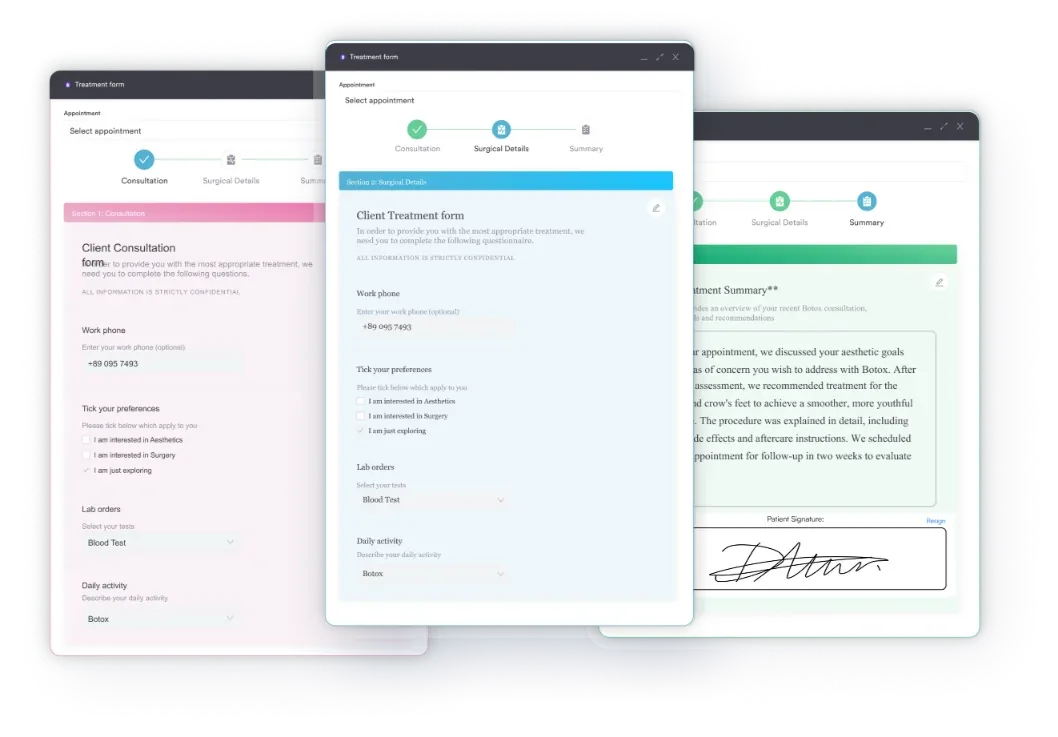
Use digital intake forms during sessions so you can assign the worksheet in real time and review responses at the next appointment.
The DTR is specifically designed to surface and challenge cognitive distortions — systematic errors in thinking that fuel emotional distress. Common patterns it helps clients identify include:
By working through the DTR, clients begin to notice these patterns in their own thinking and interrupt them before they amplify emotional distress.
Clients who want to dig deeper into naming these patterns can work through a dedicated cognitive distortions worksheet alongside the DTR.
Here’s a fully worked example for a common clinical scenario: social anxiety after a brief awkward interaction at work.
Notice the shift: by examining evidence and developing a balanced perspective, the client’s emotional intensity drops significantly without denying the awkwardness.
The DTR is versatile across presentations. In anxiety, it helps clients identify catastrophic predictions and test them against evidence.
In depression, it surfaces hopelessness thoughts and counters them with evidence of resilience.
In OCD, it addresses intrusive thoughts and reduces compulsive behaviors driven by misinterpretation.
Some therapists run a muscle relaxation script before reaching for the record, since high arousal makes the evidence columns harder to work through.
Assign the worksheet as homework after identifying thought patterns in session.
Many therapists photograph or scan completed worksheets and attach them to session notes, so patterns become visible across multiple weeks of treatment.
When assigning DTR homework, follow four steps:
Consistency and positive reinforcement build compliance and deepen the skill.
The DTR is widely available as a free resource, and many clients explore it independently via NHS Every Mind Matters, Psychology Tools, or therapy blogs. Self-directed use can help with mild-to-moderate anxiety or low mood.
However, self-directed CBT worksheets aren’t a substitute for professional support in acute crisis, severe mental illness, or complex trauma. When clients say they’ve tried DTRs on their own without improvement, explore:
Always include safeguarding language on any DTR you share: “This worksheet is educational and may help with stress or worry. If you are having thoughts of harming yourself or others, please contact your local emergency services or your mental health provider immediately.”
Link clients to mental health platforms where they can message their therapist if questions arise during homework completion.
Pabau’s automated therapy workflows let therapists distribute DTR templates, track completion, and review responses asynchronously. You can attach blank DTR PDFs to homework assignments in the client portal, collect completed forms, and file them in the client’s record alongside session notes.
Over time, this builds a longitudinal record of each client’s thought patterns. Many therapists also cut paperwork by scanning and storing digital copies instead of managing paper sheets.
The dysfunctional thought record remains one of the most evidence-based, practical tools in CBT. By systematically walking clients through the process of identifying, examining, and challenging automatic thoughts, the worksheet teaches the core cognitive restructuring skill that creates lasting emotional change.
Whether you use the 3-column, 5-column, or 7-column format depends on your client’s readiness. Start simple, build confidence, and progress to the full 7-column format as clients gain skill. To see how Pabau can help you store, track, and integrate DTR assignments into your practice workflow, book a demo today.

Want to dig into one specific distortion pattern? The emotional reasoning worksheet zooms in on the belief that feelings are facts, a distortion the DTR’s evidence columns are built to challenge.
The dysfunctional thought record helps clients identify automatic negative thoughts, examine evidence for and against them, and develop more realistic, balanced perspectives. It reduces emotional intensity by changing how clients interpret situations.
Not exactly. A thought diary is a simple log of thoughts and emotions. A dysfunctional thought record includes the structured cognitive restructuring process: identifying hot thoughts, examining evidence, and writing balanced alternatives. It’s more therapeutic and goal-directed.
The hot thought is the automatic thought that triggered the most intense emotion in a situation. It’s usually the one causing the most distress and is the target for cognitive restructuring in the dysfunctional thought record.
Yes. The dysfunctional thought record is particularly effective for anxiety because it helps clients identify catastrophic predictions (e.g., “This will end badly”), examine evidence that contradicts them, and reality-test their worries.
Typically 2-3 per week during active CBT treatment. Consistency matters more than frequency. Assign worksheets for real situations the client encountered, then review and refine the process in your next session.
Maladaptive thoughts are habitual thinking patterns that are unrealistic, unhelpful, or exaggerated and typically fuel emotional distress. The dysfunctional thought record is designed specifically to identify and challenge these patterns.
Aaron Beck, with colleagues Rush, Shaw, and Emery, introduced the dysfunctional thought record in Cognitive Therapy of Depression (1979). Christine Padesky and Dennis Greenberger later added the separate evidence-for and evidence-against columns in the 7-column version, published in Mind Over Mood (1995).