Despina Petrushevska

OT SOAP note sample: Free template and worked examples
Download your free OT SOAP note sample A four-page form with an identifying head...

1
Last Updated: Nov 5, 2026
Free PDF 4 pages, print-ready Clinician-reviewed
The Leicester Cough Questionnaire (LCQ) is a 19-item patient-reported outcome measure that scores how chronic cough affects physical, psychological and social quality of life. Patients rate each item from 1 to 7 for the past two weeks. Each domain score is the average of its items, and the three domains add up to a total from 3 to 21. Higher means better, and a change of 1.3 points is the smallest that patients notice. Birring and colleagues developed the questionnaire, and it is copyrighted by its authors.
A ready-to-use PDF with the 19 cough impact items, the 7-point response scale and a results table for the three domains and total. The LCQ is copyrighted by Birring et al. (Thorax, 2003), so confirm the license terms before you use it.
Start from scratch, or upload this PDF or any form you already use, and Pabau's AI Form rebuilds it with tick boxes, text fields and a signature. Attach it to the treatment once, and every patient gets it on time.
AI Form rebuilds the consent, history and aftercare forms you already use. You review each one, then publish.
Patients complete forms on their phone before they arrive, so the front desk stops retyping paper.
Every signed form is versioned and attached to the treatment record, ready when you need it.
Set how long a consent stays valid. Returning patients skip forms they have already signed.
Supports HIPAA and GDPR compliance AES-256 encryption 4.8 on G2 4.7 on Capterra Trusted by 4,000+ practices worldwide

The Leicester Cough Questionnaire scores cough-related quality of life across physical, psychological and social domains.
Each domain score is the average of its items, so the three domains add up to a total from 3 to 21.
A change of 1.3 points in the total is the smallest change patients with chronic cough notice.
The LCQ is copyrighted by its authors, so confirm the license terms before you use it.
Pabau, the practice management platform we build, can send the questionnaire as a digital form before each review.
The Leicester Cough Questionnaire (LCQ) is a validated patient-reported outcome measure for chronic cough. It captures how a patient’s cough affects daily life across physical, psychological and social domains.
Birring and colleagues at Glenfield Hospital in Leicester developed it and published it in Thorax in 2003. They cut 44 candidate items down to the 19 that patients rated most important.
Because the patient completes it, the LCQ records the burden that a chest exam can’t show. Pair it with a structured respiratory assessment so symptom burden and clinical findings sit side by side.
Use the PDF as a standard intake or review form. Follow these steps to keep scoring consistent across patients and visits.
Some practices send the form ahead of time through digital intake forms, so patients arrive with their answers already recorded.
The questionnaire has 19 items, grouped into three domains. Each item asks about the impact of cough over the past two weeks, and patients answer on a 7-point scale.
The response options run from all the time to none of the time. Higher scores always mean less impact, so a 7 is the best answer on every item.
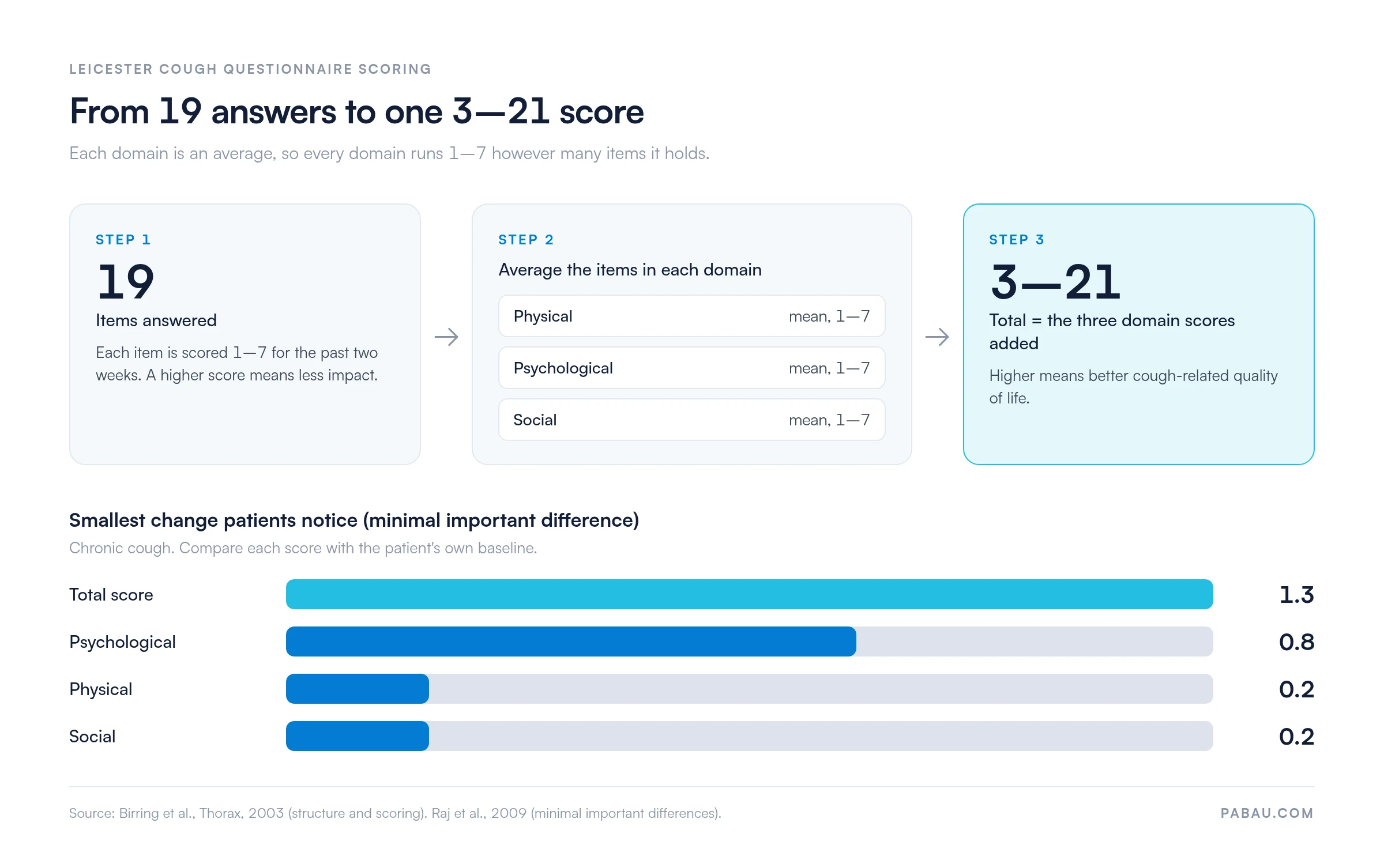
Scores run from 3 to 21, and a higher score means better quality of life. Scoring takes three steps.
Averaging stops the physical domain, which holds the most items, from swamping the social one. The diagram below shows the arithmetic and the change size that counts as meaningful.
The PDF carries a blank results table but no scoring instructions. Keep the published method above, because altering item wording or response options changes what the score means.
A single score tells you little on its own. Change over time guides decisions, and the minimal important difference separates noise from a shift the patient feels.
For chronic cough, Raj and colleagues put that difference at 1.3 points on the total. The domain thresholds differ: 0.2 for physical, 0.8 for psychological and 0.2 for social.
The instrument was developed for chronic cough, and it has been studied in several respiratory populations. These are the ones most often reported in the literature.
Only use the questionnaire in populations where a published study supports its validity, and note the population in the patient record.
The development study tested the LCQ in chronic cough outpatients. Internal reliability ranged from 0.79 to 0.89, and two-week repeatability was high, with domain coefficients of 0.88 to 0.96.
The European Respiratory Journal bronchiectasis validation study followed 120 patients. Median scores rose from 11.3 to 17.8 after two weeks of antibiotics, and stable scores held over six months.
The LCQ is a copyrighted instrument, and its authors, Birring and colleagues, hold the copyright. The questionnaire in this PDF is reproduced with attribution to their 2003 Thorax paper.
Pabau does not grant a license to use it. Before you use the LCQ in your practice, a service evaluation or a study, confirm the license terms with the authors.
On paper, the form is handed out at the desk, scored by hand and filed. Comparing this review with the last one then means digging out two sheets.
Pabau sends the questionnaire as a digital form before the appointment instead. The answers land in the patient record, so the baseline and every follow-up score sit in one timeline.

Book a demo to see how Pabau sends questionnaires before each visit and keeps every score on the patient record.

The LCQ earns its place when you use it the same way every time. Take a baseline before treatment, repeat it at each review, and judge change against 1.3 points, not against other patients.
Watch the domains too. A patient whose total holds steady may still be slipping psychologically, and that shift needs only 0.8 points to matter.
Check the license terms with the authors before the form goes into routine use. Book a demo to see how Pabau sends the LCQ before each review and keeps every score on the patient record.

Want the bigger picture on patient-reported outcomes? Patient-reported outcome measures explains how PROMs fit into routine reviews.
Need an objective record to pair with the LCQ? Respiratory assessment template covers the breath sounds, rate and saturation findings to file alongside it.
Assessing the chest at the bedside? Nursing lung assessment walks through inspection, palpation, percussion and auscultation.
Caring for patients with COPD? COPD nursing care plan sets out goals and interventions for chronic airway disease.
Tracking inhalers and controllers? Asthma medication list keeps each patient’s respiratory medicines in one record.
The Leicester Cough Questionnaire is a 19-item patient-reported outcome measure for chronic cough. It records how cough affects physical, psychological and social quality of life.
Average the item scores within each domain to get three domain scores of 1–7, then add the three for an overall score of 3–21. Higher means better quality of life.
Yes. It was validated in chronic cough in 2003 and in non-cystic fibrosis bronchiectasis in 2009. Check that a published study supports the population you plan to use it with.
Its authors do. Birring and colleagues developed the questionnaire and published it in Thorax in 2003. Confirm the license terms with them before you use it in a practice or a study.