Medication tracker template: Free PDF for clinicians and caregivers
A medication tracker is a form that records each medication a patient takes, whe...

3
Last Updated: Oct 12, 2026
Patient reported outcome measures (PROMs) are validated questionnaires that record a patient’s own view of their health, symptoms and quality of life, without clinician interpretation. PROMIS, an NIH-funded measurement system, provides precise PRO measures of physical, mental and social health, capturing how patients feel and function.
In practice, a PROM tells you whether a treatment is working from the patient’s side. Practices use them to track change between visits, regulators use them as trial endpoints, and the NHS uses them to compare surgical outcomes across hospitals.

Patient reported outcome measures (PROMs) are validated questionnaires that record a patient’s self-assessed health status, function and quality of life, distinct from clinician-observed measures.
PROMs fall into two categories. Generic instruments (SF-36, EQ-5D, PROMIS) apply across conditions, while condition-specific instruments (PHQ-9, KOOS, Oxford Hip Score) target one diagnosis.
Only validated PROMs, assessed for reliability, validity and responsiveness, belong in clinical or regulatory use. Since its 2009 guidance, the FDA expects PRO instruments used as endpoints to be well-defined and reliable, with content validity supported by patient input.
Pabau, the practice management platform we build, sends PROM questionnaires through digital forms before or after appointments. Scores reach the patient record without paper.
Patient reported outcome measures capture the patient’s lived experience of their condition, which biomarkers, imaging and clinician assessments cannot. A patient recovering from knee replacement surgery may show good range-of-motion scores on examination while still reporting significant pain during daily activities. Instead, a PROM puts that pain on the record in a form you can score and compare.
The distinction between a PRO (patient-reported outcome) and a PROM (the measurement instrument) matters. A PRO is any outcome reported directly by the patient with no clinician interpretation. A PROM is the validated questionnaire used to collect that outcome systematically. Not every patient self-report qualifies, because the instrument must pass psychometric testing before clinical or regulatory use.
PROMs earn their place in three ways. First, they support shared decision-making by showing practitioners how a patient experiences their condition between appointments. Second, they track treatment effectiveness over time. Third, they can also surface differences in patient experience across demographic groups that aggregate clinical data can mask.
PROMs split into two broad categories. Generic instruments measure health status across populations and conditions, which makes them useful for comparisons across disease areas. Condition-specific instruments target a particular diagnosis or body region, so they pick up clinically relevant change in that population more sensitively.
For example, generic PROMs allow comparisons across patient groups and are common in health economics research. In contrast, condition-specific instruments trade breadth for sensitivity, which is why trials targeting one disease endpoint prefer them. Either type only works when you give it consistently and on schedule, and that timing is where paper-based processes tend to break down.
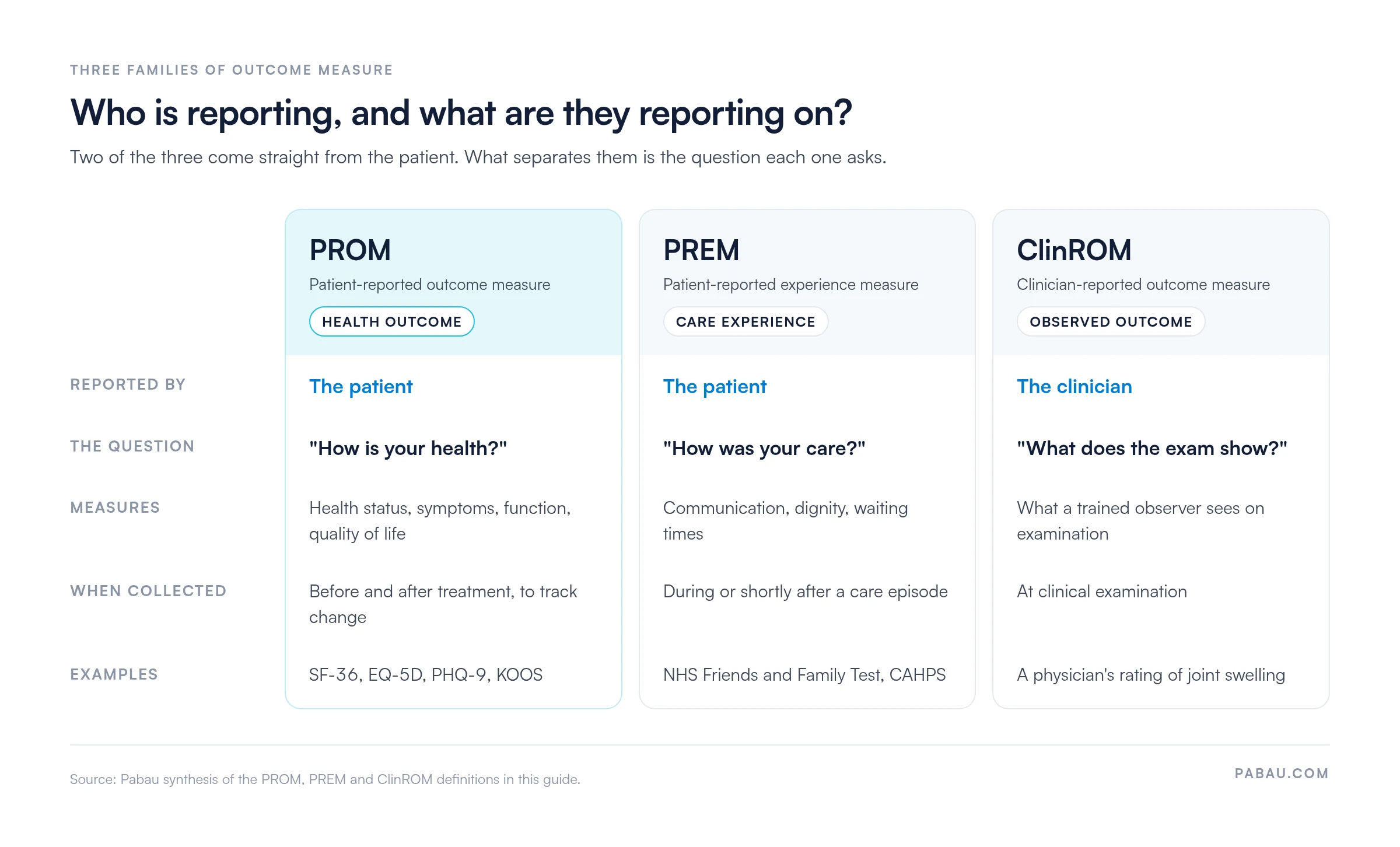
Patient reported outcome measures and patient-reported experience measures (PREMs) are often conflated. PROMs ask how the patient’s health is. Meanwhile, PREMs ask how their care went. Both come directly from the patient, but the object of measurement differs.
Clinician-reported outcome measures (ClinROMs) are assessments a healthcare professional makes from observation or examination, without patient input. A physician rating joint swelling on a standardized scale is a ClinROM, and so is a score on the Karnofsky performance status scale. A patient completing a KOOS questionnaire about their own knee pain and function is a PROM.
Both have a place in clinical practice. ClinROMs capture what a trained observer can see, and PROMs capture what only the patient can report. However, the two do not always agree, and that disagreement is clinically meaningful in itself. The comparison below sets all three families side by side.
A PROM is only as useful as its psychometric properties. An unvalidated questionnaire is hard to defend in a clinical or regulatory setting, and regulators expect documented measurement evidence before they accept a PRO endpoint. Validation involves several distinct assessments:
The SF-36’s validation literature spans decades, starting with Ware and Sherbourne’s 1992 paper on its conceptual framework and item selection. That depth of evidence is why it remains one of the most-cited generic PROMs worldwide. In contrast, newer instruments like PROMIS use item response theory and computer-adaptive testing, which reach the same precision with fewer items and less patient burden.
When selecting a PROM for routine clinical use, check whether a minimum clinically important difference (MCID) has been published for your specific patient population. An MCID established in a post-surgical orthopedic cohort may not transfer to a chronic pain population using the same instrument.
Regulators treat PROs as primary or secondary endpoints when a treatment’s intended benefit is something only the patient can observe. Typical examples are symptom burden, functional ability and quality of life. Without a patient-reported endpoint, a drug that shrinks a tumor but leaves the patient feeling no better cannot claim a patient benefit in its label.
The FDA’s 2009 guidance on patient-reported outcome measures sets out the FDA’s expectations (its current thinking) for PRO use in drug approval submissions. Like all FDA guidance, it is not legally binding, and sponsors may use an alternative approach that satisfies the applicable rules.
The guidance recommends that sponsors demonstrate content validity through qualitative research with patients from the target population. It also expects them to set out the instrument’s conceptual framework and justify the score thresholds that define a treatment responder. The guidance expects new or modified instruments to meet these standards from the outset.
The European Medicines Agency (EMA) has issued reflection papers along similar lines. They expect PRO instruments in EMA submissions to be fit for purpose, linguistically validated for each language version, and documented for their psychometric properties. In addition, the ICH E9(R1) addendum on estimands has changed how trial protocols specify PRO endpoints. As a result, sponsors now state how intercurrent events, such as treatment discontinuation or crossover, will be handled in the PRO analysis.
The NHS England PROMs program is one of the largest routine outcome collection systems in the world. According to NHS Digital, the program now covers hip and knee replacement only. NHS Digital discontinued collections for varicose vein and groin hernia procedures in October 2017.
Patients complete the EQ-5D (a generic PROM) and a condition-specific instrument before and after surgery. Patients complete the pre-operative questionnaire in hospital before the operation. Afterward, the follow-up questionnaire goes out by post or online about six months after surgery. The current instruments are:
In turn, the data feeds NHS England’s quality benchmarking, which compares patient-reported outcomes across trusts, hospital types and surgical teams. As a result, NHS England can identify and support trusts with consistently poor post-operative results. For private practices working alongside NHS pathways, the same pre- and post-procedure design is a useful template for their own outcome collection.
Private practices that collect PROMs on paper tend to stall at the same points. For example, forms get lost between reception and the treatment room. Likewise, email attachments go unopened. As a result, scores never reach the patient record, so they cannot inform the next visit.
Moving from paper to digital PROM collection takes five practical steps:
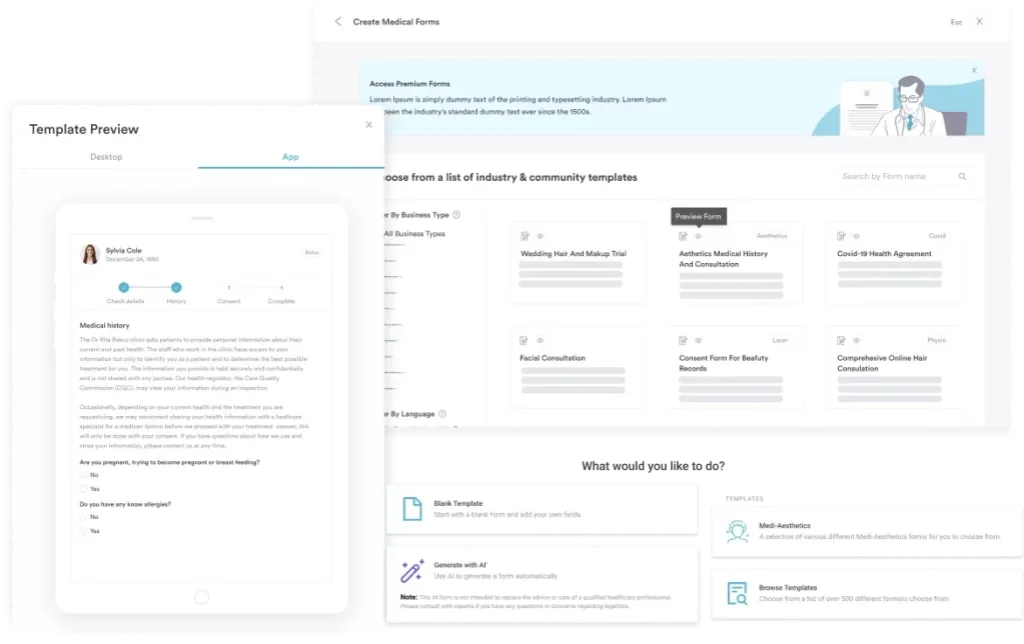
Without a system, PROM collection depends on someone remembering to hand out the right form at the right visit. Pabau’s digital forms let you build PROM questionnaires and send them to patients automatically before or after appointments. Publishers copyright many instruments, including SF-36, EQ-5D, DASH and the Oxford scores. Confirm you hold the right license for clinical use before putting them in a form.
A physical therapy practice could send a DASH questionnaire to each patient 48 hours before their first appointment. Then a follow-up goes out at six weeks, with no manual work from the front desk. Responses land in the patient’s file within Pabau’s medical records management, so score trends sit next to the clinical notes.
With Pabau’s measurements tracking software, you can log numeric PROM scores alongside weight, blood pressure or body composition. That helps practices running outcome-based treatment programs show improvement over time. Pabau delivers and collects the questionnaire, but the validated psychometric properties belong to the instrument itself, so use published, validated versions.
Pair the scores with a short PREM, such as a post-visit survey, and you see both the clinical outcome and the experience around it.

Send PROM questionnaires automatically before and after appointments, and keep every score in the patient record. Your team stops chasing forms and starts reviewing results.

Start small. Pick one validated instrument for the condition you treat most, confirm its license, and collect a baseline before the first session. Add one follow-up at a fixed interval, then judge the change against the instrument’s published MCID rather than by feel.
Once that loop runs without staff chasing it, add a second instrument or a PREM. The trade-off is setup time up front, in exchange for evidence that shows whether your treatments work for the people receiving them.
Pabau sends the questionnaires and stores every score in the patient record, so your team reviews results instead of chasing forms. Book a demo to see a PROM workflow set up for your practice.

Need a clinician-rated measure alongside PROMs? Karnofsky performance status scale gives you a ready-made ClinROM for functional status.
Building a baseline questionnaire for new patients? New patient questionnaire template covers the history fields worth capturing before the first visit.
Want questionnaires completed before the appointment? Digital patient intake forms explains how to get forms back on time.
Comparing tools that send forms automatically? Best patient intake software ranks the options for private practices.
Documenting outcomes in a nursing setting? Nursing outcomes classification list sets out the NOC outcomes in one reference.
Patient reported outcome measures are validated questionnaires that record a patient’s self-assessed health status, symptoms, functional ability, and quality of life, without any clinician interpretation. They are standardized instruments with documented psychometric properties, used in clinical practice, research, and regulatory submissions to capture outcomes that biomarkers and clinical examination cannot.
PROMs measure health outcomes: how a patient’s symptoms, function, and quality of life have changed as a result of treatment. In contrast, PREMs measure the experience of receiving care: communication quality, dignity, waiting times, and staff responsiveness. Both are self-reported by the patient, but PROMs assess clinical change while PREMs assess service quality.
Widely used generic PROMs include the SF-36, EQ-5D, and PROMIS. Condition-specific examples include the PHQ-9 (depression), GAD-7 (anxiety), KOOS and Oxford Knee Score (knee outcomes), Oxford Hip Score (hip replacement), and DASH (upper limb disability). The right choice depends on the clinical context and whether cross-condition comparisons are needed.
Rigorous psychometric testing validates established PROMs, covering content validity, construct validity, reliability, responsiveness and interpretability. Researchers must conduct validation in the target patient population. The FDA’s PRO guidance expects evidence of content validity for any PRO instrument used as an endpoint in a US drug approval submission. Direct patient input, such as cognitive interviewing, should support that evidence.
Digital PROM collection starts with choosing validated instruments for your patient population and setting pre- and post-treatment collection points. A practice management platform then sends the questionnaires automatically by email or SMS. Finally, responses should feed directly into the patient record to enable longitudinal score tracking without manual data entry.