Nursing narrative note template
A nursing narrative note template is a structured PDF that guides you through re...

1
Last Updated: Oct 21, 2026

The KELS scores 17 living skills across five areas: Self-care, safety and health, money management, transportation and telephone, and work and leisure.
Scoring is binary and inverted. Independent scores 0 points, needs assistance scores 1 point, and a lower total is the better result.
Totals run from 0 to 17. A total of 5.5 or less indicates capacity for independent living, and 6 or above indicates a need for assistance.
A 2009 study of 200 older adults found KELS scores tracked the EXIT25, MMSE, CLOX, geriatric depression scale and modified physical performance test.
Pabau’s digital forms and patient records hold KELS scoring and the observations behind it in one clinical workspace.
A ready-to-use occupational therapy assessment form covering self-care, safety and health, money management, transportation and telephone, and work and leisure across 17 scored items.
Download templateOccupational therapy practitioners evaluating a patient for independent living need a structured assessment grounded in clinical evidence. The Kohlman Evaluation of Living Skills (KELS) provides one. It scores 17 living skills and returns a single number that speaks directly to community placement. This guide covers the five areas the KELS assesses and how to administer it. It also explains how to read a score that runs in the opposite direction to most functional measures.
The Kohlman Evaluation of Living Skills (KELS) is a standardized occupational therapy assessment of a person’s capacity for independent community living. Linda Kohlman Thomson published the original in 1978, and the American Occupational Therapy Association publishes the current fourth edition. The instrument scores 17 living skills grouped into five areas.
It pairs interview questions with performance tasks, which lets the examiner see where knowing and doing come apart. A patient may describe a sound budgeting routine and still misread the price tags in front of them. Administration takes 30 to 45 minutes and suits adults with psychiatric diagnoses, older adults moving toward community living, and people recovering from acute illness.
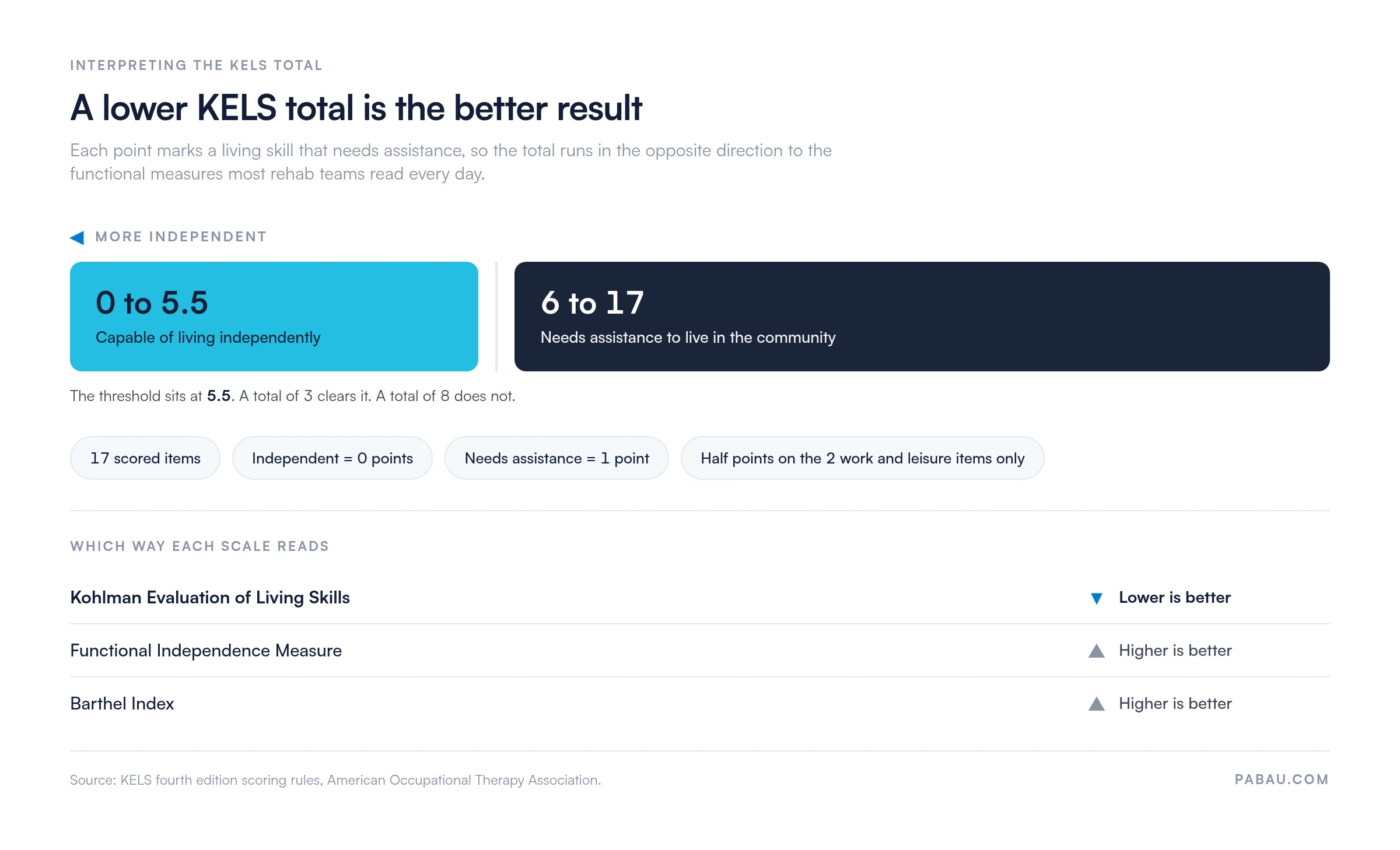
The scale is binary and it runs downward. Each item is marked independent for 0 points or needs assistance for 1 point. Totals therefore fall between 0 and 17, and a lower total is the better result. That direction catches out clinicians used to the FIM or the Barthel Index, where a high score is the good outcome. The scale below shows where the threshold falls and which way each measure reads.
The KELS groups its 17 items into five areas. Shopping is not one of them, despite appearing as a domain in several secondary summaries. Buying items with cash sits inside money management, and telephone use is paired with transportation.
The fourth edition words the last two areas as community mobility and telephone, and employment and leisure participation. The content is the same. Points in any area flag skills needing support, supervision, or intervention before discharge to community living.
Administration runs in five steps, from setting up the room to reading the total against the threshold.
The AOTA library provides the complete score sheet, administration guide, and interpretation resources, all required for standardized administration. Record the patient’s performance on each item in your clinical records, together with the observation that justifies the point you assigned.
Each of the 17 items takes one of two ratings. Independent scores 0 points. It means the patient performs the skill in a way that maintains their own safety and health, without direct help from another person. Needs assistance scores 1 point. Totals therefore run from 0 to 17.
The direction is the part clinicians most often get wrong. A point is a problem, not a credit, so a lower total is the better result and 0 is the best score available. Two refinements apply. The two work and leisure items can take a half point for needs assistance. An item that does not fit the person’s situation is marked not applicable.
A patient totaling 3 clears the threshold. A patient totaling 8 does not. The KELS is criterion-referenced rather than normed, so the same threshold applies across populations instead of an age-adjusted cutoff.
Which items carry the points matters more than the total. Points concentrated in money management and obtaining food suggest a halfway house or supported housing. The same total sitting in safety and health points toward a nursing facility instead. Use the item pattern to shape post-discharge recommendations and to plan follow-up support.
The KELS has substantial psychometric support in peer-reviewed literature. A 2009 study in the Archives of Physical Medicine and Rehabilitation assessed 200 community-dwelling adults aged 65 and over, half of them referred for self-neglect. It reported correlations between KELS scores and measures of executive function, cognition, mood and physical performance.
The strongest association was with the EXIT25 executive interview (r = .705). KELS scores also tracked four further measures, all at p < .001:
Read the signs of those coefficients closely, because they confirm the scale’s direction. KELS scores rise alongside the EXIT25, where a high score also means impairment. They fall as cognitive and physical performance scores rise. A more capable patient earns fewer KELS points.
Inter-rater agreement across validation studies has ranged from 74% to 94%, meaning different therapists reach broadly consistent conclusions on the same patient. That consistency is what makes the KELS defensible in a high-stakes decision such as discharge placement. The Shirley Ryan AbilityLab rehabilitation measures database holds the detailed psychometric summaries.
The KELS earns its keep in discharge planning from acute psychiatric admissions, geriatric rehabilitation units, and post-stroke or post-injury recovery programs. Clinicians use the result to decide whether a patient can return home independently, needs a supported living arrangement, or needs 24-hour supervised care.
Physical and occupational therapists on a rehab unit work toward the same discharge target. That makes a shared physical therapy EMR useful, because the KELS total then sits beside the mobility goals it informs.
In psychiatric settings, where much of the validation work happened, the assessment identifies patients ready for community reintegration. Results guide referrals to transitional employment, supported housing, and outpatient mental health services. Insurance and funding agencies often request KELS scores as evidence of functional capacity when approving a discharge plan.
For older adults, the item pattern guides geriatric care planning. It also shows which home supports are needed, from meal delivery to medication management and transportation help. The instrument is not recommended where lengths of stay are long. By then the patient’s daily resources have changed too much for the result to describe their current situation.
The KELS is evidence-based, and five limitations still shape how far you can push a single total. It was validated primarily in psychiatric and geriatric populations. Using it with traumatic brain injury, developmental disability, or substance use disorders calls for clinical judgment.
The binary scale is the second constraint. It buys agreement between raters by removing gradation. A patient who needs one verbal prompt and a patient who cannot attempt the task both score 1 point. Only your written observation preserves that difference for the next clinician.
Third, the KELS captures a single point in time. Performance on assessment day may not predict day-to-day consistency or behavior under stress. Pair the result with trial community leave and observation in the patient’s own environment.
Fourth, the instrument does not test cognition directly, though the 2009 correlations with the EXIT25 and the mini-mental state examination show cognition drives item performance. A patient can score well and still exercise poor judgment in an unfamiliar situation. Run a cognitive screen alongside the KELS.
Finally, cultural and socioeconomic context affects performance. The money management, transportation and telephone items assume urban or suburban access, so results may not transfer to rural or international settings. Digital assessment forms built into your clinical software help hold administration consistent across those complexities and reduce scorer drift.

A KELS total is the number a placement decision rests on. It is only defensible when the score sheet, the observations behind each point, and the resulting discharge plan sit in the same record. Practice management software like Pabau keeps the three together on the patient’s file.
Most OT teams still score on paper, retype the total into a note, and file the sheet somewhere else. Pabau’s occupational therapy software carries the 17 items as a structured digital form, so scoring happens once during the session. The total and the item-level detail attach to the patient record rather than a cabinet.
Because the items stay structured, repeat administrations line up for comparison. You can see whether the money management points cleared before discharge or held. Automated workflows then hold the steps a KELS result triggers, so a referral or a home-support request does not slip.
Pabau Scribe, our AI scribe, drafts the narrative note from the session. That cuts the charting that follows a 45-minute assessment. Compliance controls keep scores and supporting notes restricted to the team members who need them, across every location you run.

Pabau’s digital forms and patient records let OT teams score the 17 KELS items and store the observation behind each point. Results line up across repeat administrations, so discharge decisions stay traceable to the evidence.

The KELS holds its place in discharge planning because it asks a narrow question and answers it with one number. Treat that number as the start of the conversation rather than the verdict. A total of 6 spread thinly across five areas describes a different patient from a total of 6 sitting entirely in safety and health.
So write down what you observed next to every point you assign. The binary scale is what makes the KELS reliable between raters. It also hides the difference between a single prompt and a total inability, and your notes are the only place that difference survives. Book a demo to see how Pabau keeps KELS scores, session notes, and discharge workflows on one patient record.

Comparing record systems for an OT practice? Occupational therapy EMR walks through the features, CPT codes and compliance requirements to check before you commit.
Need a shorter screen for basic daily activities? ADL assessment tool gives you a scored form for activities of daily living, plus a guide to filling it in.
Want a client-led measure to run alongside the KELS? Canadian Occupational Performance Measure scores the occupations the patient names as priorities, rather than a fixed item list.
The KELS scores 17 living skills across five areas: Self-care, safety and health, money management, transportation and telephone, and work and leisure. The result indicates whether an adult can live independently in the community or needs assistance, supervision, or a supported placement.
Each of the 17 items is scored 0 for independent or 1 for needs assistance, giving a total between 0 and 17. Only the two work and leisure items can take a half point. A lower total is the better result.
No. The KELS runs in the opposite direction to most functional measures. Every point marks a skill that needs assistance, so a lower total is the better outcome and 0 is the best score available.
No. Shopping is not one of the five areas, although several secondary summaries list it as one. Using cash to purchase items sits inside money management, supported by the instrument’s Price Tags form. Telephone use is paired with transportation.
Standard KELS administration takes 30 to 45 minutes, combining interview questions and performance tasks. Time varies with patient fatigue, comprehension, or the need for clarification.
Occupational therapists and occupational therapy assistants trained in the KELS protocol administer the assessment. Some psychiatric nurses and social workers also use it, depending on their training and their institution’s protocols.
Yes. A 2009 study of 200 community-dwelling adults aged 65 and over found KELS scores tracked measures of executive function, cognition and physical performance. The KELS is criterion-referenced rather than normed, so the 5.5 threshold applies instead of age-specific cutoffs.
Yes. KELS results directly inform discharge decisions in psychiatric, geriatric and post-acute settings. A total of 5.5 or less indicates the patient is capable of independent living. A total of 6 or above indicates a need for assistance or supervision in the community.
The FIM rates burden of care on a seven-level scale across 18 items covering self-care, mobility, cognition and social function. The KELS asks a narrower question with a binary score: Can this person manage the skills community living requires? The scales also run in opposite directions, since a high FIM score is good and a high KELS score is not.