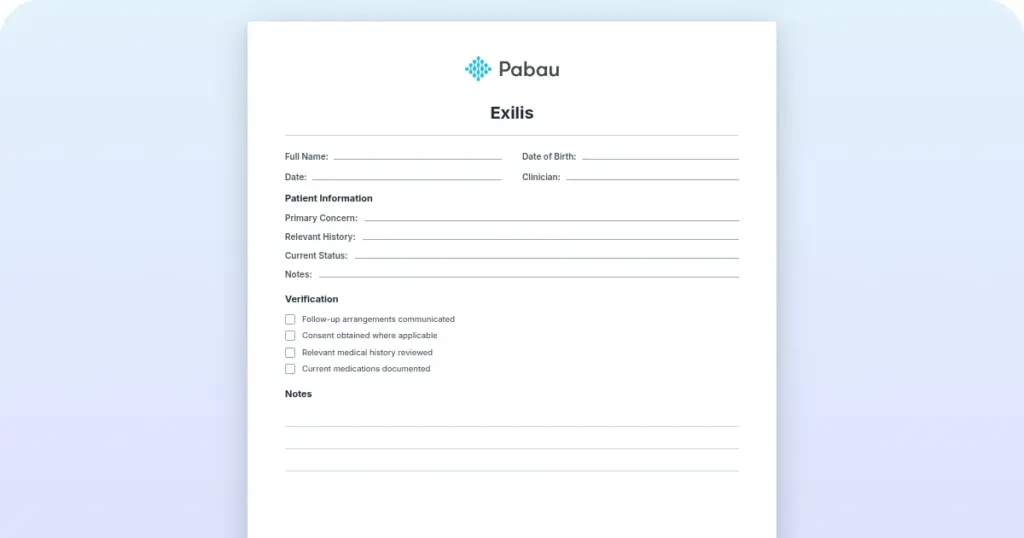
Exilis patient treatment record: Free PDF for RF sessions
An Exilis patient treatment record is the session log for BTL’s radiofrequ...

1
Last Updated: Oct 23, 2026

A hair transplant template is a structured patient intake and documentation form capturing medical history, hair loss patterns, and treatment expectations before FUE or FUT procedures.
Informed consent is a legal requirement in the UK, US, and most regulated healthcare markets-templates standardize this critical documentation.
Digital forms reduce administrative burden, improve data capture accuracy, and support compliance with GDPR and HIPAA during patient onboarding.
Pabau’s digital forms and Pabau Scribe automate the template workflow, turning manual paperwork into streamlined clinical documentation.
A comprehensive patient intake form covering medical history, current medications, allergies, hair loss classification, treatment goals, and pre-operative expectations. Ready to download and customise for your clinic.
Download templateA hair transplant template is a structured, standardised patient documentation form designed specifically for hair restoration clinics. Unlike generic medical intake forms, a hair transplant template captures the unique clinical information surgeons and technicians need: alopecia classification (Norwood scale), graft density goals, donor area characteristics, and post-operative expectations.
In clinical practice, these forms serve two critical functions. First, they document informed consent-a legal requirement across the UK, US, Canada, and most regulated markets. The General Medical Council (GMC) in the UK and state medical boards in the US explicitly require written evidence that patients understand procedural risks, recovery timelines, and realistic outcomes before surgery. A standardised consent documentation form satisfies this requirement and protects your clinic legally.
Second, these templates capture pre-operative assessment data that informs treatment planning. Medical history, current medications, allergies, and previous hair loss treatments shape which technique (FUE or FUT) suits each patient; when the plan calls for follicular unit extraction. This data becomes the foundation for clinical notes and ensures continuity of care across all appointments.
Implementing a hair transplant template in your clinic workflow follows five operational steps that transform paper intake into structured clinical data.
When you transition to digital intake forms, these steps accelerate. Patients complete the template on a tablet during check-in or via your patient portal beforehand. Data flows directly into clinical records, eliminating manual transcription and reducing errors.
Hair transplant templates serve multiple clinic types and staffing models across the aesthetic and surgical spectrum.
Staffing-wise, templates help both solo practitioners and larger teams. A solo surgeon uses the template to document their own consultations. A team-based clinic uses templates to train new consultation coordinators, ensuring every staff member captures the same essential information before the surgeon enters the room. This accelerates onboarding and reduces variability.
An online intake tool replaces paper versions of this form and files responses automatically.
Standardised templates deliver measurable operational and clinical benefits.
Clinics that digitise these templates see the greatest benefit. A clinic management software platform integrating digital forms automatically routes completed templates to the clinical record, triggers pre-operative reminders, and flags high-risk patients for additional consultation time.
Hair transplant consultations are high-intent moments. Patients arrive with years of hair loss anxiety and significant financial investment ahead. The quality of your intake documentation directly shapes their confidence in your clinic’s professionalism.
A structured template ensures consultations feel thorough and confidential, not rushed or bureaucratic. When patients see a dedicated hair transplant form-with sections for their specific concerns, medical history, and personalized goals-they perceive your clinic as experienced and specialised. This builds trust and improves conversion from consultation to booking.
The template also protects your clinic from common consultation pitfalls: overpromising graft yield, overlooking medication interactions that affect healing, or failing to discuss realistic post-operative shedding timelines. Each of these shortcomings leads to patient dissatisfaction and complaints. A well-designed patient experience workflow supported by standardised templates prevents these issues.
Clinical governance in hair transplant clinics requires consistent documentation standards. Every patient chart must contain the same core data: informed consent signature, contraindication assessment, baseline photography, procedural plan, and post-operative instructions.
A standardised template ensures this consistency across all clinicians in your clinic. Whether your surgeon has 5 years or 25 years of experience, every patient receives the same pre-operative assessment structure. This uniformity is what regulators like the CQC and NHS expect during inspections.
For clinics wanting to leverage technology. AI-assisted note generation creates narrative summaries from your structured template data, ensuring clinical notes follow standardised formats while reducing clinician documentation time by 50-70%.
A standardised hair transplant template transforms patient intake from a time-consuming, variable process into a clinical safeguard. It documents informed consent, captures essential pre-operative data, accelerates consultation workflows, and protects your clinic from regulatory and legal risk.
Whether you adopt a paper-based template or transition to digital forms, the core principle remains: structured documentation ensures consistent, safe, professional care. Hair transplant patients expect meticulous attention to their medical details and surgical planning. A dedicated hair transplant template delivers on that expectation and differentiates your clinic as serious about patient safety and clinical excellence. Ready to streamline your intake process? Book a demo to explore how digital forms and automated documentation can accelerate your consultation-to-surgery workflow. A med spa running injectable treatments needs batch and lot detail attached to the note, not to a separate log. A med spa running injectable treatments needs batch and lot detail attached to the note, not to a separate log.
Yes. Before deploying any consent or risk disclosure template in your clinic, have a healthcare solicitor or medical-legal advisor review it for compliance with GMC, CQC, and HIPAA requirements specific to your jurisdiction. This is especially important if you serve patients across multiple countries.
A core intake template captures universal information (medical history, medications, goals). However, risk disclosure and post-operative sections should be procedure-specific. FUE patients need different scar discussion and recovery expectations than FUT patients. Create modular sections so you can customise without rewriting the entire form.
Do not proceed with the procedure. Unsigned consent documentation means you cannot demonstrate the patient understood risks or gave informed consent. This creates unacceptable legal exposure. Use refusal as a signal to explore the patient’s concerns in greater detail before rescheduling.
Review and update annually or whenever your procedural protocols change. If you adopt a new surgical technique, update the template to reflect new risk profiles or recovery timelines. Staying current protects your clinic and ensures templates remain relevant to your actual practice.
Store completed templates in your secure clinical record system (EMR or practice management software). Paper copies should be filed in locked cabinets with restricted access. Digital copies should be encrypted and backed up according to HIPAA or GDPR requirements. Retention period is typically 7-10 years for adult patients.