GLP-1 usage by state: Who’s taking, searching and paying in 2026
GLP-1 usage by state peaks in West Virginia, America’s GLP-1 capital, with...

Last Updated: Oct 16, 2026
Dermatology practice marketing works best as one system rather than a set of separate campaigns. Local SEO gets your practice found, review volume earns the click, and automated recall brings the patient back for the next visit. Practices that treat those three as separate projects lose patients between appointments.
That loss is quiet. A patient finishes an acne treatment course, hears nothing afterward, and books the next appointment somewhere else.
The survey data backs that up. PatientPop’s 2020 Patient Perspective Survey found that 72.9% of patients say a provider’s online reputation makes them more likely to choose that practice. Roughly 7 in 10 would switch providers over poor responsiveness or limited communication.
The Tebra 2025 patient survey reaches a similar conclusion. It found that 82% of patients give a provider only one or two chances before switching. A poor experience often means simply not hearing from the practice again.
Those odds improve when marketing runs inside the clinical workflow, which is what dermatology practice management software does. This guide is for owners and managers who want marketing that keeps working without daily manual effort. It covers digital foundations, social strategy, reputation management, and the automation touchpoints along the patient journey.

Niche positioning beats generalist marketing, because a defined patient segment converts better than a broad one.
Local SEO and Google Business Profile optimization are the highest-ROI starting points for practices not yet ranking in map results.
Before-and-after photography requires written patient consent under HIPAA and state medical board rules.
Exceptional results also need a typicality disclosure under the FTC Endorsement Guides, which cover what consumers can generally expect.
Practice management software like Pabau automates recall, review requests, and HIPAA-compliant email and SMS.
Every aesthetic marketing strategy starts with the same question. What does your practice stand for in your market? A solo medical dermatologist in a rural county competes differently from a multi-location cosmetic practice with 40 rivals in town. Niche positioning is how a smaller practice wins.
Practice marketing guidance from the American Academy of Dermatology (AAD) member resources and the wider healthcare marketing literature points the same way. Practices grow faster when their public identity is built around one area of expertise. That might be psoriasis management, cosmetic injectables, pediatric dermatology, or surgical excision.
Generalist positioning makes you invisible in a competitive market. Owning a niche makes you the obvious choice for a defined patient segment.
Before investing in any paid channel, audit these four foundational assets:
Paid advertising on top of a weak foundation buys expensive traffic that does not convert. Fix the foundation first.
Local SEO is the highest-ROI channel for most dermatology practices. When a patient searches “dermatologist near me” or “acne treatment [city],” Google returns a map pack of three results above the organic listings.
Three inputs decide whether a practice enters that map pack. You need consistent NAP (name, address, phone) data across directories, plus a fully optimized Google Business Profile. You also need enough review volume to signal that the practice is active.
On-page SEO for dermatology websites follows a predictable pattern. Each core service deserves its own page, with a clear title tag, a unique meta description, and body copy about that condition or procedure.
“Botox injections in [city]” is a page. “Acne scar treatment [city]” is a page. One combined services page that lists every procedure rarely ranks for any of them.
| SEO priority | Action required | Timeline |
|---|---|---|
| Google Business Profile | Complete all fields, add 10+ photos, enable booking link | Week 1 |
| NAP consistency | Audit and fix listings on Healthgrades, Zocdoc, Yelp, Bing Places | Week 2-3 |
| Service pages | Create individual pages for top 5-8 procedures or conditions | Month 1-2 |
| Review velocity | Set up automated post-visit review requests | Week 1 |
| Blog content | Publish 2-4 condition or procedure guides per month, targeting long-tail queries | Ongoing |
Content marketing compounds over time. Educational articles that answer questions like “how long does psoriasis treatment take” or “what causes adult acne” reach patients at the research stage. Those visitors are not ready to book yet, but they come back when they are.
Instagram and TikTok drive patient volume for cosmetic dermatology practices. Medical dermatology practices see stronger results from Facebook community engagement and YouTube educational content. Let the channel follow the audience. A practice treating adult acne in patients in their 20s and 30s will get more from Reels than from LinkedIn.
Social media marketing in dermatology relies on two content types. Educational posts explain conditions, correct skincare myths, and walk through procedures. Human content shows the team, the office, and the patient experience without revealing patient information.
HIPAA compliance comes before publishing. The Health Insurance Portability and Accountability Act governs this. Replying to a review in a way that confirms someone is a patient counts as a protected health information (PHI) violation. Sharing identifiable details in a post does too.
Every practice needs a written social media policy that each team member has read and understood.
Before-and-after photos are the most persuasive assets in cosmetic dermatology marketing. They are also the most legally exposed. The Federal Trade Commission (FTC) Endorsement Guides (16 CFR Part 255) require testimonials and before-and-after images to reflect results consumers can generally expect.
Exceptional outcomes can still be shown. They have to carry a clear and conspicuous disclosure of what the average patient should realistically expect.
State medical boards add another layer. Several states require specific consent language telling patients how images will be used, on which platforms, and for how long. A verbal agreement is not enough. Written consent must be obtained before any image is captured, stored, or shared.
A written dermatology consent form turns that requirement into a repeatable step rather than a per-photo scramble. Name each platform, the storage period, and the patient’s right to withdraw.
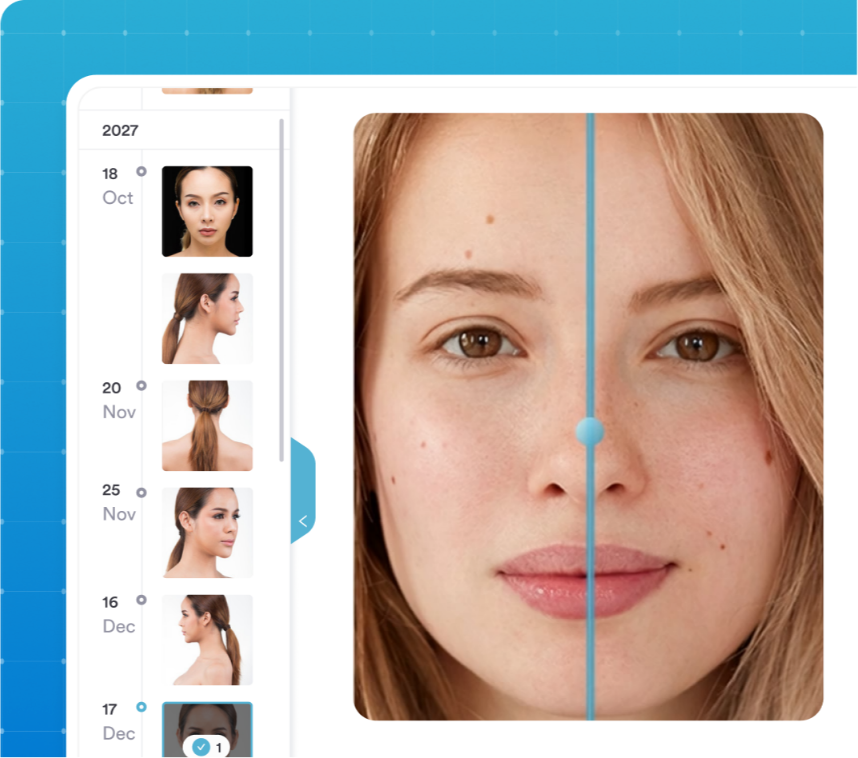
Pabau stores those images in the patient record and links them to the matching consent form. Sharing stays controlled, so nobody posts an unconsented image, and the practice keeps an auditable trail.
Audit your photo library before your next social media post. Check every before-and-after image against three questions. Is there a signed consent form on file? Does that consent specify social media use? Has it expired? Remove any image without a complete paper trail. One non-compliant post is not worth the regulatory exposure.
Research published by Software Advice found that 71% of patients use online reviews as their first step in choosing a new physician. For dermatology practices, the platforms that matter most are Google, Healthgrades, Zocdoc, and Yelp. RealSelf matters for cosmetic procedures specifically.
Volume matters. A practice with 8 reviews averaging 4.8 stars is less visible, and less trusted, than one with 85 reviews averaging 4.5 stars.
Review velocity, meaning the rate at which new reviews arrive, tells Google the practice is active. A single burst followed by months of silence looks staged and will not hold a map pack ranking.
The most reliable way to build volume is to automate the request. Once an appointment closes, an automated message asks for feedback within 24 hours, while the visit is still fresh. Pabau sends that request straight after appointment completion and routes satisfied patients toward public review platforms.
Practices running this workflow typically report three to five times the review volume of practices relying on verbal front desk requests.
Responding to reviews takes care. Acknowledge a negative review without confirming or denying that the reviewer is a patient. “We take all feedback seriously and invite you to contact us directly” is compliant. “We’re sorry your treatment didn’t go as planned” is not, because it confirms a clinical relationship.
Review management software with pre-approved response templates keeps that discipline in place on the days the front desk is busiest.
Patient retention costs less than new patient acquisition. Estimates that originate in Bain and Company research put acquisition at roughly five to seven times the cost of retention. Frederick Reichheld popularized that figure in Harvard Business Review.
Budgets rarely reflect that ratio. Acquisition spend is easy to justify at the start of a quarter. The follow-up that turns a first visit into a second one usually runs on whoever remembers it.
Five automated touchpoints carry retention in a dermatology practice. The timeline below shows when each one fires across the patient’s year, and what it returns.
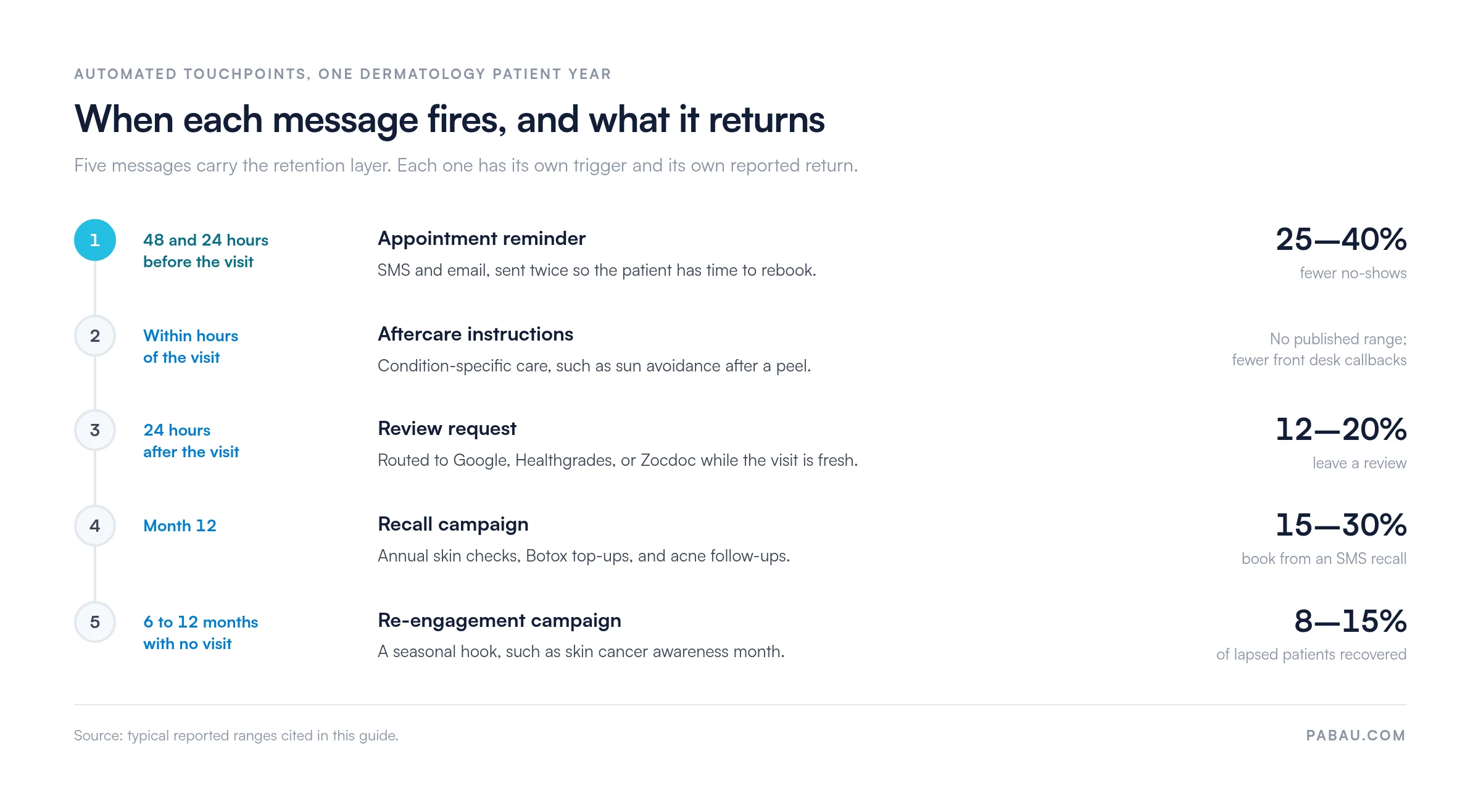
Here is what each touchpoint does in practice:
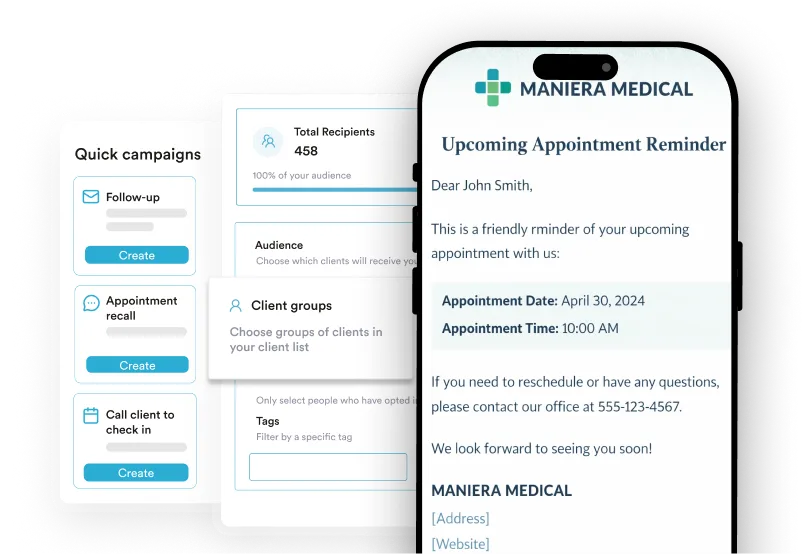
Segmentation matters for practices running medical and cosmetic dermatology side by side. A patient on an eczema plan should never receive Botox promotions. Pabau filters campaigns by treatment history, appointment type, and last visit date.
A cosmetic service line runs on much the same campaign logic as a med spa. If you are building one out, our medical spa software page covers how those segments and campaigns are set up.
Google Ads is the most direct paid channel for dermatology practices. Search campaigns on high-intent keywords like “dermatologist [city],” “acne treatment near me,” or “mohs surgery specialist” reach patients who are ready to book.
Cost per click varies by market, running between $8 and $35 in competitive urban areas. Cost per acquired patient is often lower than on social advertising, because the search intent is already there.
Meta Ads on Facebook and Instagram work differently. They interrupt rather than respond, so they suit cosmetic procedures with visual appeal, promotional offers, and new service launches. A practice adding laser resurfacing or a summer skincare package can generate strong lead volume from a well-targeted campaign.
For medical dermatology services, search advertising usually outperforms social.
Physician referral networks stay underused in many markets. Primary care physicians, OB-GYNs, and endocrinologists see skin conditions regularly, and many have no dermatologist they trust.
A structured outreach program can produce steady referral volume with no advertising spend. Send brief practice profiles to local primary care physicians, visit quarterly in person, and guarantee referred patients an appointment within five business days.
Track your new patient referral source at intake. Ask every new patient how they found your practice, and record the answer in the patient record. After 90 days, run a report. Which channels produced the most new patients? Which produced patients who came back, and what did each source cost per patient? That tells you where to spend more and where to stop.
Marketing without measurement is guesswork. Follower counts and email open rates say little about revenue. The numbers worth tracking are the downstream clinical and financial outcomes.
| Metric | What it tells you | Target (general benchmark) |
|---|---|---|
| New patient acquisition cost | Total marketing spend divided by new patients in the period | Under $80-120 for medical; $100-200 for cosmetic |
| Patient lifetime value (LTV) | Average revenue per patient across all visits over 3 years | Know your number by service line |
| Recall response rate | % of recall messages that result in a booked appointment | 15-30% for SMS; 8-15% for email |
| Review conversion rate | % of review requests that result in a published review | 12-20% with automated requests |
| No-show rate | % of scheduled appointments that are missed | Under 8% with automated reminders |
Pabau’s reporting dashboard tracks appointment volume by source, revenue by service type, and patient retention by cohort. None of it needs a separate spreadsheet. When a cosmetic campaign runs, you can see whether it produced appointments that were completed.
These workflows usually live in separate places. Reminders come from the scheduling system. Review requests come from whoever has a spare moment at the front desk. Recall runs off a spreadsheet somebody remembers to open, and the patient record sits somewhere else again.
Pabau keeps them together. Reminders, aftercare, review requests, recall, and re-engagement all fire from the same patient record. A message reflects what the patient was treated for, and consent forms and before-and-after images sit with that record too.
Every subscription includes the full marketing suite, reporting, and patient records. The outcome is a front desk that stops chasing reviews and rebookings by hand. The marketing report is readable without building a spreadsheet first.

Automated recall, review requests, and HIPAA-compliant email and SMS all run from the patient record. Your team markets the practice without adding hours to the week.

In competitive dermatology markets, the fastest-growing practices tend to be the ones with systems rather than the biggest ad budgets. An optimized Google Business Profile, a steady review cadence, automated recall, and segmented email compound over months in a way paid advertising cannot.
The trade-off is patience. None of this produces a spike next week, and all of it keeps working while you are with patients. If you can only start one project this quarter, start with the Google Business Profile and automated review requests.
Pabau’s recall system, with HIPAA-compliant email and SMS, handles retention and re-engagement without adding to clinical workload. Book a demo to see these workflows running against a dermatology schedule.

Scoring atopic dermatitis severity in your practice? SCORAD vs EASI comparison compares which scoring tool is faster and more reliable for your practice.
Want to improve how patients experience your booking process? Customer journey in aesthetics maps the patient lifecycle from discovery to repeat visit, with touchpoints at each stage.
Tracking allergy skin test results on paper? Allergy skin test results chart template gives you a standardized way to document every test so no reaction goes unrecorded.
Start with local SEO and Google Business Profile optimization, then build automated patient communication workflows (reminders, recall, review requests). These two areas produce the highest return for most practices before any paid advertising investment.
Local SEO and Google Business Profile management generate the most consistent new patient volume. Instagram and TikTok drive bookings for cosmetic procedures. Google Ads perform well for high-intent service searches. Email and SMS recall campaigns produce the best retention at the lowest cost per reactivated patient.
Niche ownership is more effective than generalist positioning. Become the recognized authority in one condition, such as severe acne, surgical dermatology, or pediatric skin conditions. Patients who arrive have already self-selected for that specialty, which lifts conversion rates and word-of-mouth referrals.
Research from Software Advice indicates 71% of patients use online reviews as their first step in selecting a physician. Review volume and recency both affect Google map pack rankings. An automated review request after every appointment is the most reliable way to build that profile.
Focus on educational content, such as condition explanations, procedure walkthroughs, and skincare guidance. Practice culture content works too, including team introductions and the office environment. Never respond to reviews or comments in a way that confirms a clinical relationship. Every before-and-after image needs signed consent specifying social media use before publication.