HIPAA compliant texting: What you can send patients & how to communicate securely
HIPAA compliant texting is possible when a text holds no protected health inform...

Last Updated: Oct 16, 2026

A hair transplant clinic’s qualifications live in three roles: the physician who operates, the technicians who assist, and the front desk who guard patient data.
The lead surgeon should hold a valid state medical license (MD or DO) or GMC registration, plus ABHRS board certification and a hair restoration fellowship. General surgical experience alone doesn’t transfer to the scalp.
Technicians assist with graft dissection and the sterile field; incisions and placement stay with the licensed physician. Hire on verified training, not a polished interview.
Hair restoration is lightly regulated. In the US, any licensed physician can legally perform it, so board certification, facility accreditation, and verified credentials do the heavy lifting.
Verify every credential against the source: the state board, the ABHRS registry, or the ISHRS members directory. Track renewal dates centrally so no credential expires unnoticed.
A hair transplant clinic needs qualifications in three places at once: the physician who performs the surgery, the technicians who assist through every graft, and the front-desk team who handle patient data.
Get all three right, keep proof that each credential is current, and you have a clinic patients and regulators trust. Miss one, and you’re gambling with patient safety, your operating license, and the reputation you’ve spent years building.
That’s the short answer. The rest of this guide is the working version: who needs which credential, how to tell a verifiable qualification from wall decoration, and how to keep the whole picture current without turning into a full-time paperwork wrangler.
Hair transplant surgery is a medical procedure, not a beauty treatment. It involves anesthesia, incisions, and grafts that either take or scar, so the people doing it sit squarely inside the medical scope of practice.
Here’s what’s actually at stake when a role isn’t properly qualified:
Patients feel that difference long before they can name it, which is where the commercial case starts.
Patients do their homework, and rightfully so. Before they hand over their scalp, they Google your team, read your credentials, and look for proof they’re in safe hands with something as personal as hair loss.
Give them that proof and the payoff compounds. Qualified staff and consistent results drive referrals and testimonials, the marketing channels that generate the most durable new patient pipeline.
Your work speaks, word spreads, and it lands even harder once you’re using review management software to collect and showcase it. Trust is also a legal duty, not just a marketing asset.
In both the UK and the US, you have a legal duty to make sure every staff member is qualified for the role they’re actually performing. In practice, that means:
Miss a license, let a credential expire, or put an unqualified person on a task outside their scope, and the bill arrives as fines, lawsuits, or a lost operating license. So before you can protect any of that, you need to know exactly which seats have to be filled by qualified people.
Think of your clinic like a surgical team, because that’s what it is. Three roles carry the qualification load, and each one fails differently when you get the hire wrong. Here’s who needs to be qualified, and what to look for in each seat.
Your surgeon performs the procedure. The credential check here is non-negotiable. Start with the non-negotiable: a licensed medical doctor, meaning an MD or DO in the US, or a GMC-registered physician in the UK.
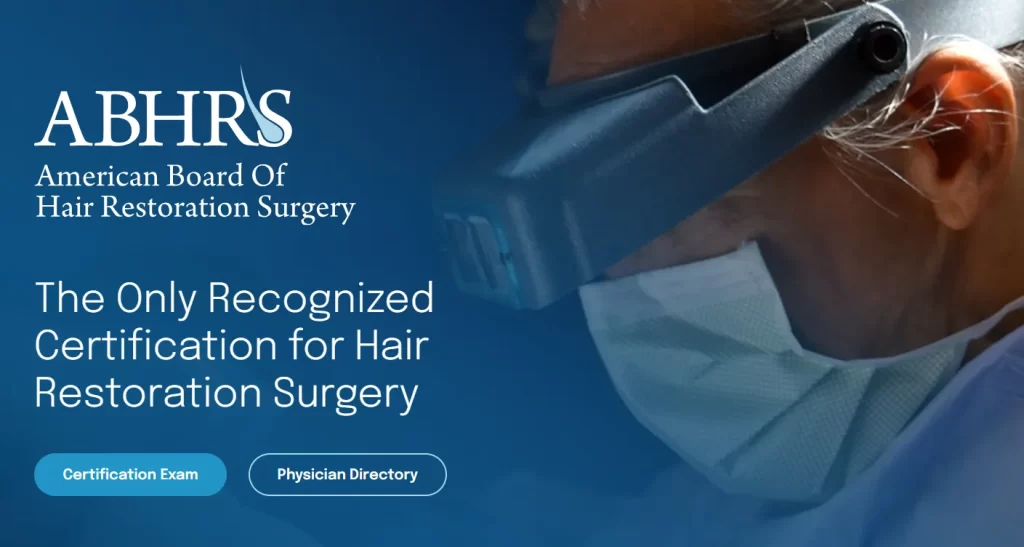
The license is the floor, not the ceiling. On top of it, look for ABHRS certification from the American Board of Hair Restoration Surgery, which proves a doctor has met rigorous standards specific to hair restoration rather than surgery in general.
Most reach that point through a surgical residency in plastic surgery or dermatology, followed by a hair transplant fellowship, dedicated hair restoration training in graft harvesting, hairline design, and placement.
Beyond credentials, confirm directly that the surgeon performs the critical steps themselves (hairline design, graft harvesting, and placement) rather than handing them to unlicensed technicians while moving between rooms.
Source: ABHRS
One more signal worth checking: an ISHRS (International Society of Hair Restoration Surgery) Full Member or Fellow (FISHRS) designation, not just baseline membership, tells you peers recognize the doctor as a specialist.
Between them, board certification and fellowship training confirm a surgeon actually knows the techniques the job runs on, including follicular unit extraction (FUE) and follicular unit transplantation (FUT).
Your hair transplant technicians work shoulder to shoulder with the surgeon through every case. On the day, their job is to:
That work comes with a hard boundary that’s worth understanding clearly: technicians handle graft dissection, preparation, and the sterile field, while incisions and graft placement stay with the licensed physician (or a mid-level provider your state explicitly authorizes).
Knowing what the role covers is one thing; knowing how someone earns their way into it is another.
Your front desk is the first face a nervous patient meets, and the quiet engine that keeps the day from unraveling. They may never touch a graft, but they manage bookings, protect patient records, and hold the whole schedule together.
Look for candidates with:
Get this hire right and administrative issues don’t reach the clinical floor. With the team mapped out, the next question is which credentials on their résumés actually mean something.
Not every certificate is worth the frame it’s printed on. To staff a serious hair transplant clinic, you need to know which hair transplant qualifications carry real weight and which are just wall decoration. The next few sections sort one from the other.
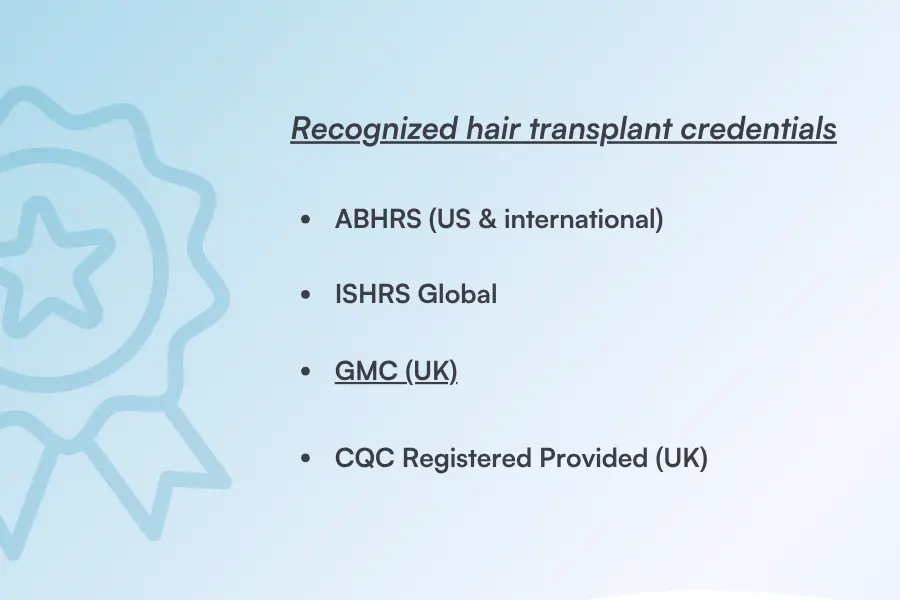
Some credentials stand out because they prove a practitioner has gone well past the minimum. These are the ones that signal advanced training, adherence to hair transplantation standards, and an ongoing commitment to doing the work properly.
Source: Pabau
For hair transplant professionals, ABHRS is the gold standard for board certification, while ISHRS provides global training and ethical guidance. In the UK, practitioners must register with the GMC, and clinics must be CQC registered to offer regulated services.
Additional indicators of credibility: publication in peer-reviewed journals, presentations at ISHRS events, or fellowship training under a recognized surgeon. But a credential only tells you where someone finished, so it pays to look at how they got there.
When you assess a candidate’s hair transplant training, study the route, not just the certificate on the wall. Surgeons and technicians reach competence along genuinely different paths.
For surgeons, hair transplant surgery training usually means a surgical residency followed by a hair restoration fellowship. ISHRS fellowship programs run 9 to 12 months with a minimum caseload, a far stronger signal than a weekend hair transplant course.
For technicians, hands-on courses and structured programs build graft-handling skill through supervised practice, and eligibility usually starts with a nursing or clinical background, so ask what a candidate did before the certificate.
Whichever seat you’re filling, verify:
If you’re building a team from scratch, it helps to understand how to become a hair transplant technician, so you can judge a candidate’s route rather than take their paperwork at face value. The pathway usually runs like this:
The most revealing interview question is straightforward: how many procedures did you assist under direct supervision before certification? That number tells you more about readiness than the certificate itself, which is exactly what you’re screening for when you write the job ad.
Hair transplant technician jobs sit at the center of a smooth procedure, so hire for proven skill over a polished interview.
When you write the hair transplant technician job description, ask for certification from a recognized training program, then verify it yourself directly with the ISHRS or ASAHRS instead of taking a candidate’s word for it.
Skilled technicians are in short supply, so anchor the hair transplant technician salary to verified credentials and supervised caseload, not interview performance. Revisit pay whenever a technician earns a new certification, and you’ll keep the people worth keeping.
Credentials only mean something in the regions where they’re actually recognized, though, which brings us to licensing.
Licensing doesn’t work the same way everywhere. What clears you in the US won’t necessarily clear you in the UK, and the reverse holds too. Here are the key licenses and compliance standards to watch, wherever you’re based.
In the US:
In the UK:
Knowing the rules is only half the job. The other half is confirming that the person in front of you actually meets them, which is where most clinics get sloppy.
Not everyone who applies is qualified, and a confident interview hides a lot. These are the mistakes that cost clinics the most, and how to catch them before they reach a patient.
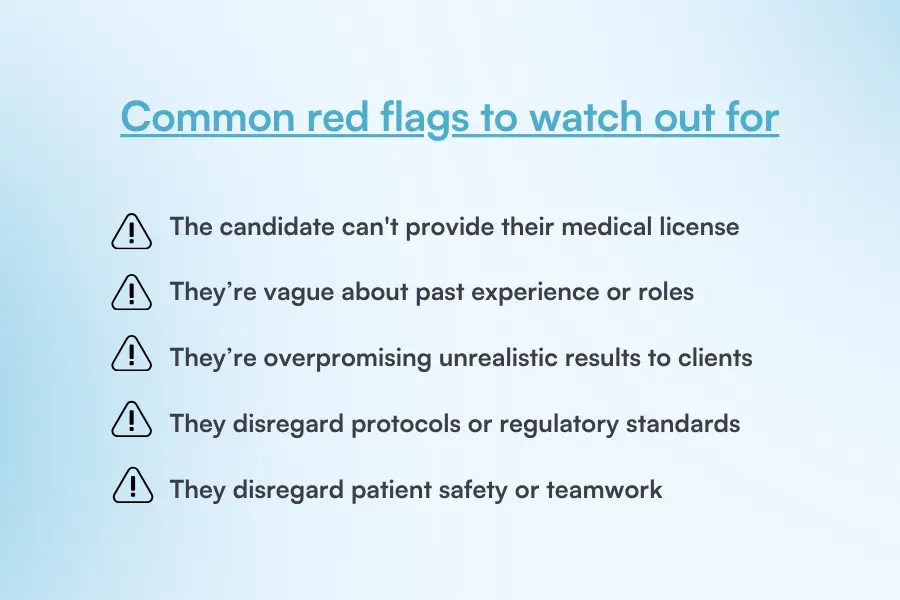
Source: Pabau
Catch these early and you hire with confidence, protect your practice’s reputation, and keep patient safety front and center. It starts with knowing exactly how to check a credential.
Before you hire a surgeon or trust a supplier’s claim, verify it yourself. Evaluating hair transplant clinic credentials and experience is a short, repeatable process. Here’s how the check actually moves:
Where it usually trips up: people stop at the badge on the website, or they check the surgeon and forget the facility and the technicians assisting alongside them.
Document the outcome of each check alongside the credential itself, and you won’t need to repeat the verification at renewal. Before any offer goes out, it’s worth running the same short checklist every time:
Two patterns appear consistently. They’re worth naming on their own.
Picture a candidate who says they’re a licensed hair transplant surgeon but can’t produce a medical license, or goes vague when you ask about their last role. That’s your cue to slow down, not speed up. With any candidate like this, always:
Get the facts straight from day one, and your clinic stays solid while your patients stay happy.
Be wary of anyone (a candidate or a current team member) who promises patients outcomes no surgeon can guarantee, such as:
These claims aren’t just unrealistic. They set false expectations that curdle into complaints, refund demands, and lawsuits. They put your clinic’s name on every one of them. Which raises the real day-to-day challenge: keeping all of this straight once the clinic is busy.
Tracking every license and training record manually creates unnecessary exposure. One missed renewal and a credential lapses without warning. There’s a calmer way to run it.
When a license renewal or training reminder slips through, it doesn’t just create a scramble. It chips at the reliability patients came to you for, and they notice when things feel rushed or disorganized. Beyond shaken confidence, manual tracking tends to:
Stay current on credentials and you protect both patient safety and your operating license. The simplest way to close them is to stop tracking credentials in your head.
Whether you’re opening in New York or New York or Arizona, you can’t afford to guess who’s cleared to hold a punch tool. Keeping licenses, certifications, and training current is the backbone of safety, compliance, and patient trust. It’s exactly the kind of thing a system should carry for you. Medical spa management software links the consultation, the consent and the treatment into one sequence.
That’s where practice management software like Pabau earns its place. Instead of a spreadsheet nobody updates, you get one profile per team member where their credentials live, so you can:

Image source: Pabau
The upshot is quieter days: the credentials are filed, the scope is set, and nothing important lives only in your memory.
Solid qualifications keep your practice safe, compliant, and credible, right down to letting you sleep the night before an audit.
Knowing the requirements is the starting point. Keeping every license, certification, and scope current once the schedule fills up is where practices fall behind.
That’s the job Pabau is built to carry: practice management built for the hair transplant clinic, holding your team’s credentials, roles, and permissions in one secure place so nothing important lives only in your head. Want to see how credential tracking would work for yours?
Book a free demo and we’ll walk through it with your team in mind.

Opening a new clinic? Starting a hair clinic walks through setup from license to launch.
Worried about compliance? Compliance guide covers the standards that keep your license safe.
Chairs sitting empty? Attract more patients turns a qualified team into steady bookings.
Want repeat clients? Client experience shows what turns a first visit into a referral.
Becoming a hair transplant surgeon starts with a medical degree, then a surgical residency in a field such as plastic surgery or dermatology. From there, doctors add hair restoration fellowship training and, in many cases, ABHRS board certification before leading procedures on their own.
Hair transplants are performed by physicians, most often those trained in plastic surgery, facial plastic surgery, or dermatology. The field is not separately licensed, so a doctor’s board certification and hands-on hair restoration experience matter more than the specialty name on the door.
Yes. In the US, any physician with an active state medical license can legally perform hair transplant surgery. The field has no separate license of its own. That light regulation is exactly why board certification, ABHRS credentials, and facility accreditation carry so much weight when you hire or refer.
Yes. Because hair restoration is lightly regulated, facility accreditation, valid medical licenses, and verifiable board certification are among the clearest signals a clinic operates safely. Check them against official registries before you book or hire.