Maja Popovska

The clinical audit cycle: Stages, challenges, and how to complete it
The clinical audit cycle is a repeating process for measuring care against an ag...

Last Updated: Nov 10, 2026
Free PDF 3 pages, print-ready Clinician-reviewed
The Glogau scale is a four-type classification that grades photoaging by the wrinkling, pigment change and keratoses a patient shows. Practitioners use it to match the assessment to a treatment plan. Developed by Dr. Richard Glogau in 1996, it sorts patients into Types I to IV, from no wrinkles to only wrinkles.
Aesthetic consultations often include a skin assessment, but without a shared scale, notes vary from practitioner to practitioner. A consistent classification makes treatment plans easier to justify and easier to compare over time. This guide explains each type, how to grade a patient at consultation, and how the type shapes treatment selection.
A two-page record for grading photoaging into Glogau Types I to IV. It includes regional findings, a treatment planning table and practitioner and patient sign-off.
Start from scratch, or upload this PDF or any form you already use, and Pabau's AI Form rebuilds it with tick boxes, text fields and a signature. Attach it to the treatment once, and every patient gets it on time.
AI Form rebuilds the consent, history and aftercare forms you already use. You review each one, then publish.
Patients complete forms on their phone before they arrive, so the front desk stops retyping paper.
Every signed form is versioned and attached to the treatment record, ready when you need it.
Set how long a consent stays valid. Returning patients skip forms they have already signed.
Supports HIPAA and GDPR compliance AES-256 encryption 4.8 on G2 4.7 on Capterra Trusted by 4,000+ practices worldwide

The Glogau scale grades photoaging into Types I to IV, from no wrinkles to only wrinkles.
Each type rests on four signs, which are wrinkle behavior, pigment change, keratoses and how much makeup the patient wears.
The Glogau type shows how much correction the skin needs, and the Fitzpatrick type shows how safely it can be delivered.
The scale was built around lighter skin, so darker skin types and patients who wear no makeup need an adjusted read.
Recording the type, regional findings and photos at every review keeps progression comparable over time.
The Glogau scale is a four-type classification of photoaging that groups patients by wrinkle development, pigment change and keratoses. Dermatologist Dr. Richard Glogau described it in a 1996 paper on the aesthetic and anatomic analysis of aging skin. It is one of several skin assessment tools used at consultation, and the one focused on sun damage.
Photoaging is the skin change caused mainly by cumulative UV exposure. It sits on top of intrinsic aging, the slow change every patient goes through regardless of sun. The scale grades the sun-driven part, which helps practitioners decide how conservative or intensive a treatment should be.
Each type describes a pattern of sun damage, so the grade guides treatment planning and leaves diagnosis to medical assessment. Age ranges for each type are approximations, and many patients sit between two types. A heavy sun-seeker in their 30s can grade as Type III, while a careful 55-year-old may still be Type II.
Its main value is consistency. Without a shared scale, one practitioner’s “moderate sun damage” is another’s “early aging,” and notes become hard to compare. A Glogau type gives every note in the patient record the same reference point.
The scale has four types, and Glogau named each one for what the patient’s wrinkles do. Type I has no wrinkles, Type II has wrinkles in motion, Type III has wrinkles at rest, and Type IV has only wrinkles.
Published age ranges vary slightly between sources. The bands above match the downloadable template, and they describe typical patients rather than limits.
Type I is early photoaging. Skin shows mild pigment change and no keratoses, and lines are minimal at rest or in motion. Patients usually wear little or no foundation. The focus at this stage is prevention, so the conversation centers on daily sun protection and a simple home routine.
Type II lines appear when the face moves and fade when it relaxes. Parallel smile lines start to form, early lentigines appear, and pores look more prominent. Keratoses can often be felt before they can be seen. Most patients wear some foundation to even out their tone.
In Type III, lines stay visible when the face is still. Discoloration is obvious, telangiectasia appears and keratoses are visible. Patients tend to wear heavier foundation every day. This is often the stage where patients first ask about resurfacing.
Type IV skin is wrinkled throughout, with little normal skin left. It often looks yellow or gray, and makeup cakes and cracks instead of covering the changes.
Type IV skin can carry precancerous or cancerous lesions, and a history of skin cancer is part of the type’s description. Refer any suspicious lesion for medical assessment rather than treating it within an aesthetic consultation.
Assess the patient in even, indirect light, with makeup removed, before discussing treatment. Then work through the steps below and record each finding.
Repeat the assessment at follow-up visits using the same lighting and method. Consistent conditions make changes in photoaging easier to see. If the consultation covers more than sun damage, a broader skin assessment form records the rest of the skin picture alongside the Glogau type.
Borderline patients are common, so agree on one rule and apply it every time. A sensible default is to grade the face overall by its dominant feature, then record the outlier areas separately. Reading each sign on its own, as in the grid below, shows which one is pulling the grade up.
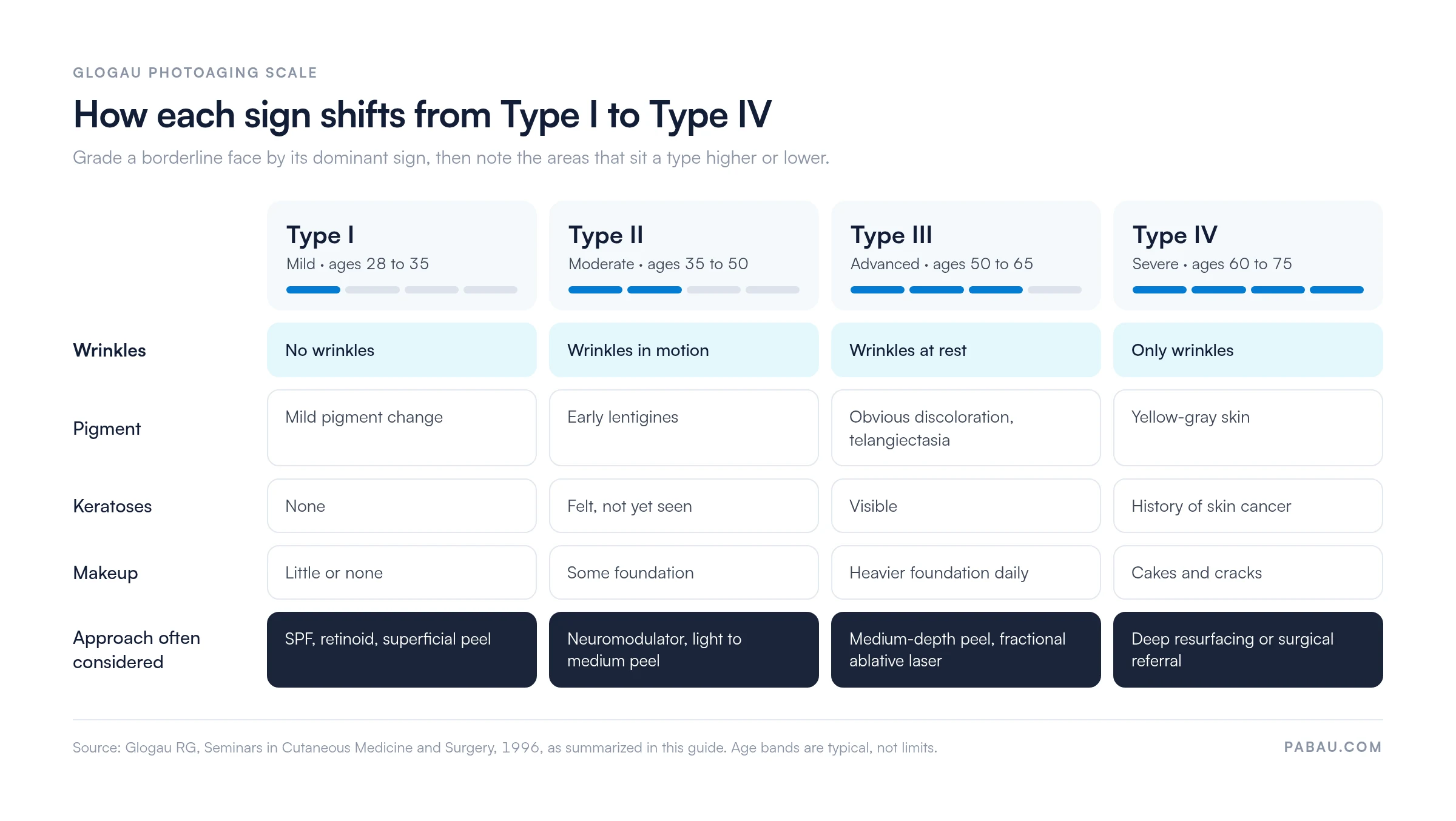
Photoaging rarely spreads evenly. Areas that catch the most sun, such as the forehead and cheeks, often grade higher than shaded skin. The template’s regional table covers the forehead and glabella, the periorbital area, the cheeks and midface, the perioral area, and the neck and décolletage.
When an area falls between two types, record both and note which features pulled it each way. Whoever reviews the record next then sees the reasoning behind the grade, along with the grade itself.
The Glogau scale grades photoaging severity, while the Fitzpatrick scale classifies skin type by its response to UV exposure. The two answer different questions and are often used together.
Recording the Fitzpatrick type on a Fitzpatrick skin type chart alongside the Glogau grade gives a fuller pre-treatment picture. The Glogau type tells you how much correction the skin needs. The Fitzpatrick type tells you how safely that correction can be delivered, especially with pigment-active treatments.
The pairing matters most at the extremes. A Type III patient with Fitzpatrick type V skin may look like a resurfacing candidate on the Glogau grade alone. Deeper peels and ablative lasers carry a higher risk of post-inflammatory hyperpigmentation in darker skin, so the plan often needs a gentler route.
The Glogau scale is quick and widely understood, but it was designed around a specific kind of patient. Knowing where it fits poorly stops a grade from steering the plan the wrong way.
In practice, that makes the Glogau type one input among several, recorded with the context that explains it.
Treatment options should follow from the assessed type, the patient’s goals and the practitioner’s training. The mapping below shows approaches commonly considered for each type, not prescriptive protocols.
Confirm every option against the patient’s Fitzpatrick type, medical history and tolerance for downtime before recommending it. Document the treatment rationale alongside the type. If a plan changes, record why, so the reasoning stays visible at review.
Sun protection belongs in every plan, whatever the type. Continued UV exposure keeps photoaging moving, so a patient who skips SPF can lose the gains of a peel or laser course.
With digital forms in Pabau, the practice software we build, the consent form sits in the same record as the Glogau assessment. Anyone opening the record sees the grade and the consent together.

The downloadable template turns the four types into a two-page assessment record you can print or fill in at the consultation chair. It follows the order of a consultation, from patient details through to sign-off.
Treat the fields as prompts during the assessment, and adapt them to your practice’s consent and documentation policy.
The template is a general record sheet and does not replace clinical judgment. Review it against your own training and local regulatory requirements before use.
Record the Glogau type, the features that support it and the date of assessment in every consultation note. Keep the wording consistent so two practitioners reading the same record reach the same picture.
Set the review date when you set the plan. Re-grading after a treatment course, with matching photos, shows the patient and the next practitioner what has changed.
Storing these entries in structured patient records makes progression easier to track over time. Assessments, photos and treatment notes then sit in one place.
In many practices the Glogau type lives on a paper sheet or in a free-text note. Photos sit on a phone, and the next practitioner has to piece the two together before comparing visits.
Pabau’s med spa software puts the whole assessment in one patient record. A Glogau form built from this template captures the type, the regional findings and the plan in structured fields. Before-and-after photos are captured and tied to the same record, so each review compares like with like.
Care Pathways send the forms and prompt for before photos ahead of the visit. The practitioner sees that checklist in Pabau GO, our iOS app. Recall workflows then invite the patient back when the review is due, so reassessments happen without staff chasing them.

Pabau stores your Glogau forms, consent and before-and-after photos in the same patient record. Each review starts from the last grade, so progress is easy to show patients.

The Glogau scale earns its place when every practitioner in the practice uses it the same way. Agree on the lighting, the borderline rule and how to grade patients who wear no makeup. Then hold every new patient and every review to that standard.
Pair the type with the Fitzpatrick type before planning anything intensive, and refer any suspicious Type IV lesion before treating. The grade then tracks how the skin responds over months of treatment. Book a demo to see how Pabau keeps Glogau grades, photos and consent together in one patient record.

Need a full-face record beyond photoaging? Full skin assessment template covers the wider skin exam in one downloadable form.
Grading skin before a facial or peel? Skin analysis form template gives estheticians a structured sheet for pre-treatment analysis.
Running a first skin care consultation? Skin care consultation form captures history, goals and concerns before you grade the skin.
Writing up the aesthetic consultation itself? Aesthetic consultation notes shows how to document the conversation, findings and plan.
Using another scored skin scale? EASI score calculator walks through scoring eczema severity area by area.
The Glogau scale is a four-type classification of photoaging based on wrinkles, pigmentation and keratoses. It helps practitioners describe how far sun-related skin changes have progressed.
Dermatologist Dr. Richard Glogau described the scale in a 1996 paper on the aesthetic and anatomic analysis of aging skin. It was designed to guide aesthetic treatment planning.
Type I is no wrinkles, Type II is wrinkles in motion, Type III is wrinkles at rest and Type IV is only wrinkles. Each type also reflects pigment change, keratoses and makeup use.
No. The Glogau scale grades photoaging severity, while the Fitzpatrick scale classifies skin type by UV response. Many practitioners use both.
Yes, estheticians can use the Glogau scale as an assessment aid, within the scope of practice set by their training and local rules.
It can be used, but it was built around lighter skin. Darker skin often shows photoaging as uneven pigment before deep lines, so pair the Glogau type with the Fitzpatrick type.
No. It is a clinical reference for describing photoaging and does not replace medical diagnosis. Suspicious lesions should be referred for medical assessment.