Professional development record
A professional development record is a structured log of a healthcare practition...

8
Last Updated: Oct 8, 2026

This free medical information form template is a four-page health screening questionnaire you can print and give to new patients.
Section one asks six yes-or-no questions, from pregnancy and contraceptives through to medication, tobacco, controlled substances and allergies. Only the last four have an explain box.
Section two is a checklist of around 70 medical conditions, and section three logs past surgeries and hospitalizations.
The last page collects one insurance carrier block and a single signature line for the patient, parent or guardian.
The template has no emergency contact fields, no provider contacts and no HIPAA release authorization, so those need separate paperwork.
A four-page health screening questionnaire for new patients, opening with yes-or-no questions on pregnancy, medication, tobacco, substance use and allergies. It then covers around 70 medical conditions, past surgeries and hospitalizations, insurance details and a signature line.
Download templateA medical information form gives your clinicians a written health history before the patient sits in the treatment chair. The template on this page is a four-page screening questionnaire you can print, hand to new patients, and file in their record. It was built for practices that need a general health history rather than a procedure-specific consent form.
Each section is broken down below, along with the fields the form leaves out. You will also find the HIPAA handling rules that apply once a patient fills it in, and what changes when intake moves online.
A medical information form is a standardized questionnaire that records a patient’s health history before treatment. Practices use it to screen for the conditions, medications and allergies that change how a treatment is delivered. Sometimes the answers show that a treatment should not go ahead at all.
It is not the same as a consent form. Consent covers one named procedure and its risks. A medical information form covers the patient’s general health, so a single completed form supports many appointments.
The template runs to four pages, split into three numbered sections, followed by an insurance block and a signature line. Here is what each part captures.
Section one asks six yes-or-no questions. The first two cover pregnancy or trying to conceive and oral contraceptives, and both take a yes or no answer only. The medication, tobacco, controlled substances and allergies questions each add a free-text explain box.
Because those four answers are free text, what you get back depends on how you prompt the patient. Ask for the drug name and how often it is taken. For allergies, record the substance and what the reaction looks like.
Section two is a two-column checklist of roughly 70 conditions. It runs from anemia and asthma through to heart pacemakers, hepatitis, psychiatric care and thyroid disease. Patients check everything that applies, now or in the past.
The list leans toward conditions that affect bleeding, cardiac risk, infection and anesthesia, which is what most treatment decisions turn on. A free-text prompt underneath catches any serious illness the checklist missed.
Section three is a log rather than a checklist. It holds three past surgeries and four other hospitalizations, each with a month and year, a reason and a hospital name. Patients with a longer history will run out of room, so keep a continuation sheet at the front desk.
The final page collects one set of insurance details, including carrier, plan, contact number, policy number and group number. It also asks for a Social Security number, and for a parent or guardian name where the patient is a minor.
Consider striking the Social Security field before you print. It is rarely needed to deliver treatment, and it raises your exposure if a paper form goes missing. The form then closes with one signature and date line.
This is a health history questionnaire, so several fields you might expect from a full intake pack are absent. Check the list below before you adopt it as your only intake document.
A broader new patient questionnaire picks up the contact and provider fields this one leaves out. For releasing records, a separate authorization form is the cleaner route, and the HIPAA section below explains why.
Clinical safety: incomplete medication or allergy answers lead to drug interactions, missed contraindications and avoidable reactions. A printed checklist also prompts patients about conditions they would never volunteer in conversation.
Regulatory compliance: a form that every patient completes gives you a consistent record of what was asked and when. The HHS Office for Civil Rights enforces the HIPAA rules that govern how you then store and share those answers.
Operational efficiency: staff know exactly what to ask and where to record it, and new team members can be trained on one document.
Patient experience: a clear, familiar form takes minutes to complete and signals that your practice takes their health history seriously.
Work through the form with the patient rather than handing it over and hoping. Five steps cover it.
The same screening questions serve very different practices, because they all turn on medication, bleeding risk and existing conditions.
HIPAA does not certify forms. It governs how your practice collects, stores and shares the information a form captures. That makes compliance a question of how you handle the paperwork afterward.
Once a patient fills this template in, the paper carries a full health history and, if you keep the field, a Social Security number. Store it in a locked cabinet. Scan it into a system with role-based access and an audit trail.
The signature line is not a release authorization. Signing this form confirms that the patient’s answers are accurate. It does not permit you to send their records to an employer, a family member or another practice.
Use a separate authorization form for disclosures. 45 CFR 164.508 requires written authorization before you release protected health information for most purposes outside treatment, payment and operations. That authorization names the recipient, the information covered and an expiration date. It also tells the patient how to revoke it.
For the wider set of obligations.
Start from the template, then edit it against the treatments you actually deliver and the patients you actually see.
Date every completed form and set a re-screening rule. Medication, conditions and insurance all change between visits. Many practices re-issue the form annually, or whenever a patient mentions a new drug or diagnosis. A three-year-old form is a liability rather than a record.
A form is only as good as the data it captures and the consistency with which it is used. Review yours at least once a year, and whenever a regulation or a service line changes.
Paper works, but it costs you twice. A staff member files the sheet, then retypes the answers into the chart, and any illegible handwriting becomes a phone call.
Practice management software like Pabau replaces the printed sheet with a digital form the patient completes before arrival. You send it by email or text, the patient fills it in on a phone, and the answers land in their record. Required fields are enforced, so nobody arrives with the allergy question blank.
The form is built from your own fields. You can keep the parts of this template that work and add the ones it lacks. Emergency contacts, a medication table and a second insurance block are all fields you set up once and reuse.
Conditional logic keeps the experience short for the patient, since someone who answers no to past surgeries never sees the surgery log. Every submission is signed digitally and timestamped, so you keep an audit trail of who completed what and when.
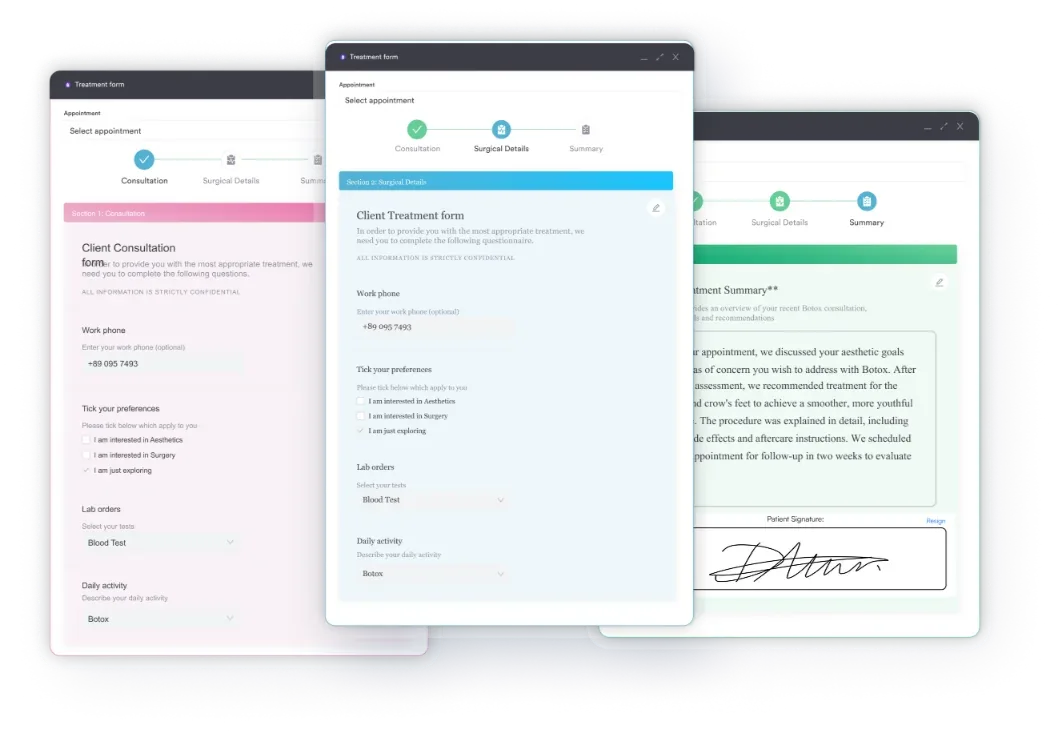

Replace paper screening forms with a digital intake process you design yourself. Patients complete the form before the appointment, the answers flow into the patient record, and your team stops retyping.

This template earns its place as a general health screen. It asks the questions that change a treatment decision, and it does it in four pages a patient can finish in a waiting room.
What it will not do is stand in for your whole intake pack. Emergency contacts, provider details and any release authorization still need their own paperwork, so decide up front which document owns which field.
Download it, edit it for your specialty, and put a review date in the calendar. If retyping answers into the chart is the part that hurts, book a demo to see how Pabau collects the same information digitally.

Building a care plan for diarrhea? Diarrhea nursing care plan template guides assessment, diagnosis, intervention planning, and outcome evaluation for diarrhea.
Building a full intake pack? New patient questionnaire template adds the contact, provider and emergency fields this health screen leaves out.
Comparing transcription tools for your practice? Medical transcription software compares nine tools for practices, weighing ambient scribe options against traditional transcription.
Choosing software for clinical notes? Clinical notes software compares options for practices looking to cut the hours clinicians spend on documentation.
Comparing patient intake software? Patient intake software compares seven platforms and matches each to how a practice books and screens patients.
The template has three numbered sections. Section one asks screening questions on pregnancy, contraceptives, medication, tobacco, controlled substances and allergies. Section two is a checklist of around 70 medical conditions. Section three logs past surgeries and hospitalizations. The last page collects insurance details and a patient signature.
No. This template is a health history questionnaire. It has no emergency contact fields, no provider contacts and no HIPAA release authorization. The signature line confirms that the patient’s answers are accurate. Add a separate authorization form if you need to release records to a third party.
HIPAA applies to how you handle the information rather than to the form itself. Store completed paper forms in a locked cabinet. Keep scanned copies in an encrypted system with role-based access and an audit trail. A consistent, dated form is the evidence of your process during a review.
A medical information form records a patient’s general health history and supports every appointment they attend. A consent form covers one named procedure, its risks and its alternatives, and is signed for that procedure only. Practices need both, and this template is the first of the two.