Best longevity clinic software: 8 platforms scored on labs, memberships and booking
The best longevity clinic software follows one member through a full year in a s...

Last Updated: Nov 18, 2026
Peptide therapy clinic software has to do more than book appointments. Peptide programs need consent for each peptide, a dosing log that changes between visits, and recurring membership or package billing.
For practices that offer peptides alongside other services, Pabau, the all-in-one practice platform we build, is the strongest fit. It keeps peptide programs, aesthetics, hormone therapy, weight loss and insurance-billed care in one patient record. Pabau users on G2 describe managing appointments, patient communication, records and reports in one place.
If peptides are your whole practice, OptiMantra and Aminova may suit you better. Cerbo suits cash-based functional medicine, and Zenoti suits large multi-location groups.
Pabau wrote this list, and Pabau is one of the eight options on it. The criteria reflect our view of what peptide practice software has to do, and we did not test rival products hands-on. Each rival verdict comes from that vendor’s own website, checked on November 18, 2026.
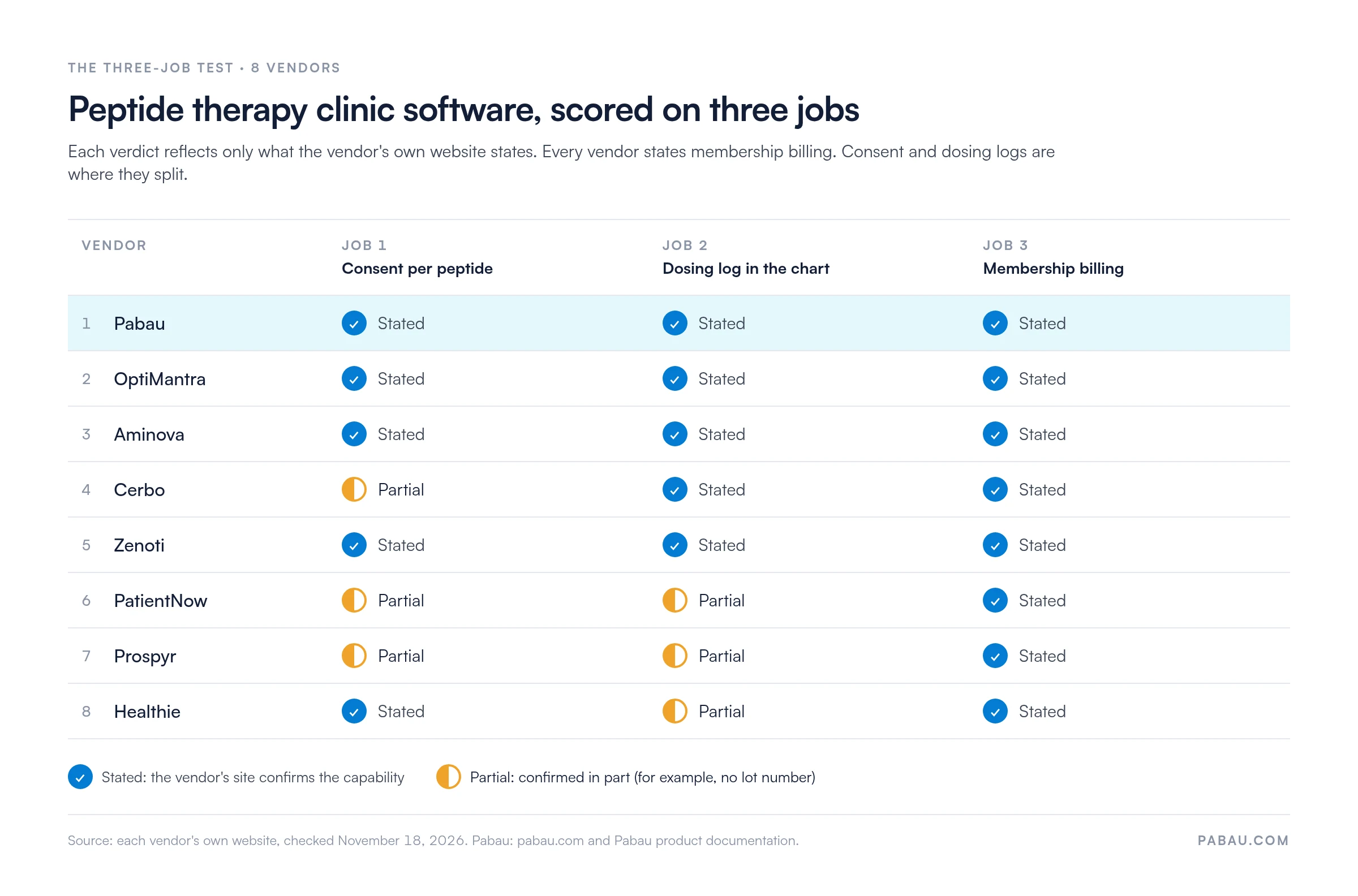
We call the scoring method the three-job test: consent per peptide, a dosing log in the patient record, and membership billing. This list covers software that runs the practice, not patient apps for tracking doses at home. The star rating on each card is our editorial score, not a review-site figure.

1. Pabau — the best fit for practices running peptides alongside aesthetics, hormones, weight loss or insurance billing.
2. OptiMantra — integrative and peptide practices that want per-treatment consents at a low published price.
3. Aminova — peptide-first EMR that ties consent forms to protocols and logs injections on the chart.
4. Cerbo — cash-based functional medicine practices that dispense from in-house stock.
5. Zenoti — multi-location med spa groups that need lot and expiry per injection zone.
6. PatientNow — aesthetic and wellness practices that want memberships, deposits and prepaid treatments.
7. Prospyr — med spas that run peptides and hormone therapy through one chart.
8. Healthie — low-cost EHR for recurring virtual care, with no injection log stated.
Pabau runs peptide programs next to aesthetics, hormones, weight loss and insurance billing in one patient record.
Pabau is the strongest fit when peptides are one service line among several. A practice that also offers injectables, hormone therapy, weight loss or insurance-billed visits keeps every patient in one chart. Pabau is rated 4.7 on G2 and 4.7 on Capterra.
Pabau sends consent forms before the visit, and the signed form lands in the patient record, not as a loose PDF. Pabau GO, our iOS app for practitioners, supports care-pathway forms and consents. The practitioner sees which pre-appointment steps are still open before the patient arrives.
Pabau records the lot and expiry against the patient and the appointment. Each stock item carries a batch number and an expiry date, and the injection face chart requires the lot. IV sessions record lots too, which matters if you also run drips, as our IV therapy EMR comparison explains.
For GLP-1 programs, practices can switch on a GLP-1 tab that shows dose over time, the current dose and weight. The GLP-1 tab records doses given and does not plan future dose steps.
Pabau handles recurring memberships and treatment packages for hormone, GLP-1 and longevity programs. A membership perk can cover any service, a category, or wallet credit with rollover. The till sells 2–12 month instalment plans through Stripe, and gift cards are supported.
Recall Workflows send SMS, email or WhatsApp on 90-day and 6-month templates. The recall Workflows skip patients who already have a booking, so nobody gets chased for a visit they have booked.
Where Pabau is not the fit: a peptide-only practice that wants prescriptions sent from the chart to a named compounding pharmacy should look at Aminova. Aminova states that integration on its site. Pabau does not claim compounding-pharmacy routing.
Pabau’s telehealth uses one credit per minute per staff member, and Pabau Scribe, our AI scribe, uses credits too. Both are free with the Care Plus add-on.
“From appointment bookings and patient communications to medical histories, consent forms, clinical photographs, treatment notes, laser settings, payments and reporting, it really does cover everything we need to run our clinic efficiently.”
Pabau publishes a starting price of $104 per month for one user, and annual billing saves up to 20%. Every Pabau plan includes the core features, and add-ons enhance the experience. Usage-based credits for SMS, two-factor codes, telehealth and Pabau Scribe can add to the bill.
OptiMantra pairs per-treatment consents and lot tracking with a low published starting price.
OptiMantra describes itself as software that helps integrative and wellness practitioners manage their practices. Every point below comes from OptiMantra’s own site, checked November 18, 2026.
OptiMantra states consent per treatment: its consent forms can be tailored for HRT and other treatments. OptiMantra’s consent overview adds e-signature through the patient portal and storage in the chart. That claim sits on the vendor’s blog, not a product page, and names no peptide form specifically.
OptiMantra tracks product quantities, lot numbers and expiration dates from the charting screen, according to its med spa page. Injection templates can be built around your own protocols, and annotated images record injection sites and quantities.
OptiMantra supports membership and recurring subscription programs, tied to services or packages if you choose. The plan list includes membership and package management.
Where OptiMantra wins: an integrative or peptide-only practice that wants a low entry price may get more for less here. OptiMantra also lists custom compounding entries in its plan.
OptiMantra lists no setup fee and asks for 30 days’ cancellation notice. OptiMantra also offers a 15-day free trial, and its compliance disclosures note that eRx may need a separate MDToolbox subscription.
Aminova is built around peptide and longevity programs, with consent forms tied to protocols.
Aminova calls itself the EMR built for peptide and longevity clinics. Every point below comes from Aminova’s own site, checked November 18, 2026.
Aminova states consent per protocol, the closest any vendor here comes to consent per peptide. Aminova’s consent guide says a form can be linked to a visit type or to a protocol. Anyone enrolled in that protocol then gets the form, signed in the patient app or on an office tablet.
Aminova keeps an in-clinic administrations list on the patient chart, where staff log each injection. Aminova also records the dispensed lot on the chart and offers a recall lookup showing which patients received a given lot.
Aminova memberships are built once, assigned from the chart, then billed on schedule. Included visits are counted at check-in, and a plan can include medication.
Where Aminova wins: a peptide-only practice that sends prescriptions to compounding pharmacies may prefer Aminova. Aminova says its peptide software sends peptide and compounded prescriptions to the pharmacies you already use.
Aminova bills month to month with no contract, and insurance billing is quoted separately. Aminova says its older Solo, Duo, Core and Growth tiers were retired in November 2026.
Cerbo suits cash-based functional medicine practices that dispense from in-house stock.
Cerbo says it is built for cash-based, direct primary care and functional medicine practices. Every point below comes from Cerbo’s own site, checked November 18, 2026.
Cerbo partly states this job: patients complete consent forms in the patient portal, and the forms come into the EHR. Cerbo’s site does not state e-signature wording or a way to attach a consent to a specific treatment.
Cerbo’s dispense logs track inventory by patient, item, batch or lot, and date. Cerbo also tracks expiry dates and Rx lot numbers, and providers document injectables and treatment areas in the chart.
Cerbo supports automatic recurring subscription payments for direct-pay and concierge practices. Cerbo also tracks how many purchased items remain on a subscription.
Where Cerbo wins: a cash-based functional medicine practice that dispenses supplements and compounded products in-house fits Cerbo well, as our functional medicine EMR guide explains.
Cerbo requires at least one full-time primary provider, and part-time means under 30 hours a week. The patient portal costs $79 per month, and telemedicine costs $27 per month per provider.
Zenoti records lot and expiry per injection zone and scales across many locations.
Zenoti positions itself as a platform for beauty and wellness, covering salons, spas, med spas and fitness. Every point below comes from Zenoti’s own site, checked November 18, 2026.
Zenoti states per-appointment consent: as soon as an appointment is booked, Zenoti auto-sends tailored intake and consent forms. Zenoti’s forms and charting page says consent forms are stored, encrypted, in the charting environment.
Zenoti’s injectable records capture the product, units per injection zone, lot number, expiry date and administering provider. For IV and wellness services, Zenoti tracks each bag, booster and vial by dose, batch and expiry.
Zenoti handles recurring billing, auto-renewals and proactive notifications for memberships and packages. Members can freeze or skip payments.
Where Zenoti wins: a large multi-location med spa group with a central operations team may prefer Zenoti’s footprint-based setup.
“This solution is helping us move to better reporting, improve our ability to track our patients, and ultimately increase our revenue.”
Zenoti publishes no figures, and multi-location pricing is customized to your footprint. Every Zenoti subscription includes onboarding support, while SMS and voice are billed on consumption.
PatientNow covers aesthetic and wellness care, but its site does not state lot tracking.
PatientNow says its EMR is built for aesthetic and wellness care, including injectables, surgery and weight loss. Every point below comes from PatientNow’s own site, checked November 18, 2026.
PatientNow partly states this job: its EMR page says digital consent forms go out by SMS or email before the visit. Consents stay connected to the patient record. Per-treatment consent appears only in a customer testimonial, not as a vendor statement.
PatientNow partly states a dosing log: providers document injection sites, units and treatment areas directly on the image. PatientNow’s site does not state lot numbers.
PatientNow’s FAQ says it supports memberships, packages, deposits, prepaid treatments, cards on file and recurring billing.
Where PatientNow wins: an aesthetic or surgical practice that sells a lot of deposits and prepaid treatments may find PatientNow’s payment options a close match.
“Very easy and convenient. Quick and clear to make appointments, schedule, invoices etc…”
“Patient Now told us we could not cancel our contract based on a minor technicality, even with a nearly decade-long customer. They would not even negotiate with us for some kind of middle ground solution.”
PatientNow builds each quote around practice size, locations and the features you need, and states no setup fee.
Prospyr is med spa software that runs peptides and hormone therapy through one chart.
Prospyr describes itself as practice management software built for med spas. Every point below comes from Prospyr‘s own site at prospyrmed.com, checked November 18, 2026.
Prospyr partly states this job: its med spa page lists consents signed before the visit, and intake writes straight into the chart. Prospyr offers per-treatment consent templates as downloads, but in-software assignment per service is not stated.
Prospyr partly states a dosing log: its weight loss page tracks injectables down to the unit, tied to the appointment. Prospyr’s site does not state lot numbers.
Prospyr memberships are recurring subscription plans that keep billing and delivering credits each cycle. Prospyr’s longevity page says hormone therapy, peptides, labs and aesthetic services run through one chart.
Where Prospyr wins: a med spa adding a small peptide menu to an aesthetics-heavy schedule may find Prospyr’s charting familiar.
Prospyr publishes no prices, and its pricing URL returned a 404 on November 18, 2026, so a demo is the only route to a quote.
Healthie is a low-cost EHR for recurring care, but it does not state an injection log.
Healthie calls itself an EHR purpose-built for recurring, collaborative care. Every point below comes from Healthie’s own site, checked November 18, 2026.
Healthie states per-appointment consent: its intake tools send forms automatically based on appointment type. Forms flow into the patient chart, and Healthie lists e-signature support.
Healthie partly states this job: its medication history tracks current and past medications on the profile. An injection, administration or lot log is not stated.
Healthie’s billing tools create recurring subscriptions, scheduled payments or automatic charges when a session is completed. Client packages can carry one-time or recurring pricing.
Where Healthie wins: a virtual-first nutrition or coaching practice that adds peptides through an outside prescriber may only need Healthie’s lower price.
Healthie offers a 14-day trial of Plus. Add-ons include DoseSpot e-prescribing at $40 per clinician per month and ClaimMD from $30 per month.
A peptide clinic EMR should handle three jobs: consent for each peptide, a dosing log with lot numbers, and billing for ongoing programs. Those three jobs make up the three-job test, and seat counts, operating systems and other basics are deliberately left off it.
When owners adding peptides talk to us, the same three frustrations come up. Each one has a consequence that lands on the patient record or the bank balance.
Owners tell us they wrote every peptide consent from scratch, because their form templates were built for aesthetics. Someone then chases unsigned forms by hand each week. When a form is still unsigned on the day, treatment waits, or it goes ahead without a signed record.
Look for software that attaches the right form to the service or protocol and files the signed copy in the chart automatically.
The lot number has to follow the product from stock into a named patient’s chart, with the dose and the site. Without that link, a recall or an adverse event cannot be traced back to the patients who received the lot.
Practices sell peptide programs as memberships or monthly instalments. Tools that cannot model a program push owners into spreadsheets, which means missed renewals and no view of what each program earns. Our guide to longevity membership pricing covers how to set those tiers.
The matrix below scores all eight vendors on those three jobs, using only what each vendor’s site states.
Most peptides marketed to practices are not FDA-approved for the uses promoted, and several sit in the FDA’s restricted category for compounding. The FDA states that compounded drugs are not FDA-approved, so it does not verify their safety, effectiveness or quality before marketing.
The FDA’s list of risky bulk substances, current as of April 22, 2026, places four peptides in Category 2:
Category 2 means the FDA has identified significant safety risks and would consider enforcement action against compounders using the substance. That definition comes from the FDA’s 503A bulk substances page, current as of May 14, 2026.
The Category 2 page also lists peptide nominations that their nominators withdrew, including BPC-157, TB-500, CJC-1295, AOD-9604 and GHK-Cu. The FDA says it does not intend to place substances nominated on or after January 7, 2025, into these categories.
The FDA’s Pharmacy Compounding Advisory Committee met on July 23–24, 2026, to discuss BPC-157, KPV, TB-500, MOTs-C, emideltide, Semax and Epitalon. As of November 18, 2026, the meeting page posts no vote or outcome.
For the software choice, two records matter most. The consent should record what the patient was told about the product’s regulatory status, and the dosing log should hold the lot. Have your medical director or counsel approve consent wording, because requirements vary by state.
Pabau runs booking, charting, consent forms, payments and memberships for practices that offer aesthetics, hormone therapy, weight loss and longevity care in one system. That breadth is why our software for longevity practices suits a mixed menu.
Here is how a peptide program runs end to end in Pabau:
Pabau’s membership tools cover any service, a category, or wallet credit with rollover. Practices can also switch on Labs to order Quest tests from the patient record, with a biomarker chart showing trends.
Pabau handles self-pay, memberships and insurance billing in one system, in the US, UK and Australia. US claims run through Claim.MD, which Pabau’s insurance billing uses for eligibility checks, ERA remittances and secondary claims.
Pricing starts at $104 per month for one user. Every Pabau plan includes the core features, and add-ons enhance the experience. Instead of a free trial, new practices get structured onboarding, so consent forms, stock and memberships are set up before the first patient.

Pabau sends peptide consents before the visit, records each lot against the patient, and bills programs as memberships or instalments. See it run on your own service menu.

Run the three-job test on your shortlist before you sit through a single demo. Ask each vendor to show a peptide consent going out with a booking, a lot landing in a patient’s chart, and a program renewing.
If peptides sit next to aesthetics, hormones, weight loss or insurance-billed visits, one system that passes all three saves the hand-offs between tools. If peptides are the whole practice and cash-pay, a peptide-first EMR such as Aminova or OptiMantra is a reasonable trade. If longevity programs lead your menu, our longevity clinic software ranking scores eight platforms on labs, memberships and booking.
Book a demo to watch Pabau take a peptide program from signed consent to monthly renewal.

Building injection consents? Vitamin D3 injection consent form covers dosage, protocol and aftercare in one form.
Rebuilding your intake? Functional medicine intake form gives you a ready intake template to adapt.
Opening a new practice? How to start a functional medicine practice covers the setup steps in order.
Pabau is the strongest peptide practice software for practices that also offer aesthetics, hormone therapy, weight loss or insurance-billed care. Peptide-only practices may prefer OptiMantra or Aminova, which both state consent, lot-level dosing logs and membership billing on their own sites.
Published starting prices on November 18, 2026, ran from $49.99 per month for Healthie Essentials to $281 per month per full-time Cerbo prescriber. Pabau starts at $104 per month for one user. Zenoti, PatientNow and Prospyr quote on request.
Yes, if the software passes the three-job test. Check that it can attach a consent to the peptide service, record the lot against the patient, and bill a monthly program. If any of the three needs a spreadsheet, plan a switch.
Some do. A practice that also offers hormone care, weight loss or primary care visits may bill insurance for those visits while selling peptide programs as self-pay. Pabau handles both, with electronic claims in the US, UK and Australia.
A peptide consent form should record the product, what the patient was told about its FDA status, and their signature and date. Have your medical director or counsel approve the wording, because requirements vary by state.