How to open a peptide clinic: 7 steps for licensed practices
How to open a peptide clinic: run peptide therapy as a prescribed service inside...

Last Updated: Nov 19, 2026
Who can prescribe peptides depends on license and state: physicians (MD or DO) can, as can nurse practitioners and physician assistants with state prescriptive authority. Which peptides they may prescribe depends on each product’s FDA status, and research-grade peptides are off the table for every license.
The Federation of State Medical Boards’ May 2026 prescribing guidance limits diagnosis, treatment and prescribing to licensed professionals acting within their lawful scope of practice. Supervision and collaboration rules come from your state, so confirm your setup with your state board and healthcare counsel before you launch.
This guide sets out the rules for prescribing peptides from the owner’s side. It covers which license on your team carries the authority and who may administer. It also shows where each named peptide stands on November 19, 2026, and the records to hold.

Physicians can prescribe peptides, and so can nurse practitioners and physician assistants with state-granted prescriptive authority. Registered nurses, aestheticians and the business entity cannot.
Nurse practitioners prescribe independently in 27 states plus DC on AANP’s May 2026 map, and need a collaborative agreement or supervision everywhere else.
On November 19, 2026, kisspeptin-10 is the only popular peptide left in the FDA’s 503A Category 2. Most withdrawn peptides have no compounding route.
HHS enforcement discretion covers six peptides, BPC-157 among them, only when every condition is met, and it is not FDA approval.
Alabama and Mississippi bar licensees from giving patients research-grade peptides, and a signed consent form does not change that.
Physicians can prescribe peptides, as can nurse practitioners and physician assistants wherever state law grants prescriptive authority, under the supervision or collaboration that state requires.
The FSMB’s 2026 guidance (adopted May 2026, checked November 19, 2026) names three groups who may prescribe for wellness treatments:
No peptide certificate creates that authority. The state license does, and the state board sets its limits. In practices we onboard, the owner is often not the prescriber. The license question is then about the medical director or NP the practice relies on. Our guide to launching a longevity clinic makes that oversight decision step one.
A licensed physician (MD or DO) can prescribe peptides within state law, after personally evaluating the patient, diagnosing them and making the treatment recommendation.
So the short answer to “can doctors prescribe peptides?” is yes, with three conditions. The first is the visit. FSMB’s 2026 guidance says the prescriber “must personally evaluate the patient, diagnose the patient, and make treatment recommendations,” and keep a comprehensive medical record.
The second is the patient’s location. FSMB’s telemedicine policy dates from April 2022. It says a physician “must be licensed, or appropriately authorized, by the medical board of the state where the patient is located.” A telehealth peptide program therefore needs a prescriber licensed in every state its patients sit in.
The third is the product. The Alabama Board of Medical Examiners (notice undated, checked November 19, 2026) is blunt. It says that “under no circumstances” may a physician “compound, administer, or dispense a non-FDA approved or research grade peptide to a patient.” A medical license does not stretch to research-grade stock.
Nurse practitioners can prescribe peptides wherever state law grants prescriptive authority: independently in 27 states plus DC, and under a collaborative agreement or supervision elsewhere.
The question “can nurse practitioners prescribe peptides?” has three answers, one for each practice environment on the AANP state practice environment map (updated May 2026, checked November 19, 2026). The NP’s authority comes from the state NP or APRN license, not from a peptide course.
Some guides put the full-practice count at 28 states. AANP’s own map data counts 27 states plus DC, so check the map on the day you staff the program. Telehealth adds the patient’s state to the question, so confirm with that state’s board of nursing before an NP prescribes across a state line.
Physician assistants can prescribe peptides within their state’s scope of practice, and nearly every state requires them to have a specific relationship with a physician.
FSMB’s 2026 guidance lists a licensed PA among the professionals who may prescribe. The AAPA’s PA practice modernization page (checked November 19, 2026) names 10 states that have eliminated the legal requirement for a specific PA–physician relationship:
Virginia sits on two lists at once. AANP classes it as restricted for NPs, yet AAPA lists it among the states with no required PA–physician relationship. Staffing a Virginia peptide program around a PA or an NP therefore changes the agreements you need. Everywhere outside those 10 states, the PA’s supervising or collaborating physician is part of the prescribing record.
Staff who cannot prescribe may administer peptides only under a prescriber’s order, where state delegation rules allow it and administration falls within their own scope.
FSMB’s 2026 guidance says “licensees may administer drugs only if administration is within that licensee’s scope of practice.” It adds that “supervising physicians retain ultimate responsibility for delegated care.”
Diagnosing and prescribing stay with the licensed prescriber. Administering can be delegated, and the person who administers still documents the dose.
Texas shows how a state writes this down. Texas Occupations Code §157.001 took effect on September 1, 1999, and we checked it on November 19, 2026. Section 157.001 lets a physician delegate medical acts to “a qualified and properly trained person acting under the physician’s supervision.” The delegating physician “remains responsible for the medical acts.”
Section 157.002(b) of the same code covers “administering or providing dangerous drugs in the physician’s office, as ordered by the physician.” Your state’s wording will differ, and the board decides who counts as qualified. Where your state requires a supervising physician or medical director for delegated injections, delegation runs through that person.
Delegation has a hard limit with research-grade products. Alabama’s board says physicians may not delegate research-grade peptides to CNMs, CRNPs or PAs at all. The same delegation logic shapes IV drips, covered in our guide to administering IV vitamin therapy.
Most peptides marketed to practices are not FDA approved for the uses promoted, although a few peptide drugs are approved for specific labeled indications.
The peptides FDA approved as drugs are few, and each approval covers its labeled indication only. Three examples from Drugs@FDA, checked November 19, 2026:
A compounded peptide is a different product, legally. FDA’s human drug compounding laws page states it plainly: “Compounded drugs are not FDA-approved.”
“Research use only” stock fails on both counts. FDA’s August 24, 2026 warning letter to Tex Peptides found its “research use only” products were intended as drugs for human use. Its tesamorelin and PT-141 (bremelanotide) were “unapproved new drugs.” The molecule matches Egrifta SV or Vyleesi, but the vial does not share their approval.
A peptide’s compounding status decides whether a pharmacy can lawfully compound it for your patient at all, and under which conditions.
Peptide compounding runs through two routes in federal law. A 503A pharmacy compounds on “valid patient-specific prescriptions,” per FDA’s compounding laws page. A 503B outsourcing facility is held to CGMP and may also fill an order from a health care provider for office use.
For 503A peptides, the bulk substance must pass one of three tests on FDA’s 503A bulk drug substances page (updated May 14, 2026):
While that list is built, FDA sorts nominated substances into interim categories. Category 1 substances “may be eligible for inclusion.” Category 2 means FDA “has identified significant safety risks.” Category 3 substances were nominated “with insufficient supporting information.” FDA says it will not categorize substances nominated on or after January 7, 2025.
The list of category 2 peptides has shrunk to one popular name. By April 22, 2026, nominators had withdrawn 17 substances from Category 2, according to FDA’s withdrawn-substances page (checked November 19, 2026). Withdrawal is not approval. Those peptides now sit on no category list, and FDA kept its safety notes on that page.
Size sets a second line. A peptide over 40 amino acids is regulated as a biological product. Since March 23, 2020, those products cannot be compounded under 503A or 503B. FDA’s deemed-to-be-a-license page defines peptides as polymers of 40 or fewer amino acids.
Then came HHS. Its 503A peptide enforcement discretion policy (October 2026) covers six peptides. HHS “does not intend to take enforcement action” against a state-licensed pharmacy, federal facility or licensed physician compounding them. Appendix A lists BPC-157, Epitalon, KPV, MOTS-c, Semax and TB-500. Every condition must be met:
The policy runs only until a final rule addresses each substance, and HHS says it “may revisit” it if a safety signal arises. On November 9, 2026, the American Medical Association voted to urge HHS and FDA to rescind the policy. Enforcement discretion is a decision not to act, not an approval, and it does not override a state ban.
Put together, those documents give the Peptide status ladder: five dated tiers a practice sorts each peptide into before offering it.
The ladder below places each named peptide on its tier, with what the practice can do at that tier.
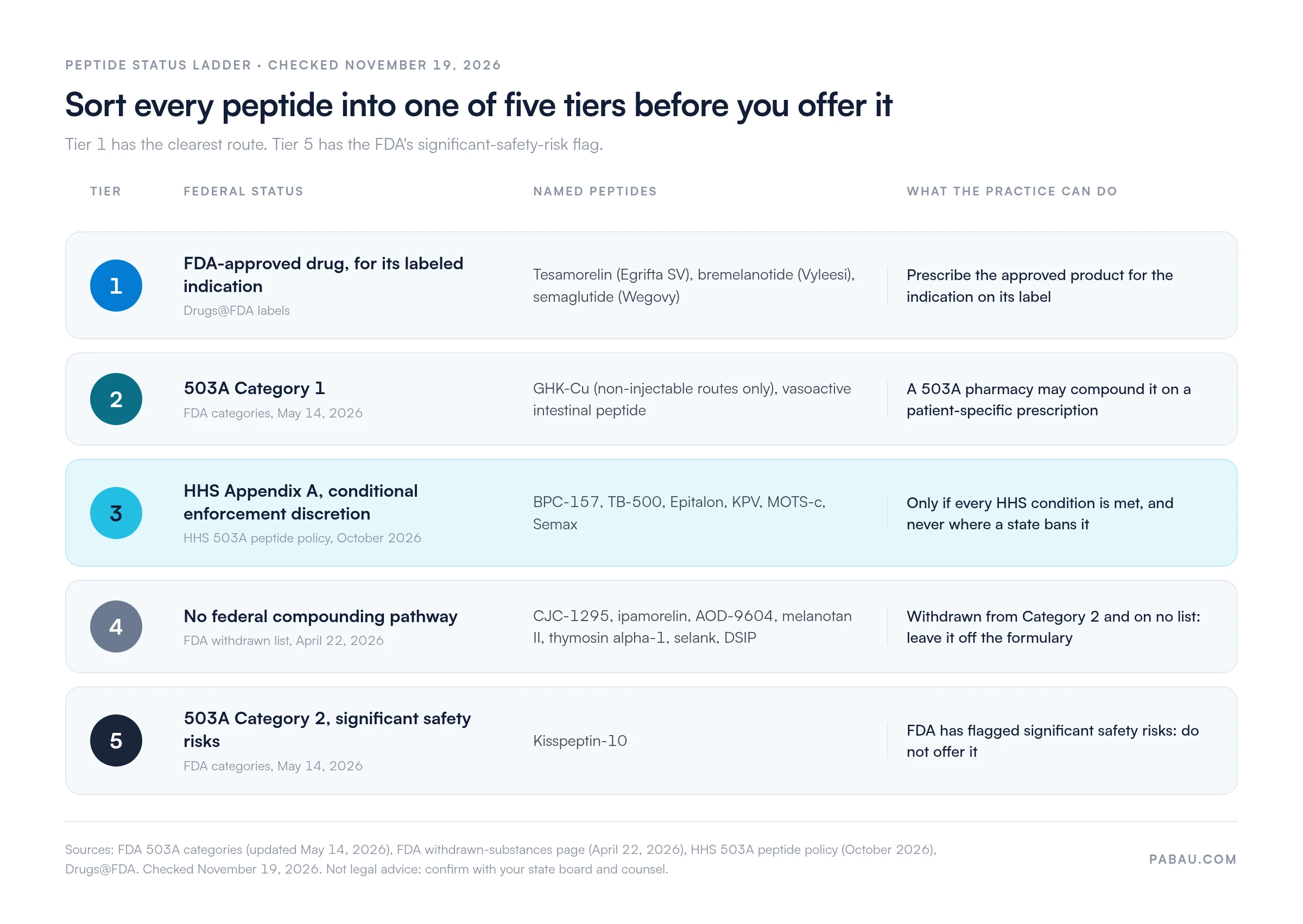
Each row below gives the tier on the Peptide status ladder and the primary source it rests on.
These lists moved in April, May and October 2026, so check the FDA and HHS pages on the day you prescribe. FDA’s Pharmacy Compounding Advisory Committee reviewed several of these peptides on July 23–24, 2026. FDA had posted no outcome on its meeting page by November 19, 2026.
Alabama’s and Mississippi’s boards bar licensees from giving patients non-FDA-approved or research-grade peptides, and a signed consent form does not change that.
Alabama’s notice says “no CNM, CRNP, or PA is legally authorized to prescribe, administer, advise, or dispense” a research-grade peptide. It also says “patient consent forms purporting to identify a product as ‘research-grade’ are ineffective.” The page carries no date. We checked it on November 19, 2026.
Mississippi’s Board of Nursing, Board of Pharmacy and State Board of Medical Licensure issued a joint statement on August 19, 2026. Its wording mirrors Alabama’s: no healthcare provider may “compound, administer, or dispense a non-FDA approved or research-grade peptide to a patient.” The statement repeats Alabama’s waiver and consent-form language.
State rules can be stricter than federal enforcement policy, so HHS discretion over BPC-157 does not reopen research-grade BPC-157 in either state. We found no primary peptide notice from the Texas or Florida boards on November 19, 2026, which is not the same as permission.
Is peptide therapy legal in your state, in the form you plan? That is a question for your board and counsel. Once both sign off, our guide to opening a peptide clinic covers the remaining setup, from compounding route to patient recall.
The Peptide prescribing check runs six steps: name the prescriber, confirm their authority, build a dated formulary, set administration and records, then confirm with counsel.
We see the same pattern in med spas and longevity practices adding peptides. The owner doesn’t prescribe, the medical director signs off from a distance, consent templates were written for another treatment, and forms get chased by hand. The check below puts prescribing peptides on a footing you can show a board.
For step 5, these are the records a practice holds for every peptide it offers:
Pabau’s practice software runs booking, charting, consent forms, payments and memberships in one system, for practices offering aesthetics, hormone therapy, weight loss and longevity care.
Practices that run peptides inside a longevity service can see that setup on our longevity clinic software page. For a peptide program, Pabau holds the Peptide prescribing check’s records on one patient record, so you’re not stitching them together before an audit.
Practices build a consent form for each peptide and send it before the visit. The completed form lands in the patient record, so it doesn’t sit as a PDF. Pabau GO, our iOS app for practitioners, supports care-pathway forms and consents too.
In Pabau, non-prescribers can draft a prescription, but only a prescriber can approve and send it. US e-prescribing runs through DoseSpot. That split matches the license table: your RN or coordinator prepares the order, and the licensed prescriber makes the decision.
Pabau stock carries a batch number and an expiry date, and the lot is recorded against the patient and the appointment. Recall Workflows (90-day and 6-month templates) send SMS, email or WhatsApp and skip patients who already have a booking. SMS runs on usage-based credits.
Programs sold as memberships run on the same record, and our guide to longevity clinic membership pricing covers how to structure them. Every Pabau plan includes the core features, and add-ons enhance the experience.
To see how Pabau compares with other systems, read our roundups of peptide therapy clinic software and the best longevity clinic software.

Pabau keeps consent per peptide, prescriptions only a prescriber can approve and send, and lot numbers on one patient record. See it set up for your formulary.

The license question is the easy part. A physician, NP or PA with authority in the patient’s state, under the agreement that state requires, settles it. The formulary is where practices get exposed, because a peptide’s status can change between one quarter and the next.
Date every check, keep tiers 4 and 5 off the menu, and treat HHS discretion as conditional rather than settled. Book a demo to see how Pabau keeps consent, prescriptions and lot records in one place for a peptide program.

Comparing systems for a peptide program? Best peptide therapy clinic software ranks the platforms that handle consent, prescriptions and lot tracking for peptide practices.
Running IV drips alongside peptides? Who can administer IV vitamin therapy sets out the license and delegation rules for IV services.
Choosing software for a longevity practice? Best longevity clinic software compares the systems built for longevity and functional care.
Selling peptide programs as memberships? Longevity clinic membership pricing walks through how to price and structure recurring programs.
No. BPC-157 has no FDA approval, and its nominators withdrew it from 503A Category 2, so it sits on no FDA category list. HHS will not take enforcement action against compounding it only when every Appendix A condition is met. Alabama and Mississippi still bar research-grade BPC-157.
Yes, a peptide intended for human use is regulated as a drug under the Federal Food, Drug, and Cosmetic Act. FDA’s August 2026 warning letter to Tex Peptides found that “research use only” labels did not change that status.
No, the business itself holds no prescriptive authority. A licensed physician, nurse practitioner or physician assistant on the team writes the order, and ownership rules vary by state, so check them with counsel.
Yes, when a licensed prescriber orders an FDA-approved or lawfully compounded product within state law. Research-grade peptides fail that test, and Alabama and Mississippi say so outright.
No commonly marketed peptide appears on the DEA’s controlled substances list dated November 17, 2026, including BPC-157, ipamorelin, tesamorelin and semaglutide. Testosterone is Schedule III, and dispensing a controlled substance requires DEA registration under 21 CFR 1301.11.