Despina Petrushevska
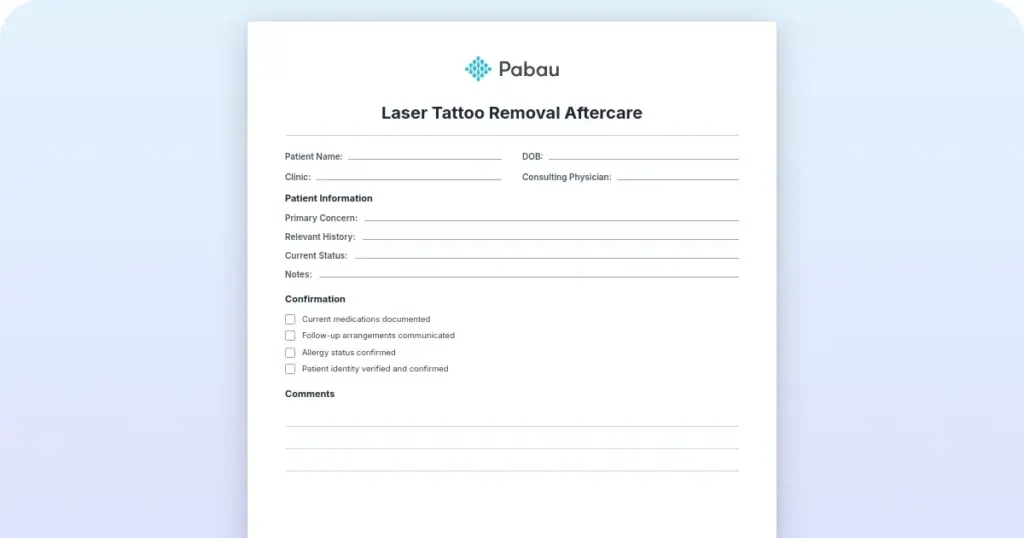
Laser tattoo removal aftercare instructions template
Download your free laser tattoo removal aftercare instructions template A ready-...

26
Last Updated: Sep 4, 2026
Free PDF 2 pages, print-ready Clinician-reviewed
What is a Consent for Laser Tattoo Removal? A digital consent form for laser tattoo removal is a legal document that documents a patient’s informed agreement to undergo the procedure. It outlines the procedure description, potential risks, side effects, contraindications, expected outcomes, aftercare instructions, and the patient’s acknowledgment that they understand these elements before treatment […]
A ready-to-use consent form covering procedure description, risks and side effects, contraindication screening, risk disclosures, patient acknowledgment, photography consent, minor/parental consent, multi-session validity, and liability waiver.
Upload this PDF, or any form you already use, and Pabau's AI Form rebuilds it with tick boxes, text fields and a signature. Attach it to the treatment once, and every patient gets it on time.
AI Form rebuilds the consent, history and aftercare forms you already use. You review each one, then publish.
Patients complete forms on their phone before they arrive, so the front desk stops retyping paper.
Every signed form is versioned and attached to the treatment record, ready when you need it.
Set how long a consent stays valid. Returning patients skip forms they have already signed.
Supports HIPAA and GDPR compliance AES-256 encryption 4.8 on G2 4.7 on Capterra Trusted by 4,000+ practices worldwide

A consent form for laser tattoo removal is a legally binding document that ensures patients understand the procedure, risks, aftercare, and expected outcomes before treatment begins.
The form must include procedure description, risk disclosures (dyspigmentation, scarring, incomplete removal), contraindication screening, and photography consent in compliance with HIPAA and GDPR.
Minors (under 18) require parental or guardian consent in all US states and the UK – this clause must be explicitly included in your consent form template.
Pabau’s digital forms feature allows clinics to collect, store, and manage patient consent electronically, reducing paperwork and ensuring compliance documentation is always audit-ready.
A digital consent form for laser tattoo removal is a legal document that documents a patient’s informed agreement to undergo the procedure. It outlines the procedure description, potential risks, side effects, contraindications, expected outcomes, aftercare instructions, and the patient’s acknowledgment that they understand these elements before treatment begins.

Informed consent protects both the clinic and the patient. According to clinical guidance from the National Center for Biotechnology Information, obtaining informed consent with a clear outline of risks and benefits prior to tattoo removal is essential and protects both clinician and patient from miscommunication and liability exposure.
The form also serves as a critical compliance document. In the UK. In the US, HIPAA regulations mandate that patient records-including consent forms-are securely stored and accessible for audit purposes.
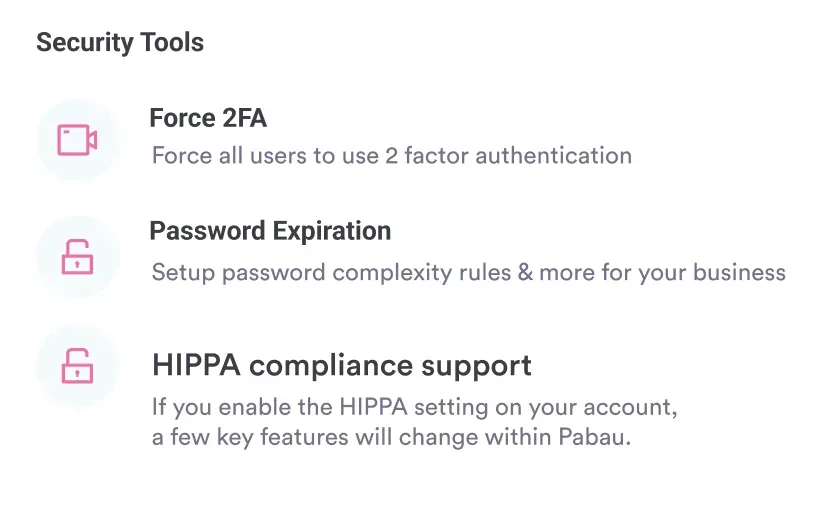
Using the consent form effectively requires a structured, patient-centered workflow. Each step ensures the patient is informed and the clinic is legally protected.
This template is ready to download, customize with your clinic branding and logo, and implement immediately. The form is editable in both Word and PDF formats, making it easy to adapt to your clinic’s specific protocols and regulatory jurisdiction.
The laser tattoo removal consent form is essential for any aesthetic or medical clinic offering laser tattoo removal services. This includes:
Whether you operate a single-location clinic or a multi-location aesthetic group, having a standardised, legally-reviewed consent form is non-negotiable for patient safety and regulatory compliance. Medical spas offering laser tattoo removal alongside other treatments need software that manages consent, scheduling and compliance in one place.
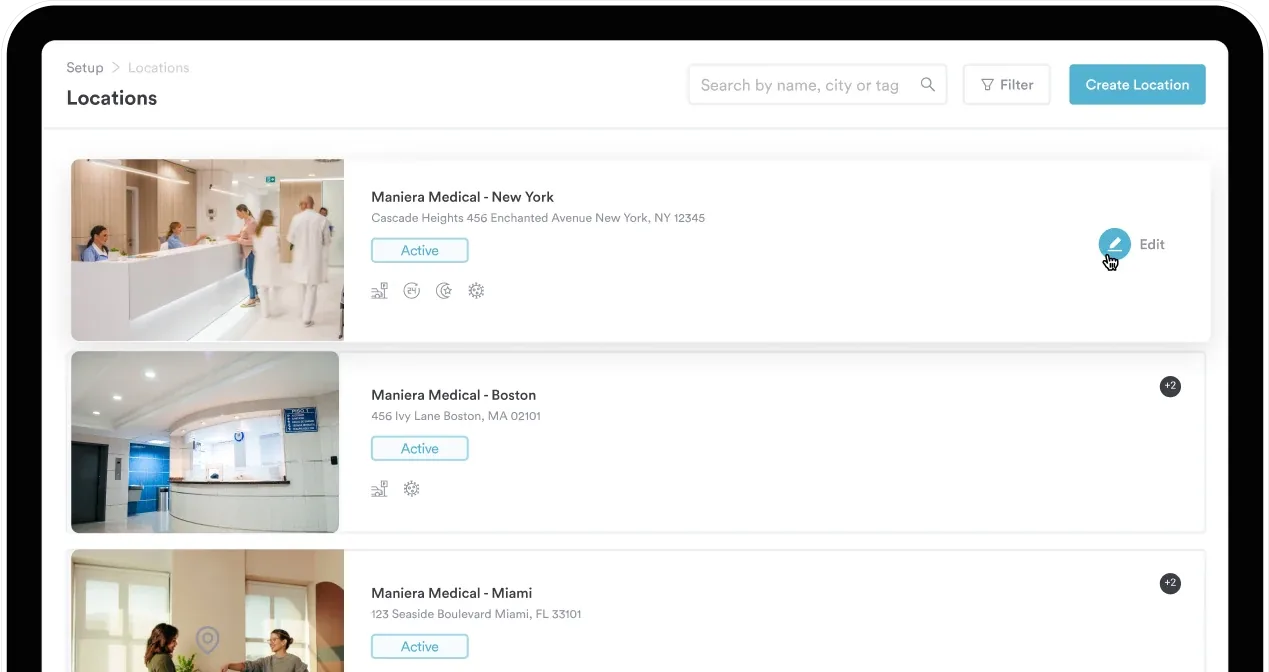
If you are comparing platforms, this guide to the best aesthetic clinic software weighs charting, photos, and payments side by side.
Legal protection: A clear, comprehensive consent form documents that the patient was informed of risks and agreed to proceed. This protects your clinic in the event of a patient dispute or regulatory investigation. CQC inspections specifically review consent documentation; clinics without evidence of informed consent receive compliance findings.
Patient safety and realistic expectations: When patients understand that complete tattoo removal is not always possible, that multiple sessions are typically required, and that side effects (dyspigmentation, temporary erythema, scarring) may occur, they develop realistic expectations. This reduces post-treatment dissatisfaction and disputes.
Regulatory and data protection compliance: A form that includes HIPAA (US) and GDPR (UK) language for photo storage, data retention, and patient rights demonstrates that your clinic takes compliance seriously.
Operational efficiency: Using digital consent forms (rather than paper) allows patients to complete and sign the form before arriving at the clinic, reducing check-in time and ensuring all documentation is standardised and searchable in your electronic health record.

Digital forms reduce paperwork, improve compliance, and let patients complete consent before arrival. See how Pabau’s forms feature works.

Photography is a critical part of the laser tattoo removal consent process. According to NCBI clinical standards, photographs and written informed consent should be obtained initially, before every session, and after treatment to document progression and outcomes.
Your consent form must include a dedicated photography clause that covers:
Patients under the age of 18 require parental or guardian consent for laser tattoo removal. This is a legal requirement across all US states (Washington, California, New Jersey, and others explicitly codify this) and in the UK under the Mental Capacity Act 2005 and common consent law.
Alongside the signed consent, a laser treatment tracker logs the settings, treated area and skin response from each visit in the course.
A comprehensive laser tattoo removal consent form must include procedure description, list of known risks and side effects (dyspigmentation, scarring, incomplete removal, pain), contraindication screening, photography consent with GDPR/HIPAA language, minor/parental consent section, multi-session validity clause, aftercare instructions, and patient acknowledgment. The form must be signed and dated by both patient and clinician.
Yes. All US states and the UK require parental or guardian consent for patients under 18. Your consent form must include a dedicated minor consent section with the parent/guardian’s signature, verification of legal authority to consent, and documentation of the minor’s assent.
Clinical standards recommend obtaining initial written informed consent before the first session. Consent may remain valid for all future sessions on the same tattoo provided the patient alerts staff to any new contraindications or medical changes. However, brief verbal re-confirmation of willingness to proceed before each session is good practice.
Key risks include pain during treatment, temporary or permanent dyspigmentation (lightening or darkening of skin), scarring and textural changes, incomplete pigment removal despite multiple sessions, infection if aftercare is not followed, and rare allergic reactions. Risk profiles vary by Fitzpatrick skin type and tattoo depth.
Yes, most consent forms state that consent is valid for all future laser tattoo removal treatments on the same area, provided the patient alerts staff to any changes in health status, medications, or contraindications. This avoids re-signing at every appointment while maintaining compliance documentation.