HIPAA compliant texting: What you can send patients & how to communicate securely
HIPAA compliant texting is possible when a text holds no protected health inform...

Last Updated: Oct 16, 2026

A confidentiality agreement is a legally binding contract that protects sensitive patient data, business information, and proprietary processes from unauthorized disclosure.
Key clauses define confidential information, party obligations, the duration, exclusions, breach remedies, and the governing law.
Practices use confidentiality agreements at staff onboarding, alongside HIPAA compliance. The agreement complements HIPAA’s regulatory requirements rather than replacing them.
Pabau’s digital forms and team management tools deliver, store, and track signed agreements across your staff.
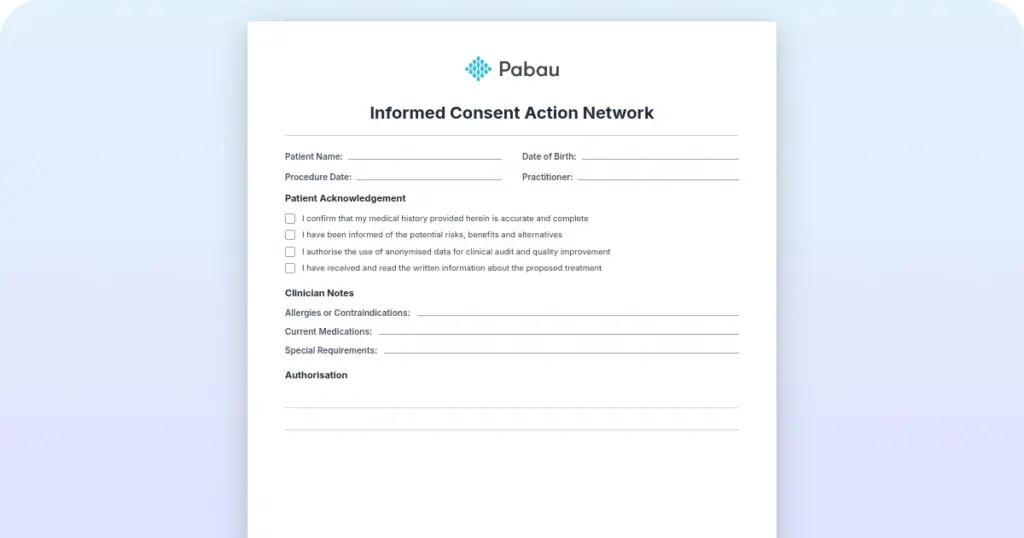
A ready-to-use confidentiality agreement covering employee obligations, patient data protection, consent declarations, and HIPAA-aligned confidentiality requirements for healthcare practices.
Download templateA confidentiality agreement is a signed contract that stops staff and partners from disclosing patient data, business information, or clinical processes. In a healthcare practice it reaches somewhere HIPAA does not. HIPAA binds your organization, while the agreement binds the individual who signed it.
The template above covers the clauses most practices need, and the sections below explain how to adapt each one. You will also see where the agreement stops, since it does not replace HIPAA training or documented security policies.
A confidentiality agreement, also called a non-disclosure agreement or NDA, is a legally binding contract. One or more parties promise to keep specific information confidential and not disclose it to third parties. In healthcare, it protects patient data, staff information, and proprietary clinical processes.
The agreement sets out what counts as confidential information and what happens if someone breaches those obligations. Practices use it during staff onboarding, so every team member has documented their duty to protect patient privacy.
The terms “confidentiality agreement” and “NDA” get used interchangeably, and both serve the same legal purpose. Each creates a contractual relationship where the protected information stays protected and a dispute can be settled in court.
Confidentiality agreements apply across several practice relationships:
The Society for Human Resource Management (SHRM) recommends confidentiality agreements as best practice for healthcare employers, particularly in practices handling regulated patient information.
A solid template contains these components:
Store each signed agreement where you can retrieve it during an audit, with a timestamp showing when the person signed. A digital form does both, so an inspection does not depend on finding the right paper file.
Healthcare employers use an employee-specific version to set baseline expectations during onboarding. It usually covers:
According to the Equal Employment Opportunity Commission (EEOC), these agreements must be reasonable in scope. They cannot block disclosures that employment law protects, such as a whistleblower complaint.
The social media clause is the one staff break most often, usually without meaning to. Our guide to HIPAA and social media covers the posts that cross the line. Running HIPAA training for employees alongside the signature makes the clause stick, because staff learn why it exists.
A confidentiality agreement does not replace HIPAA, the Health Insurance Portability and Accountability Act. It complements HIPAA, and the two cover different ground.
What HIPAA requires: Practices must secure protected health information, known as PHI, put safeguards in place, train staff, and document their policies. HHS official HIPAA guidance sets those organizational standards.
What the agreement adds: A contractual promise from each staff member or partner to uphold confidentiality personally. It names the consequences of unauthorized disclosure and documents that the person understood the rules.
HIPAA and the agreement overlap on one line of the comparison below, and diverge on the other six. That is the case for signing one even though your HIPAA program is already in place.
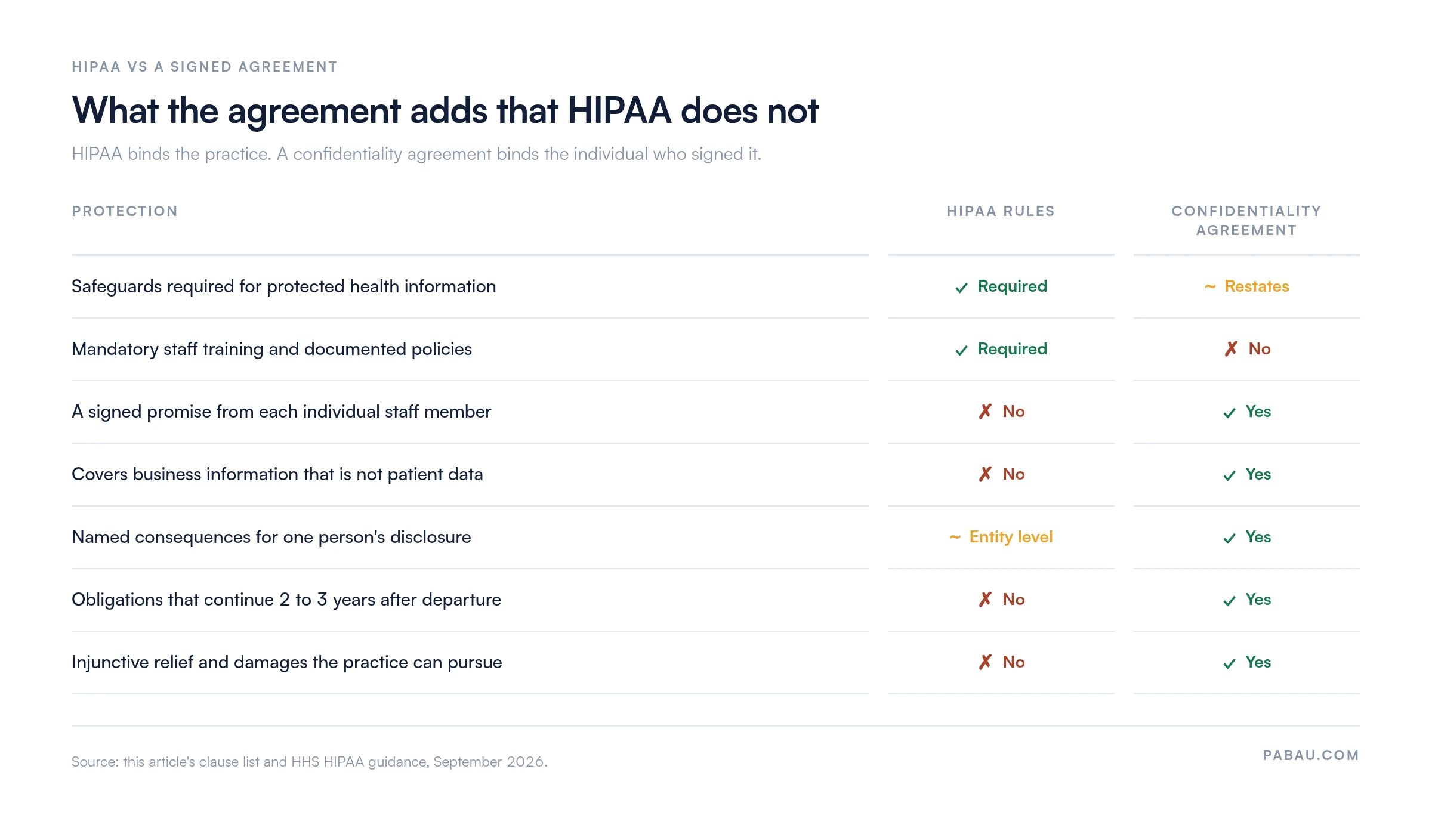
Run both and you get two layers of protection. HIPAA supplies the organizational policy, and the signature supplies individual accountability.
Confidentiality agreements come in four forms, and the relationship decides which one you use.
Most practices run a unilateral employee agreement for staff and a mutual one for business partners. Recording which form applies to each relationship is the difference between easier compliance management and a scramble when an inspector asks.
The template gives you a ready-made foundation. Adapt it for your practice with these steps:
Legal review is worth it. This template is a solid foundation, but employment law varies by state and country. Ask a healthcare attorney in your jurisdiction to check the wording before you roll it out.
A breach exposes the person who disclosed the information to dismissal and to civil action. Five consequences come up most often:
Access logging is how a breach gets detected in the first place, and EHR security controls decide how much of the trail you keep. If a disclosure has already happened, our guide on what to do after a HIPAA violation walks through the reporting deadlines.
To lower the risk, cover the obligations during onboarding and revisit them each year. Keep a record of every training session and every signature for audit purposes.
Most practices handle this on paper. The manager prints the agreement, catches the new hire between appointments, and files the signed sheet in a drawer. Finding it two years later is somebody’s afternoon.
Practice management software like Pabau turns the agreement into a digital form. You send it with the rest of the onboarding paperwork, and the new hire signs on a tablet or their phone. The signed copy lands in their staff record with a timestamp.
Team management shows you who has signed and who has not, so you can chase two people instead of auditing thirty files. Every Pabau subscription includes both the forms and the team records, so you are not adding a module to get them.

Pabau’s digital forms and team management tools help you deliver, store, and track signed confidentiality agreements across your whole staff in one secure system.

The agreement is only as good as the rollout. A template signed by every member of staff and stored where you can retrieve it beats a perfect document nobody has signed.
The trade-off worth remembering is scope. Draw the confidential-information clause too narrowly and it protects little. Draw it so broadly that it blocks a protected complaint and a court may refuse to enforce it. Your attorney is the one who should draw that line.
Get the wording right once, then make the signing and the filing automatic. Book a demo to see how Pabau collects and stores every signed confidentiality agreement in your staff records.

Need the organizational side of compliance, not just the signature? HIPAA compliance for medical offices walks through the safeguards, training and policies HIPAA expects of the practice itself.
Need the patient-facing privacy policy to match? HIPAA privacy policy template gives you a practice-ready policy covering how you collect, use and disclose patient information.
Moving your signed forms off paper? Running a paperless practice that stays HIPAA compliant covers the storage, access and retention rules a digital archive has to meet.
Wondering how long to keep a signed agreement? How long to keep medical records sets out the retention periods that apply to staff and patient documentation.
A confidentiality agreement is a legally binding contract. One or more parties promise to keep specific information confidential and not disclose it to unauthorized third parties. In healthcare, these agreements protect patient health information, staff records, business strategies, and proprietary clinical processes.
Yes, provided it meets the standard requirements for forming a contract. There has to be an offer, which is the practice presenting the agreement, and acceptance, which is the employee signing it. Consideration is the employment or pay the employee receives in return. Courts enforce a breach through injunctive relief and damages.
Employee confidentiality agreements usually stay in force during employment and for a defined period afterward. Two to three years after departure is common for healthcare roles. Trade secret protection can run longer. State the exact term in your agreement, because an indefinite or perpetual term can be hard to enforce in some jurisdictions.
A unilateral, or one-way, agreement obligates only the receiving party to keep information confidential. It suits employee and vendor relationships. A mutual, or bilateral, agreement binds both parties equally to protect each other’s confidential information. It suits partnerships and joint ventures.
No. A confidentiality agreement does not replace HIPAA obligations. HIPAA is a regulatory requirement that mandates organizational safeguards, staff training, and security policies. A confidentiality agreement adds a contractual layer, creating individual accountability and consequences for breaches. Best practice is to implement both.
You can use the same template as a foundation, but customize it for different roles. Clinical staff may carry stricter obligations around patient data. Administrative staff focus more on business information. Make sure each version reflects the confidentiality risks specific to that role.
Exclusions usually cover information already in the public domain. They also cover knowledge the receiving party developed independently, without access to your confidential information. Disclosures the law requires, such as a court order or a whistleblower protection, are excluded too. List these exceptions clearly in the agreement.
A data processing agreement is required under GDPR and similar rules when a third party processes personal data on your behalf. A software vendor is the common example. The DPA specifies how data is processed, stored, and deleted. A confidentiality agreement is broader and protects other sensitive information, including business and trade secrets. For vendors, use both.