HIPAA compliant texting: What you can send patients & how to communicate securely
HIPAA compliant texting is possible when a text holds no protected health inform...

Last Updated: Oct 16, 2026
A medical renewal form, sometimes called a medical renew form, is the document patients complete to confirm they still qualify for their health coverage. It updates household details, income, and insurance status once a year, or sooner when circumstances change.
Practices use it for Medi-Cal and Medicaid redeterminations, private plan renewals, and prescription renewal requests. A standardized template keeps every renewal complete, comparable across patients, and ready for audit.
A comprehensive template covering patient identifiers, household composition, income verification, insurance details, renewal consent, and clinic audit trail fields. Ready to customize for Medi-Cal, private insurance, and prescription renewal workflows.
Download template
A medical renewal form captures patient identifiers, household composition, income, insurance details, and consent, so the payer can confirm ongoing eligibility.
Medicaid and Medi-Cal require an annual redetermination. Private plan renewals and prescription refill requests run on their own timelines.
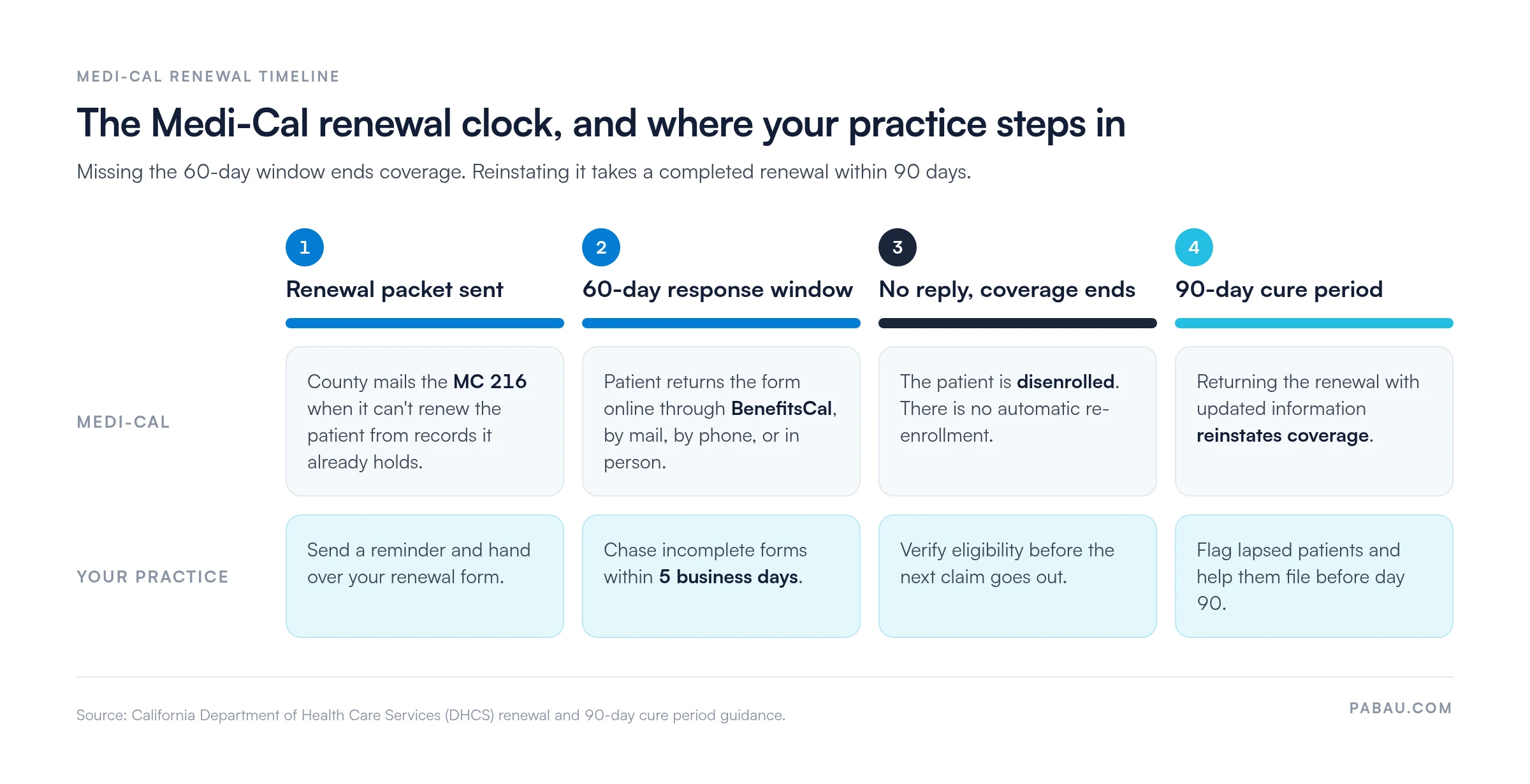
Medi-Cal gives beneficiaries 60 days to return a renewal packet. A missed deadline ends coverage, followed by a 90-day cure period to reinstate it.
The practice audit trail on each form, with the date, staff initials, and attestation, is your evidence in payer audits and disputes.
Practice management software like Pabau sends renewal forms and reminders automatically, so fewer patients lose coverage between visits.
A medical renewal form documents the annual or triggered update of a patient’s coverage eligibility, household composition, income, and insurance enrollment. Practices use it to confirm patients still qualify for the benefits they claim and to meet payer requirements. The form does three jobs:
The forms are standard in Medicaid and Medi-Cal, where DHCS (California Department of Health Care Services) issues the official MC 216 renewal form. They matter just as much in private insurance, where current eligibility data prevents claim denials.
Renewal triggers vary by insurance type and state program. Knowing the timing lets your front desk plan outreach before coverage lapses.
Start outreach early. A first reminder 90 days before the deadline, then the form itself at 60 days, gives patients time to gather their documents. Automated SMS and email reminders flag upcoming renewal dates and send patients to the online portal, so your team isn’t phoning round.
A complete medical renewal form captures five categories of data: Patient identifiers, household composition, income verification, insurance enrollment, and practice audit fields.
Practices must also include a consent box. In it, the patient acknowledges the renewal and authorizes the practice to contact the insurer about eligibility. This consent matters under HIPAA, which governs when protected health information can be shared with third parties.
Practice staff manage four core steps: Form distribution, data collection, eligibility verification, and record documentation.
Practices that automate these four steps spend less time chasing paperwork and see fewer eligibility-related claim denials.
The terms “redetermination” and “renewal” are often used interchangeably, but they have distinct regulatory meanings in Medicaid and private insurance.
For practice purposes, both processes need a renewal form that captures updated eligibility data. The key difference is what happens when the patient stays silent. Medi-Cal’s response window is 60 days, and a missed deadline ends coverage. Private plans may end coverage or re-enroll the patient in the same plan.
The timeline below maps each stage of a Medi-Cal renewal to the step your practice takes at that point.
A prescription renewal request form is a subset of the medical renewal form. Practices use it when a patient needs a new dispensation without a new prescription order. It documents patient consent, the current medication list, refills remaining, and prescriber contact details. It needs no income or household data. It only confirms the medication is still clinically appropriate and that the patient is authorized to refill.
Practices that run these requests through prescription management software route them electronically to the prescriber, which cuts phone tag and speeds up approval. That matters most in primary care and chronic disease management, where patients refill stable medications quarterly or annually.

Want to see renewal forms, eligibility tracking, and prescription requests handled in one platform? Schedule a call with our team to see how digital forms and automated reminders keep your eligibility records current.
Five operational habits cut errors and compliance risk:
Renewal admin often runs on paper packets, phone reminders, and a spreadsheet of deadlines that someone has to remember to check. When a patient misses the 60-day Medi-Cal window, the practice may only find out when the next claim is denied.
In Pabau, you build the renewal form once as a digital template. You then send it to patients by email or SMS and track completion as it happens. Submitted answers update the patient record automatically, so staff see eligibility status, renewal dates, and flagged deadlines in one place.
Pabau’s workflow automation sends reminders ahead of each deadline and chases forms that haven’t come back. Your front desk stops chasing paperwork by phone, and billing works from current coverage dates.

Pabau sends renewal forms and reminders automatically and files every signed form in the patient record. Your team spends less time on paperwork and more time with patients.

Treat renewals as a date-driven workflow, because the Medi-Cal clock doesn’t bend. Patients get 60 days to respond, then lose coverage, then have 90 days to reinstate it. Starting outreach at 90 days and tracking every returned form gives your patients the best chance of never reaching that last stage.
Download the template, add your practice’s audit fields, and send it digitally so the answers land in the chart. Book a demo to see how Pabau keeps renewal forms, reminders, and eligibility dates in one place for your team.

Ready to go digital? Medical forms at your healthcare practice covers designing intake and renewal workflows that reduce errors and improve the patient experience.
Need a matching intake document? Medical information form gives you a ready-made template for the health history that sits alongside renewal data.
Sharing records with a payer? Authorization for release of confidential information is the consent template to pair with your renewal paperwork.
Choosing a forms platform? Patient intake software compares the tools that send, collect, and file patient forms digitally.
A medical renewal form documents the annual or triggered update of a patient’s coverage eligibility, household composition, income, and insurance enrollment. Practices use it to verify ongoing eligibility, record consent for redetermination, and keep an audit trail for HIPAA and payer compliance.
Medicaid and Medi-Cal beneficiaries renew once a year. Private plans renew annually during open enrollment, which runs November 1 to January 31 for Covered California. Changes in household or income can trigger an interim redetermination outside the regular cycle.
Yes. Medi-Cal beneficiaries can renew online through BenefitsCal, or by mail, by phone, or in person at their county office. Covered California enrollees renew on the Covered California website. Practices can also email digital renewal forms to patients, which improves completion rates and reduces paper handling.
Medi-Cal beneficiaries who miss the deadline are disenrolled. They then have a 90-day cure period to reinstate coverage by returning the renewal with updated information. Private plans typically end coverage if the patient doesn’t renew during open enrollment, though some auto-renew in the same coverage tier.
Keep signed renewal forms, eligibility verification letters, and payer correspondence for at least three years. Some states require longer retention, so check your state insurance department’s rules. Digital retention in a HIPAA-secure system is acceptable.
Not strictly, but practices should verify current eligibility before submitting claims. Billing a plan after coverage ends, or without current household and income data on file, raises the risk of claim denials and retroactive disenrollment complications.