HIPAA compliant texting: What you can send patients & how to communicate securely
HIPAA compliant texting is possible when a text holds no protected health inform...

Last Updated: Oct 16, 2026

A client agreement is a legally binding contract that protects both you and your client by defining service scope, payment terms, and responsibilities.
Every healthcare client agreement must include scope of services, payment terms, confidentiality clauses, termination conditions, and signatures.
Healthcare-specific clauses like informed consent references, HIPAA/GDPR compliance, and data protection safeguard against regulatory risk.
Pabau’s built-in digital forms and e-signature workflows automate agreement execution and storage without manual document management.
A legally binding document covering client details, service scope, payment terms, cancellation policies, confidentiality obligations, termination conditions, and signature blocks for healthcare and aesthetic practices.
Download templateA client agreement template protects your practice and clarifies expectations for every client you serve. This guide walks you through the essential clauses every healthcare client agreement must contain, why they matter, and how to customize the downloadable template for your practice.
A client agreement is a legally binding document that establishes the terms, conditions, and expectations between your practice and each client before treatment begins. It specifies what services you will provide, how much you will charge, when payment is due, what happens if the client cancels, and how you will handle their personal and health information.
Healthcare practices of every kind — aesthetic practices, physical therapy providers, mental health practices, and medical spas — rely on a client agreement for three critical functions: it reduces disputes over service scope and pricing, it documents informed consent and treatment expectations (reducing liability), and it confirms the client’s agreement to your confidentiality and data protection obligations.
Without a signed agreement on file, you have no documented proof of what you promised or what the client agreed to.
Many practices operate without a formal client agreement, relying instead on verbal understanding or assumption. This creates compliance risk and legal exposure, especially in regulated jurisdictions like the UK (CQC requirements) or the US (HIPAA). A written client agreement shifts that risk to documented mutual understanding.
The downloadable client agreement template below covers the core clauses you need. You can customize it for your practice type, add industry-specific language, and integrate it into your intake workflow so every client signs before their first appointment.
A robust client agreement contains eight essential sections, each addressing a specific aspect of your professional relationship with the client. Competitors’ generic templates often omit healthcare-specific clauses, leaving you vulnerable to regulatory or contractual disputes.
The scope of services section is where you spell out exactly what you will and will not do. Vague language (“providing aesthetic services”) creates confusion. Specific language (“three initial consultation hours plus four follow-up sessions spaced two weeks apart”) leaves no room for misinterpretation.
For aesthetic practices, name the exact treatments: “Botox injections to the forehead and glabellar region” not just “facial injections.”
For physical therapy providers, specify session length and frequency, such as “12 sessions of one-hour physical therapy, one per week” . For mental health practices, state modality and duration: “weekly psychotherapy, 50 minutes per session, for 12 weeks.”
Include any exclusions (“treatment does not include laboratory testing” or “does not include prescription medications”) so the client knows what falls outside the agreement.
The more specific you are upfront, the fewer disputes arise later.
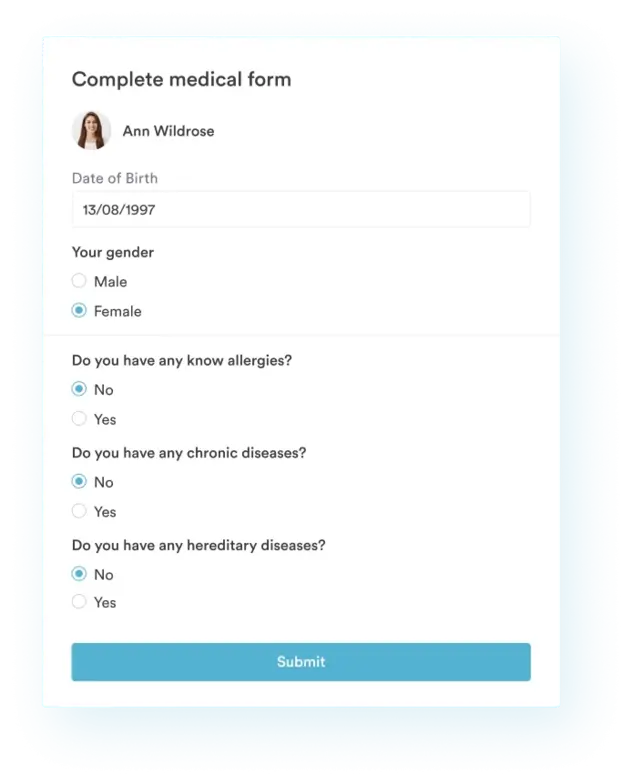
With online patient intake, completed forms land in the chart before the appointment starts.
A clear payment clause protects your revenue. State your full fee, whether you require a deposit (and if so, whether it is refundable or non-refundable), when final payment is due, and what payment methods you accept. Include your cancellation and no-show policy with at least 24-48 hours’ notice. Specify any cancellation fees or forfeit of deposits.
Example: “Client agrees to pay $800 for the full treatment package. A non-refundable deposit of $200 is due at booking. The balance is due in full at the first appointment. If the client cancels with less than 48 hours’ notice, the deposit is forfeited. Three consecutive no-shows without cancellation will result in automatic termination of this agreement.”
Clients are far less likely to skip an appointment if they know a deposit is at stake.
This is where healthcare-specific language is essential. Your client agreement must reference HIPAA (US) or GDPR (UK/EU) compliance and confirm how you will safeguard their data. Generic templates from PandaDoc or Plutio skip this entirely, leaving regulated healthcare practices exposed.
Include language like: “The Provider agrees to maintain the confidentiality of all Client information, including health records, photographs, and communications, in accordance with HIPAA regulations (if applicable in the US) or GDPR (if applicable in the UK/EU).”
It should also state that client data is stored securely and will not be shared with third parties without explicit written consent, except where required by law, and that the Client agrees not to disclose the Provider’s treatment protocols or fees to unauthorized parties without consent.
UK data protection rules require you to document how client personal data is processed and stored. A confidentiality clause in your client agreement fulfills part of this obligation. In the US, HIPAA Privacy Rule requirements mandate written privacy notices and data safeguards. A client agreement that addresses both confidentiality and data handling strengthens your compliance posture.
Define how either party can end the relationship and under what circumstances. State notice periods (“either party may terminate with 14 days’ written notice”) and grounds for immediate termination (“non-payment, abusive behavior, or violation of confidentiality clauses”).
Include what happens to client records — archived, destroyed.
Add a brief dispute resolution clause: “If a dispute arises, the parties agree to attempt mediation before pursuing legal action. Mediation will take place within [your jurisdiction] and be governed by [applicable law].” This can save both you and the client money if disagreements arise.
Generic template providers miss critical healthcare clauses that protect you from liability and ensure compliance. When customizing your client agreement, add these language blocks:
Clients see these clauses as a sign of professionalism and regulatory diligence.
Follow these five operational steps to create a practice-specific client agreement from the template:
Once you have customized the template.
Using overly vague language (“client receives treatment”) instead of specific descriptions is the most common error. A second mistake is omitting healthcare-specific clauses entirely, leaving you unprotected against regulatory scrutiny. A third is failing to update the agreement when your services, pricing, or cancellation policy changes.
If clients repeatedly ask about cancellation fees or treatment scope, clarify that language in your next revision. Review and update your template annually or whenever your practice’s policies change.
Manually emailing agreements, waiting for signatures, printing copies, and filing them is inefficient and error-prone. Pabau embeds client agreements directly into the client intake workflow, eliminating friction.
When a client books an appointment through your online booking portal, Pabau automatically presents your customized client agreement. The client reviews, signs electronically, and the signed PDF is instantly saved to their client record. No printing, no delays, no missing signatures.
Pabau’s automation supports your HIPAA compliance checklist and data retention rules. Every signature is timestamped and stored securely, and audit trails show when agreements were signed, by whom, and from which device — satisfying regulatory record-keeping requirements.

Explore how Pabau’s digital forms and e-signature features replace manual document management with automated, compliant workflows.

A client agreement is your first line of defense against misunderstandings, payment disputes, and regulatory exposure. The template provided above covers all essential clauses.
Customize it for your practice type, integrate it into your intake workflow, and ensure every client signs before treatment.
A well-drafted client agreement protects both you and your clients by establishing clear expectations, payment terms, and responsibilities. The downloadable template addresses scope of services, payment, confidentiality, termination, and healthcare-specific compliance requirements.
Rather than relying on generic PandaDoc or Plutio templates, customize this one to your practice’s specific workflows and regulations. Then use Pabau’s compliance management tools to automate execution and storage so you never miss a signature again.
Ready to streamline your compliance workflows? Book a demo with Pabau today and see how easy it is to manage documents, signatures, and storage in one secure platform.

Running a neurological exam at the bedside? Neuro exam cheat sheet covers mental status, cranial nerve, motor, sensory, reflex, and gait findings.
Onboarding a new client? New client intake form template captures demographics, medical history, medications, allergies, and consent at the first appointment.
Collecting a new patient’s health history? New patient questionnaire template covers demographics, medical history, medications, allergies, family history, and HIPAA consent.
A client agreement is a legally binding contract between a healthcare provider and client that outlines the services to be provided, payment terms, cancellation policies, confidentiality obligations, and mutual responsibilities throughout the treatment relationship.
While requirements vary by jurisdiction and service type, a written client agreement is strongly recommended best practice for all healthcare and aesthetic practices. It documents informed consent, protects you from payment disputes, and demonstrates compliance with regulatory standards (CQC in the UK, HIPAA in the US).
Review your client agreement annually or whenever your services, pricing, cancellation policy, or regulatory obligations change. Major updates should be communicated to existing clients. Minor clarifications can apply to new clients only.
A client agreement covers contractual terms (scope, payment, cancellation). A consent form addresses informed consent to specific treatments and acknowledges understanding of risks. Both are important. A client agreement is typically signed once. Consent forms may be signed per treatment.
Yes, in most countries. The eIDAS Regulation (EU/UK) and the US ESIGN Act recognize electronically signed documents as legally valid. Digital signatures via platforms like Pabau’s digital forms feature are admissible in court and satisfy regulatory audit requirements.
Generic templates provide a starting point, but they typically omit healthcare-specific clauses (HIPAA, GDPR, informed consent, aftercare liability). Always customize any template to reflect your practice’s services, pricing, jurisdiction, and regulatory obligations. Consider having a lawyer review your final agreement before rolling it out.