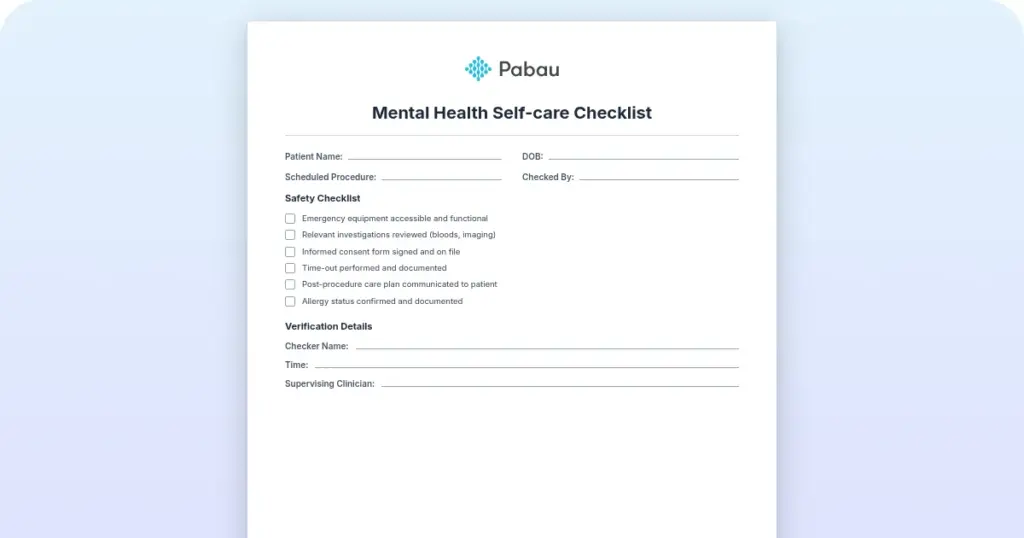
Mental health self-care checklist
A mental health self-care checklist is a structured daily tool for tracking the ...

5
Last Updated: Oct 20, 2026

CDRS scale template is a clinician-rated 16-item assessment tool for measuring depression severity in children aged 6-17
Scores range from 17-113, with thresholds used to guide diagnosis and treatment intensity decisions
The scale requires trained clinician administration and structured interview techniques for reliability
Pabau’s digital forms enable secure CDRS tracking, automated scoring reminders, and integrated clinical note storage
A clinically validated 16-item rating scale for assessing depressive symptom severity in children and adolescents aged 6-17, administered by trained clinicians to guide treatment planning and monitor therapeutic progress.
Download templateThe Children’s Depression Rating Scale (CDRS) is a standardized, clinician-administered assessment tool that measures the severity of depressive symptoms in pediatric populations. Developed by Elva Poznanski and colleagues, the scale has become one of the most widely used depression rating instruments in child psychiatry and mental health research globally.
The instrument comprises 17 items evaluated on a 1-7 rating scale, yielding total scores between 17 and 113. Higher scores indicate greater depression severity. The American Academy of Child and Adolescent Psychiatry (AACAP) recognizes the CDRS as a gold-standard tool for diagnosis, treatment monitoring, and research protocols in pediatric depression.
Unlike self-report questionnaires, the CDRS requires trained clinician administration through a structured interview format. This approach reduces bias from patient insight limitations and developmental maturity variations, making it particularly valuable in clinical settings where reliability is essential for treatment decisions.
Administering the CDRS scale template requires a structured five-step clinical workflow. Each step builds on clinician observation, patient/parent interview data, and behavioral assessment to complete the 16-item scale accurately.
The CDRS scale template is appropriate for trained mental health professionals working with pediatric populations. Child psychiatrists, clinical psychologists, and licensed therapists with formal training in assessment administration are the primary users. Pediatricians and family medicine practitioners in psychiatry EMR systems also use the CDRS for initial depression screening and referral decision-making.
Administration requires understanding of child development, symptom recognition across age groups (6-17), and structured interview techniques. The scale is not suitable for lay administrators, parents, or untrained staff. In teaching environments, trainees must complete supervised administration under clinician oversight before independent use.
An occupational therapy platform can store each completed scale beside the patient’s goals and session history.
CDRS total scores guide severity classification and treatment intensity. The following ranges represent commonly used clinical thresholds, though individual context (duration of symptoms, functional impairment, suicidality risk) always informs clinical decision-making.
| Score Range | Severity Classification | Clinical Interpretation |
|---|---|---|
| 17-28 | Minimal symptoms | No clinically significant depression; continue monitoring |
| 29-40 | Mild depression | Symptoms present but mild; consider psychosocial interventions first |
| 41-60 | Moderate depression | Clear depressive syndrome; psychotherapy plus possible medication indicated |
| 61+ | Severe depression | Urgent intervention needed; psychiatric evaluation and likely pharmacotherapy required |
A score of 40 is often cited as a clinical threshold, but scores in the 29-40 range warrant careful evaluation of functional impairment and symptom duration. Young children may present with irritability rather than sadness, altering the symptom profile while still indicating significant depression.
Mental health clinics use the CDRS scale template across multiple clinical workflows. Psychiatric evaluation templates often incorporate CDRS scoring as a structured component of initial assessment. The scale is valuable in initial diagnostic evaluation, monitoring treatment progress, and measuring medication response in medication management clinics.
Research settings employ the CDRS in treatment outcome studies, particularly trials evaluating psychotherapy efficacy or antidepressant medication response in pediatric populations. The American Psychiatric Association (APA) recommends standardized rating scales like the CDRS for DSM-5 Major Depressive Disorder assessment in children. Telehealth-based mental health intake workflows can integrate pre-session CDRS completion to streamline initial assessments.
The CDRS differs meaningfully from self-report scales like the Patient Health Questionnaire for Adolescents (PHQ-A) and observer-rated tools like the Hamilton Depression Rating Scale (HDRS). The CDRS is clinician-administered only, reducing responder bias but requiring trained raters. In contrast, the PHQ-A is self-report, faster to administer, but may underestimate symptoms in children with limited insight. Comorbid ADHD is common enough in this population that clinicians often score the Vanderbilt ADHD scale alongside the CDRS.
The HDRS, originally developed for adults, is sometimes used in older adolescents but lacks validation for younger children. The CDRS’s 16-item format and age-appropriate language (validated for ages 6-17) make it superior for broad pediatric depression assessment. Other rating scales like the Vanderbilt ADHD scale address different symptom domains (ADHD vs. mood) and should be used alongside the CDRS when comorbidity is suspected. Where chronic stress appears to drive or maintain the depression, a self-reported Perceived Stress Scale (PSS) can run alongside the CDRS to quantify that contributor. Loneliness is another common driver in young people, so where social isolation features in the presentation. A private practice reviewing outcomes needs the same measure captured at intake and at review. A private practice reviewing outcomes needs the same measure captured at intake and at review.
CDRS administrations and scores constitute protected health information (PHI) under HIPAA. Any digital HIPAA-compliant clinic software storing CDRS data must encrypt transmission, limit access to authorized clinicians only, and maintain audit logs of score access. Paper CDRS templates should be stored in locked cabinets and destroyed securely per your clinic’s records retention policy.
When using patient data security tools to track CDRS scores over time, ensure your system meets HIPAA’s technical and administrative safeguard requirements. Digital forms should never transmit CDRS data to unencrypted email or unsecured cloud storage.
Standardized CDRS administration improves diagnostic accuracy by reducing clinician rating variability. Consistent use across your team ensures comparable scores over time and across providers, supporting informed treatment adjustments. Documentation of the rationale for each item rating creates a clinically defensible record for peer review, supervision, and liability protection.
The CDRS enables measurement of treatment response. A 50% reduction in CDRS score after 8-12 weeks of psychotherapy or medication signals clinical improvement. This objective metric supports discussions with families about treatment progress and justifies continued or modified interventions.
Research and quality improvement initiatives benefit from CDRS data. Your clinic can track aggregate depression severity trends, identify gaps in early identification, and evaluate program outcomes. Many insurance providers and value-based contracts now require standardized outcome metrics like CDRS scores to demonstrate quality of care.
Safer clinical note templates can embed CDRS administration instructions at the top of your psychiatric evaluation form. Digital forms allow clinicians to enter item ratings directly into the EHR, with automatic score calculation and severity flagging. Set calendar reminders to reassess patients at evidence-based intervals (typically 4-8 weeks for active treatment cases).
Train all clinicians on your team on CDRS administration and scoring before independent use. Document this training and include CDRS competency assessment in your clinic’s quality improvement plan. Consider establishing a standardized CDRS administration protocol that outlines the structured interview questions your clinic uses, ensuring consistency across providers.
The CDRS scale template is an evidence-based, clinically validated tool for assessing childhood depression severity. Standardized administration across your pediatric mental health team ensures diagnostic consistency and treatment responsiveness monitoring. Digital integration through Pabau’s digital assessment forms and AI-powered clinical documentation reduces administrative burden while improving score accuracy and outcome tracking.
Start implementing structured CDRS assessment today to elevate the quality and consistency of your pediatric depression evaluations. Book a demo to see how Pabau makes CDRS administration and tracking seamless.
The CDRS scale template measures depressive symptom severity in children and adolescents to support diagnosis, guide treatment intensity, monitor medication or psychotherapy response, and track outcome progress over time in pediatric mental health care.
Each of the 17 items is rated on a scale of 1-7 by the clinician during a structured interview. All 17 ratings are summed to calculate the total CDRS score, which ranges from 17-113. A score of 40 or above often indicates moderate-to-severe depression requiring intervention.
Scores of 17-28 represent minimal depressive symptoms with no clinical concern. Scores of 29-40 indicate mild depression; 41-60 indicate moderate depression; 61+ indicate severe depression. Clinical context (symptom duration, functional impairment) always informs severity interpretation.
Child psychiatrists, clinical psychologists, and licensed mental health therapists with training in standardized assessment administration may administer the CDRS. Pediatricians and family medicine practitioners can also use the scale with appropriate training. Parents and untrained staff are not appropriate raters.
Yes. The CDRS was originally validated for children aged 6-12 and has been extended and validated for adolescents through age 17 in the revised version. The scale’s language and symptom items remain developmentally appropriate across this full age range.
For active treatment cases, rescoring every 4-8 weeks tracks response to psychotherapy or medication. At session completion or significant clinical milestones, reassess to document outcome. Quarterly or semi-annual rescoring maintains outcome awareness in maintenance or monitoring phases.