Physician credentialing checklist
A physician credentialing checklist lists every license, certificate, verificati...

Last Updated: Oct 23, 2026

A caries risk assessment is a systematic clinical evaluation that identifies how susceptible a patient is to developing tooth decay. The result drives the preventive plan, the recall interval, and the treatment sequence.
Risk factors include poor oral hygiene, frequent sugar exposure, low fluoride use, xerostomia (dry mouth), and clinical indicators such as active caries or existing restorations.
Protective factors pull risk back down. Fluoride therapy, dental sealants, healthy saliva flow, and consistent oral hygiene all reduce a patient’s likelihood of future decay.
Caries risk assessment is billed with CDT codes D0601, D0602, and D0603, one per visit, matching a finding of low, moderate, or high risk.
Practice management software like Pabau stores risk assessment forms on the patient record and schedules the next recall automatically for that risk category.
A ready-to-use clinical form for comprehensive caries risk evaluation. It includes risk factor checklists, protective factor documentation, clinical findings scoring, and risk category classification.
Download templateA caries risk assessment is a systematic clinical process that evaluates a patient’s individual susceptibility to dental decay. Dental professionals use it to sort patients into low, moderate, or high risk. The category depends on the biological, behavioral, and environmental factors found at the appointment.
That single result then guides preventive interventions, treatment planning, and recall scheduling. The practice spends its chair time on the patients who need it most.
The American Dental Association (ADA) and the American Academy of Pediatric Dentistry (AAPD) recommend caries risk assessment for every patient. It is a core component of evidence-based preventive dentistry. Identifying risk early lets the team target its interventions, from fluoride therapy and sealants through to dietary counseling. Those interventions reduce the incidence of decay and improve long-term oral health outcomes.
Caries risk factors fall into three categories: biological, behavioral, and environmental. A comprehensive assessment examines all three to create a complete picture of a patient’s decay risk.
In pediatric populations, maternal or caregiver caries status is a particularly strong indicator. It predicts a child’s early colonization with decay-causing bacteria. For adults, medication-induced xerostomia and existing restorations contribute most to caries risk.
Protective factors counterbalance risk and guide intervention selection. Clinicians use them to design a preventive plan that matches each patient’s risk profile.

Fluoride and sealants combined with good oral hygiene make the strongest protective strategy. Patients with strong protective factors and few risk indicators may need only routine recall and standard preventive care.
Results are classified into three or four categories that set recall intervals, preventive interventions, and treatment urgency. Each category also carries its own billing code, so the finding on the form decides both the clinical plan and the claim.
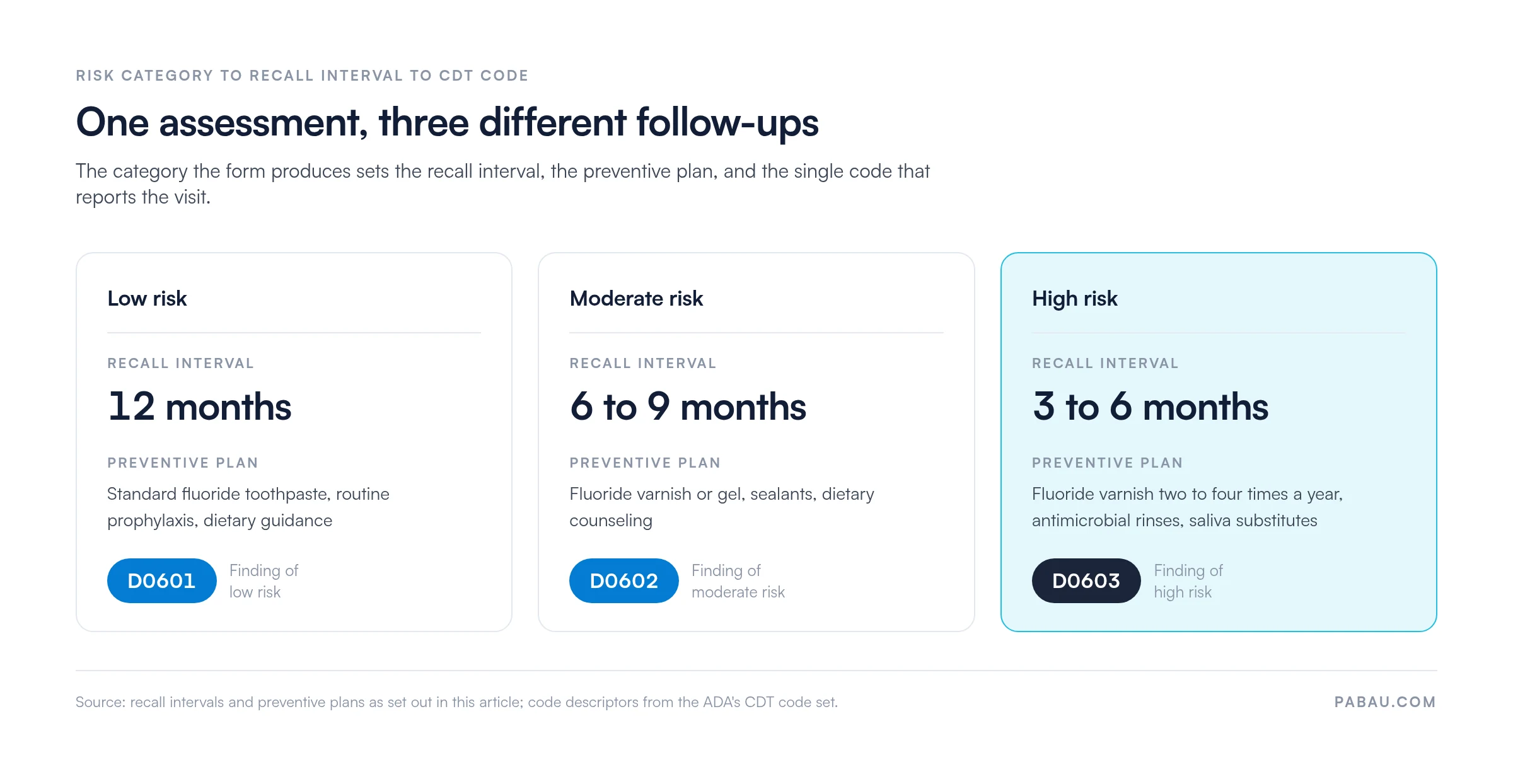
Some systems add an “extreme risk” category for patients with severe xerostomia, multiple systemic conditions, or rampant caries. These patients often need monthly or quarterly appointments and intensive preventive measures.
The Caries Management By Risk Assessment (CAMBRA) protocol is an evidence-based framework that folds risk assessment into a structured clinical pathway. It guides clinicians through four sequential steps to diagnose, treat, and manage caries risk systematically.
CAMBRA is endorsed by the ADA and widely adopted, because it points resources at the patients who benefit most from intensive prevention. That lowers the overall decay burden without spending the same effort on low-risk populations.
The form works best filled in chairside, while the patient is in front of you. Written up afterwards from memory, it loses the detail that changes a category. Five steps keep it consistent across the whole team.
Record the final category in a field the whole team can see, not in the body of a clinical note. The category sets the recall interval and the preventive plan, so the front desk and the hygienist both need it. A risk score buried in free text gets missed at the next visit.
The findings behind the score belong on the same chart as the rest of the exam. Keeping them on the dental examination form means the lesion count and the risk category are read together at the next visit.
Adult assessment leans on medication-related dry mouth, existing restorations, and systemic disease. Many adults present with a history of previous decay, which makes caries experience itself a strong predictor of future risk. Consistent medical records management keeps that history usable, so the team can spot candidates for shorter recall and intensive fluoride therapy.

Adults with multiple restorations or a history of periodontitis face compounded risk. Root surfaces exposed by gum recession are especially vulnerable. Include a medication review in the assessment, as over 400 medications can reduce salivary flow.
The AAPD recommends assessing every pediatric patient from the eruption of the first tooth, at roughly six months of age. Early childhood caries means decay in the primary dentition, and early identification with family-centered intervention prevents much of it. Caregiver caries status is a key indicator here, because a caregiver with active caries passes Streptococcus mutans to the infant.
Pediatric assessment leans on a short list of factors that carry unusual weight in the first years of life.
Anticipatory guidance for caregivers is the intervention that does most of the work. Cover dietary habits, fluoride exposure, and brushing technique at every visit, and record what was discussed. That record is what lets the next clinician see whether the advice landed.
Caries risk assessment is reported with one of three Current Dental Terminology (CDT) codes, and the code you pick is the finding itself. D0601 reports a finding of low risk, D0602 moderate risk, and D0603 high risk. Each one describes caries risk assessment and documentation carried out with a recognized assessment tool. You report a single code per visit, matching the category the completed form produced.
These three codes are the only ones the ADA’s Dental Quality Alliance recognizes in its caries risk documentation measure. That measure asks a simple question of the record: Was a risk level assessed and documented for this patient in the measurement year? Reporting D0601, D0602, or D0603 is how the practice answers it in claims data.
Two preventive codes get confused with the assessment codes because they so often follow one. D1206 is the topical application of fluoride varnish. D1330 is oral hygiene instructions. Both sit in the preventive category of CDT, and both describe something you did to the patient rather than a risk level you recorded.
They belong on the claim as follow-on treatment for a moderate or high-risk finding, alongside D0602 or D0603. Neither one reports the assessment. Billing D1206 in place of a D0601 to D0603 code leaves the risk finding undocumented in claims data. The form in the chart can be perfect and the claim still shows nothing.
The age-based split some teams remember belongs to the ADA’s forms, not to the codes. The ADA publishes two caries risk assessment forms, one for ages 0 through 6 and one for patients over 6. Those are documentation tools you choose between. The billing code still comes from the finding.
Coverage for D0601 through D0603 varies by payer and by state Medicaid program. Several plans treat the codes as informational and reimburse them at zero, while others pay for the assessment once or twice a year. Check the fee schedule before you decide how to submit, and report the code either way so the record is complete.
The documentation behind the code is what survives an audit. The chart should name the assessment tool used, the risk and protective factors found, the clinical findings, and the resulting risk category. Record who performed the assessment and the date. Note that the category was communicated to the patient as part of the treatment plan.
Capturing risk assessment data, booking the matching recall, and keeping documentation consistent across a team is slow work on paper. Practice management software like Pabau removes most of it by embedding digital risk assessment forms directly in the patient record.
When the hygienist completes the form, the risk category lands on the record, and the recall interval for that category is scheduled from it. Nobody has to remember which patient was due back in three months.
With patient intake software, the data is entered once and carries across clinical notes, billing, and appointment reminders. That cuts transcription errors and keeps the risk category in front of whoever is treating the patient. The code that belongs on the claim, D0601, D0602, or D0603, follows straight from the category on the form.

Pabau turns your caries risk assessment into a digital form that saves onto the patient record. The risk category sets the recall interval and stays visible to the whole team. High-risk patients are booked back in without anyone chasing a list.

A caries risk assessment only pays off when the category it produces changes something. Let it set the recall interval, the preventive plan, and the code on the claim. The practice then spends its prevention budget where decay is most likely. Complete the form but file it away, and it becomes paperwork.
Two habits make the difference. Score every patient with the same tool, so a category means the same across the team. Then report the finding with D0601, D0602, or D0603, so the assessment exists in the record rather than in someone’s memory of the appointment.
Book a demo to see how dental teams score risk once and let the recall schedule itself.

Need the exam findings on the same chart? Dental examination form records lesions, restorations, and soft tissue findings that feed straight into the risk score.
Charting decay tooth by tooth? Tooth charts give you a printable notation layout for mapping active lesions and existing restorations.
Setting up a new patient properly? Dental new patient form collects the medical history and medication list that shape a first risk category.
Treating a moderate or high-risk patient? Dental treatment consent form documents the discussion before restorative or preventive treatment begins.
Assessing infants and young children? Baby teeth eruption chart shows which teeth are through, so early decay is scored against the right dentition.
A caries risk assessment is a systematic clinical evaluation that identifies a patient’s susceptibility to tooth decay. It examines biological, behavioral, and environmental risk factors, and it guides preventive and treatment planning decisions.
Risk factors include poor oral hygiene, frequent sugar consumption, xerostomia, existing cavities or restorations, medication use, salivary bacterial counts, and family history. Protective factors include fluoride exposure, dental sealants, and good oral hygiene.
Risk is assessed at the first dental visit, then annually for low-risk patients. Moderate and high-risk patients may be reassessed every 3 to 9 months, depending on clinical status and how they responded to intervention.
Low-risk patients have few or no cavities and few risk factors, so they need a 12-month recall and standard preventive care. Moderate-risk patients have 1 to 3 cavities and several risk factors, so they need a 6 to 9-month recall and fluoride therapy. High-risk patients have multiple cavities, xerostomia, and multiple risk factors, so they need a 3 to 6-month recall and intensive prevention.
Yes. The form above is a ready-to-use clinical template suitable for general dental practices and specialty practices. It includes risk factor and protective factor checklists, clinical findings scoring, and risk category classification.
CAMBRA (Caries Management By Risk Assessment) is an evidence-based clinical framework built on four steps. Assess risk, diagnose caries, implement targeted interventions, then reschedule on the risk category. It focuses preventive resources on the patients who need them most.
Caries risk assessment is reported with D0601, D0602, or D0603, depending on whether the finding is low, moderate, or high risk. One code is reported per visit. D1206 is fluoride varnish and D1330 is oral hygiene instructions, so neither reports the assessment itself.