HIPAA compliant texting: What you can send patients & how to communicate securely
HIPAA compliant texting is possible when a text holds no protected health inform...

Last Updated: Oct 16, 2026
A nutrition handout is a one-page or multi-page education resource that a practice gives patients to reinforce the dietary guidance discussed in consultation.
It sets out evidence-based advice, meal planning strategies, portion-size guidance and practical tips the patient can check at home between visits.
This downloadable template suits dietitians, nutritionists, primary care physicians, functional medicine practitioners and wellness practices. Use it as a starting point, then adapt the wording to your branding and to the health goals your patients are working toward.
A fillable four-section handout covering macronutrients and micronutrients, how to build a balanced plate, and practical tips on hydration, portion control and added sugar. The final section leaves space for the reading and websites you recommend.
Download template
A nutrition handout is a patient education resource that reinforces the dietary guidance given in consultation.
The handout type decides its opening section, so match it to the patient before you print.
Every version needs food group guidance, portion sizes, condition-specific advice and your practice contact details.
Walk the patient through one marked section in the room, rather than reading the whole page aloud.
Practice management software like Pabau stores the handout once, then shares it from the patient record or the Client Portal.
Patient education is one of the strongest drivers of dietary adherence. A practice that hands over a clear take-home guide gives the patient something to check against between visits. The handout answers the questions that surface at the supermarket or the kitchen counter, when nobody from the practice is there to ask.
A well-designed handout also carries clinical weight. It shows the patient that dietary management belongs in the care plan and was decided in advance. A small library of topic-specific handouts keeps advice consistent across the clinical team. It also shortens the consultation, because the detail is already on the page.
Practitioners tailor the handout to a population or a condition. A structured weight program, usually run on weight loss clinic software, leads with portion control and calorie awareness. An integrative practice leads with whole foods and micronutrient density. Knowing the common types makes it quicker to pick the one that fits your caseload.
Read the six as a lookup rather than a menu. What changes between them is the section that goes first, and that section is the part most patients read.
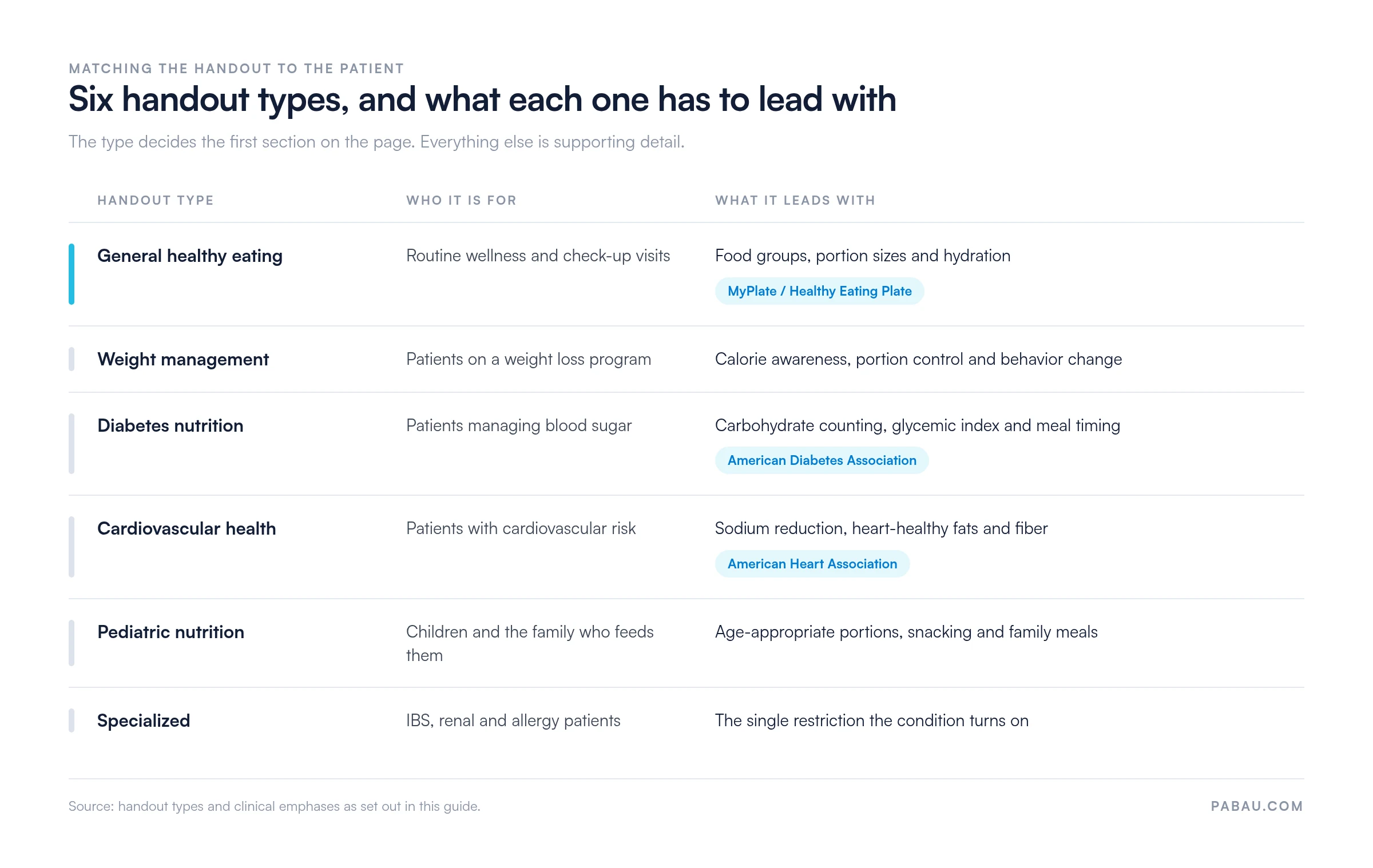
A handout stops being enough once a patient needs day-by-day structure. At that point, send a diabetes diet plan or a comparable meal plan alongside it.
Timing decides whether the handout gets read. Give it to the patient during the consultation or straight after, while the dietary conversation is still fresh. Then walk through one section only. Reading six pages aloud guarantees that none of it lands.
Pick the section that matches the goal you just set. For a weight patient that is portion control. For a patient with diabetes it is carbohydrate counting. Mark it with a pen before you hand the page over, and leave the rest for the patient to find later.
For a remote consultation, email the handout before the appointment so the patient has it open while you talk. Store the file in your patient portal as well, so patients can find it months later. That matters most in weight programs and chronic disease management, where people revisit the same advice for weeks.
A generic handout gets folded away. Customization is what turns the template into a page the patient keeps. A practice built around a metabolic health EMR emphasizes blood sugar stability and nutrient timing. A general wellness practice sticks to foundational habits.
A good handout balances clinical depth against readability. Too much text and the patient skims. Too little and they fill the space with guesswork. Six components cover both sides.
Each component earns its place on the page. Pair the handout with a portion size chart where patients keep asking what a serving looks like. A short follow-up message a week later, pointing at one section, does more for adherence than a longer document would.
Printing, filing and tracking handouts by hand takes time the front desk does not have. Pabau, our practice management platform, stores the file once against the patient record. From there your team attaches it to a record, shares it through the Client Portal, or sends it in an automated post-appointment email.
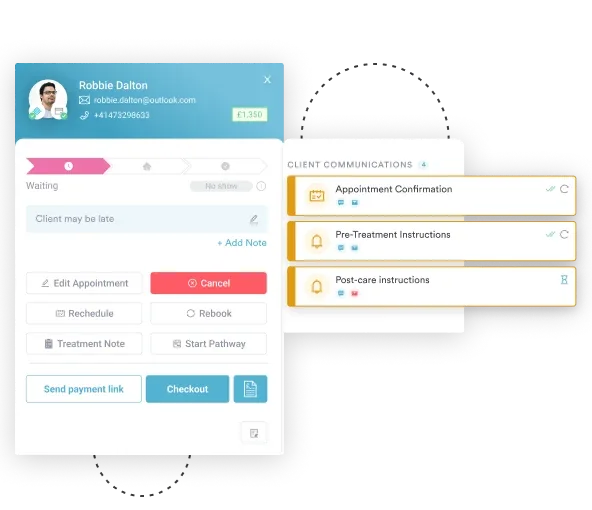
Your team can personalize a copy for an individual patient, adding their name and the dietary targets you agreed in the room. You can also see which patients have opened the document, which tells you who to prompt before the next appointment.
The result is one version of your nutrition advice, delivered the same way to every patient. Nobody queues at the printer in the middle of a busy day.

Store your nutrition handout once in Pabau, attach it to the patient record, and let automated follow-ups deliver it. Your team stops printing and starts seeing who opened it.

The handout is only as useful as the one section you point at. Hand over six pages with “have a read” and the work moves to the patient. Circle the portion-size box, name two swaps for this week, and the patient leaves with something to do on Tuesday.
Customize the template once for your caseload, then keep it somewhere the whole team pulls from. Consistency between clinicians matters more than the polish of any single page.
Book a demo to see how Pabau stores, personalizes and sends patient handouts straight from the record you already keep.

Need a week of structure rather than a handout? Healthy eating plan gives patients a day-by-day framework they can follow without counting calories.
Collecting dietary history at intake? Nutrition assessment form captures the habits and restrictions that shape the handout you hand over.
Patients asking about storage and reheating? Food safety handout covers roasting times and safe storage on a single page.
Managing cardiovascular risk? Heart healthy diet plan sets out sodium limits and fat swaps in plan form.
Want the clinical detail behind the advice? Nutrition cheat sheet keeps macronutrient and micronutrient references to hand during a consultation.
Clear dietary guidance aligned with an authoritative standard, such as the USDA Dietary Guidelines, ADA or WHO. Add visual aids like a food group chart, portion-size guidance, condition-specific advice where it applies, practical meal examples, and your practice contact details. Close with three to five steps the patient can start this week.
Start from this free template and adapt it to your specialty and your patient population. Add your branding and contact details, include visual aids and meal examples, and ground each claim in published dietary guidance. Save it as a PDF and share it digitally, in print, or both.
Yes. The USDA’s nutrition.gov and professional bodies such as the Academy of Nutrition and Dietetics publish free downloadable resources. The template on this page is also free to customize and give to your patients.
Add your logo and contact information, then adjust the dietary guidance to match your specialty. Swap in visual aids and meal examples your patients will recognize, and add a condition-specific section where you need one. Save the customized version and send it by email, through the patient portal, or on paper.
Carbohydrate counting, glycemic index, meal timing, portion control and blood sugar monitoring, following American Diabetes Association standards. Include food lists, a meal-planning grid, and a short section on reading carbohydrate content off a nutrition label.