Slocum test: How to perform, interpret and record it
The Slocum test is a knee drawer test performed with the tibia rotated. It check...

3
Last Updated: Oct 21, 2026

The bounce home test is a passive knee extension exam used to screen for meniscal tears and joint effusion.
With the patient supine, you cup the heel, flex the knee fully, then release the leg into extension.
A rubbery or springy end-feel, or extension that stops short, counts as a positive result.
No study has measured the original technique, and the forced-hyperextension version reports 47% sensitivity and 67% specificity.
Practice management software like Pabau lets you standardize how every end-feel, result, and next step gets recorded.
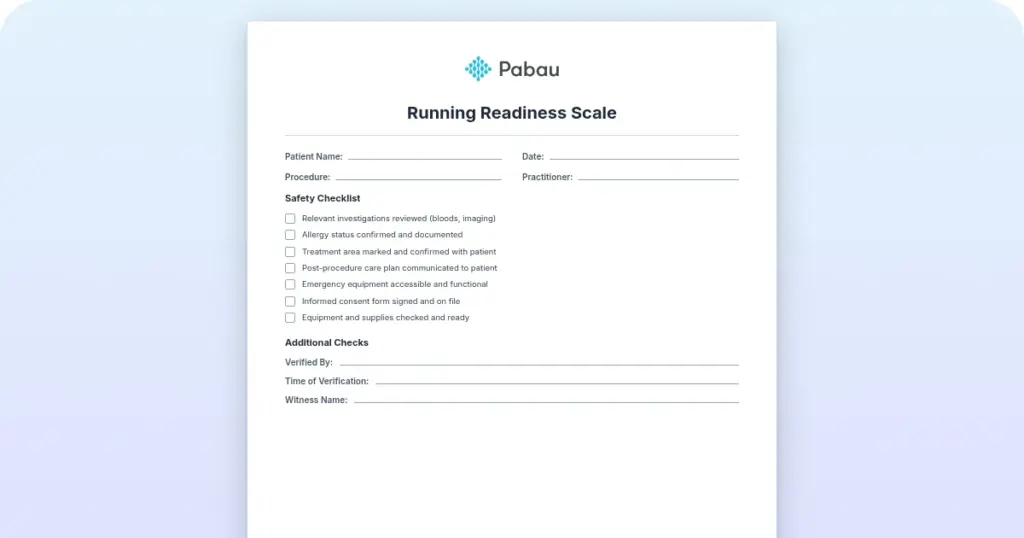
A one-page clinical form covering patient positioning, the step-by-step technique, a positive/negative result classification with end-feel description, and space for additional notes. Print it for the chart or attach it to the patient record after each exam.
Download templateThe bounce home test checks whether a knee can passively drop into full extension. A rubbery end-feel, or a block short of full extension, is a positive result. That points to a meniscal tear, a loose body, or joint effusion.
It takes about 15 seconds and needs no equipment. What it will not do is confirm a tear, and the published numbers below explain why.
The bounce home test is a passive knee extension exam that screens for intra-articular pathology, mainly meniscal tears and joint effusion. You are judging two things. Does the knee reach full extension, and what does the endpoint feel like?
A normal knee bounces home into full extension with a sharp, firm endpoint and no pain. Restriction, a mechanical block, or a springy resistance suggests something inside the joint is in the way. That finding earns further investigation, usually MRI or an orthopedic opinion.
The knee holds two crescent-shaped menisci, medial and lateral, sitting between the femur and tibia. A tear from rotation, hyperextension, or degeneration can displace a fragment into the joint. That fragment physically blocks the last few degrees of extension.
Joint effusion produces the same limitation by a different route. Excess synovial fluid raises pressure inside the capsule until the knee stops moving freely.
Reach for the test when a patient presents with any of the following.
Run it alongside the other meniscal tests rather than on its own. Combined with McMurray, Thessaly, and joint line palpation, it helps you decide who needs imaging first.
Technique decides whether the result means anything. Follow these six steps.
The whole thing takes 10 to 15 seconds. Test both legs where the presentation allows, and compare the injured knee against the other side.
Occupational therapists often score assessments like this directly inside occupational therapy software, keeping results attached to the treatment plan.
A positive test is any one of the following four findings.
None of that confirms a tear. Read it against the mechanism of injury, the symptom pattern, and your other test findings. When the picture stays unclear, send the patient for imaging.
Some clinicians use a modified bounce home test when a free drop is too much for the patient. Severe pain, a tense effusion, or high anxiety are the usual reasons.
The modified approach. You guide the knee slowly into extension rather than releasing it from full flexion. Resistance and end-feel are read continuously through the movement. Patients keep more control, and guarding drops in acute or anxious presentations.
The trade-off is sensitivity. A guided extension is less likely to catch a small fragment than a free drop. Use it as a first pass, then repeat the standard technique once tolerance improves during the session.
No published study has measured the sensitivity or specificity of the test as originally described. The figures you see quoted elsewhere come from a different maneuver.
Shybut and McGinty described a modification that forces the knee into hyperextension, with a block counting as positive. Kurosaka and colleagues tested that version and reported 47% sensitivity, 67% specificity, and 51% diagnostic accuracy. Those figures come from a published narrative review of meniscal examination.
Across studies of the forced-hyperextension version, sensitivity ranges from 36% to 47% and specificity from 67% to 86%. Fowler and Lubliner reported 44% and 86% for pain on forced hyperextension.
Forced hyperextension differs from the passive drop described above, so read the numbers as an upper bound. The practical read. Use the test as a fast screen that flags a knee worth examining further. A negative result should never stop you testing when the history points to a tear.
Knowing where each test sits helps you order the exam sensibly. The ranges below come from the same review of the orthopedic literature.
Clinical strategy. Start supine with the bounce home test, since the patient is already positioned for it. Move to Thessaly when the screen is positive or unclear, because it carries the strongest numbers of the group. Rotatory findings are a separate question.
A positive result on its own does not send anyone to a surgeon. Read it inside a decision pathway.
Effusion produces the same springy end-feel as a displaced fragment. Cross-check with ballottement or a patellar tap before you commit to a mechanical explanation.
Clearing an athlete asks a different question than diagnosing one. Full painless extension is the entry requirement.
Consistent notes protect clinical continuity and survive a medical chart audit without a scramble for missing detail. Capture these fields every time.
Pair the exam note with a patient-reported measure so progress stays traceable. The knee outcome survey works well for that. A confirmed right medial meniscus tear codes under S83.241.
Most practices record special tests in free text. One clinician writes a two-word abbreviation, another writes a paragraph, and a third omits the end-feel. Six weeks later nobody can tell whether the knee improved.
An all-in-one practice management system like Pabau replaces that with a structured form. You build the bounce home test as a set field with fixed options for end-feel, result, and next step. The entry lands in the patient record beside the photos, consents, and treatment history.
That consistency pays off in three places. Progress comparisons stop depending on who wrote the note. Referral letters pull the exam findings straight from the clinical record. And a new hire follows the same protocol on day one, because the form asks for the fields your senior clinicians already use.

Pabau’s digital forms turn the bounce home test into a set field with fixed end-feel and result options. Every clinician then records it the same way. Findings stay comparable visit to visit, and referral letters pull straight from the record.

The bounce home test earns its place because it costs you 15 seconds and needs nothing but your hands. It does not earn a diagnosis. Once you accept that split, it becomes a useful gate rather than a source of false confidence.
The bigger win is in what you write down afterward. A knee that felt springy in March means nothing in May unless the note says so in the same words. Fix the wording once, and every follow-up visit gets easier to interpret.
Download the template above and use it on the next knee that walks in. Book a demo to see how Pabau standardizes special test documentation across your whole physical therapy team.

Screening the lumbar spine too? Passive lumbar extension test applies the same passive-loading logic to segmental instability.
Charting extension deficits properly? Range of motion assessment sets out the measurement technique behind the numbers you record.
Explaining the anatomy to a patient? Knee muscle diagram gives you a labeled handout to talk through in the room.
Onboarding a new personal training client? fitness assessment form template covers medical history, fitness goals, and training preferences in a ready-to-use intake document.
Planning the loading phase of rehab? Strength exercises for older adults covers progressions for patients managing knees conservatively.
A positive result means an extension block or an abnormal end-feel, which points to intra-articular pathology. A meniscal tear or joint effusion are the two most common causes. It is a screen rather than a diagnosis. Combine it with the injury mechanism, the history, and your other special tests before referring for imaging.
No study has measured the accuracy of the test as originally described. The forced-hyperextension version reported by Kurosaka and colleagues gives 47% sensitivity, 67% specificity, and 51% diagnostic accuracy. Treat a negative result as weak evidence, since the negative likelihood ratio sits near 0.8.
The bounce home test assesses passive knee extension quality and end-feel in supine position. The McMurray test combines flexion, rotation, and extension while you listen and feel for a click or reproduced pain. McMurray is often more sensitive for peripheral tears, and bounce home is faster as a first screen.
Yes. A rubbery end-feel or blocked extension can come from effusion rather than a meniscal fragment. Separate the two with ballottement or a patellar tap, and correlate with the swelling and pain pattern. Effusion-related findings usually settle as the swelling comes down.
Use the slow, guided extension in acute presentations with severe pain, a tense effusion, or high patient anxiety. It is gentler and improves tolerance, though it may catch fewer small fragments than the standard drop. Return to the standard technique once the patient can tolerate it.
It is most reliable in acute presentations with a clear mechanism of injury. Accuracy drops in chronic conditions, in patients with a high body mass, and where guarding or pain limits passive movement. Multiple joint pathologies also muddy the finding, so always read it alongside your full assessment.