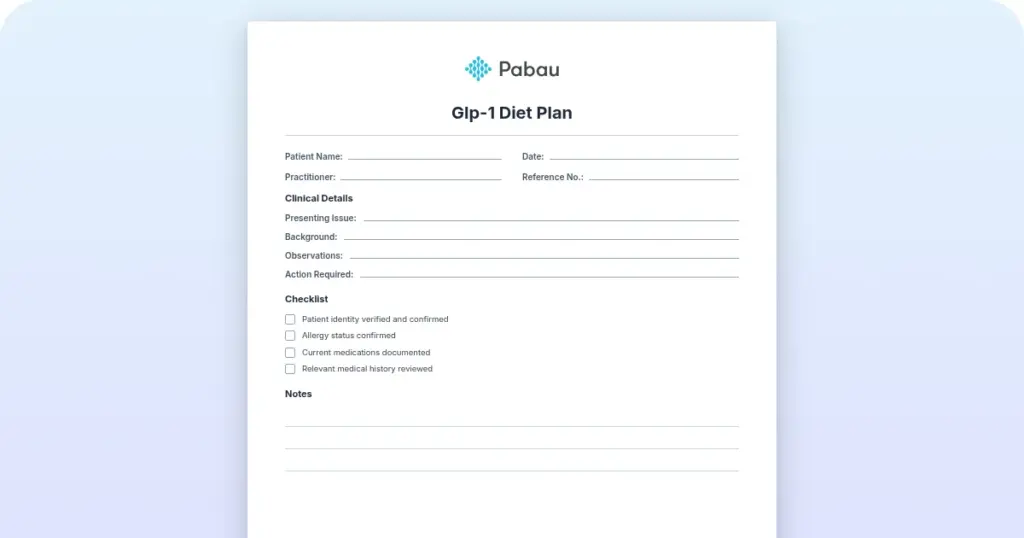
GLP-1 diet plan
A GLP-1 diet plan is a structured eating framework for patients taking semagluti...

2
Last Updated: Oct 13, 2026

Visceral fat drives the metabolic risk, and it is the first fat to respond to a calorie deficit.
Hold the deficit at 15% to 25% below maintenance and keep protein high to protect lean muscle.
The 7 day meal plan to lose belly fat below runs at roughly 1,500 calories and 100g of protein.
An at-a-glance table pairs every meal with its approximate calories and protein, so portions are quick to scale.
Build meals on lean protein, soluble fiber, and olive oil, then cut added sugar, refined carbohydrates, and alcohol.
Women need fewer carbohydrates in the luteal phase, and everyone needs a fixed review at week four.
A printable 7-day plan with breakfast, snack, lunch, and dinner for every day, set at roughly 1,500 calories. Hand it over at the end of a consultation, or adjust the portions to the patient’s calorie target first.
Download templateA meal plan to lose belly fat works by holding a moderate calorie deficit, keeping protein high, and pushing fiber up. Visceral fat, the deep fat packed around the organs, is the first thing to move.
The 7-day plan below runs at about 1,500 calories and 100g of protein, split roughly 30% protein, 45% carbohydrate, and 25% fat. Every day is listed with its own calorie and protein estimate, so you can scale it to the person in front of you.
Patients usually want to know how to reduce the weight in 7 days. One week is enough to change how clothes fit, but the waist measurement moves over four to eight weeks.
Two adjustments decide whether week five still works. One is carbohydrate timing across the menstrual cycle. The other is a fixed review at four weeks, with a rule for what to change when the scale stalls. Both are below, along with the science, the food lists, and the plan itself.
Your abdomen holds two kinds of fat. Subcutaneous fat is the layer you can pinch, sitting just under the skin. Visceral fat sits deeper, wrapped around the organs, and it is the one that moves health markers.
Visceral fat is metabolically active. It releases hormones and inflammatory compounds tied to type 2 diabetes, heart disease, and metabolic syndrome. Harvard Health makes the same point about which fat deserves attention. Programs built around metabolic health therefore track waist measurements as closely as weight.
A tape measure at the navel is enough to track progress week to week. A body composition test goes further and separates fat mass from lean mass. That distinction earns its keep when scale weight stalls and the patient assumes the plan has failed.
A diet for belly fat loss works through three mechanisms. It creates a calorie deficit, lowers the insulin load, and cuts inflammatory inputs.
The calorie deficit is non-negotiable. Visceral fat mobilizes once total energy intake drops 15% to 25% below maintenance. The 1,500-calorie template below illustrates that deficit for one average adult. It is not a universal target.
Individual needs shift with sex, body size, and activity level, so work out maintenance first and take the deficit from there. The NIDDK publishes a reasonable starting point for that calculation.
Protein protects muscle. Holding protein at 25% to 35% of total calories raises satiety and limits lean-tissue loss during a deficit. That is what keeps the weight off once the plan ends.
Soluble fiber steadies blood sugar. Sharp glucose rises push the body to store surplus energy. Fiber from oats, barley, and legumes slows digestion and flattens those spikes. It also feeds gut bacteria that produce short-chain fatty acids, which help lower systemic inflammation.
Cortisol sends fat to the abdomen. Sustained stress keeps cortisol elevated, which pushes storage toward the visceral depot and raises appetite for refined carbohydrates. Food alone cannot outrun that, so treat the lifestyle section below as part of the plan.
Anti-inflammatory foods support the result. Chronic inflammation and visceral fat accumulation travel together. The plan leans on fatty fish, leafy greens, berries, nuts, and olive oil, all of which are linked to lower inflammatory markers.
The best diet to lose belly fat is the one a patient is still following in week six. Adherence beats macro precision, which is why this plan uses ordinary supermarket food rather than specialist products.
A healthy meal plan to lose belly fat rests on five principles. Swap the recipes as often as you like. Keep these five intact and the weight loss diet plan still does its job.
These five are what separate a 7-day diet plan for weight loss from a crash week. Nothing on the list needs a specialist product, so the plan survives an ordinary grocery run and a normal working week.
Wellness practices track plans like this inside wellness clinic software, alongside bookings and client notes.
The 7 day meal plan to lose belly fat below runs at about 1,500 calories a day. The split is roughly 30% protein, 45% carbohydrate, and 25% fat. Those are the same ratios behind our macro diet plan.
Protein sources and vegetables rotate through the week. That keeps micronutrients varied and stops the plan getting dull by day four, which is usually where adherence breaks.
| Day | Breakfast | Snack | Lunch | Dinner | Approx. calories | Approx. protein |
|---|---|---|---|---|---|---|
| Day 1 | Greek yogurt (150g) + berries + granola (30g) | Almonds (23) + apple | Grilled chicken (120g) + quinoa (100g) + steamed broccoli | Salmon fillet (120g) + sweet potato (150g) + sauteed spinach | 1,480 | 105g |
| Day 2 | Oatmeal (50g dry) + almond butter + banana | Hummus (50g) + carrot sticks | Turkey breast (120g) + brown rice (100g) + roasted vegetables | Cod fillet (130g) + sweet potato + kale salad | 1,440 | 95g |
| Day 3 | Scrambled eggs (2) + whole grain toast + avocado | Greek yogurt (150g) + walnuts | Lentil soup (300ml) + whole grain bread + side salad | Lean beef (110g) + barley (100g) + Brussels sprouts | 1,500 | 100g |
| Day 4 | Cottage cheese (200g) + berries + chia seeds | Mixed nuts (small handful) + orange | Baked chicken (120g) + couscous (100g) + roasted peppers | Mackerel (120g) + sweet potato + mixed green salad | 1,510 | 115g |
| Day 5 | Chia pudding (made with almond milk, overnight) | Apple + almond butter | Chickpea curry (300ml) + brown rice (80g) + cucumber raita | Turkey (120g) + whole grain pasta (80g dry) + tomato sauce + spinach | 1,460 | 92g |
| Day 6 | Whole wheat pancake + lean ham + blueberries | Celery sticks + almond butter | Grilled fish (130g) + quinoa + roasted root vegetables | Chicken stir-fry (120g) + brown rice (100g) + mixed vegetables | 1,530 | 110g |
| Day 7 | Smoothie: Greek yogurt + spinach + banana + berries + almond milk | Pear + walnuts | Lentil bolognese (300ml) + whole grain pasta (80g) + side salad | Salmon (120g) + roasted vegetables + olive oil drizzle | 1,470 | 98g |
The week averages about 1,485 calories and 102g of protein a day. That lands inside the 1.2g to 1.6g per kg range for a patient between 65kg and 85kg. Most adults can take the plan as written.
Day 5 is the lowest-protein day at roughly 92g, so it is the one to adjust for anyone lifting weights that afternoon. Days 3, 5, and 7 carry the most fiber, near 30g, from lentils, chickpeas, and barley. Adjust any day by 200 calories either way to fit the individual.
Prep tip: Group the proteins by day so one shop covers the week. Chicken carries days 1, 4, and 6, fish carries days 1, 2, 4, 6, and 7, and turkey covers days 2 and 5. Our grocery list maps to those days, and cooked grains keep in airtight containers for three days.
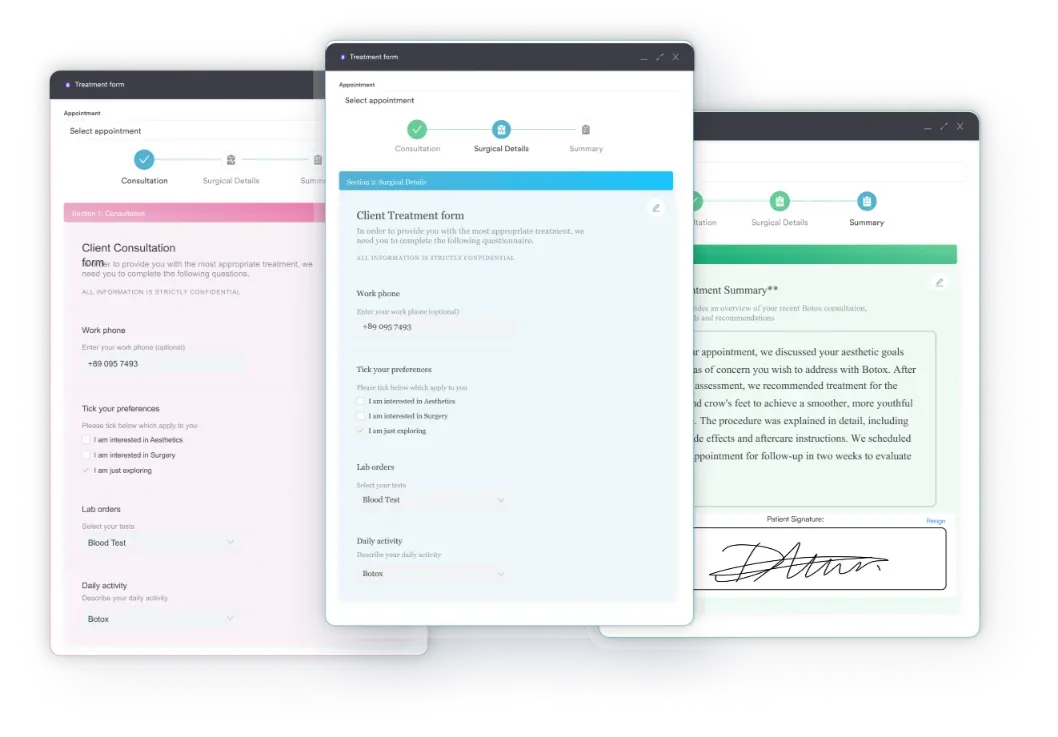
Anyone searching for a seven day meal plan for weight loss is really asking for one week they do not have to think about. Capture allergies and food preferences before you issue anything. Practice management software like Pabau collects them in advance through digital intake forms. You then avoid rebuilding the whole week after a patient mentions a shellfish allergy.
Eat lean protein at every meal and 25g to 30g of soluble fiber a day. Add two or three servings of fatty fish across the week, and cook with olive oil rather than butter. That is what to eat to lose belly fat in 1 week, and it covers most of what any flat belly diet is actually doing.
Two of those categories work through mechanisms worth naming out loud to a patient. Soluble fiber ferments in the colon and triggers the release of GLP-1 and PYY, the hormones that signal fullness. That is why oats hold someone to lunch and white toast does not.
Protein has the highest thermic effect of any macronutrient. Roughly 20% to 30% of its calories are burned during digestion, against 5% to 10% for carbohydrate and almost nothing for fat. A high-protein day quietly costs more energy to eat than a high-fat day of the same size.
The pattern is essentially Mediterranean, which has the strongest evidence behind it for waist circumference. These are the foods for a flat stomach that earn their place in a 7-day diet plan for weight loss. None of them is exotic.
These foods push visceral fat up by spiking insulin and feeding inflammation. Cutting them entirely for the first four to eight weeks makes the deficit far easier to hold.
The plan does not ask for perfection. One off-plan meal a week costs nothing as long as the other six days hold. Say that up front, and a single slip stops turning into a lost month.
A belly fat loss diet plan for female patients uses the same 1,500-calorie template, with carbohydrate and protein shifted across the menstrual cycle. Estrogen moves hunger hormones and carbohydrate tolerance week by week, so a fixed macro split works for half the month only.
Through the follicular phase, days 1 to 14, insulin sensitivity runs higher and the standard carbohydrate split works well.
Through the luteal phase, days 15 to 28, insulin resistance edges up. Drop carbohydrate to around 40% of calories and lift protein to around 35%. Fat loss then usually continues through the second half of the cycle instead of flattening out.
After menopause: Falling estrogen moves fat storage toward the abdomen. Protein belongs at the top of the range, near 1.6g per kg, alongside phytoestrogen-rich foods such as soy, flaxseed, and legumes.
Calorie needs also drop by roughly 200 to 300 a day after menopause. If weight has not moved after three weeks, take the template down to 1,200 to 1,300 calories rather than adding more exercise.
Patients often arrive having searched for the menopause diet 5 day plan to lose weight. Five days is too short to measure anything on a tape measure. Neither five days nor seven is where the result comes from. Protein at the top of the range and two resistance sessions a week are what move the waist.
The same logic applies to a 30-day female weight loss diet, which is this week repeated four times with one review in the middle. Resistance work protects muscle mass, which keeps resting metabolic rate up while the deficit runs.
Track body composition rather than BMI here. BMI cannot tell a lost kilo of fat from a lost kilo of muscle, and after menopause that distinction is the whole point.
No fat loss meal plan survives five hours of sleep a night. Diet does the heavy lifting, but sleep, stress, movement, and gut health decide how fast the deficit shows up on the tape measure.
Hand the template over at the end of the consultation, then book the review before the patient leaves. A diet plan for weight loss only works when somebody checks in on it. Here is the sequence that holds up in practice.
Patients who came in asking for a 7 day diet plan to lose weight get a file they can stick on the fridge. Accountability then stops depending on somebody remembering to call.
Most practices email a plan like this as an attachment, then track the follow-up in a spreadsheet. Measurements sit in one place, notes in another, and the patient has no idea what changed between visits.
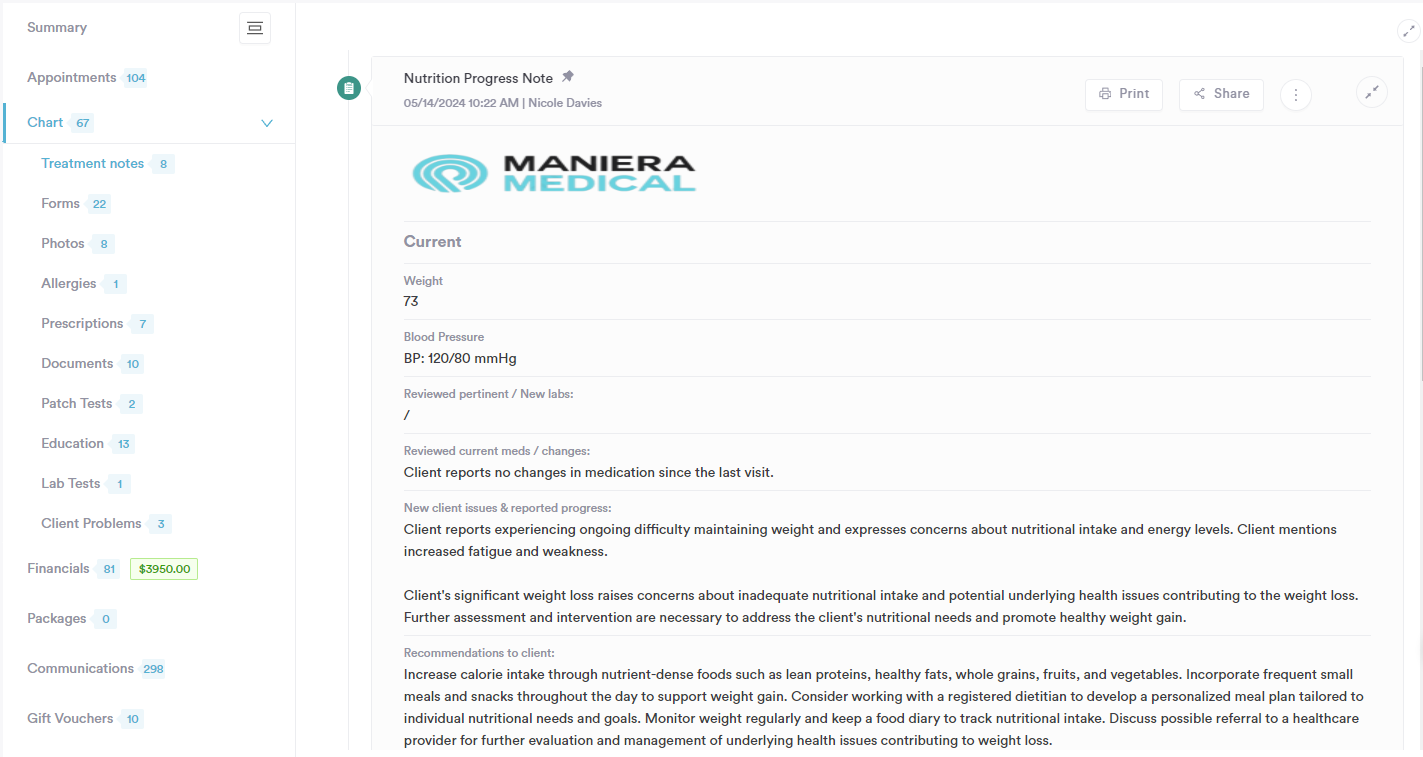
Pabau keeps all of it on the client record instead. You send the plan from the client portal, log waist and weight at every visit, and the progress chart builds itself. When a patient asks whether anything is happening, you can show them on screen.
Weight-management programs run on repetition. Templates are stored once and reused, checkpoints are booked when the plan goes out, and every clinician works from the same version of the plan.
The payoff is fewer dropped follow-ups, and no more time spent reconstructing what you told somebody six weeks ago.

Pabau stores your plan templates, sends them through the client portal, and logs waist and weight at every visit. Follow-up appointments are booked when the plan goes out, so nobody quietly drifts away.

This plan is only as good as the follow-through. A patient who leaves with a PDF and no checkpoint usually drifts by week three, whatever the macros say.
So set the review date when you issue the plan, and take the waist measurement before day 1. When progress stalls, change one variable at a time. That is the difference between a plan that works on paper and one that works in somebody’s kitchen.
Book a demo to see how Pabau sends meal plans, logs measurements, and books the follow-up in one place.

Need to document lab results too? basic metabolic panel template documents eight core analytes with reference ranges for electrolyte balance and kidney function screening.
Managing a patient after surgery? bland diet food list guides patients toward easy-to-digest foods while avoiding common gastric irritants during recovery.
Counseling a patient on an animal-based diet? carnivore diet plan template gives a standardized framework for guiding patients through animal-based eating with risk assessment and documentation.
Want a more general meal plan option? healthy meal plan template offers a seven-day plan built on current dietary guidelines, with serving counts and a grocery list.
Starting a patient on tirzepatide? tirzepatide consent form documents patient understanding of the benefits and risks before starting tirzepatide for weight management.
A structured eating guide that combines a calorie deficit, high protein, soluble fiber, and anti-inflammatory foods. It reduces both subcutaneous and visceral abdominal fat while protecting muscle mass.
Visceral fat usually responds within four to eight weeks, showing up first as a smaller waist measurement and better fasting glucose. Scale weight often lags behind that, so consistency matters more than speed.
Yes. Visceral fat mobilizes when total energy intake sits 15% to 25% below maintenance. Activity alone rarely creates a deficit that size, which is why the food side has to change.
Yes. Proteins and vegetables are interchangeable, so swap freely. Use rice instead of oats if grains are a problem, or coconut yogurt instead of Greek yogurt if dairy is. The principles hold either way.
Water does most of the work, at 2.5 to 3 liters a day, since thirst is often misread as hunger. Unsweetened green tea and black coffee are useful additions before training. Taking drinks away matters more than adding them, though. Soda, fruit juice, and alcohol are the three that quietly close a deficit.
Yes, and it is the single best predictor of whether someone finishes the week. Cook proteins and grains on one day and refrigerate them for up to three days, or freeze portions for up to three months. Freeze grains and proteins separately from salads, yogurt, and avocado. Reheat each portion once only.
It can help, mostly by simplifying calorie control and improving insulin sensitivity. It is not better than a standard deficit. A 16:8 pattern fits this template as long as protein and fiber still fit inside the eating window.
Cut 100 to 150 calories by trimming snacks or cooking oil rather than dropping a food group. Add 50 minutes of walking a week. Check sleep and stress before changing anything else. If nothing moves in two more weeks, refer to a registered dietitian.