

CCSD code G5100: Bypass of duodenum billing guide
CCSD code G5100 bills a bypass that leaves the duodenum in place CCSD code G5100...

Last Updated: Oct 16, 2026
Billable Code
51715 is the CPT code for endoscopic injection of implant material into the submucosal tissue of the urethra and/or bladder neck. Urologists and urogynecologists use it to report urethral bulking for stress urinary incontinence, most often with Bulkamid.
The code includes the cystourethroscopic access, so a same-day diagnostic cystoscopy (52000) is bundled into it. Claims usually pair it with N39.3, and most commercial and Medicare Advantage plans require prior authorization.
Let Pabau's smart automation suggest the right codes, reduce claim denials, and keep your practice compliant—effortlessly.
Automate repetitive tasks and focus on what matters most—your patients.
Reduce coding errors and ensure compliance with the latest regulations.
Clean claims, fewer denials, and faster reimbursements.
Powerful insights and reporting to help your practice thrive.
HIPAA compliant SOC 2 certified GDPR-compliant Trusted by 4,000+ clinics worldwide

CPT code 51715 reports endoscopic injection of implant material into the urethra or bladder neck to treat stress urinary incontinence.
Pair it with N39.3 or N39.46, because payers deny 51715 claims linked to the unspecified code R32.
Most commercial and Medicare Advantage plans require prior authorization, and a missing one is the leading denial reason for this code.
CPT 51715 carries a 0-day global period, and a same-day diagnostic cystoscopy (52000) is bundled into it under NCCI edits.
Practice management software like Pabau runs validation checks before each claim goes out, so missing details are caught before a payer rejects them.
CPT code 51715 describes “endoscopic injection of implant material into the submucosal tissue of the urethra and/or bladder neck.” The American Medical Association maintains it in the urinary system section, among the bladder introduction procedures (51600-51721). The code covers cystourethroscopic access, needle placement into the submucosal tissue, and injection of the bulking agent. The agent goes in at one or more sites around the urethral lumen or bladder neck.
The “endoscopic” qualifier is the key billing distinction. The physician passes a cystoscope through the urethra and finds the target tissue under direct vision. The implant material then goes in through a needle in the working channel. That visualization-plus-injection combination is what 51715 captures. It’s also why a standalone diagnostic cystoscopy (CPT 52000) can’t substitute for it.
The procedure treats confirmed stress urinary incontinence (SUI), which is leakage triggered by coughing, sneezing, exertion, or a sudden rise in intra-abdominal pressure. Urologists and urogynecologists use it once patients have exhausted conservative options, including pelvic floor physical therapy, behavioral changes, and medication.
Payers expect urodynamic confirmation before they approve the injection, and sphincter electromyography can form part of that study. CPT code 51784 reports the non-needle version of that sphincter EMG.
Bulkamid (polyacrylamide hydrogel, manufactured by Axonics, which acquired Contura in 2021) is the primary FDA-approved agent billed under 51715 in current US practice. Before submitting, confirm the agent is FDA-approved and not excluded by payer policy. Older materials like bovine collagen (Contigen) are no longer marketed in the United States.
The operative note is the billing foundation for 51715. Payers audit it for specific elements, and a generic endoscopy note that doesn’t describe the injection technique won’t support the claim. The note must capture four elements.
Missing injection volumes or anatomical landmarks are among the most common reasons payers request more records or deny on medical necessity grounds.
Document the total volume of bulking agent injected per site and in aggregate in every operative note for CPT 51715. Payers use volume figures to judge whether the procedure reached a clinically meaningful threshold. Notes that record only ‘injection performed’ without volume data are routinely flagged for additional documentation requests.
Payers require a diagnosis code that specifies the type of urinary incontinence. An unspecified or non-matching code is a leading cause of medical necessity denials for this procedure. Pick the most specific ICD-10 code the documentation supports.
Three codes cause the most confusion alongside 51715. Getting the distinction wrong costs the practice either a duplicate-billing denial or lost revenue from under-coding.
The NCCI bundling relationship between 52000 and 51715 matters most day to day. Sometimes a diagnostic cystoscopy evaluates the bladder before the injection, separately from the access 51715 already includes. Modifier 59 may then allow separate billing, but the operative note must show the diagnostic scope had its own clinical purpose. Check current NCCI edit tables first, because edit status can change quarterly.
Medicare pays 51715 from the CMS Physician Fee Schedule, and rates vary by place of service. The non-facility (office) rate is higher than the facility rate. That’s because the practice carries the overhead when the procedure happens in-office.
Commercial payer rates differ substantially. Cigna publishes allowable amounts for 51715 through its provider fee schedule portal, and WellCare maintains a clinical policy for urinary incontinence treatments. Track electronic remittance advice (ERA/835 files) per payer to compare contracted rates against Medicare benchmarks.
Most commercial plans and Medicare Advantage plans require prior authorization (PA) for this procedure. Traditional Medicare (Parts A and B) doesn’t require PA for 51715. Where a plan does require it, a missing authorization is the most common denial reason for this code.
Confirm authorization status for each payer during insurance eligibility verification, before the procedure date. For WellCare specifically, use its authorization lookup tool to check current PA requirements by CPT code and plan.
Medicare covers CPT 51715 when a Local Coverage Determination (LCD) from the Medicare Administrative Contractor (MAC) supports the indication. Requirements vary by MAC region, and not every jurisdiction has an active LCD for urethral bulking.
Where no LCD exists, claims fall under general coverage principles, and the operative report carries more weight in deciding medical necessity.
The American Urological Association submitted comments on the CY 2027 Medicare Physician Fee Schedule proposed rule on urology procedure valuation. Watch the AAPC coding resources for any updates affecting 51715 valuation or coverage. Key Medicare coverage points include:
Revenue cycle teams that bill this code regularly see the same denial patterns, and each one maps to a specific fix. Tracking root causes in your practice management system shows which fix your team needs first.
Check your remits against the medical billing denial codes regularly to spot patterns. A run of CARC 197 denials across several 51715 claims in one month usually means scheduling is skipping the authorization step. The fix belongs there, not at billing. The checkpoints below show where each denial on the list can be stopped before the claim goes out.
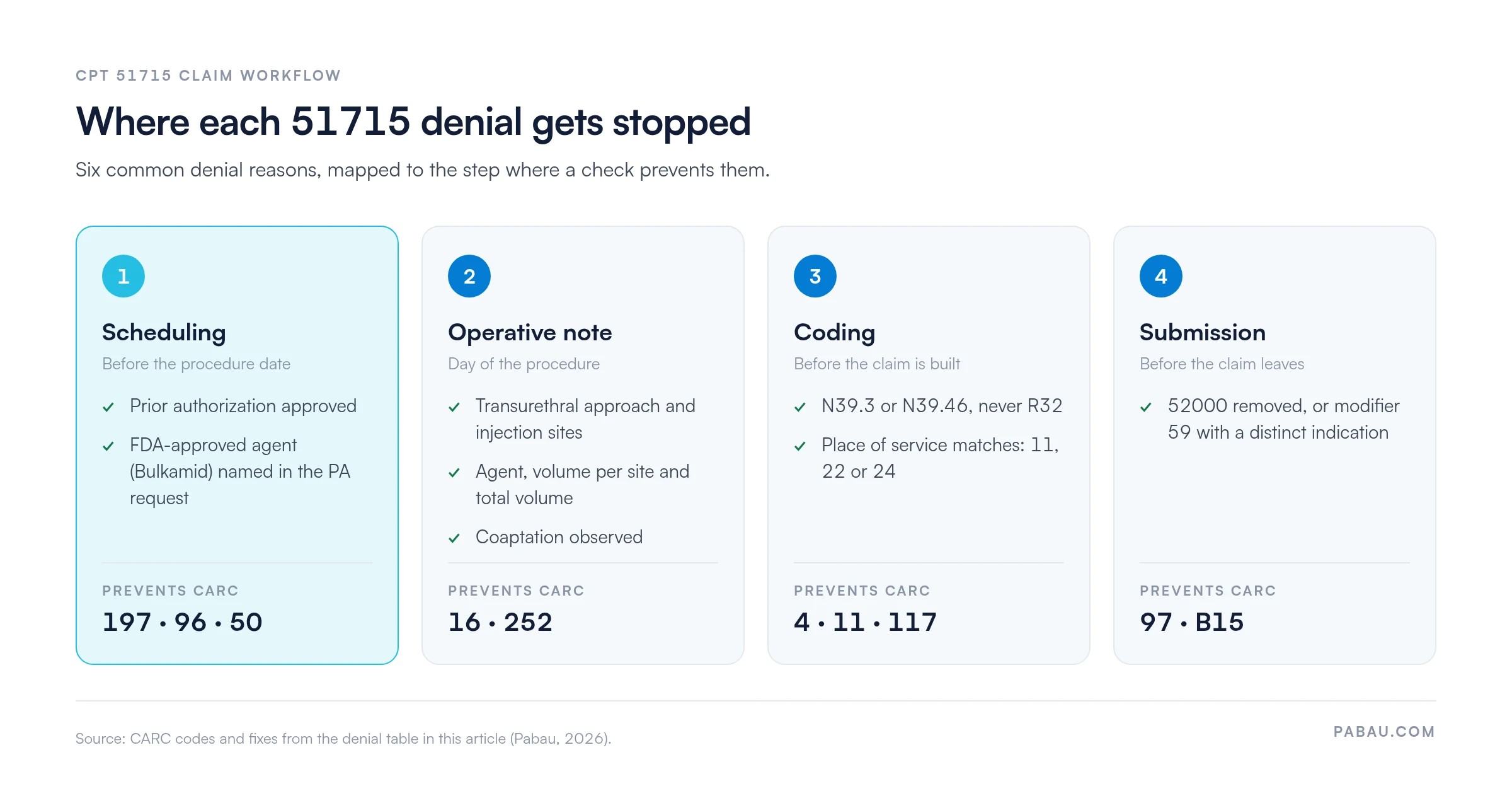
Most 51715 encounters need no modifier at all. The four below come up most often, and 59 and 25 cause the most confusion in urology billing departments.
CPT 51715 carries a 0-day (000) global surgical period under the 2026 Medicare Physician Fee Schedule. Preoperative and postoperative care on the day of the procedure are bundled into the payment. Check the CMS MPFS data file each year, because global periods are subject to periodic review.
Follow-up visits from the next day onward are separately billable when they’re documented. Modifiers 58 and 78 matter less here than on 10-day or 90-day codes, because the global period ends on the procedure day.
For same-day E/M visits, append modifier 25 to the E/M code. Document that the evaluation addressed a clinical question separate from the pre-procedure assessment for 51715.
Most 51715 denials start before billing ever sees the claim. A missed authorization, a note without injection volumes, or R32 on the claim each surface weeks later as a remittance code. Then someone on the team reworks the claim by hand.
Practice management software like Pabau keeps the appointment, the operative note, and the invoice in one patient record. With claims software for practices built into that record, Pabau runs validation checks every time you send a claim. Missing details get caught before they turn into rejections.
In the US, Pabau connects to Claim.MD, our clearinghouse partner. Claims go out electronically to payers, eligibility checks run in real time, and ERA remittances post back against the invoice. Your team follows each 51715 claim from submission to payment in one dashboard. When a CARC 197 or 16 comes back, the fix reaches scheduling or documentation before the next case.
Run a monthly audit on every 51715 claim submitted in the prior 60 days. Pull CARC codes from your 835 remittance files and group them by denial type. If CARC 197 (authorization) and CARC 4/11 (ICD-10 specificity) make up more than half your denials, fix the scheduling and documentation workflows first.

Pabau checks each claim for missing details before it goes out, then tracks it through Claim.MD to payment. Your team spends less time on rework and more time on reimbursement.

The 51715 claims that deny are rarely hard cases. They’re routine claims where one step slipped, usually the authorization, the diagnosis code, or the injection volumes.
So put the checks where those errors start. Confirm PA when the case is booked. Template the operative note so volumes and sites can’t be skipped, and code N39.3 or N39.46 before the claim is built.
The trade-off is a little more work at the front desk and in the procedure room. It still costs far less than appealing a denied claim weeks later.
Book a demo to see how Pabau checks and tracks your 51715 claims from scheduling to payment.

Need a framework for tracking claim denials across your urology practice? Denial management in healthcare covers root-cause analysis methods and appeal workflows for high-denial specialties.
Want to understand how electronic claims reach your payers? 837 electronic claim file explains the 837P transaction structure, clearinghouse routing, and what happens when a file is rejected.
Looking to tighten your billing compliance? Medical billing compliance requirements outlines the documentation and audit trail standards that reduce payer audit exposure for surgical procedure codes.
Want more 51715 claims paid on the first pass? What is a clean claim covers what a claim needs before it reaches the payer.
Need to confirm coverage before the procedure is booked? Insurance eligibility verification walks through checking benefits before the patient arrives.
CPT code 51715 is the procedure code for endoscopic injection of implant material into the submucosal tissue of the urethra and/or bladder neck. It’s used to treat stress urinary incontinence. The physician reaches the urethra through a cystoscope and injects the bulking agent, typically Bulkamid (polyacrylamide hydrogel), around the urethral lumen to improve coaptation.
Traditional Medicare covers CPT 51715 when medical necessity is documented. Coverage also depends on whether the MAC jurisdiction has an active Local Coverage Determination (LCD) for urethral bulking. Where an LCD exists, it typically requires documented failure of conservative therapy and urodynamic confirmation of stress urinary incontinence. Medicare Advantage plans usually require prior authorization.
Yes. Bulkamid (polyacrylamide hydrogel, manufactured by Axonics, which acquired Contura in 2021) is an FDA-approved urethral bulking agent. It’s the primary material billed under 51715 in current US practice. Include the product name and FDA approval status in the operative note and prior authorization request. Payers may deny claims for agents their clinical policy doesn’t list as covered.
CPT 52000 is a diagnostic cystourethroscopy code. It covers endoscopic examination of the bladder and urethra only, with no injection component. CPT 51715 includes the endoscopic access and the injection of implant material. Under NCCI edits, 52000 is bundled into 51715 on the same date unless modifier 59 supports a separate diagnostic service.
The most common denials are missing prior authorization (CARC 197) and a non-specific diagnosis code, such as R32 instead of N39.3 (CARC 4 or 11). NCCI bundling of 52000 without modifier 59 (CARC 97) and incomplete operative notes follow. All four are preventable with checks before submission rather than appeals after a denial.
CPT 51715 has a 0-day global period under the 2026 Medicare Physician Fee Schedule. Only care on the day of the procedure is bundled, so follow-up visits from the next day onward are billed separately.



