CPT Code 62284: Injection procedure for myelography
CPT Code 62284: official descriptor and procedure overview The American Medical ...

Last Updated: Oct 19, 2026
V2760 is the HCPCS Level II code for scratch resistant coating, per lens. It is an add-on code, reported with a primary spectacle lens code from V2100-V2499 and billed one unit per coated lens.
A bilateral pair therefore takes two units. Many payers won't pay V2760 on polycarbonate lenses, which have scratch resistance built in. Every claim also needs an itemized dispensing record that names the coating.
Let Pabau's smart automation suggest the right codes, reduce claim denials, and keep your practice compliant—effortlessly.
Automate repetitive tasks and focus on what matters most—your patients.
Reduce coding errors and ensure compliance with the latest regulations.
Clean claims, fewer denials, and faster reimbursements.
Powerful insights and reporting to help your practice thrive.
HIPAA compliant SOC 2 certified GDPR-compliant Trusted by 4,000+ clinics worldwide

V2760 covers scratch-resistant coating as an add-on to a primary lens code, billed as one unit per lens (two units for a bilateral pair).
Traditional Medicare excludes routine vision supplies, including lens coatings. Most V2760 claims go through vision benefit plans or commercial insurers.
The top denial trigger is a unit count error: billing one unit for both lenses instead of the correct two units.
Practice management software like Pabau tracks per-lens units and payer-specific billing rules, so fewer V2760 claims go out with the wrong unit count.
HCPCS Code V2760 is the code for scratch-resistant coating applied to a spectacle lens. Its official descriptor is Scratch resistant coating, per lens. It sits in the V2700-V2799 vision services range of HCPCS Level II codes maintained by CMS. Optometrists, ophthalmologists, and optical dispensaries use this range to bill lens features and treatments.
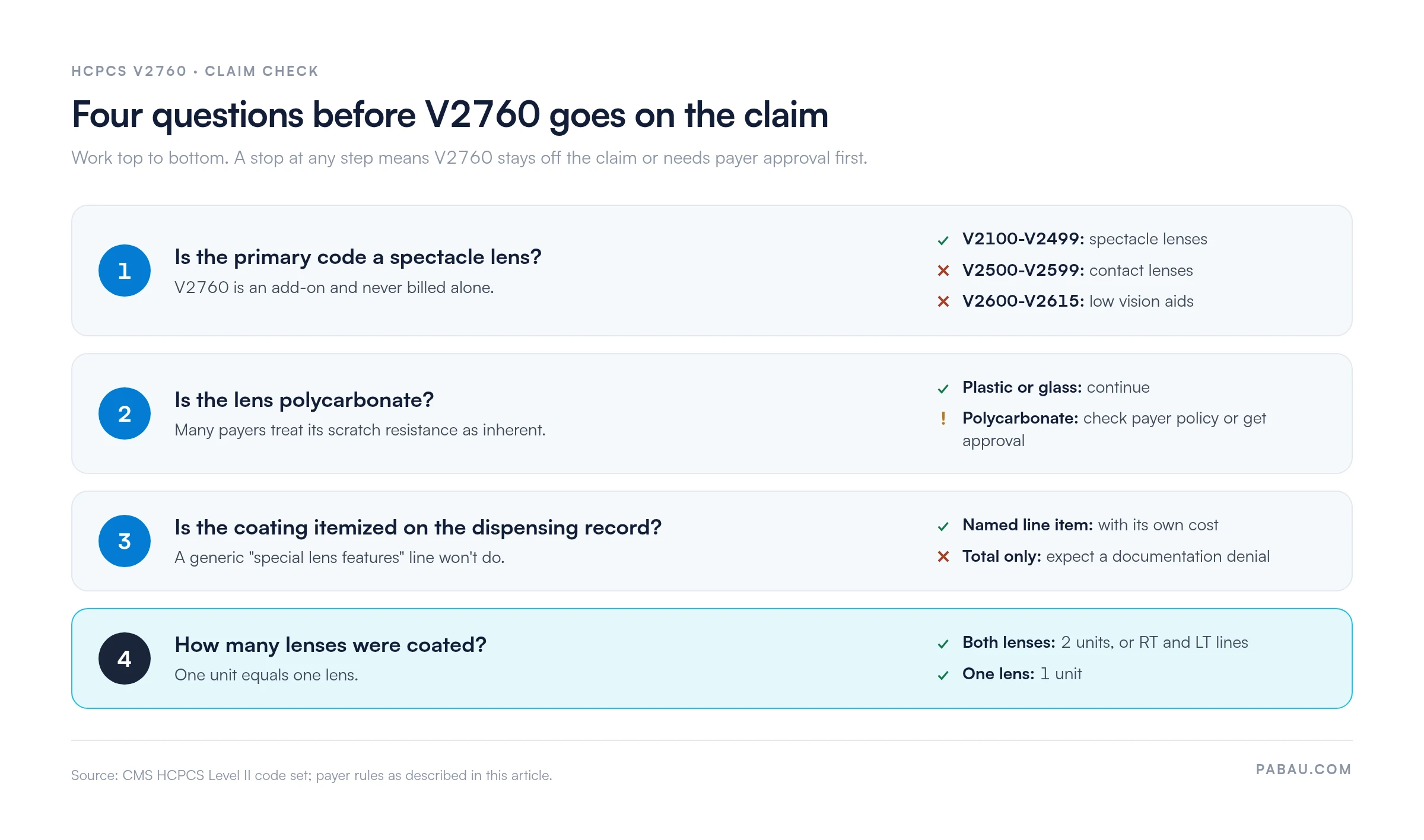
V2760 is an add-on code, so it is never billed alone. It always attaches to a primary lens code from the V2100-V2499 series, which identifies the lens type being dispensed. That series covers single vision, bifocal, trifocal, variable asphericity, and lenticular lenses. The scratch-resistant coating is the secondary service on that claim.
V2760 applies when a scratch-resistant coating is applied to a plastic or glass ophthalmic lens as a distinct finishing service. The coating must be a separately performed treatment, not a characteristic inherent to the base lens material.
The main exclusion to understand is polycarbonate. Polycarbonate lenses have a degree of built-in scratch resistance as a material property. Many payers treat this as inherent and won’t reimburse V2760 when the dispensing record shows polycarbonate lenses. Check your payer’s coverage policy before billing V2760 on a polycarbonate claim.
Four checks decide whether V2760 belongs on the claim at all, and the lens material is only one of them.
V2760 also does not cover photochromic lenses where scratch resistance is built in during manufacturing. It doesn’t cover anti-reflective coating (V2750) or UV treatment (V2755) either. Those are separate codes for separate services. Polarized lenses carry their own add-on code, billed with V2762 at one unit per lens.
When multiple lens add-on codes appear on the same claim, each must represent a distinct, separately performed service with its own documentation. Bundling edits can apply when payers determine that two coatings are not clinically distinguishable in the dispensing record.
The “per lens” descriptor is the most important part of V2760 in day-to-day billing. One unit equals one lens. A patient receiving scratch-resistant coating on both lenses of a pair needs two units on the claim, not one. Billing a single unit for bilateral orders is the most common V2760 claim error and a routine denial trigger.
Report two units when both lenses are coated. Use one unit when only one lens is treated, for example when the other side is a plano carrier lens.
Electronic claims follow the 837 claim file format, which handles vision add-on codes like any other HCPCS Level II code. The code goes in loop 2400, with the unit count in SV1-04. Optical practices using claims management software can set per-lens unit rules to apply automatically, which cuts manual entry errors on bilateral orders.
Run a monthly audit of V2760 claims filtered by unit count. Review any V2760 claim with exactly one unit. Was it a single-lens order, or did the biller enter one unit for a pair? Catching this before remittance posting saves the rework cycle entirely.
A V2760 claim without complete dispensing documentation rarely survives review. Payers need to confirm the coating was applied as a separate, billable service, not assumed as a standard lens feature. The superbill and the dispensing record together must show what was coated, on which lenses, and at what cost.
Treat the dispensing record for optical add-ons with the same rigor as a clinical note. Practices that store only a total invoice amount, with no line-item breakdown, routinely lose V2760 audits.
Traditional Medicare does not cover routine vision supplies, and scratch-resistant lens coating is explicitly within that exclusion. Most V2760 claims submitted to traditional Medicare Part B will be denied as a non-covered service under the statutory vision exclusion.
There are two situations where coverage may apply. First, Medicare Advantage (Part C) plans set their own vision benefits, and some include optical dispensing add-ons. Verify each patient’s Advantage plan benefit before billing V2760.
Second, post-cataract patients may have Medicare coverage for one pair of eyeglasses or contact lenses after lens implantation, under the prosthetic device benefit. Even then, coating add-ons like V2760 are typically not covered under standard Part B and remain patient-pay.
Checking insurance eligibility before dispensing is the most efficient safeguard. If the patient’s coverage doesn’t include vision add-ons, collect payment at the time of service rather than billing and waiting for a denial.
CMS publishes annual HCPCS fee schedule updates, and the CMS Physician Fee Schedule lookup tool is the authoritative source for current allowed amounts. V2760 reimbursement varies significantly by MAC jurisdiction and payer contract, so no single published rate applies universally.
For commercial vision plans, allowed amounts for scratch-resistant coating typically fall between $15 and $35 per lens. The figure varies by plan tier, plan year, and whether the practice is in-network.
Verify the current contracted rate in your payer portal before setting patient expectations. Posting electronic remittance advice lets you benchmark allowed amounts across payers and spot contracts worth renegotiating.
State Medicaid programs set their own vision benefit policies, and coverage for lens coating add-ons like V2760 varies considerably. Some states list covered V-codes in their provider bulletins, while others exclude all cosmetic or elective lens features. Wisconsin’s ForwardHealth program, for example, publishes vision-specific provider guidance that references V-code coverage.
Before billing V2760 to any state Medicaid program, locate the current vision services coverage policy in that state’s provider portal. Billing without confirmed coverage in a Medicaid context carries audit risk, particularly for add-on codes classified as elective.
Commercial vision plans (VSP, EyeMed, Davis Vision, Spectera) generally include scratch-resistant coating as a covered add-on. It’s often at a fixed copay or in a covered-in-full tier.
A clean claim to these plans matches the coating to the plan’s benefit grid. Some plans cover only one coating type per pair. Billing V2760 with V2755 can then trigger a bundling denial under the plan’s own fee schedule, separate from NCCI edits.
V2760 denials are predictable. The same errors appear repeatedly across optometry practices, and most are correctable on first appeal when the documentation is in order. The table below maps each one to its fix. For the payer reason codes that appear on an explanation of benefits (EOB), see our guide to common denial codes.
Repeat V2760 denials usually trace back to the handoff between the optical order and the claim. Adding a scratch-resistant coating checkbox to the optical order form, tied to claim generation, catches unit errors before submission. High-volume practices can also set their billing system to flag any V2760 claim carrying a single unit on a bilateral order.
An audit of a V2760 claim is a chance to check the other add-on lines as well. A tint line still carrying V2742 will be rejected, because CMS deleted that code at the end of 2003. Solid and gradient tints now use V2745 instead.
When appealing a V2760 bundling denial, request the payer’s specific edit rationale in writing. Many vision plan bundling edits are plan-level policies rather than NCCI edits. Documentation showing each coating was ordered and applied as a distinct service can often overturn them.
V2760 always appears on a claim as a secondary code. The anchor codes come from the V2100-V2499 range, which identifies the primary lens type. The table shows which primary codes pair with V2760 and which neighboring ranges never take it.
When V2760 is billed with other add-on codes (V2750, V2755), each coating needs its own line item and documentation. Check the AAPC’s HCPCS code range lookup to confirm each companion code’s current status before stacking them. The PGM Billing HCPCS lookup tool provides free descriptor and bundling reference data derived from CMS files.
Prism correction is another per-lens add-on with its own code. A press-on Fresnel prism membrane applied to an existing lens is billed with V2718, one unit per eye.
Most V2760 problems start before the claim exists. The optical order says both lenses and the biller types one unit. Then the lab invoice sits in a separate folder when the payer asks for it.
Practice management software like Pabau keeps the appointment, the dispensing details, and the invoice on the same patient record. Per-lens unit rules can apply automatically to bilateral orders, and the itemized dispensing record can be attached to the claim before it goes out.
Denials are tracked by code and payer type too. When V2760 rejections cluster around one payer or one error, you can fix that step of the workflow instead of reworking claims one by one.

Pabau tracks per-lens billing units, applies payer-specific rules, and flags V2760 claims missing a coating line item before they go out. That means less time reworking denied vision claims for optometry and ophthalmology practices.

Treat V2760 as a documentation code as much as a billing code. The code itself is simple, but payers pay it only when the dispensing record proves a separate coating on a specific number of lenses.
Start with the unit count on bilateral orders and the payer check on polycarbonate lenses, since those two cause most rejections. Then make the itemized lab invoice a required step before any V2760 claim is released.
Book a demo to see how Pabau keeps per-lens units and dispensing records attached to every vision claim.

Want to understand denial reason codes on your EOBs? Common denial codes in medical billing explains the most frequent CARC and RARC codes payers use when rejecting vision and optical claims.
Billing anti-reflective coating on the same pair? HCPCS code V2750 covers the anti-reflective lens add-on that often shares a claim with V2760.
Looking up another Level II code? HCPCS codes collects our HCPCS code guides in one place, from lens add-ons to supplies.
How does clearinghouse submission work for HCPCS V-codes? Medical claims clearinghouse guide covers how electronic claims move from practice to payer and where V-code claims can stall.
Need a framework for reducing repeat claim denials? Denial management in healthcare outlines a systematic approach to tracking, appealing, and preventing recurring rejections across billing codes.
HCPCS Code V2760 covers scratch-resistant coating applied to an ophthalmic (spectacle) lens as a separately performed finishing service, billed per lens. It applies to plastic or glass lenses where scratch resistance is not built into the base material. It does not cover anti-reflective coating (V2750), UV treatment (V2755), or coatings a payer considers inherent to polycarbonate lenses.
V2760 is billed per lens. One unit equals one lens, so a bilateral order where both lenses receive scratch-resistant coating needs two units on the claim. Billing one unit for a bilateral pair is the most common V2760 claim error and a routine denial trigger. Some payers want RT and LT modifiers on separate lines instead of two units on one line, so check before submission.
Traditional Medicare Part B does not cover V2760, because Medicare’s statutory exclusion of routine vision supplies applies to lens coatings. Medicare Advantage (Part C) plans set their own vision benefits, and some include optical add-ons, so verify each patient’s plan. Post-cataract patients may have limited spectacle coverage under the prosthetic device benefit, but coating add-ons are generally excluded even then.
You need a current signed eyeglass prescription and an itemized dispensing record or lab invoice that lists scratch-resistant coating with its own cost. The record must also show the lens material and how many lenses were coated. Some payers also want a medical necessity statement, particularly for Medicaid claims or post-surgical cases. A general invoice without a coating line item won’t support a V2760 claim on audit.
The most common reason is an incorrect unit count, with one unit billed for a bilateral pair. Others include a plan that excludes coating add-ons, bundling edits when V2760 is stacked with an incompatible code, and missing itemized dispensing records. Polycarbonate exclusions and missing RT/LT modifiers round out the list. Most are correctable on first appeal when the dispensing record is complete.
Medicaid coverage for V2760 varies significantly by state. Some states list V-code lens add-ons as covered services in their vision benefit schedules, while others exclude elective or cosmetic coating features entirely. Wisconsin’s ForwardHealth program, for example, publishes state-specific vision code coverage policies. Check the current provider bulletin for the specific state before billing V2760 to Medicaid.
V2760 always pairs with a primary spectacle lens code from the V2100-V2499 series, covering single vision, bifocal, trifocal, and variable asphericity lenses. It can share a claim with other lens treatment codes, such as V2750 (anti-reflective coating) or V2755 (UV coating). Each one must be separately applied and documented. Contact lens codes (V2500-V2599) and low vision aid codes (V2600-V2615) do not pair with V2760.
No single 2026 fee applies universally, and traditional Medicare does not reimburse V2760. Commercial vision plans typically allow $15 to $35 per lens for scratch-resistant coating, though contracted rates vary by plan and network tier. Verify the current allowed amount for each payer in your contract schedule or payer portal. CMS publishes annual HCPCS fee schedule files at cms.gov for Medicare Advantage or Medicaid managed care contexts.