CCSD code H4430: Examination of rectum under anaesthetic
CCSD code H4430 pays for the examination alone CCSD code H4430 is the UK private...

Last Updated: Oct 20, 2026
V2111 is the HCPCS Level II code for a spherocylinder, single vision lens, billed per lens. The descriptor covers sphere of plus or minus 7.25 to plus or minus 12.00 D, with cylinder of 0.25 to 2.25 D.
Most denials on V2111 claims trace back to the same three mistakes. The first is selecting V2112 when the cylinder is 2.25 D or below. The second is omitting the RT or LT modifier. The third is submitting without a written prescription that states both sphere and cylinder values.
Let Pabau's smart automation suggest the right codes, reduce claim denials, and keep your practice compliant—effortlessly.
Automate repetitive tasks and focus on what matters most—your patients.
Reduce coding errors and ensure compliance with the latest regulations.
Clean claims, fewer denials, and faster reimbursements.
Powerful insights and reporting to help your practice thrive.
HIPAA compliant SOC 2 certified GDPR-compliant Trusted by 4,000+ clinics worldwide

V2111 covers single vision spherocylinder lenses with sphere ±7.25 to ±12.00 D and cylinder 0.25 to 2.25 D, billed per lens
V2112 and V2113 share that same sphere band and differ from V2111 only by cylinder power
V2114 is set apart by sphere alone, covering any single vision lens over ±12.00 D with no cylinder qualifier
Medicare Part B covers V2111 only after cataract surgery under specific medically necessary conditions, not routine eyewear
RT and LT modifiers are required for per-lens billing; NU indicates a new (not rental) item on Medicare DME MAC claims
Pabau’s claims management software supports optical dispensing billing workflows to reduce V2111 claim rejections
HCPCS Code V2111 is the Level II code for a single vision spherocylinder lens. Its official descriptor sets the sphere at plus or minus 7.25 to plus or minus 12.00 diopters. The cylinder must fall between 0.25 and 2.25 diopters, and the code is billed per lens.
It sits within the V2100 to V2199 HCPCS series, which CMS maintains for eyeglass lens and optical dispensing supplies. Each code in that series maps to a distinct combination of sphere power and cylinder range. Selecting the wrong neighboring code exposes the practice to audit findings as well as denied claims.
The official CMS descriptor uses precise diopter language, and both halves of it have to be checked. The sphere phrase, plus or minus 7.25 to plus or minus 12.00 D, means the sphere power sits inside that band in either direction.
The cylinder phrase, 0.25 to 2.25 D, means a cylinder component is present and falls within that range. A prescription of -9.00 D sphere with -1.00 D cylinder meets both conditions, so it bills as V2111. A cylinder above 2.25 D in the same sphere band moves the claim to V2112 or V2113.
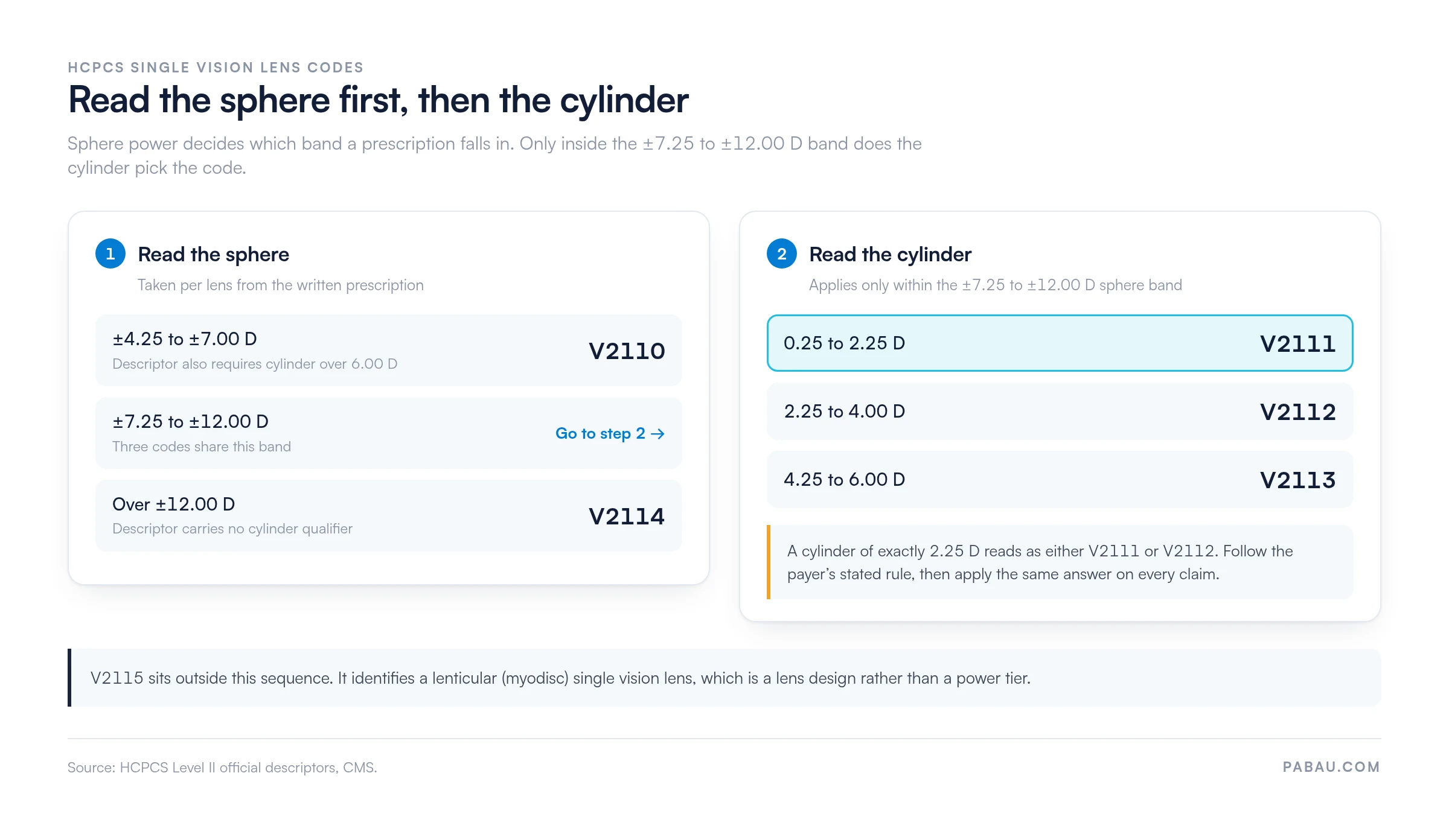
V2112 and V2113 are V2111’s closest siblings. All three carry the same sphere band of plus or minus 7.25 to 12.00 D, and only the cylinder value separates them.
V2111 runs from 0.25 to 2.25 diopters of cylinder, V2112 from 2.25 to 4.00, and V2113 from 4.25 to 6.00. Reading the cylinder off the prescription before picking a code settles the choice between the three.
V2114 breaks the pattern. It covers a single vision lens with sphere over plus or minus 12.00 D, and its descriptor carries no cylinder qualifier at all. Once the sphere passes ±12.00 D, the cylinder value no longer decides the code.
Two nearby codes are often pulled into this comparison by mistake. V2110 sits in the band below, at sphere ±4.25 to 7.00 D with cylinder over 6.00 diopters. It is not the low-cylinder companion to V2111. V2115 is a separate category again, identifying a lenticular (myodisc) single vision lens, which is a lens design rather than a sphere-power tier.
One boundary in the official wording deserves a written house rule. The V2111 descriptor ends at 2.25 D of cylinder and the V2112 descriptor begins there. A prescription landing exactly on that value reads as either code.
Check the payer’s own policy for which one it expects, and apply the same answer on every claim. Staff memory also tends to fail at the ±12.00 D sphere boundary. Reading the prescription in a fixed order removes both problems, and the sequence below is the order to read it in.
V2111 covers a single vision (monofocal) prescription lens where the dispensed lens meets both the sphere and the cylinder range in the official descriptor. The lens can be made from any material, including glass, plastic, polycarbonate, and high-index.
The code does not specify a material. One code is billed per lens, so a pair of glasses generates two line items, each with the appropriate RT or LT modifier.
What V2111 does not cover:
Low vision aids sit in their own device category, outside the V2100 lens power tiers. A spectacle-mounted single lens aid for vision loss that standard glasses cannot correct bills as V2610.
Add-on services like tints, anti-reflective coating, or photochromatic treatment are not included in V2111 and are billed as companion codes alongside it. CMS publishes the HCPCS Level II code set through its quarterly HCPCS code update. Those release files carry the definitive list of companion codes within the V2100 to V2199 range.
Medicare Part B does not cover routine eyeglasses or contact lenses. V2111 is payable under Part B only after cataract surgery with insertion of an intraocular lens (IOL). The patient must need corrective lenses as a direct result.
CMS provides coverage for one pair of eyeglass lenses (or one pair of contact lenses) under these post-surgical conditions. Billing V2111 for routine refractive eyewear and submitting to Medicare Part B is a compliance violation.
Run insurance eligibility verification before every vision claim, so nothing reaches a payer as a non-covered benefit.
Medicaid vision coverage varies significantly by state. Some state Medicaid plans cover one pair of lenses per year; others limit coverage to medically necessary conditions.
Always verify the specific state Medicaid vision benefit schedule before billing V2111 for a Medicaid patient. Private commercial plans may require prior authorization for lenses above certain power thresholds or per-plan frequency limitations.
Medicare fee schedule rates for V2111 are set by the DME MAC (Durable Medical Equipment Medicare Administrative Contractor) and vary by geographic locality. The CMS DMEPOS fee schedule files carry the allowed amounts by HCPCS code and jurisdiction.
The Physician Fee Schedule lookup tool will not answer this question, because it excludes MAC-priced codes. Rates are updated each January 1, so confirm the current year’s published rate rather than relying on a prior-year figure.
Medicare allowed amounts for single vision spherocylinder lenses in the V21xx series typically fall between $40 and $80 per lens. The figure moves with locality and lens complexity. Publishing a single national figure is not accurate because rates differ across DME MAC jurisdictions.
Use the DMEPOS fee schedule published for calendar year 2026 to retrieve the allowed amount for your MAC region. Reconciling allowed amounts against paid amounts through electronic remittance advice (ERA) processing catches variances without a manual check of each remittance.
Medicaid reimbursement for V2111 is set by each state’s fee schedule and is generally lower than Medicare allowed amounts. Commercial and vision-plan reimbursement is contractual and varies by negotiated rate. Track expected versus received amounts per code in your practice management system, and flag consistent underpayments for follow-up.
Run a quarterly V2111 payment variance report: compare your DME MAC allowed amount against each ERA line item. Consistent underpayments often signal a modifier error (missing NU) that the payer is silently adjusting rather than denying. Catching the pattern early prevents months of lost reimbursement.
RT and LT modifiers indicate right eye and left eye respectively. Because V2111 is billed per lens, a pair of glasses generates two claim lines: one with V2111-RT and one with V2111-LT.
Billing both lenses on a single line without laterality modifiers is a common denial trigger. Medicare DME MAC claims and most commercial payers that process per-lens supply codes both reject it.
The NU modifier requirement is specific to Medicare DME MAC claims. Commercial vision plans and Medicaid programs may not require NU, or may have their own modifier conventions.
Always verify payer-specific modifier rules before submitting. A clean V2111 claim depends on matching the modifier set to the payer’s own edits, rather than applying one universal ruleset.
A V2111 claim requires a written prescription that explicitly states both the sphere power and the cylinder value. The prescription must be signed by a licensed prescriber (optometrist or ophthalmologist) and dated before the date of dispensing. A prescription that records sphere only, without a cylinder value, does not support V2111. Code selection depends on the cylinder range, and the record has to establish it.
The patient record should contain the original written prescription and the dispensing date. It also needs the lens specifications as dispensed, confirming they match the prescription. Add the dispensing provider’s NPI and any payer-specific enrollment or authorization reference.
For Medicare post-cataract claims, the record must also include documentation of the qualifying cataract surgery and IOL insertion. Keeping that documentation on file for the payer’s audit retention period is part of billing compliance for optical supplies. The period is typically five to seven years, depending on the program.
A structured dispensing process captures every field on that list at the point of service, rather than reconstructing it at billing time. Records rebuilt after the fact are what let a claim pass initial scrubbing and then fail on audit.
A V2111 line needs a diagnosis code that explains why the lens was dispensed. For a routine refractive claim to a vision plan, that is the refractive error itself. For a Medicare post-cataract claim, the diagnosis has to establish the surgical history rather than the refraction alone. Laterality on the diagnosis code should agree with the RT or LT modifier on the lens line.
Medicare DME MAC claims for post-cataract eyewear normally carry Z96.1 alongside the refractive diagnosis. Aphakic patients who received no implant are reported with the H27.0 series instead.
Commercial vision plans are usually satisfied with the refractive error code by itself. A plan that treats lenses as a medical benefit may ask for more. Check the payer policy before the claim leaves the practice.
Most V2111 denials fall into a handful of categories. Working out which one applies to a returned claim determines the fastest correction path. Practices with high V2111 denial rates usually have a systematic error rather than isolated mistakes.
Two patterns dominate. One is a missing modifier applied consistently across every claim. The other is a code selection process that never checks the cylinder value before choosing between V2111, V2112, and V2113. A prescription in that sphere band with no cylinder at all bills as V2102 instead.
Reading the denial codes on the remittance advice alongside the explanation of benefits maps each returned claim to a root cause. The CARC (Claim Adjustment Reason Code) on the ERA identifies which category applies and which corrective action clears the denial.
A structured resubmission process prevents the timely-filing window from closing before the corrected claim reaches the payer. Work through these steps in order:
Log each denial reason and its resolution as you work it. When the same CARC recurs across multiple V2111 claims, it signals a process fix rather than a one-off correction.
V2111 covers the base single vision spherocylinder lens. Several add-on codes can be billed alongside it for optional treatments applied to that lens. Each add-on is billed per lens, matching the RT or LT modifier on the base V2111 line. Verify current NCCI (National Correct Coding Initiative) edits before billing any combination, as bundling rules can change annually.
Mirror coating is another per-lens add-on, billed on V2761 alongside the base V2111 line. It takes one unit per coated lens, so a mirrored pair bills two units.
V2781 (progressive lens) is mutually exclusive with V2111 by definition. A single vision code cannot carry a progressive add-on, because the two are different lens designs. Billing V2781 alongside V2111 triggers an NCCI edit and an automatic denial.
If the patient receives a progressive lens, select the appropriate bifocal or multifocal base code from the V2200 series instead of V2111. The AAPC HCPCS code lookup allows you to verify the current status and bundling flags for each add-on code before billing.
Practices that run optical dispensing claims software with built-in NCCI edit checking catch incompatible add-on combinations before submission, rather than after a denial. That check earns its keep fastest in dispensaries billing a high volume of single vision lens codes alongside treatment add-ons.
Before submitting any V2111 claim with an add-on code, confirm the combination is not flagged in the current NCCI edits table. CMS updates NCCI edits quarterly. Bookmark the CMS NCCI policy manual page and check it each time a new add-on enters your dispensing workflow.
Most optical dispensaries split V2111 billing across three places. The prescription sits in the chart, the modifier rule sits in a staff member’s head, and the underpayment only surfaces when the remittance lands. Each handoff is another chance to drop RT, LT, or NU from a line.
Practice management software like Pabau keeps the dispensing record and the claim on the same patient file. Lens specifications captured at dispensing carry through to the claim line. Laterality is applied per lens, and NCCI edits run before the claim is submitted. An incompatible add-on is caught at the desk rather than on the remittance.
Pabau also posts electronic remittance advice back against the original line, so an underpaid V2111 is flagged instead of written off. Denials arrive with their CARC attached to the claim they belong to, which shortens the correction cycle and protects the timely-filing window.


Pabau’s claims management software helps optical dispensing and vision care practices track modifier requirements, manage per-lens billing, and submit cleaner claims. See how it fits your workflow.

Write three checkpoints into the dispensing workflow and V2111 stops being a denial risk. They are the 2.25 D cylinder boundary that divides V2111 from V2112 and the laterality modifier on every lens line. The third is the Medicare Part B restriction to post-cataract cases. A dispenser who clears those three before submission rarely sees a V2111 claim come back.
The trade-off worth remembering is that none of these rules hold steady across payers. A cylinder of exactly 2.25 D reads as either code. NU is a DME MAC requirement rather than a universal one, and Medicaid coverage is set state by state. Pick a house answer for each, write it down, and revisit it when the fee schedule updates each January.
Book a demo to see how Pabau handles per-lens claim lines, modifier rules, and remittance reconciliation for an optical dispensary.

Dispensing a lens over ±12.00 D of sphere? V2114 is the single vision code that sphere alone decides, with no cylinder qualifier in its descriptor.
Want to streamline the full claims submission process? Medical claims clearinghouse explains how electronic claim routing reduces manual errors and speeds up reimbursement for HCPCS supply codes.
Looking to improve your practice’s overall billing accuracy? Revenue cycle management outlines the end-to-end process from eligibility check through payment posting, including where optical dispensing codes typically leak revenue.
HCPCS Code V2111 covers a single vision spherocylinder lens, billed per lens. The sphere must sit between plus or minus 7.25 and 12.00 diopters, with cylinder between 0.25 and 2.25 diopters. It does not cover bifocal, multifocal, or progressive lenses, or lenses whose sphere or cylinder falls outside those ranges.
All three cover single vision spherocylinder lenses with sphere between plus or minus 7.25 and 12.00 diopters, and only the cylinder separates them. V2111 covers cylinder from 0.25 to 2.25 diopters, V2112 from 2.25 to 4.00, and V2113 from 4.25 to 6.00. V2114 is the next code up, but sphere over plus or minus 12.00 diopters defines it, not cylinder.
V2110 covers a different power band. Its descriptor is sphere plus or minus 4.25 to 7.00 diopters, with cylinder over 6.00 diopters. V2111 begins where that sphere band ends, at plus or minus 7.25 diopters. The two are not low-cylinder and high-cylinder versions of one another, so a single prescription qualifies for only one of them.
Medicare Part B covers V2111 only after cataract surgery with insertion of an intraocular lens. The patient must also need corrective lenses as a direct medical result. Routine eyeglass lenses are excluded from Medicare Part B coverage. Billing V2111 to Medicare for routine refractive eyewear is a compliance violation.
RT (right eye) and LT (left eye) modifiers are required for each per-lens line item. Medicare DME MAC claims also require the NU modifier to indicate the lens is a new (not rental) item. Commercial and Medicaid payer modifier requirements vary, so confirm each payer’s current billing guidelines before submitting.
Yes, V2111 remains an active HCPCS Level II code for 2026. CMS publishes the updated HCPCS code set each October for the following calendar year. Verify current status through the CMS HCPCS release files or an AAPC-verified lookup tool before submitting claims under any V-series code.
Yes. V2744 (tint, photochromatic, per lens) and V2750 (anti-reflective coating, per lens) can be billed alongside V2111 as companion add-on codes. Payer coverage and the current NCCI edits still apply. V2781 (progressive lens) cannot be billed with V2111 because single vision and progressive are mutually exclusive lens designs.