CCSD code H4430: Examination of rectum under anaesthetic
CCSD code H4430 pays for the examination alone CCSD code H4430 is the UK private...

Last Updated: Oct 20, 2026
T2039 is the HCPCS Level II code for vehicle modifications, waiver; per service. It covers adaptive equipment and structural changes to a vehicle, such as hand controls, wheelchair lifts, and raised roofs.
Payment comes from Medicaid home and community-based services waivers, and Medicare does not pay T2039 at all. T-codes are reserved for state Medicaid agencies under the Centers for Medicare and Medicaid Services (CMS) HCPCS Level II system. Each state sets its own dollar cap, modifiers, and prior authorization rules.
Let Pabau's smart automation suggest the right codes, reduce claim denials, and keep your practice compliant—effortlessly.
Automate repetitive tasks and focus on what matters most—your patients.
Reduce coding errors and ensure compliance with the latest regulations.
Clean claims, fewer denials, and faster reimbursements.
Powerful insights and reporting to help your practice thrive.
HIPAA compliant SOC 2 certified GDPR-compliant Trusted by 4,000+ clinics worldwide

HCPCS code T2039 bills vehicle modifications under a Medicaid home and community-based services waiver, one claim per completed modification.
Medicare never pays T2039. CMS lists it as not payable, with no grace period.
Most states treat T2039 as a capped benefit rather than a fee, with limits set per year, per lifetime, or per ten years.
Prior authorization, a clinical evaluation, and contractor bids are needed before the work starts in almost every waiver program.
Modifier meaning is state-specific. Indiana uses U8 for modification maintenance, while Utah uses U8 for the modification itself.
HCPCS code T2039 is the Medicaid waiver procedure code whose official CMS descriptor is “Vehicle modifications, waiver; per service.” It pays for adaptive equipment and structural changes that let a person drive a vehicle, or ride in one safely.
CMS added the code on October 1, 2003 and has published no maintenance changes since. Its Medicare coverage status is “not payable by Medicare (no grace period)”, so a claim sent to Medicare is rejected outright.
The “per service” unit is not a time unit. One unit covers one completed modification service, which in practice means one approved project or one authorized item. The code itself fixes no price, no cap, and no modifier. Each state waiver program decides all three.
CMS updates the HCPCS Level II file quarterly. Confirm T2039 is still active for the current quarter through the CMS HCPCS release files or the AAPC listing for T2039 before you submit.
T2039 covers adaptations that let a waiver participant drive a vehicle, or enter, ride in, and leave one safely. The work falls into three groups, and a single project often draws on all three.
The assessment that decides which modification fits the participant is usually payable too. Minnesota’s waiver billing chart authorizes it under T2039 with a UD modifier, separately from the installation itself.
Waiver funds pay for the adaptation, never for the vehicle underneath it. The exclusions below appear in state waiver manuals and in New York’s vehicle modification authorization guidelines, which set out the pattern most programs follow.
Only one vehicle qualifies per participant, and it has to be that person’s primary means of transportation. It may be owned by the participant, or by a family member or other supporter who provides their long-term transportation.
Used vehicles draw the tightest screening, because the state is paying to attach expensive equipment to a car that may not last. New York applies these conditions before it will fund work on a used vehicle.
Driver eligibility is screened separately. A participant who will drive must hold a current license listing the restrictions tied to the disability, and must be able to operate the vehicle. For a participant who will not drive, the work has to be essential to safe travel and to getting in and out.
One more rule trips practices up on cost. A van is approved only when a car cannot be adapted to meet the same need. The file should record why the smaller option was ruled out.
Coverage is Medicaid-only. T-codes are reserved for state Medicaid agencies, so Medicare has no benefit category for T2039 and no coverage-based appeal exists after the denial.
Several states fund vehicle modifications outside a waiver as well. New York pays for them through the Community First Choice Option, as a state plan service. That route has its own authorization path rather than the waiver one described here.
T2039 carries no national modifier rule. States assign the U1 to U9 range themselves. The same letter and number can carry a different meaning two states apart.
That U8 clash is worth putting in front of any biller who works across state lines. The same two characters bill a $1,000 repair in Indiana and a full modification project in Utah.
Keep a one-page modifier map per state you bill, and rebuild it from the state chart rather than from a previous claim. Modifier meaning on T2039 is set state by state. A value copied from another program bills the wrong service under a name that looks right.
Vehicle modification is a construction project with a clinical justification attached, so the file is thicker than a normal service note. Every item below is reviewable, and a missing one is enough to void payment on work already finished.
Bid counts scale with project size. New York asks for one bid on work under $1,000, and three bids above that. The lowest responsible bid meeting the approved scope must be chosen. Managed care plans are not held to the bid rule.
Cost changes discovered mid-job are the expensive trap. The vendor may find extra work once the vehicle is stripped. Approval has to be obtained before that work proceeds, or the extra cost may go unpaid.
Large projects can need a second sign-off above the local level. In New York, agreements above $15,000 in a year need state Department of Health approval. The limit is a soft one that medical necessity can push past.
The sequence below reflects how waiver vehicle modification claims actually move, from the plan meeting through to the paid remittance.
Vehicle modification sits beside several waiver codes that cover nearby needs, and the wrong pick is a routine cause of rejection. Confirm the descriptors against the current CMS file, since the site of the work decides the code more often than the equipment does.
Iowa shows how close the pairing gets. Its waiver chart lists one service called home and vehicle modification, then splits it in two. Home work goes to S5165 and vehicle work goes to T2039. A ramp in the driveway and a lift in the van come off the same allowance but bill on different codes. Our guide to T2003 covers the transportation side of that same waiver benefit.
Running costs after the installation fall to a separate code. HCPCS code T2035 covers the utility cost of keeping medical equipment and assistive technology working at home.
Denials on T2039 rarely come from the coding itself. They come from the sequence around it, because the money is committed to a vendor long before the claim is created. Preventing them means fixing the order of operations rather than the claim form.
Read the denial codes on the remittance before you appeal. Re-sending the same claim without correcting the underlying sequence earns the same denial a second time.
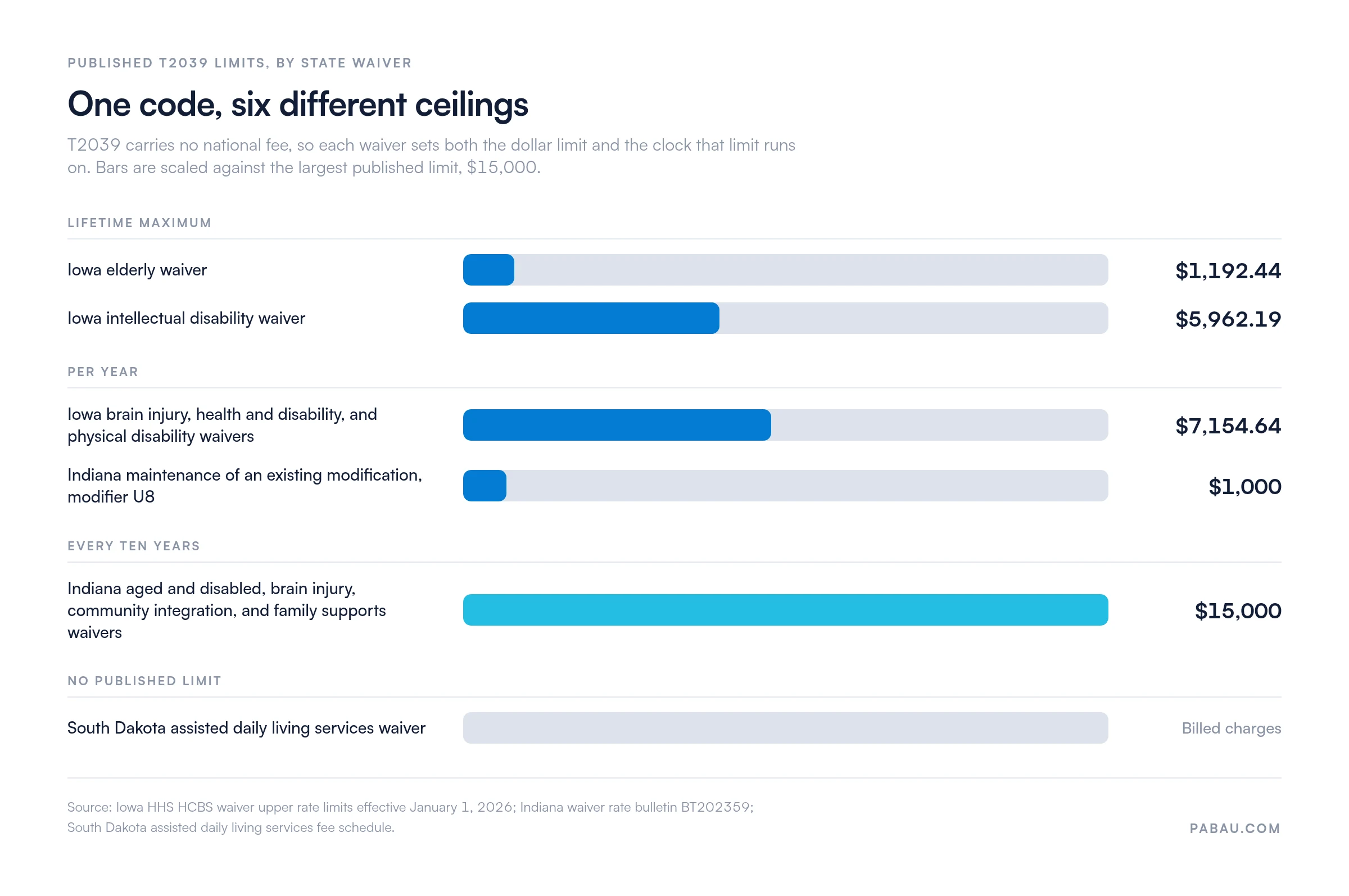
There is no national rate for T2039. CMS publishes no fee for T-codes, so payment is whatever the state’s waiver rule allows for the approved project. Most states express that as a cap rather than a unit price, which is why two identical lifts can be paid at different amounts.
Iowa’s figures come from its HCBS waiver upper rate limits effective January 1, 2026. Indiana’s come from waiver rate bulletin BT202359, and South Dakota’s from its assisted daily living services fee schedule.
Treat all of them as examples of structure rather than as current numbers for your own state. Set side by side, they differ as much in the clock attached to the limit as in the dollar figure.
Track the modification allowance as a running balance per participant, not as a yes or no on the claim. Some states share one cap between home and vehicle work. They will pay for a lift one year and deny an identical lift the next, because a bathroom ramp used the allowance in between.
Most teams billing T2039 keep the moving parts in separate places. The authorization number sits in an email and the bids sit in a shared drive. The clinical justification sits in the chart, and the running cap total sits in a hand-kept spreadsheet.
Practice management software like Pabau keeps the participant’s record, the supporting documents, and the claim in one system. Notes, uploaded evaluations, and authorization details stay attached to the person. The evidence behind a capped project is still there years later when an auditor asks.
Pabau’s claims management software then prepares and tracks the claim from that same record. Billing staff work from the documentation already on file rather than rebuilding it, so fewer projects stall between the finished job and the paid remittance.

Pabau keeps waiver documentation, authorizations, and claims on one patient record, so capped projects like vehicle modifications stay auditable from the evaluation through to payment.

T2039 pays for a single job. It funds the adaptations that let a waiver participant drive a vehicle or travel in one safely. The code is simple, and the money is decided elsewhere, in the state’s cap, its modifier map, and its authorization rules.
That is why the work that protects payment happens before the vendor touches the vehicle. Confirm the remaining allowance, get the evaluation and the bids in, and hold the authorization number with its dollar amount in writing.
Pabau keeps that evidence beside the participant’s record instead of scattered across inboxes and drives. To see how it handles waiver documentation and claims, book a demo.

Need to read denial codes off your remittance? Electronic remittance advice explained covers how to map an ERA denial back to its root cause.
Want a firmer grip on the whole billing cycle? Revenue cycle management for healthcare providers walks the workflow from eligibility check to payment posting.
Enrolling a new vendor or provider with Medicaid? Getting credentialed with insurance companies explains the enrollment steps that decide who may bill T2039.
T2039 covers vehicle modifications funded by a Medicaid home and community-based services waiver. That includes driver controls such as hand controls and spinner knobs. It also covers access equipment such as wheelchair lifts, and structural work such as a raised roof or a lowered floor. The assessment that decides which modification fits is often payable under the same code.
No. CMS lists T2039 as not payable by Medicare, with no grace period. T-codes are reserved for state Medicaid agencies, so Medicare has no benefit category for vehicle adaptation and no coverage-based appeal is available. Commercial plans do not cover it either.
One unit equals one completed modification service, so it is a project unit rather than a time unit. Each state defines what counts as one service in its waiver manual. Some programs also let providers bill maintenance of an existing modification separately, usually with a state modifier.
Modifiers on T2039 are set state by state, mostly from the U1 to U9 range. Indiana uses U7 to identify the waiver and U8 for maintenance of an existing modification. Utah uses U8 for the modification service itself on the New Choices Waiver, and Minnesota uses UD for the assessment. Iowa requires no modifier at all.
Programs typically ask for the person-centered service plan, a physician order or clinical justification, and a specialist evaluation with a dated scope of work. Add contractor bids, evidence that the vehicle qualifies, and proof that other funding sources were checked. The authorization number and its approved dollar amount must be issued before any work starts.
There is no national rate, because CMS publishes no fee for T-codes. States set a cap instead. Iowa’s waiver limits run from $1,192.44 lifetime on its elderly waiver to $7,154.64 per year on several others. Indiana allows $15,000 every ten years, plus $1,000 a year for maintenance. South Dakota pays the provider’s usual and customary charge.
The site of the work decides the code. T2039 covers modifications to a vehicle, and S5165 covers modifications to a home. Some states fund both from a single allowance. A bathroom adaptation billed on S5165 can then use up the money a wheelchair lift would need later.