CCSD code H4430: Examination of rectum under anaesthetic
CCSD code H4430 pays for the examination alone CCSD code H4430 is the UK private...

Last Updated: Oct 20, 2026
T2033 is the HCPCS Level II code for residential care, not otherwise specified (NOS), waiver; per diem. State Medicaid programs use it to pay for daily residential care delivered under a home and community-based services waiver. One unit equals one calendar day.
Coders reach for T2033 when the residential service has no more specific code in the T2012-T2041 waiver range. Most denials trace back to lapsed waiver enrollment, a rejected place of service code, or notes that describe the setting instead of the daily care.
Let Pabau's smart automation suggest the right codes, reduce claim denials, and keep your practice compliant—effortlessly.
Automate repetitive tasks and focus on what matters most—your patients.
Reduce coding errors and ensure compliance with the latest regulations.
Clean claims, fewer denials, and faster reimbursements.
Powerful insights and reporting to help your practice thrive.
HIPAA compliant SOC 2 certified GDPR-compliant Trusted by 4,000+ clinics worldwide

T2033 is an HCPCS Level II T-code for residential care NOS under Medicaid HCBS waiver programs.
The billing unit is per diem, so one unit equals one calendar day of residential care.
Claims require active waiver enrollment, a current person-centered service plan, and daily notes matching the billed units.
Reach for T2033 only when no named waiver code in the T2012-T2041 range describes the service.
Pabau’s claims management software tracks HCPCS codes, prior authorization documents, and denial workflows in one record.
HCPCS code T2033 belongs to the T2012-T2041 range of waiver services codes maintained by the Centers for Medicare and Medicaid Services (CMS).
That range covers home and community-based services authorized under state Medicaid HCBS waiver agreements. T2033 is the catch-all code for residential care with no more specific descriptor elsewhere in the range.
The NOS qualifier is intentional. T2033 applies precisely when the residential care provided does not fit a named code in the waiver range.
Verify the full CMS HCPCS Level II code set annually, since T-code descriptors and program applicability change with each fiscal year update. CMS does not set the money side of this code. Rates, unit definitions, and covered populations follow each state waiver agreement.
T2033 covers the daily residential care provided to a Medicaid waiver participant who lives in a community-based residential setting approved under that state’s HCBS waiver. The NOS designation means the service bundle does not match a more specifically described residential care code in the T2012-T2041 range.
Services captured under T2033 usually include overnight supervision, help with activities of daily living (ADLs), health monitoring, and non-skilled supportive care.
The residential site must be an approved waiver-funded setting. A group home, a supported living arrangement, or a similar community-based residence qualifies; a nursing facility or hospital does not.
The HCBS waiver context is the defining condition, and T2033 cannot be billed outside a waiver program. If the participant is not enrolled in an approved state HCBS waiver on the date of service, the code does not apply.
That holds regardless of the setting or the services delivered. Check AAPC’s HCPCS Level II code range reference for additional descriptor context and coding guidance.
Several service types and settings fall outside the scope of HCPCS code T2033. Billing T2033 for excluded services is a frequent cause of claim denial and audit exposure.
Structured childcare for a waiver-enrolled child is one such separately billed service. It is coded as HCPCS T2027 in 15-minute units, so those units never fold into a T2033 residential per diem.
The most consequential exclusion is residential habilitation with a named descriptor. Where a state’s waiver uses T2016 (habilitation, residential, waiver; per diem) for the services delivered, T2033 is the wrong selection.
Confirm which code your state Medicaid program has authorized for the specific service type before defaulting to the NOS code.
Per-diem billing means one unit of T2033 equals one calendar day of residential care. A participant who receives residential care for 28 days in a month generates 28 billable units. Do not prorate for partial days or adjust units based on staffing ratios; the unit is the day, not the hour.
Several claim fields carry the audit risk on a T2033 line, and payers review them closely. Refer to your state Medicaid billing manual for the exact CMS-1500 or 837P field requirements, as the specifics vary by program.
Getting those six fields right on the first submission is the cheapest way to protect T2033 revenue. A reworked claim costs staff time that the per-diem rate was never priced to cover.
Run a monthly reconciliation between your daily service logs and your submitted units before closing each billing period. Post-payment audits flag T2033 claims where the residential care notes and the billed days disagree. Build the reconciliation step into your billing calendar, not just your audit response process.
Thin documentation is the primary reason T2033 claims fail on audit. The record has to show three things. The participant was enrolled in an active HCBS waiver, the service plan authorized residential care, and staff delivered that care on each billed day.
Documentation in residential settings must be contemporaneous, meaning written at or near the time of service rather than reconstructed later. Retrospective documentation is a red flag for Medicaid auditors and may be treated as falsification in enforcement actions. A structured daily log template, adapted for waiver residential services, keeps the record consistent across every staff member on the roster.
Most state Medicaid programs require prior authorization (PA) before T2033 services can be billed. PA approval specifies the authorized number of days, the waiver program, the approved setting, and the service start and end dates. Billing beyond the authorized period or for more days than approved is a billing error, not a gray area.
The authorization process typically flows through the state Medicaid agency or its contracted managed care organization (MCO). The referring care coordinator or support broker submits the request as part of the HCBS waiver service planning cycle.
Providers should not begin billing T2033 until written authorization is received and on file. Running insurance eligibility verification before each service period confirms active waiver enrollment and catches lapsed authorizations before services are rendered.
Managed Medicaid plans add another layer. Each MCO may run its own PA form, submission portal, and review timeline, separate from the state fee-for-service process.
Providers serving participants across several MCOs need a system that tracks PA status by plan and by participant, not just by code. Contact your state Medicaid agency or MCO for the exact process that applies to your waiver program.
Four codes are regularly confused with T2033: T2016, T2031, T2048, and H2033. Each one covers a different service type or setting. Picking the wrong one usually produces a denial, or a recoupment demand once an audit reaches the claim.
The decision runs on one question: does your state waiver name a code for the specific type of residential care being delivered? Use that named code where one exists. Where no named code fits, T2033 is the correct selection. Defaulting to T2033 without checking for a more specific T-code is a shortcut that payers flag during claims review.
Crisis stabilization is one of those cases. A participant receiving crisis intervention in a crisis stabilization unit is billed under HCPCS code T2034, the per diem crisis intervention waiver code. Billing the residential NOS code instead creates a descriptor mismatch that payers flag on post-payment review.
Utility costs for medical equipment follow the same rule. The extra electricity that runs a ventilator or power wheelchair charger is billed under HCPCS code T2035, never folded into the residential per diem.
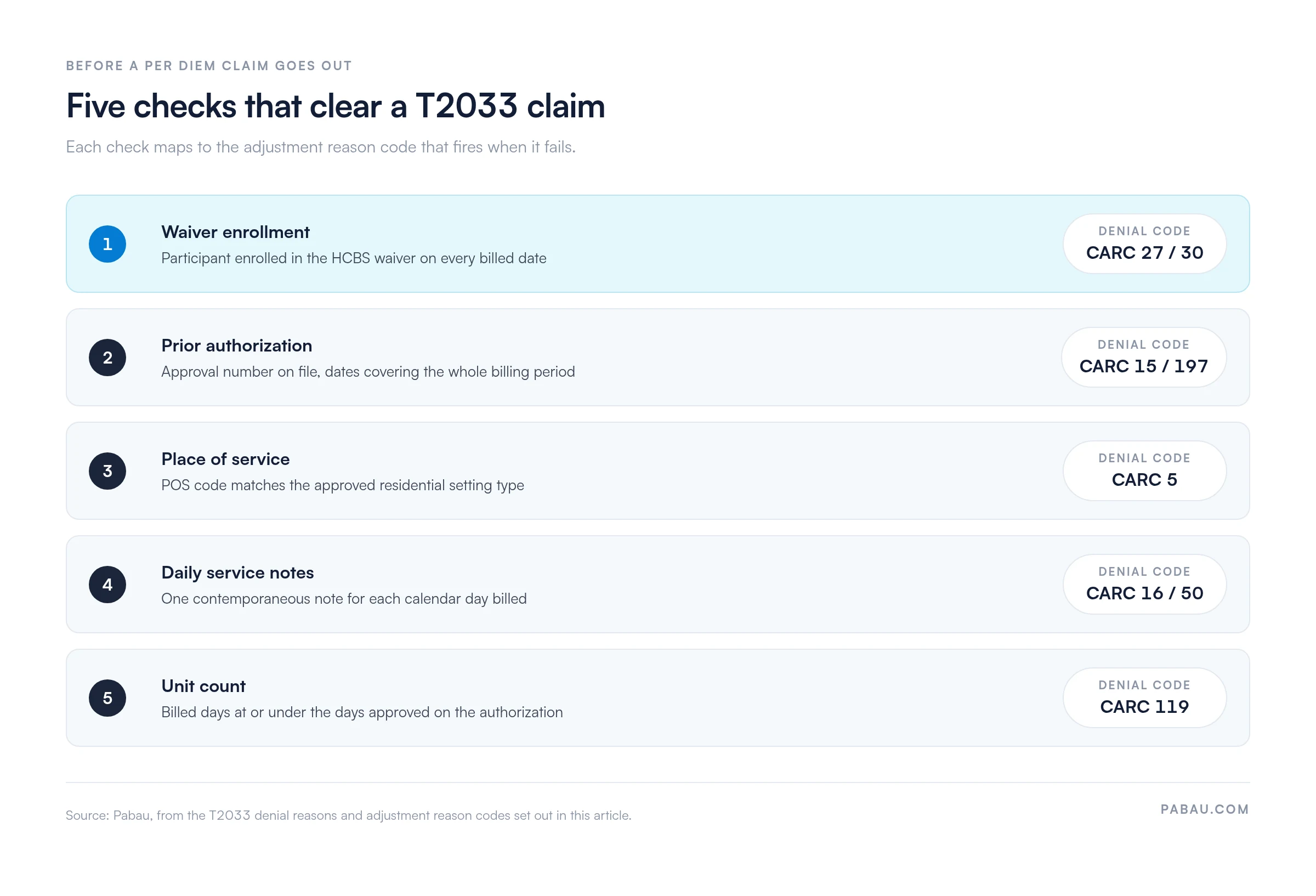
T2033 denials cluster around five root causes. Knowing which adjustment reason code (CARC) maps to each one helps billers respond correctly and prevent a repeat.
Every one of those five failures is catchable before submission, and the sequence below is the order to catch them in. Billers decoding a remittance line can start from our reference on denial codes. From there, map each CARC back to the step that prevents it.
Appeals for T2033 denials should include the waiver enrollment record, the PCSP page authorizing residential care, the PA documentation, and the relevant daily service notes.
A denial on documentation grounds is rarely won without all four. Refer to the CMS HCPCS code list and your state Medicaid billing manual to confirm current coverage criteria before submitting an appeal.
Assemble the four appeal documents as each service month closes, rather than after a denial lands. The enrollment record, the PCSP page, the PA approval, and the daily notes are all easy to pull while the month is fresh. Six weeks later, the staff who wrote those notes may have moved on.
T2033 reimbursement rates are set by each state Medicaid agency, not by CMS, and they vary substantially. A state running a supported living waiver may pay a different daily rate than a neighboring state running an intellectual disability waiver. The services can look identical on paper.
Several factors shape state-level rate variation for T2033:
To find the current T2033 rate for your program, go straight to your state Medicaid agency’s provider billing manual or fee schedule page. State Medicaid billing portals are the authoritative source. A neighboring state’s rate or a commercial coding database is no substitute, because those figures may be stale or tied to a different waiver.
In most residential waiver programs the claim and the evidence behind it live in separate systems. Enrollment sits with the care coordinator, the PA letter sits in a shared drive, and the daily notes sit in a logbook at the residence. When a payer asks for records on a 30-day claim, someone spends an afternoon assembling them.
Pabau is practice management software that keeps the billing record and the clinical record in the same place. Our claims management software stores the HCPCS code, the authorization number and dates, and the daily documentation against one patient record. Staff write the day’s note in the same system that later produces the claim line.
The result is a shorter path from a denial to an answer. Instead of chasing four documents across three systems, a biller opens the patient record and reads the authorization and the notes side by side. That also makes the monthly unit reconciliation a review rather than a rebuild.
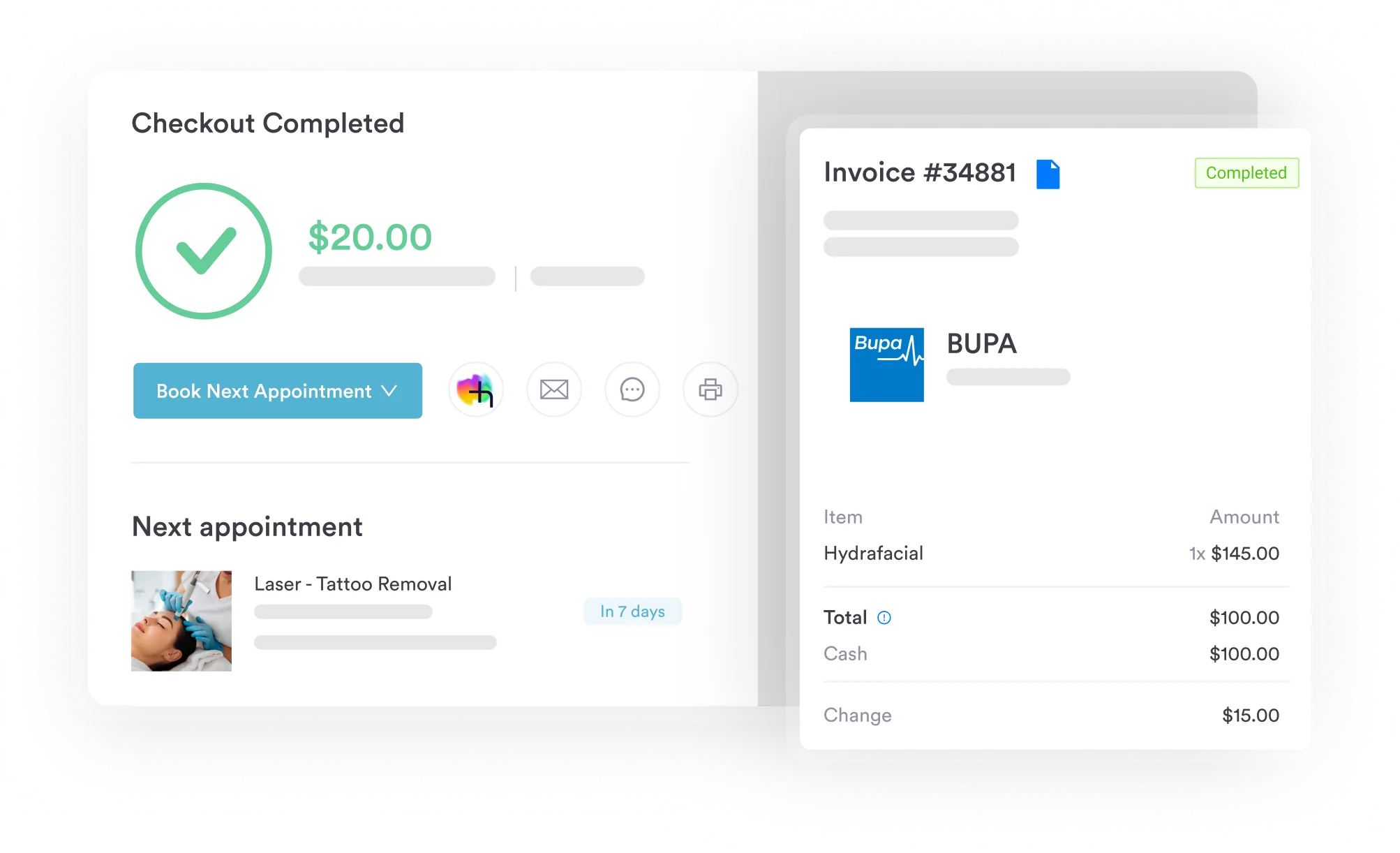

Pabau stores prior authorization dates, daily service documentation, and HCPCS claim lines against a single patient record. Residential providers can answer a payer records request without rebuilding the month.

T2033 is a simple code with a complicated claim. The descriptor takes a minute to understand, but the per-diem unit means every single billed day has to be defensible on its own. That is why the denial rate on this code tracks process discipline far more closely than coding knowledge.
So the work worth doing is upstream. Run the five checks before submission and keep each daily note written on the day. Do that, and filing an appeal becomes the exception rather than the routine. Book a demo to see how Pabau keeps waiver authorization records and daily documentation attached to the claims they support.

Looking to build a consistent pre-submission billing process? Medical billing fundamentals covers the end-to-end claim lifecycle from service delivery to payment posting.
Want to reduce claim rejections before they happen? What makes a clean claim outlines the elements payers check on first-pass review and where most claims fall short.
HCPCS code T2033 covers residential care not otherwise specified, provided under a Medicaid HCBS waiver and billed per diem. It applies when the residential care delivered does not match a more specifically described code in the T2012-T2041 waiver services range. Typical services include overnight supervision, ADL assistance, health monitoring, and supportive care in an approved community-based residential setting.
One unit of T2033 equals one calendar day of residential care. Do not prorate for partial days or adjust units based on staffing hours. For a participant receiving services for 30 days in a month, bill 30 units. State Medicaid billing manuals may specify span billing rules that allow date ranges rather than individual daily lines.
T2033 claims require four core documents. The first is the participant’s current person-centered service plan authorizing residential care. The second is waiver enrollment verification for each billed date. The third is a contemporaneous daily service note for every unit billed. The fourth is the prior authorization record with its approval number and date range. Missing any of these is grounds for denial or recoupment on audit.
T2016 is the code for habilitation, residential, waiver; per diem, which applies when the state waiver specifically funds habilitation in a residential setting. T2033 is the NOS catch-all used when no more specific residential code applies. If your state waiver names residential habilitation as a service type, bill T2016 rather than T2033. Using the NOS code when a named code exists is an incorrect code selection.
Four causes account for most T2033 denials. Prior authorization that is missing or expired returns CARC 15 or 197. Lapsed waiver enrollment on the billed date returns CARC 27 or 30. An incorrect place of service code returns CARC 5, and units above the authorized limit return CARC 119. Most denials are preventable with a pre-submission checklist. Confirm the PA dates, enrollment status, POS code, and unit count against the daily service notes before the claim goes out.
T2033 is used by state Medicaid programs operating HCBS waivers that fund community-based residential care. That includes developmental disabilities waivers, aged and disabled waivers, traumatic brain injury waivers, and similar programs. Not every state uses T2033; some use different code sets or create state-specific codes for waiver residential services. Confirm applicability with your state Medicaid agency or MCO billing manual.