CCSD code H4430: Examination of rectum under anaesthetic
CCSD code H4430 pays for the examination alone CCSD code H4430 is the UK private...

Last Updated: Oct 20, 2026
S0592 is the HCPCS Level II code for comprehensive contact lens evaluation. Commercial insurers and Medicaid managed care plans accept it, and the claim must carry a billable ICD-10 diagnosis code.
S-codes are not Medicare codes, and that single fact drives most billing errors on S0592. Submitting it to a Medicare fee-for-service plan always results in a denial, because Medicare does not recognize HCPCS Level II S-codes.
Let Pabau's smart automation suggest the right codes, reduce claim denials, and keep your practice compliant—effortlessly.
Automate repetitive tasks and focus on what matters most—your patients.
Reduce coding errors and ensure compliance with the latest regulations.
Clean claims, fewer denials, and faster reimbursements.
Powerful insights and reporting to help your practice thrive.
HIPAA compliant SOC 2 certified GDPR-compliant Trusted by 4,000+ clinics worldwide

HCPCS Code S0592 reports comprehensive contact lens evaluation for commercial and Medicaid managed care payers, not Medicare fee-for-service.
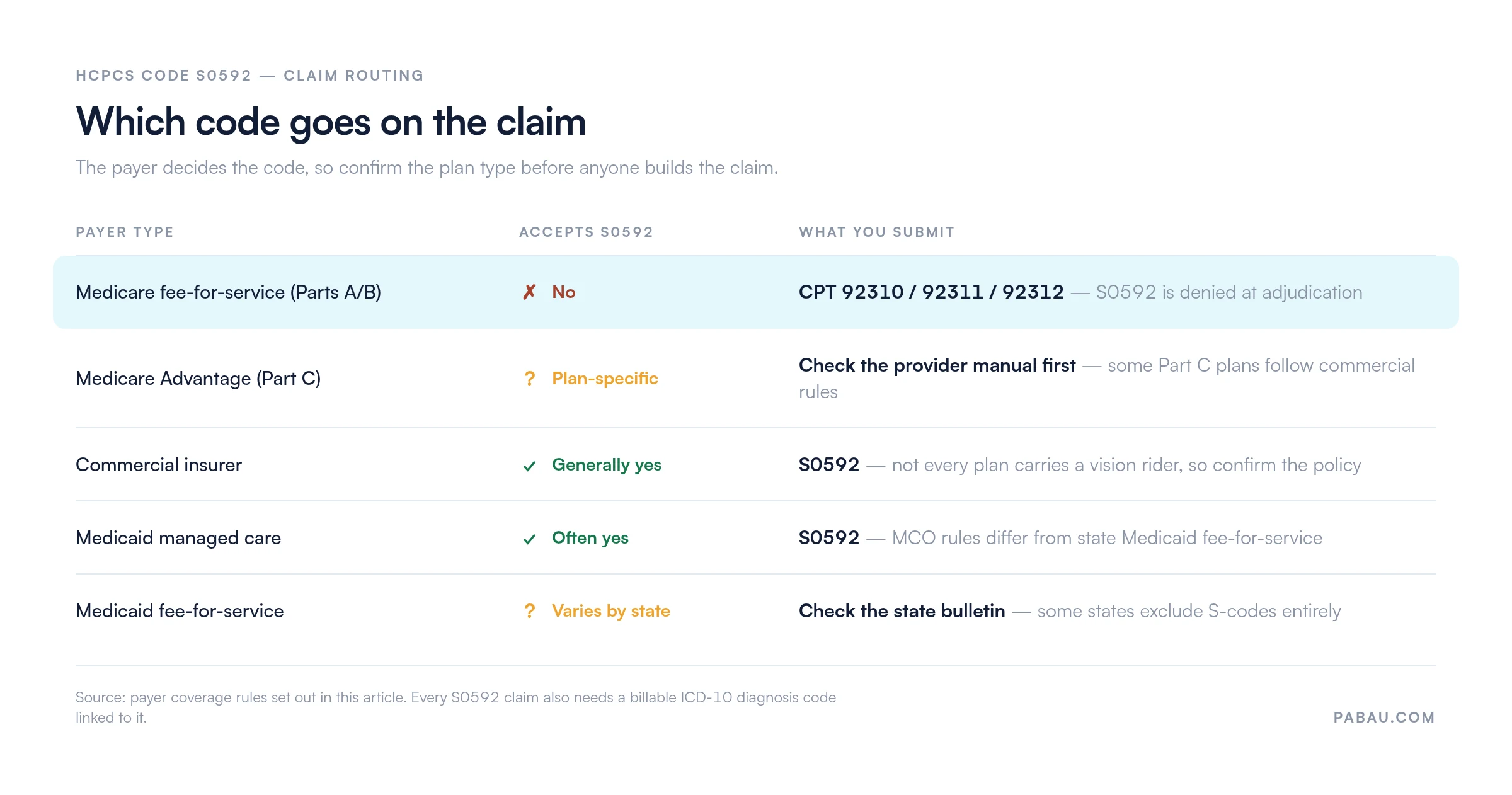
Medicare does not recognize S-codes, so submit CPT 92310 or 92311 instead of S0592 or expect an automatic denial.
Reimbursement varies by payer and state, so verify the allowed amount with each plan before assuming a rate applies.
Link S0592 to a billable child code such as H52.11, H52.221 or H18.601, never to a parent category.
The encounter note must record why the evaluation happened, what it found, and which lenses were trialed.
HCPCS Code S0592 is the Level II code for billing a comprehensive contact lens evaluation to commercial and Medicaid managed care payers. Claim systems show the short descriptor “Comp cont lens eval”.
The long descriptor is “Comprehensive contact lens evaluation”. CPT procedure codes are maintained by the AMA. S0592 sits in the HCPCS Level II temporary category instead, so billing teams manage it separately from their CPT workflows.
The table below summarizes the key reference data for S0592.
S-codes exist to name services that commercial plans pay for but CPT does not describe. The Blue Cross Blue Shield Association submits new and revised S-code requests to the HCPCS National Panel.
That panel, convened by CMS, reviews them on a quarterly and annual cycle. Check the effective status of S0592 against your payer’s current fee schedule before each claim cycle.
The most costly S0592 billing error is submitting it to Medicare. Medicare fee-for-service does not recognize any HCPCS Level II S-codes, including S0592. A claim sent to a traditional Medicare plan is denied at adjudication. The denial is not appealable on coverage grounds, because the exclusion applies to the whole S-code set rather than to one case.
Medicare Advantage plans add a layer of complexity. Some Part C plans adopt commercial payer coding rules and accept S0592 where traditional Medicare would not. Pull the plan’s provider manual before submitting, rather than assuming the Medicare exclusion covers every Medicare-branded plan. Checking the patient’s payer type at booking catches the mismatch before anyone builds a claim.
S0592 does not have a fixed national Medicare fee schedule rate, because Medicare does not cover it. Reimbursement is set by each commercial payer or Medicaid managed care organization (MCO) individually. Rates vary by state, plan type, and provider contract terms.
The ranges below reflect general market benchmarks reported across commercial plan fee schedules. Always verify the specific allowed amount with your payer.
The CMS Physician Fee Schedule lookup tool returns no rate for S0592, because Medicare does not price it. It still helps you benchmark the comparable CPT codes, 92310 and 92311, when you negotiate commercial contract rates.
Use the payer’s own fee schedule portal for the controlling figure. Keeping those rates in one place inside your practice management system saves your team from re-checking them claim by claim.
Pull your payer’s S0592 allowed amount from their provider portal or EOB before building your fee schedule. Many optometry billing teams set their charge amount at 150-200% of the highest expected commercial rate. That leaves room to accept contracted rates without billing below cost.
The decision between S0592 and CPT codes 92310 through 92314 comes down to who is paying the claim. S0592 exists because CPT codes alone do not always map cleanly to commercial payer benefit structures for contact lens evaluations. The two systems run in parallel and are not interchangeable.
Some commercial plans require the CPT code even when S0592 appears in their fee schedule, because their claims system maps the benefit through CPT logic. When a payer’s policy is ambiguous, submit whichever code their portal specifies.
Check AAPC’s HCPCS code lookup and the payer’s own coding policy rather than reading the descriptor alone. Mismatches here are a leading source of optometry claim denials, so flag every S0592 rejection for root-cause review.
Five payer types cover almost every optometry claim, and each one routes to a different answer. The chart below collapses that decision into a single rule your front desk and billing team can share.
Choosing S0592 over a CPT code (or vice versa) requires understanding what each CPT alternative actually describes. The four CPT codes most commonly cross-walked to S0592 each carry a distinct clinical context.
S0592 pays for the evaluation itself, not for the lenses the patient takes home. When a fit ends in a rigid gas-permeable extended wear lens, bill that supply separately under V2513, which is reported per lens.
Other lens types follow the same split. A disposable lens dispensed at the end of the fit bills under S0500, also per lens. A daily wear specialty lens takes its own supply line under S0512.
Practices that see both Medicare and commercial patients need coding logic that routes the correct code by payer type automatically. Leaving that switch to staff memory produces systematic denials. Building payer-code rules into claims software for optometry removes the decision from the daily workflow.
Commercial payers and Medicaid MCOs require a linked ICD-10 diagnosis code to establish medical necessity for S0592. The diagnosis must reflect the clinical reason for the evaluation, not the fact that a patient wears contact lenses. Every code below comes from the ICD-10-CM code set and must be reported to the highest level of specificity the record supports.
One detail trips up a lot of optometry billers. H52.1, H52.2, H18.1 and H18.60 are parent categories rather than claim-ready codes. Submitting one of them triggers an invalid-code rejection before a human ever reviews the claim, so the table lists the billable child codes instead.
Keratoconus carries the strongest medical necessity argument of the group. Scleral and rigid gas-permeable evaluations are hard for a payer to dispute, so claims linked to H18.601 through H18.609 are challenged less often.
For routine refractive conditions such as myopia, the note has to say why a contact lens evaluation was performed instead of a standard refraction. The code on the claim must match the diagnosis in the encounter note, not a plausible associated condition.
A payer reviewing an S0592 claim reads the encounter note before it reads the code. The note has to show why the evaluation happened and what it found. Most medical necessity denials on this code come back because one of the elements below is missing.
A note that lists only lens parameters reads as a dispense rather than an evaluation, and it will not support the code on audit. Retention periods come from state law and from each payer contract, so check both rather than applying one rule across the practice. Store the evaluation note, the lens order, and the benefit verification against the same encounter. A records request then takes one export instead of three searches.
A clean S0592 claim follows a short, predictable sequence. A missed step at any point causes the denial, not the code itself.
Practices with mixed Medicare and commercial panels should encode the routing rule in the fee schedule itself. Set it once and the correct code reaches the correct payer without anyone stopping to check.
S0592 denials cluster around a handful of recurring errors. Most are preventable with a simple pre-submission checklist.
Run a monthly audit of S0592 claims against Medicare payer IDs. Filter by primary payer to confirm no S0592 claims were submitted to traditional Medicare. Most practice management systems can generate this report in under five minutes.
Practice management software like Pabau carries a built-in code catalog covering both CPT and HCPCS Level II codes, S0592 included. Payer routing rules can be set so Medicare claims auto-select the matching CPT code, while commercial and MCO claims route to S0592. That takes the code-switching decision out of your billing team’s day.
Denial tracking is organized by code and by payer. S0592 rejections show up as their own line rather than sitting inside a general denial report. Your team can see whether a rejection came from a Medicare submission, a missing ICD-10 link, or a plan that excludes S-codes. Each of those has a different fix, and naming the cause is what makes the fix stick.
The same record carries the benefit verification, the encounter note, and the invoice. When a payer audits an S0592 claim, the documentation already sits with it.
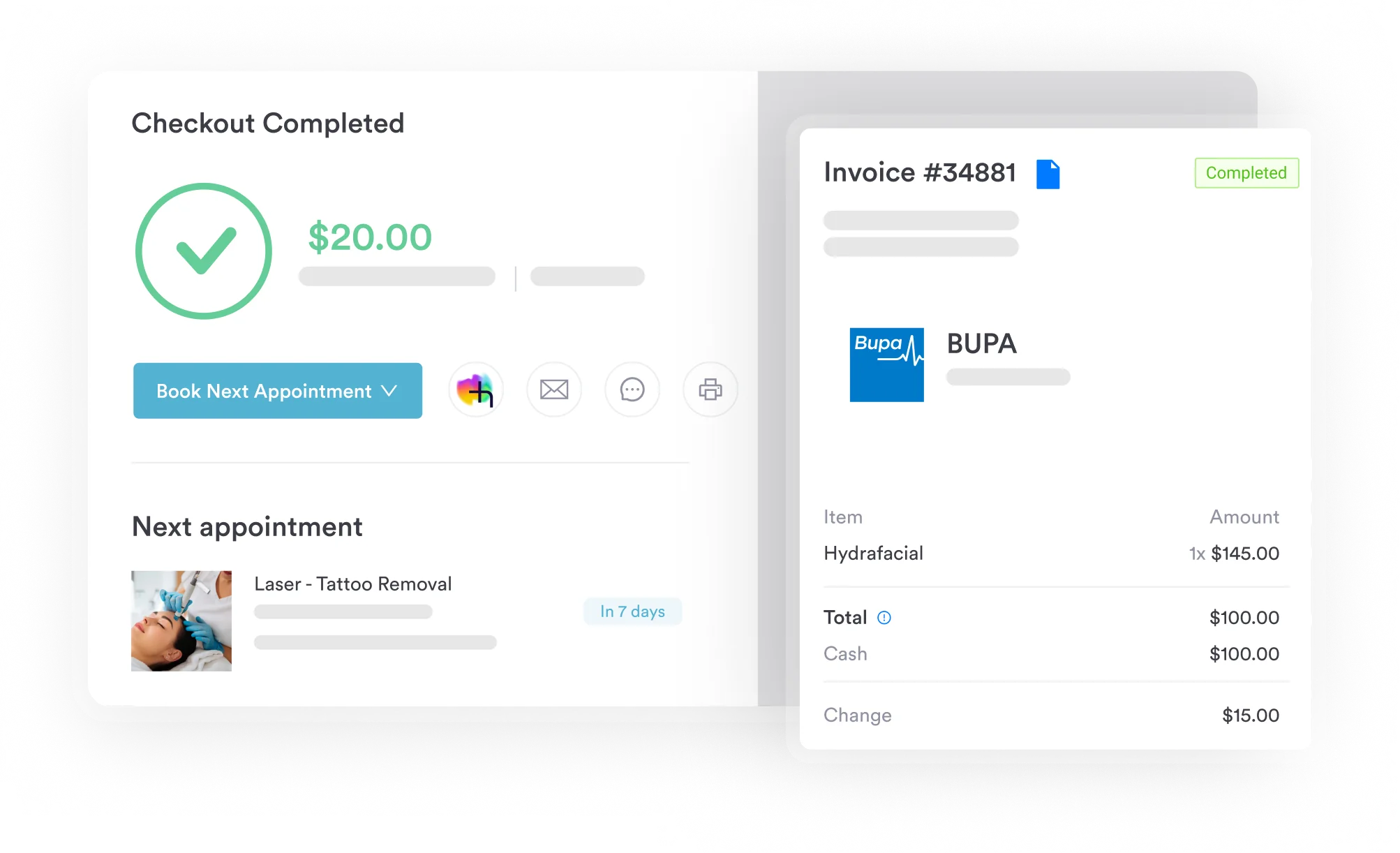

Pabau’s claims management tools route the right code to the right payer and track denials by code. Your optometry team submits clean claims without manual workarounds.

Almost every S0592 denial traces back to a decision made before the claim was built. Confirm at booking whether the plan accepts S-codes, link a billable diagnosis code, and write down why the evaluation happened. Do those three and the code behaves.
The practices that stop losing money on S0592 are the ones that make that routing decision once and record it. Put the payer rule in the fee schedule and keep the documentation checklist beside the exam lane. Your billing team then works exceptions rather than re-keying claims. Book a demo to see how Pabau routes S-code and CPT claims to the right payer for optometry practices.

Need a billing compliance checklist for your optometry practice? Medical billing compliance covers the documentation and coding requirements that keep claims clean and audits manageable.
Want to understand how payer denials are structured? Denial codes in medical billing explains the most common CARC and RARC denial reasons and what each one means for your workflow.
Looking for an end-to-end view of the claims process? Superbill guide walks through how encounter data flows from the clinical note to the submitted claim.
HCPCS Code S0592 is used to report a comprehensive contact lens evaluation to commercial insurers and Medicaid managed care plans. It is an HCPCS Level II temporary S-code and is not recognized by Medicare fee-for-service.
No. Medicare fee-for-service does not cover any HCPCS Level II S-codes, including S0592. For Medicare patients, use CPT code 92310 or 92311 depending on the lens type and clinical scenario. Some Medicare Advantage plans may accept S0592, but verify with each plan before submitting.
S0592 is an HCPCS temporary S-code accepted by commercial and Medicaid managed care payers. CPT 92310 is the AMA-maintained code for fitting corneal contact lenses, excluding aphakia, and Medicare accepts it. Use S0592 when the payer is commercial or an MCO. Use 92310 for Medicare, or when a commercial plan requires CPT codes in place of S-codes.
Commercial insurers generally accept S0592, and many Medicaid managed care organizations do as well. Acceptance varies by state, plan type, and whether the plan includes a vision benefit rider. Confirm with the specific plan before billing.
Use the billable child code, never the parent category. Examples include H52.11 (myopia, right eye), H52.221 (regular astigmatism, right eye), H18.11 (bullous keratopathy, right eye), H18.601 (keratoconus, right eye), and H52.4 (presbyopia). H52.1, H52.2, H18.1 and H18.60 are not claim-ready. The diagnosis must reflect the documented clinical reason for the evaluation.
No, not for the same service on the same date to the same payer. Submitting both S0592 and a CPT lens evaluation code such as 92310 for the same encounter triggers an edit. Payers read it as duplicate billing. Use whichever code the payer requires and bill it once.
The encounter note needs the clinical reason for the evaluation and the supporting diagnosis. It also needs objective findings, the lens parameters trialed, and the fit assessment. A note that lists only lens parameters will not support the code on audit.