Pabau Engage inbox

Pabau Engage is here: every patient conversation in one inbox.

Learn more
HCPCS Code

HCPCS code S0354 – Cancer treatment plan change


Code Definition

S0354 is the HCPCS Level II code for treatment planning and care coordination management for cancer, established patient with a change of regimen.

Commercial health plans and managed care organizations use S0354 when an existing cancer treatment plan changes. Its companion, S0353, reports the initial plan. Medicare does not pay S-codes, so S0354 has no Medicare Physician Fee Schedule rate. Each payer's contract sets coverage, authorization rules, and payment.

Level
Level II
Category
S — Temporary national codes (non-Medicare)
Status
Medicare coverage status I (not payable by Medicare)
Billable
No
Code also known as
S-code, payer-assigned HCPCS code, managed care code
Save time. Improve accuracy. Get paid faster.
Automate coding with Pabau

Let Pabau's smart automation suggest the right codes, reduce claim denials, and keep your practice compliant—effortlessly.

  • AI-powered code suggestions
  • Real-time compliance checks
  • Faster claims, fewer denials
Why practices choose Pabau
Save hours every week

Automate repetitive tasks and focus on what matters most—your patients.

Improve accuracy

Reduce coding errors and ensure compliance with the latest regulations.

Get paid faster

Clean claims, fewer denials, and faster reimbursements.

Grow with confidence

Powerful insights and reporting to help your practice thrive.

HIPAA compliant SOC 2 certified GDPR-compliant Trusted by 4,000+ clinics worldwide

Key takeaways

Key takeaways

HCPCS Code S0354 covers cancer treatment planning and care coordination for an established patient whose regimen changes. S0353 covers the initial plan.

S0354 is an S-code for non-Medicare payers, so Medicare does not pay it, and Medicaid coverage varies by state.

Prior authorization is often required, but approval does not guarantee payment, so the record must still support medical necessity.

No national CMS fee schedule rate exists for S0354, so each payer contract sets the reimbursement.

Pabau, the practice management platform we build, submits S0354 claims through Claim.MD and receives ERA remittances, so adjustment codes come back to the claim.

HCPCS Code S0354: definition and code description

HCPCS Code S0354 describes treatment planning and care coordination management for cancer, for an established patient with a change of regimen. It is the companion to S0353, which reports the initial treatment plan.

S0354 is a Level II S-code. It is maintained through the HCPCS national process for use by non-Medicare payers, such as commercial health plans and managed care organizations. S-codes span S0000 through S9999. Each payer decides whether to adopt a given S-code and how much to pay for it.

Quick reference: S0354 code details at a glance

FieldDetail
CodeS0354
DescriptorTreatment planning and care coordination management for cancer, established patient with a change of regimen
Companion codeS0353, for the initial treatment plan
Code levelHCPCS Level II (S-code)
Applicable payersCommercial health plans and managed care organizations (MCOs), not Medicare
Medicare statusCoverage code I, not payable by Medicare, with no Medicare Physician Fee Schedule rate
Medicaid coverageVaries by state and managed care plan. Verify before billing
Prior authorizationOften required and payer-specific
Claim formCMS-1500 (professional claims)

Because payers adopt S-codes by choice, each commercial plan decides whether it pays S0354. Verify acceptance through the payer’s provider portal before the date of service.

What does S0354 cover? Inclusions and exclusions

S0354 covers treatment planning and care coordination management for a patient already under cancer care whose treatment regimen changes. The descriptor is fixed nationally, so every payer that adopts the code reads it the same way. Payers differ on what they bundle into it, so check the payer’s clinical policy before you bill a related service separately.

What is typically excluded from S0354 billing:

  • Supplies, durable medical equipment, or drugs given during the same encounter, unless the payer’s fee schedule says otherwise
  • Evaluation and management services on the same date, unless a separate, significant, and identifiable service is documented
  • Services covered by a more specific HCPCS or CPT code that the payer prefers for the clinical scenario
  • The initial treatment plan itself, which S0353 reports
  • Any service rendered by a provider not enrolled and credentialed with the billing payer

ICD-10-CM codes that support medical necessity for S0354

Payers that accept S0354 expect a cancer diagnosis on the claim, because the code describes cancer treatment planning. The exact covered list still varies by payer policy, so confirm it in the payer’s clinical policy bulletin before you submit.

ICD-10-CM rangeDescriptionNotes
C00-C96Malignant neoplasms, primary and secondary sitesThe main supporting category. Code to the highest specificity the record supports
D00-D09In situ neoplasmsAccepted only where the payer’s policy allows it. Confirm before submitting

Practical step: Cross-check the patient’s documented cancer diagnosis against the payer’s covered code list before submission. Confirm the exact code and its specificity in the ICD-10-CM library for coders. A covered service with an unsupported diagnosis is one of the most avoidable S0354 denials.

Which payers accept HCPCS Code S0354?

Commercial health plans and managed care organizations accept HCPCS Code S0354, plan by plan, and Medicare does not. CMS excludes S-codes from the Medicare Physician Fee Schedule, so submitting S0354 to Medicare Part B results in automatic denial.

Coverage by payer type:

  • Commercial health plans: Major commercial payers including Anthem, Aetna, Cigna, and UnitedHealthcare may accept S0354 under their managed care product lines. Acceptance is plan-specific, not employer-line-wide.
  • Medicaid managed care: State Medicaid agencies decide whether to adopt HCPCS S-codes. Some states let managed care organizations cover S0354, and others do not. Verify against your state’s current fee schedule and the specific MCO’s policy.
  • Medicaid fee-for-service: Generally does not cover HCPCS S-codes unless the state has adopted them into its fee schedule.
  • Medicare Advantage: Plans may adopt S-codes, but most align with traditional Medicare rules and exclude S0354. Confirm with the specific plan.
  • TRICARE / CHAMPVA: Coverage policies differ from commercial payers. Check the TRICARE Operations Manual and benefit handbooks for current S-code guidance.

Two checks decide most S0354 claims before anyone codes them. The first is whether the regimen change fits S0354 rather than S0353. The second is whether the patient’s payer adopts the code at all.
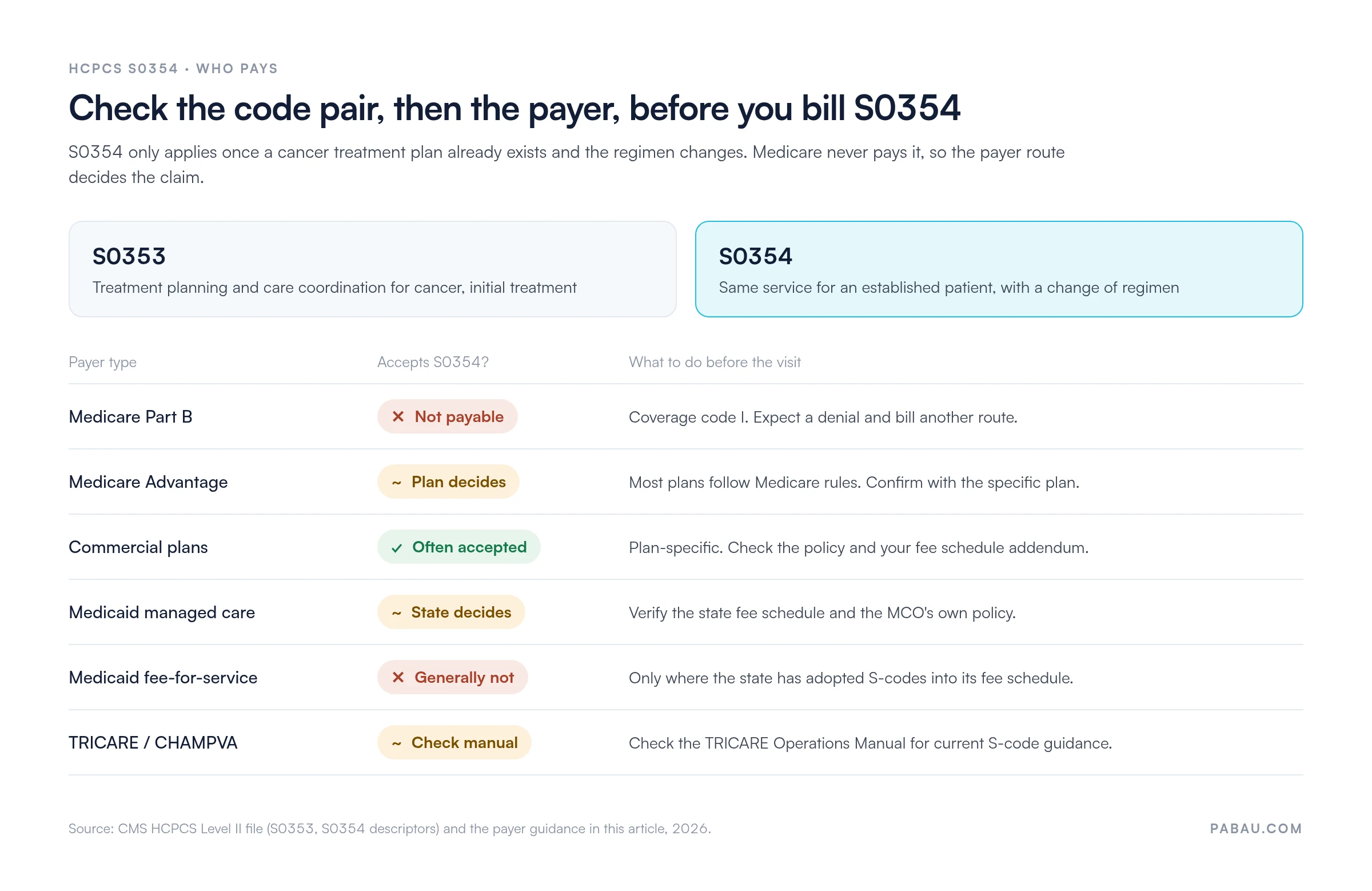
Payer route chart for HCPCS S0354.
Medicare never pays S0354, so the payer route and the S0353 or S0354 choice decide whether a claim can succeed. Built from the CMS HCPCS file and this article’s payer guidance.

Use insurance eligibility verification at the time of scheduling to confirm that the patient’s plan and product line accept S0354. A single eligibility check prevents the cost of a denied claim, an appeal, and a second billing cycle.

Prior authorization requirements for S0354

Prior authorization for S0354 is payer-specific. Some commercial plans require it for every claim, while others apply it only to certain diagnosis categories or units of service. Authorization does not guarantee payment, because the payer still reviews the claim for coding accuracy, medical necessity, and documentation afterward.

Standard prior authorization workflow for S0354 claims:

  1. Verify the PA requirement: Check the payer’s provider portal or call provider services before the date of service. Confirm whether S0354 needs prior authorization under the patient’s plan.
  2. Gather clinical documentation: Collect the treating clinician’s order, the cancer diagnosis with its ICD-10-CM code, and notes describing the regimen change. Add any lab or imaging results the payer’s policy specifies.
  3. Submit the PA request: Use the payer’s preferred channel (online portal, fax, or phone). Include the referring and rendering provider NPIs, the requested service date, and the place of service code.
  4. Record the authorization number: Enter it in Box 23 of the CMS-1500. A missing or incorrect authorization number is a common controllable denial reason.
  5. Confirm timelines: Most commercial payers respond to routine requests within 3 to 5 business days. Urgent requests typically receive a response within 24 to 72 hours, depending on plan rules.
  6. Plan for a PA denial: Review the payer’s denial rationale and supplement the clinical record. Then file a peer-to-peer review or first-level appeal before the deadline on the denial notice.

How to submit HCPCS Code S0354 on a CMS-1500 claim

Accurate S0354 claims depend on the right CMS-1500 fields, place of service code, modifiers, and provider NPI sequencing. A single field error sends the claim back before a reviewer ever evaluates medical necessity.

Follow these steps for a clean claim submission every time:

  1. Box 21 (Diagnosis Codes): Enter the ICD-10-CM cancer diagnosis code or codes that establish medical necessity. Link each diagnosis to its service line using the diagnosis pointer letters in Box 24E.
  2. Box 24D (Procedure Code): Enter S0354 without spaces. Add any required modifiers in the modifier fields immediately to the right.
  3. Box 24B (Place of Service): Use the POS code that reflects where the service was rendered. Common POS codes for S0354 include POS 11 (Office) and POS 22 (Outpatient Hospital). Payer policies may differ on which POS codes are covered.
  4. Box 24G (Units): Enter the number of units the payer’s coverage policy defines for S0354. Do not assume units based on CPT logic, because S-code unit definitions are payer-specific.
  5. Box 23 (Prior Authorization Number): Enter the payer-issued PA number if authorization was obtained. Leave it blank only if the payer has confirmed PA is not required for this plan and service.
  6. Box 33 (Billing Provider NPI): Enter the group NPI (Type 2) for the billing entity.
  7. Box 24J (Rendering Provider NPI): Enter the individual rendering provider’s NPI (Type 1). Some payers also require the rendering provider’s taxonomy code in Box 24 or Box 33b.

Modifiers commonly used with HCPCS S0354 billing

ModifierWhen to use with S0354Payer guidance
59Distinct procedural service on the same date as another billable codeUse only when the services are separate and documentation supports it
GTService delivered via interactive audio and video telecommunicationsRequired by payers that allow telehealth delivery of this service
95Synchronous telemedicine service rendered via real-time interactive audio and videoSome payers prefer 95 over GT. Check payer-specific modifier guidance
GYItem or service statutorily excluded from Medicare coverageA Medicare-specific modifier. It rarely applies to a commercial S0354 claim
GZItem or service expected to be denied as not reasonable and necessary, with no ABN on fileA Medicare-specific modifier. It rarely applies to a commercial S0354 claim

Pro Tip

Before appending any modifier to an S0354 claim, pull the payer’s current modifier guidelines. Commercial payers often update modifier preferences annually, and an outdated modifier can trigger an editing system rejection before the claim reaches a human reviewer.

S0354 reimbursement rates and fee schedule considerations

There is no CMS-set national fee schedule rate for HCPCS Code S0354. Because S-codes fall outside the Medicare Physician Fee Schedule, every dollar figure attached to S0354 comes from individual payer contracts.

Three factors that shape S0354 reimbursement in practice:

  • Contracted rate: Your reimbursement is whatever your contract with the specific MCO specifies. If S0354 appears on your fee schedule addendum, that rate applies. If it does not, the payer may apply its own default pricing, pay a percentage of billed charges, or deny the claim as non-covered.
  • Facility vs. non-facility: Some payers set separate facility and non-facility rates for S-codes, mirroring the logic of the Medicare Physician Fee Schedule. Confirm which POS code and rate apply to your practice setting.
  • EOB review: When a remittance advice (ERA or paper EOB) arrives, check the allowed amount against your contracted rate. Systematic S0354 underpayments often reflect a default rate rather than the negotiated one. They are recoverable through the contract reconciliation process.

Tracking S0354 payments within your broader revenue cycle management workflow helps billing managers catch systematic underpayments before they compound across claim cycles.

Codes similar to S0354: how to avoid confusion

Neighboring S-codes may look alike in a lookup tool but carry different descriptors, payer acceptance rules, and unit definitions. Submitting the wrong S-code, or a CPT code the payer bundles with S0354, leads to denials you can prevent.

CodeTypePayer applicabilityKey distinction
S0354HCPCS S-codeCommercial / MCO onlyEstablished cancer patient whose treatment regimen changes
S0353HCPCS S-codeCommercial / MCO; payer-specificThe initial cancer treatment plan, not a later change of regimen
Equivalent CPT codeCPT (Level I)Medicare and commercial payersUse CPT when billing Medicare, or when the payer’s policy names a CPT equivalent instead of S0354. Never substitute one without confirming payer preference

The most common mix-up is between S0354 and S0353. Bill S0353 when the treatment plan is first built, and S0354 when an established patient’s regimen changes.

Use the AAPC HCPCS code lookup and the PGM Billing HCPCS search tool to confirm current descriptors for S0354 and its neighbors.

Common denial reasons for S0354 claims and how to appeal

Most S0354 denials fall into a small set of root causes. The Claim Adjustment Reason Code (CARC) on the remittance advice tells billing teams where the problem is and what documentation to pull for the appeal.

Denial reasonTypical CARCRoot causeCorrective action
Non-covered serviceCARC 96Payer does not cover S0354 under this planVerify plan acceptance before service. Bill the patient only where the payer contract and a signed financial responsibility agreement allow
Missing prior authorizationCARC 15PA was required but not obtained, or Box 23 was blankObtain retro-authorization if the payer allows it. Appeal with clinical documentation supporting urgency
Medical necessity not establishedCARC 50The diagnosis is not on the payer’s covered list, or the clinical notes are insufficientAppeal with complete clinical notes, a letter of medical necessity, and a reference to the payer’s own clinical policy
Invalid or incorrect modifierCARC 4Modifier not recognized by the payer or applied incorrectlyReview the payer’s modifier policy, correct the modifier, and resubmit as a corrected claim
Duplicate claimCARC 18Identical claim submitted twice, or resubmitted without a frequency codeResubmit with a corrected claim frequency code (Claim Frequency Type 7) and confirm the original claim ID
Rendering provider not eligible or out of networkCARC 185 or CARC 242Rendering provider not credentialed with this plan, or not in its networkComplete payer enrollment before billing. Appeal with credentialing documentation if enrollment was pending at the time of service

A structured denial management workflow sorts S0354 denials by CARC on receipt. That makes it possible to batch corrective actions and file appeals before the payer’s deadline, typically 90 to 180 days from the original remittance date.

Documentation requirements to support S0354 claims

Each payer’s clinical policy sets the documentation requirements for S0354. Coders can still anticipate the core record elements that support any S-code claim and keep it within medical billing compliance.

  • Clinician order or referral: A dated, signed order from the treating provider authorizing the service and specifying the clinical indication
  • Clinical notes with date and signature: Encounter documentation from the date of service, signed by the rendering provider. It describes the patient’s cancer, the regimen change, the planning and coordination work, and the clinical rationale
  • ICD-10-CM diagnosis with supporting evidence: The diagnosis code on the claim must be backed by clinical findings in the note, not just a diagnosis label
  • Prior authorization documentation: A copy of the PA approval with the authorization number and service date range, stored in the patient’s billing record
  • Consent documentation: Patient consent for the service, where the payer’s policy or state law requires documented informed consent
  • Rendering provider credentials: Proof of the rendering provider’s licensure, NPI registration, and credentialing status with the payer at the time of service

Payers running post-payment audits for S0354 can request any of these elements. A missing element at audit creates repayment liability even when the original claim was paid correctly.

Pro Tip

Create a documentation checklist in your EHR template for every S0354 encounter. When the note is generated, the checklist prompts clinicians to record the diagnosis, the regimen change, and the coordination work before the note is signed. Missing documentation is far cheaper to fix before submission than after an audit.

How Pabau’s claims management supports S0354 billing

An S0354 claim often means checking eligibility in one portal, keying the CMS-1500 in another, and chasing the remittance by hand. Each handoff is a chance to lose the authorization number or the denial reason.

Pabau runs US insurance billing through Claim.MD. Its claims tools for billers submit CMS-1500/837P claims, run eligibility checks before the visit, and receive ERA remittances. Secondary claims go out from the same patient record.

Prior authorization sits on the patient’s case, with the auth code, dates, and sessions tracked together. Pabau warns staff when an authorization is missing, so the number is in place before the claim goes out. Your coders still choose the code and the diagnosis, and Pabau carries what they enter through to the payer.
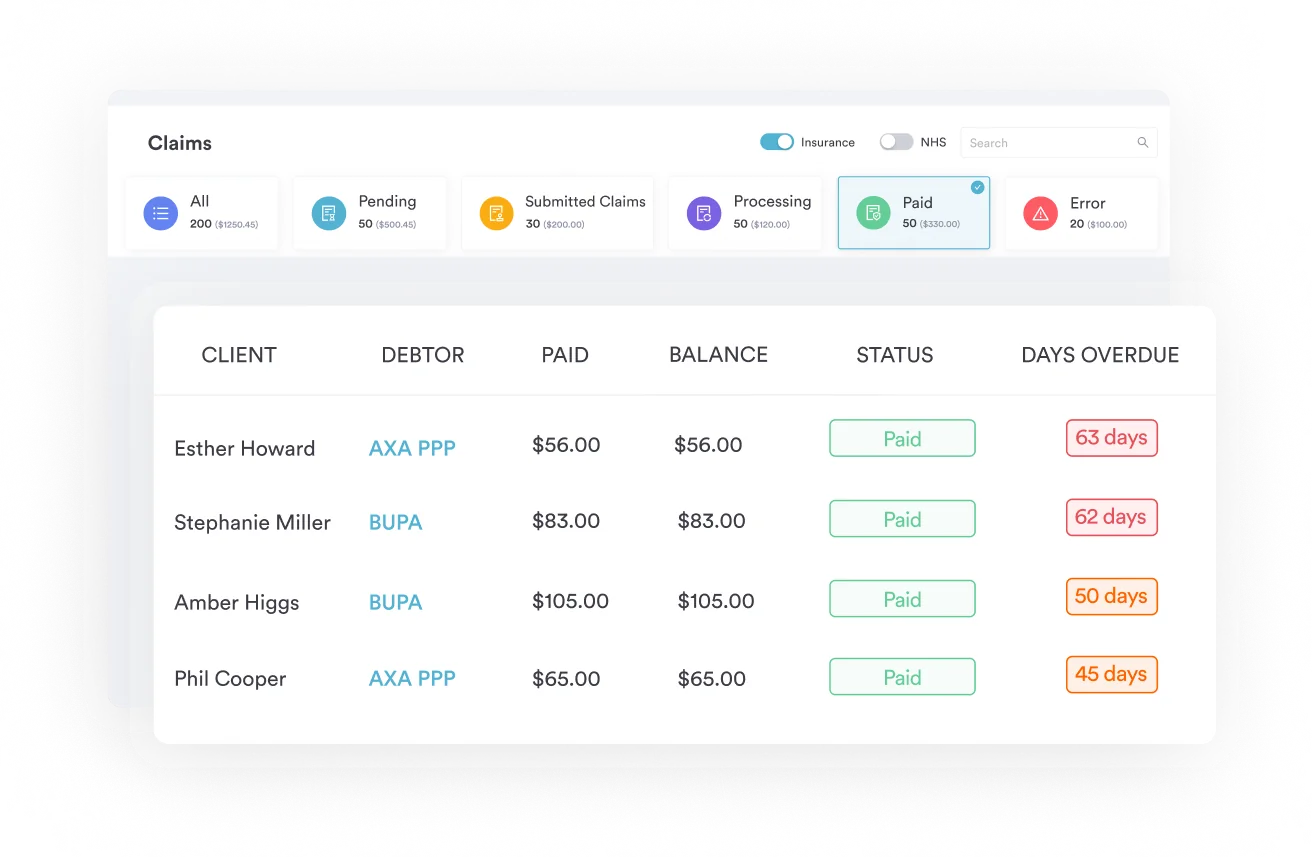
Pabau claims list with pending, submitted, processing, paid and error tabs
Pabau’s claims list sorts every claim into pending, submitted, processing, paid, or error. Your team can spot an S0354 claim that needs work before it ages.

Track every S-code claim from submission to payment

Pabau submits S0354 claims through Claim.MD, runs eligibility checks, and brings ERA remittances back to the claim. Your billing team sees each adjustment code next to the authorization it relates to.

Pabau claims management dashboard

Conclusion

S0354 pays only where a commercial or managed care plan has adopted it, and only when an existing cancer treatment plan changes regimen. Medicare will not pay it, so the work sits in the checks you run before the visit.

Settle each payer’s acceptance, authorization rules, and covered diagnoses once, when you contract with the plan. After that, each claim only needs the regimen change documented against a covered cancer diagnosis. The trade-off is setup time per plan, which pays back on the first denial you avoid.

Book a demo to see how Pabau submits S0354 claims and brings each remittance back to the patient’s case.

Continue your research

Continue your research

Need a denial resolution framework? Denial codes in medical billing explains common adjustment reason codes and how to build a systematic appeal workflow.

Looking for a clean-claim checklist? What makes a clean claim walks through every CMS-1500 field that affects first-pass acceptance rates.

Want to streamline your billing compliance process? Revenue cycle management explained covers how to structure your end-to-end billing workflow from eligibility through payment posting.

Frequently asked questions

What does HCPCS Code S0354 cover?

HCPCS Code S0354 covers treatment planning and care coordination management for cancer, for an established patient with a change of regimen. It is the companion to S0353, which reports the initial treatment plan. The descriptor is set nationally, but each payer decides whether to accept the code.

Is HCPCS Code S0354 covered by Medicare?

No. S-codes, including S0354, are not payable by Medicare and have no Medicare Physician Fee Schedule rate. Submitting S0354 to Medicare Part B results in a denial under CARC 96 (non-covered service).

Does S0354 require prior authorization?

Prior authorization requirements for S0354 vary by payer and plan. Many commercial health plans and MCOs require it, while others apply it only to specific diagnosis categories. Verify through the payer’s provider portal before the date of service, and record the authorization number in Box 23 of the CMS-1500.

What is the reimbursement rate for S0354?

There is no national CMS reimbursement rate for S0354. Rates are set entirely by individual payer contracts. If S0354 is not on your fee schedule addendum, the payer may apply a default rate or pay a share of billed charges. It may also deny the claim as non-covered. Check each remittance to confirm the allowed amount matches your contracted rate.

Why do S0354 claims get denied?

Most S0354 denials come from four causes. The plan may not cover S0354 (CARC 96), or prior authorization was missing or expired (CARC 15). The diagnosis may not be on the payer’s covered list (CARC 50). Or the rendering provider is not eligible or not in network (CARC 185 or CARC 242). Each cause needs a different fix before you appeal.

Can S0354 be billed with other procedure codes on the same date of service?

Yes, in some circumstances, but only when the additional service is distinct and separately documented. Modifier 59 is typically required to signal a separate procedure. Each payer’s bundling rules differ, so review the payer’s clinical policy before adding a second code on the same date.


Avatar photo
Despina Petrushevska
Content Writer

Despina Petrushevska is a content writer covering aesthetics, dermatology, and clinic operations, known for making detailed clinical concepts clear and engaging. Outside of work, she enjoys photography, weekend getaways, and finding inspiration in everyday experiences.
×