CPT Code 19361: Latissimus dorsi flap breast reconstruction
CPT code 19361: Official descriptor and payment basics CPT code 19361 is the Cat...

Last Updated: Nov 18, 2026
S0260 is the HCPCS Level II code for a history and physical (outpatient or office) related to a surgical procedure.
It is an add-on code, so the pre-op H&P is always listed in addition to the E/M service for the same visit. Medicare does not recognize S-codes, so S0260 goes only to commercial plans and Medicaid programs that list it. Claims fail most often when the payer rejects S-codes or bundles the visit into the global surgical package.
Let Pabau's smart automation suggest the right codes, reduce claim denials, and keep your practice compliant—effortlessly.
Automate repetitive tasks and focus on what matters most—your patients.
Reduce coding errors and ensure compliance with the latest regulations.
Clean claims, fewer denials, and faster reimbursements.
Powerful insights and reporting to help your practice thrive.
HIPAA compliant SOC 2 certified GDPR-compliant Trusted by 4,000+ clinics worldwide

HCPCS Code S0260 reports an office or outpatient history and physical tied to a planned surgical procedure.
It is an add-on code: list it in addition to the evaluation and management (E/M) service, never on its own.
Medicare does not recognize S-codes, so S0260 goes only to commercial plans and Medicaid programs that list it.
Most S0260 denials come from payers that bundle the pre-op visit into the global surgical package or reject S-codes outright.
HCPCS Code S0260 reports a history and physical (outpatient or office) related to a surgical procedure. The descriptor in CMS’s October 2026 HCPCS file tells coders to list it in addition to the appropriate E/M service. S0260 documents the pre-op workup itself, not a drug, a supply, or the surgery.
The code sits in the S-code family, a set of temporary national codes that CMS maintains for non-Medicare payers. Commercial insurers and some Medicaid programs use S-codes to report services the standard code sets don’t describe the way their contracts need.
S0260 covers one specific visit: the history and physical a patient needs before a scheduled surgical procedure, performed in an office or outpatient setting. The surgery must already be planned, and the H&P must exist because of it.
The decision-to-operate visit is the one most often confused with S0260. That visit establishes the need for surgery, so it isn’t related to an already planned procedure.
S0260 belongs to the later visit that prepares the patient for it. Payers that use S-codes have a separate one for a consultation before a screening colonoscopy, S0285.
Payer acceptance is the first check on every S0260 claim. The code is only worth billing where a contract or fee schedule recognizes it.
Because CMS doesn’t process S-codes, a Medicare claim carrying S0260 is rejected outright. A payer that recognizes the code may still pay nothing extra, using it to track pre-op visits for reporting. Read the payer’s policy before assuming the line carries a fee.
Keep a payer matrix for S0260 with three columns: accepts the code, pays a separate fee, and follows Medicare global surgery rules. Update it when contracts renew, and code from the matrix, not from memory.
S0260 never travels alone. The descriptor tells the coder to list it in addition to the appropriate E/M service. Every S0260 line therefore sits beside an E/M line for the same date. The E/M code reports the visit. S0260 marks that the visit included a surgery-related history and physical.
The global surgical package is where most of the friction comes from. Under Medicare rules, pre-op visits after the decision to operate are bundled into the surgery’s payment. For major surgery, that starts the day before the procedure.
Many commercial plans and Medicaid programs copy those global surgery rules. Where they do, a surgeon’s pre-op visit inside the global window is denied as included, with or without S0260. Where a payer pays S0260 separately, its policy defines who may bill it and when.
Timing matters for the record too. The Medicare hospital conditions of participation require a history and physical no more than 30 days before, or 24 hours after, admission or registration. When it was done before admission, an updated exam must be documented within 24 hours after admission and before surgery.
S0260 has no diagnosis requirement of its own, but the claim still needs one. For a pre-op evaluation, the ICD-10-CM Official Guidelines sequence a code from subcategory Z01.81 first. The condition that is the reason for surgery comes next.
Add the code for the condition being treated surgically, then any findings from the H&P itself. A claim that carries only the Z code tells the payer a pre-op exam happened, but not which surgery it prepared for.
A payer reviewing S0260 wants proof of two points. The H&P was complete, and it was tied to a planned procedure. Payers auditing for billing compliance look for these elements in the record:
The weakest records describe a general check-up and mention the surgery only in passing. Name the procedure at the top of the note, and make the risk assessment answer the question the surgeon asked.
Run these checks in order before the claim leaves the practice. Missing any one of them is enough for a denial.
Three of those checks decide whether the S0260 line can pay at all. The flow below runs them in the order a biller should.
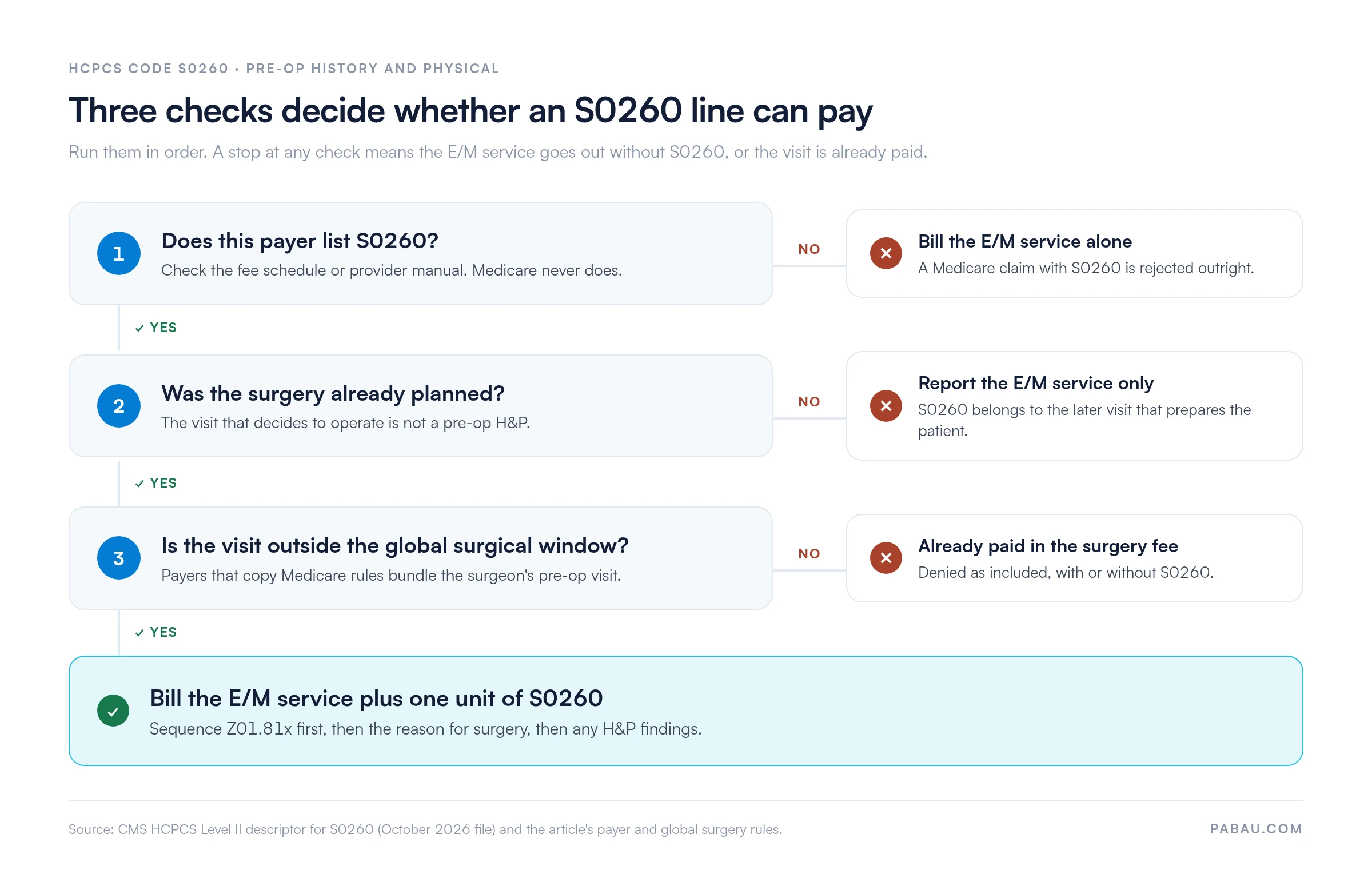
S0260 denials cluster around payer scope and bundling, not clinical detail. Start any denial management review by checking which of these drove the rejection.
Appeal only when the denial is technical or the payer misapplied its own policy. A code the payer simply doesn’t recognize won’t be overturned. The CARC and RARC codes on the remittance tell you which case you’re in, and our guide to denial codes decodes each one.
S0260 has no Medicare rate, so there is no national benchmark. Payment depends entirely on the payer contract or the state Medicaid fee schedule.
Some payers attach a fee to S0260, while others list it at zero and use it to track pre-op visits. A third group bundles it into the E/M service. Check the contracted amount before you forecast revenue from pre-op visits.
Watch remittances for the S0260 line over a few months. If one plan pays it and another routinely zeroes it out, raise it at the next contract negotiation.
Most S0260 problems start with a split record. The H&P lives in one system, the surgery date in another, and the claim is keyed from a summary. When a payer asks which procedure the visit prepared for, nobody can find the answer quickly.
Pabau, an EMR and practice management platform, keeps those pieces together. Patients complete medical questionnaires and pre-op forms before the visit. The clinician writes the H&P in the same patient record that holds the appointment for the procedure.
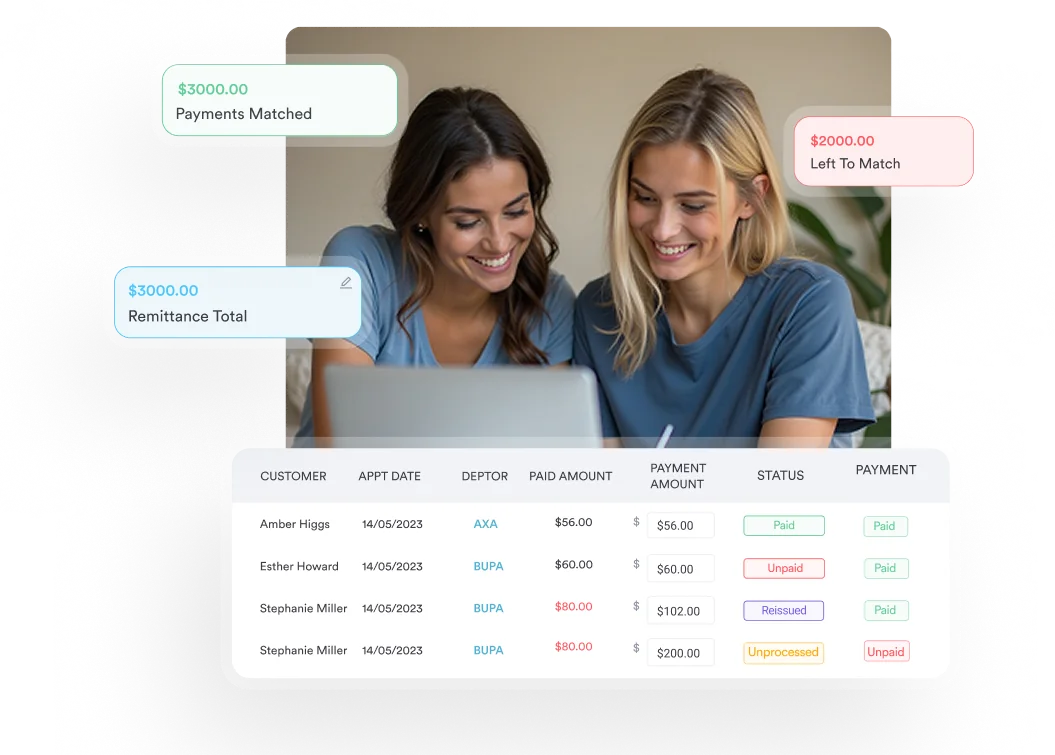
Pabau’s claims management software sends US claims through the Claim.MD clearinghouse as CMS-1500/837P files. Eligibility checks, claim status, and electronic remittances come back to the same record, so the billing team sees payment by line.

Pabau holds pre-op forms, clinical notes and US claims through Claim.MD in one system, from eligibility checks to remittance posting.

S0260 is a narrow code, and that narrowness is the point. It is the one line on the claim that tells a payer the visit was a surgery-related history and physical. It only pays off when the payer recognizes it and doesn’t bundle the visit into the surgery.
Whether it pays is settled before the claim is built. Check the payer, check the global window, and name the procedure in the note. Get those right and the code does its job. Book a demo to see how Pabau keeps the pre-op record and the claim in one workflow.

Need to understand how claims flow from submission to payment? What is revenue cycle management explains the end-to-end process from encounter to collected payment.
Seeing recurring claim rejections across multiple codes? Denial codes in medical billing covers CARC and RARC denial code definitions and resolution workflows.
Looking for clean claim submission best practices? Clean claim requirements outlines the elements every claim needs before it reaches the payer.
HCPCS Code S0260 covers a history and physical performed in an office or outpatient setting that is related to a surgical procedure. It is listed in addition to the code for the appropriate evaluation and management service. It describes the pre-op workup, not a drug, supply, or the surgery itself.
No. S0260 is a temporary national S-code, and Medicare does not recognize S-codes. It has no Medicare Physician Fee Schedule rate, and Medicare global surgery rules govern pre-op visits instead. Commercial payers and some Medicaid programs accept it.
No. The descriptor says to list S0260 separately in addition to the code for the appropriate evaluation and management service. Every S0260 line needs a supported E/M line for the same encounter, or the payer will deny it.
The ICD-10-CM guidelines sequence a code from subcategory Z01.81 first for a pre-op evaluation, such as Z01.818 for a general pre-op exam. Next comes the condition that is the reason for surgery, then any findings from the history and physical.
The payer likely follows Medicare global surgery rules, which bundle pre-op visits after the decision to operate into the surgery’s payment. For major surgery that starts the day before the procedure. Check the payer’s policy and appeal only if the visit fell outside that window.
Medicare hospital conditions of participation require the history and physical no more than 30 days before, or 24 hours after, admission or registration. One done before admission needs a documented update within 24 hours after admission. Either way, it must be in the record before surgery or anesthesia.