CCSD Code Q0750: Subtotal abdominal hysterectomy
CCSD Code Q0750: definition and official descriptor CCSD Code Q0750 covers ̶...

Last Updated: Nov 10, 2026
S0157 is the HCPCS Level II code for becaplermin gel 0.01%, 0.5 gm, the topical growth factor sold as Regranex. One unit equals 0.5 g of gel, so a 15 g tube is 30 units.
The gel treats lower-extremity diabetic neuropathic ulcers that reach subcutaneous tissue or deeper and have an adequate blood supply. Medicare does not pay S0157, so claims go to Medicaid and commercial plans.
Let Pabau's smart automation suggest the right codes, reduce claim denials, and keep your practice compliant—effortlessly.
Automate repetitive tasks and focus on what matters most—your patients.
Reduce coding errors and ensure compliance with the latest regulations.
Clean claims, fewer denials, and faster reimbursements.
Powerful insights and reporting to help your practice thrive.
HIPAA compliant SOC 2 certified GDPR-compliant Trusted by 4,000+ clinics worldwide

HCPCS code S0157 bills becaplermin gel 0.01% (Regranex) in units of 0.5 g, so one 15 g tube equals 30 units.
The gel is FDA-approved for lower-extremity diabetic neuropathic ulcers that reach subcutaneous tissue or deeper and have an adequate blood supply.
S0157 carries CMS coverage code I, so Medicare does not pay it. NCD 270.3 lists becaplermin as nationally non-covered under Part B.
Medicaid and commercial plans that accept S0157 usually want prior authorization, a diabetic foot ulcer diagnosis and proof of ongoing wound care.
An L97 code with a sixth character of 2 or higher shows the ulcer depth the label requires. A 1 or a 9 invites a denial.
HCPCS code S0157 is the Level II code for becaplermin gel 0.01%, 0.5 gm, sold under the brand name Regranex. Becaplermin is a recombinant human platelet-derived growth factor. The patient or a caregiver applies it to a diabetic foot ulcer once a day.
The code sits in the S0012–S0197 block of non-Medicare drug codes. It took effect on January 1, 2001, and it is still active in the October 2026 CMS HCPCS file. Its coverage code is I, which means Medicare does not pay it. Medicaid programs and commercial plans are the payers that use it.
S0157 bills the drug only. Debridement, wound assessment and dressing changes are reported with their own codes, such as CPT 11042 for subcutaneous debridement.
The Regranex label approves the gel for lower-extremity diabetic neuropathic ulcers that extend into subcutaneous tissue or beyond and have an adequate blood supply. It is an adjunct to good ulcer care, which the label defines as initial sharp debridement, pressure relief and infection control.
Payers read the label’s limits as exclusions, so they shape which claims get paid:
The FDA removed the boxed warning on cancer mortality in November 2018. The label still asks prescribers to weigh benefits and risks in patients with a known malignancy.
The product also changed hands. The May 2026 label records a new BLA holder, and the current tube carries NDC 85822-734-15 from LRM Therapeutics. Older Smith & Nephew stock carries NDC 50484-810-15, so check which tube was dispensed before you enter the NDC.
One unit of S0157 equals 0.5 g of becaplermin gel. Divide the grams dispensed by 0.5 to get the units, so a full 15 g tube is billed as 30 units.
The label sizes the daily dose from the ulcer. Measure its greatest length and greatest width, then apply the formula for the unit of measure you used.
Take a 4 cm by 2 cm ulcer as an example. The formula gives 2 cm of gel a day, which weighs 0.5 g, or one unit. Thirty days at that size use the whole 15 g tube, which is 30 units. The chart below walks through the same numbers.
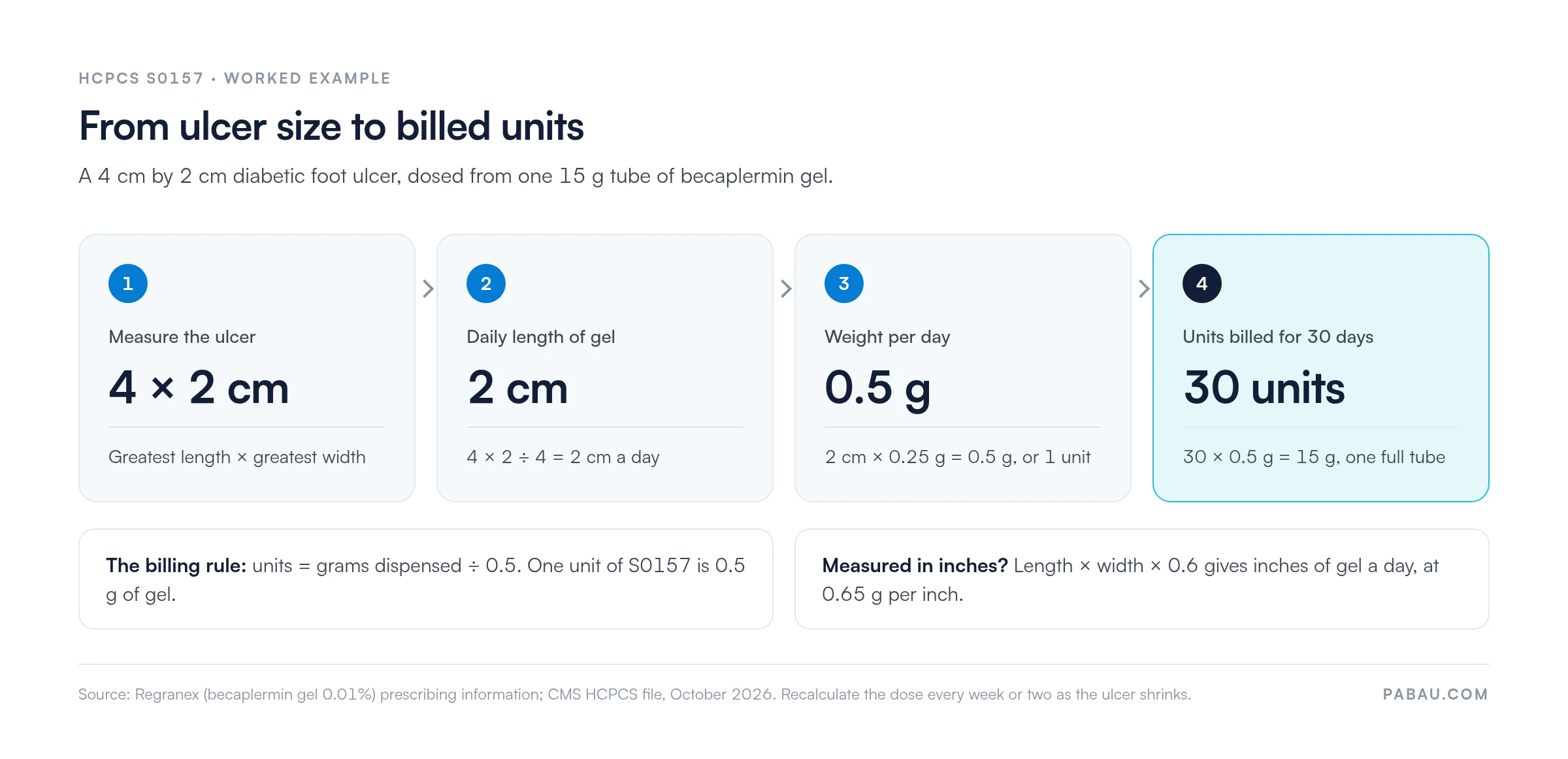
The label tells the clinician to recalculate the dose every week or two as the ulcer shrinks, so later tubes last longer. Treatment should be reassessed if the ulcer has not shrunk by about 30% after 10 weeks, or healed by 20 weeks. Confirm with each payer whether it wants units per tube dispensed before the first claim.
An S0157 claim needs two diagnosis codes. The first is the diabetes code with foot ulcer, such as E11.621. The second is an L97 code that records the ulcer’s site and depth, because E11.621 tells coders to add an L97.4- or L97.5- code.
The sixth character of the L97 code records depth, and many S0157 claims fail on it. A 1 means the breakdown is limited to skin, which falls short of the label. A 2 (fat layer exposed) or deeper matches it, while a 9 leaves the depth unproven.
Pressure ulcer codes from category L89 do not support S0157, and neither do venous stasis ulcer diagnoses. The label excludes both wound types, and payer policies follow it.
S0157 has no modifier of its own. The ones below come up when a payer policy asks for an attestation, or when the gel falls outside a plan’s benefit.
Add a modifier only when the payer asks for it. An unrequested KX or GY can send a clean claim to manual review.
Coverage for HCPCS code S0157 depends on the payer type, and Medicare does not pay it at all. Check the patient’s plan before the gel is dispensed, as part of your wider revenue cycle management.
Medicare’s answer sits in NCD 270.3. Since April 27, 2006, becaplermin has been nationally non-covered under Part B because the patient usually applies it. Part B pays for drugs that are not usually self-administered, and a gel used at home every day does not qualify.
The HCPCS file reflects that with coverage code I. A Medicare contractor will not pay an S0157 line, whatever the documentation shows.
Medicare beneficiaries get becaplermin through their Part D drug plan. The prescriber sends a prescription, the pharmacy dispenses the tube and bills the plan by NDC, and no HCPCS code is involved. The practice’s part is any prior authorization the plan requires.
The practice still bills its own wound care to Part B. Selective debridement, for example, is reported with CPT 97597. The gel never appears on that claim.
The two commercial policies we checked both sit in pharmacy programs and both require prior authorization:
Medicaid criteria vary by state, so read the state manual or the managed care plan’s pharmacy policy before the first fill. Solid medical billing compliance starts with that check.
Most S0157 denials trace back to a decision made before the claim was built. Each rejection comes back with a reason code, and our guide to medical billing denial codes explains how to fix the common ones.
A complete record is what turns an S0157 line into a clean claim. Check each item before the claim goes out.
Wound care teams that work this list before each claim spend less time appealing.
A becaplermin claim draws on three records: the wound measurements, the prior authorization and the claim. When they sit in separate systems, the biller chases the depth from a scanned note and the authorization lapses unnoticed.
Pabau, the practice management platform we build, keeps clinical notes and billing on one patient record. The prior authorization code, dates and sessions are tracked on the case, with a warning when one is missing. US prescriptions go out through DoseSpot e-prescribing.
Pabau’s claims management software sends CMS-1500 claims through the Claim.MD clearinghouse. Eligibility checks and electronic remittances come back to the same record, so your team sees a denial the day it posts.

Pabau tracks prior authorizations on the patient case and sends claims through the Claim.MD clearinghouse. See how it supports drug and wound care billing.

S0157 looks like a simple drug code, yet Medicare excludes the gel it bills and most other payers restrict it. Whether a payer covers it comes down to the wound record, more than the claim form. Depth, neuropathic origin and blood supply decide the first approval, and the measurements at each visit decide the renewal.
A practice that charts those facts at every visit rarely has to argue for the gel later. Book a demo to see how Pabau keeps wound records, authorizations and claims on one patient record.

Need help managing claim denials systematically? Denial management in healthcare covers the upstream controls that prevent the most common payer rejections.
HCPCS code S0157 is the Level II code for becaplermin gel 0.01%, 0.5 gm, sold as Regranex. It bills a topical growth factor for diabetic neuropathic foot ulcers. Medicaid and commercial plans use it, but Medicare does not pay it.
No. S0157 has described becaplermin gel since it took effect in 2001. Cetuximab is billed with J9055, “Injection, cetuximab, 10 mg”.
No. S0157 carries coverage code I, not payable by Medicare. NCD 270.3 lists becaplermin as nationally non-covered under Part B because patients usually apply it themselves. Medicare beneficiaries get the gel through their Part D plan, billed by NDC at the pharmacy.
A 15 g tube is 30 units, because one unit of S0157 is 0.5 g of gel. Bill the grams dispensed divided by 0.5.
Pair a diabetes-with-foot-ulcer code, such as E11.621, E10.621 or E13.621, with an L97 code for the ulcer’s site and depth. The L97 sixth character should be 2 or higher, which shows the ulcer reaches the fat layer or deeper.
It depends on the plan. UnitedHealthcare issues authorization for 6 months, and Cigna approves 5 months under policy IP0495. Medicaid durations vary by state.
Not with any expectation of payment. The FDA label says efficacy has not been established for pressure ulcers or venous stasis ulcers. Cigna lists both as not medically necessary.