



HCPCS code E0198: Water pressure pad billing guide
HCPCS code E0198 is a water pad for a standard mattress HCPCS code E0198 is the ...

Last Updated: Oct 13, 2026

CPT Code 11042 covers surgical debridement of subcutaneous tissue (including epidermis and dermis when performed) for the first 20 sq cm or less
Code selection must be based on the deepest tissue layer actually debrided, not the wound’s surface depth
Add-on code 11045 is required for each additional 20 sq cm beyond the first 20 sq cm threshold
Pabau’s claims management software helps wound care practices track documentation requirements and reduce 11042 denial rates
CPT Code 11042 is the billing code for surgical debridement of subcutaneous tissue, including epidermis and dermis when performed, for the first 20 square centimeters of wound area. Add-on code 11045 covers each additional 20 sq cm, and the code sits within the broader 11042-11047 family that stratifies debridement by tissue depth.
This guide covers the official code definition, documentation requirements, modifiers, 2026 Medicare reimbursement rates, ICD-10 crosswalks, and the most common denial reasons for CPT Code 11042, along with how it compares to CPT 97597 for practices billing both surgical and selective debridement.
Incorrect depth selection and missing documentation send thousands of CPT Code 11042 claims to denial every year. According to the American Medical Association’s CPT code set, 11042 describes debridement of subcutaneous tissue (including epidermis and dermis, if performed) for the first 20 square centimeters or less. It sits within the broader 11042-11047 debridement family, which stratifies by tissue depth and wound size. An authorization request approved for one code does not cover a different code billed on the day.
The parenthetical in the descriptor matters. Epidermis and dermis removal is included within 11042 when performed as part of the subcutaneous debridement procedure. Coders working in wound care, podiatry. If debridement reaches muscle, fascia, or bone, a higher-level code applies. Superficial procedures like skin tag removal.
The AMA’s CPT code set organizes surgical debridement by the deepest tissue layer removed. Choosing the wrong code in this family is one of the fastest routes to a medical necessity denial. The rule is straightforward: always code to the deepest layer actually debrided, as documented in the procedure note.
Billing a higher-level code than what the record supports is a compliance risk; billing a lower-level code undervalues the work performed. Note that some site-specific debridement procedures.
For the deepest tissue-level code in this family, bone debridement billed under 11047, Pabau’s procedure code library covers documentation guidance across practice specialties.
Payers cross-reference the ICD-10-CM diagnosis code against the procedure code to assess medical necessity. Not every wound diagnosis supports 11042 on every payer’s local coverage determination (LCD). The following are among the most commonly accepted diagnoses, but always verify against the applicable MAC’s LCD for wound and ulcer care before billing.
Pabau’s diagnostic code library provides plain-language descriptions and billing context for wound-related diagnoses such as E11.621. Coverage under Medicaid varies significantly by state, and commercial payers may apply more restrictive criteria than Medicare’s national LCD framework.
Combine wound areas at the same tissue depth on a single date of service to calculate total sq cm for billing 11042 and 11045. Bill wounds at different tissue depths with separate codes. Never average across depths.
With plastic surgery practice software, graft and flap procedures carry their full documentation trail from consult to closure.
Modifier usage errors are a leading cause of 11042 claim denials, particularly when debridement is performed alongside an evaluation and management (E&M) service. Understanding which modifier to append, and when, directly affects claim acceptance rates.
The 0-day global period for CPT Code 11042 means there is no standard post-operative period during which related services are bundled. This is why same-day E&M billing with modifier 25 is permissible when the visit addresses a separate, significant clinical issue.
Always verify the current global period indicator in the CMS fee schedule lookup, as values can change with annual MPFS updates.
Medicare reimbursement for CPT Code 11042 varies by setting and geographic location. The CMS Physician Fee Schedule applies a locality-based payment adjustment using Geographic Practice Cost Indices (GPCI). Non-facility rates (office or wound care practice) are generally higher than facility rates (hospital outpatient).
CY2026 introduced a -2.5% efficiency adjustment to work RVUs across the 11042-11047 debridement family, which is reflected in the relative value units below. The figures represent approximate CY2026 national averages, based on the CMS RVU26B relative value file; verify locality-adjusted rates using the CMS fee schedule lookup tool referenced above.
Medicare rates are updated annually with the MPFS final rule, typically published in November for the following year. Geographic locality adjustments can shift the non-facility payment by 20% or more between high-cost (San Francisco, New York) and low-cost localities. Always cite the current year and MAC locality when reporting specific rates to your billing team.

Pabau’s claims management software helps wound care practices document debridement procedures accurately, flag modifier requirements, and reduce CPT 11042 denials before claims leave the practice.

Insufficient documentation is the single most common reason CPT Code 11042 claims are denied on audit. The procedure note must support both the tissue depth and the wound dimensions. The following elements are required by most MAC LCDs and the broader Medicare coverage framework.
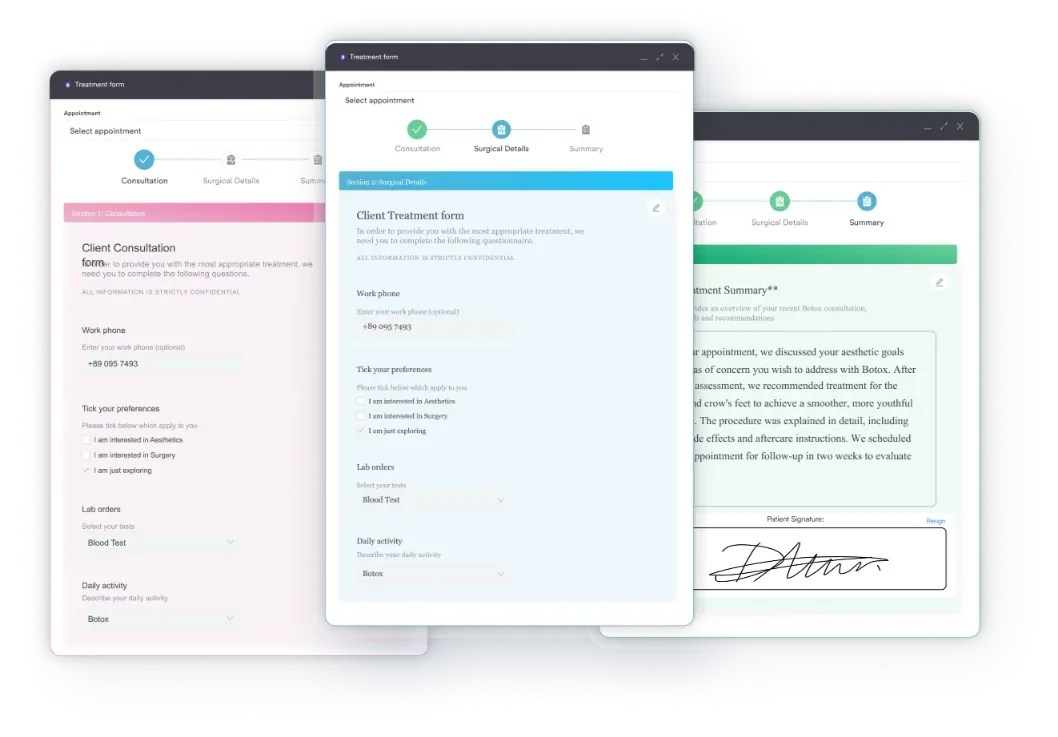
Practices using digital intake forms and structured procedure note templates reduce missing documentation by pre-populating required fields for wound dimensions and tissue depth. Pabau’s patient record management tools allow clinicians to build custom wound care note templates that prompt for each required element before the encounter closes.
CPT Code 11042 does not require a formal operative note in most outpatient settings. A detailed procedure note in the patient record, signed by the performing provider, typically meets payer requirements.
The note must be distinct from the E&M documentation if a same-day office visit is also billed. Combining debridement notes with routine visit documentation without clear separation is a frequent audit finding.
Maintaining solid HIPAA compliance documentation practices protects the practice during payer audits. Structured electronic records that timestamp entries and track provider signatures reduce exposure during retrospective reviews.
For related wound debridement procedures.
Denial patterns for CPT Code 11042 are well established across Medicare Administrative Contractors. Most trace back to one of four root causes:
Using claims management software that flags these issues pre-submission can catch the majority of preventable denials before they reach the payer.
CPT 11042 covers surgical debridement. The two codes serve different clinical purposes and sit in different code families, and billing the wrong one for the service performed creates compliance exposure.
When both procedures genuinely occur on the same date at distinct wound sites, modifier 59 on 97597 signals the services are separate. Current National Correct Coding Initiative (NCCI) edit tables govern whether this combination is permitted without an edit override. Verify the current edit status using CMS’s NCCI edit files before assuming unbundling is appropriate.
This same-day billing scenario is common in outpatient therapy settings.
Review the applicable MAC LCD for wound and ulcer care before billing 11042 alongside 97597. Palmetto GBA and Novitas publish policy-specific guidance on same-day billing combinations. What one MAC permits, another may deny.
CPT Code 11042 carries a 0-day global period under the Medicare Physician Fee Schedule. This is operationally significant. Because there is no standard post-operative period, the practice can bill for related wound care services on the same or subsequent dates without automatic bundling into the surgical global. However, same-day service bundling is still governed by NCCI edits and individual payer policy.
Practices managing clinical documentation workflows electronically can configure templates to prompt clinicians for the specific modifier rationale fields, reducing modifier errors before claims are submitted. Well-designed practice management software integrates these billing safeguards into the documentation workflow rather than treating them as a separate billing-team task.
CPT Code 11042 is straightforward in its clinical definition but demanding in its billing execution. Getting the tissue depth right, measuring the wound accurately, pairing the correct ICD-10 code, and appending the appropriate modifier are four separate steps where errors compound into denials.
Pabau’s claims management software helps wound care practices build the documentation structure and pre-submission checks that prevent these errors at source, rather than managing appeals after the fact. To see how Pabau handles wound care billing workflows, book a demo with the team.

Comparing clearinghouse pricing plans? Claim.MD pricing guide breaks down the $30, $60, and $120 monthly plans and which one costs less at your claim volume.
Billing for home-based wound care? The Medicare waiver template explains coverage exceptions that affect debridement billing in the home setting.
Choosing a claims clearinghouse? Claim.MD vs Office Ally comparison compares Office Ally’s free tier against Claim.MD’s flat $120 plan to show which wins at higher claim volume.
CPT Code 11042 is a surgical debridement code describing removal of subcutaneous tissue (with epidermis and dermis included when performed) for the first 20 square centimeters or less of wound area. It sits within the AMA’s integumentary surgery code family (11042-11047), which stratifies debridement by tissue depth from subcutaneous through muscle, fascia, and bone.
Add-on code 11045 is used for each additional 20 sq cm of subcutaneous tissue debrided beyond the first 20 sq cm threshold covered by 11042. Bill one unit of 11045 for every additional 20 sq cm increment, combined with the parent code 11042 on the same claim line.
CPT 11043 covers debridement of muscle and/or fascia as the deepest tissue layer removed, while CPT 11042 covers subcutaneous tissue as the deepest layer. Both have a base threshold of the first 20 sq cm, but 11043 reflects deeper tissue involvement and typically reimburses at a higher rate. Always code to the deepest layer documented in the procedure note.
The most commonly applicable modifiers are 25 (significant, separately identifiable E&M on the same day), 59 (distinct procedural service when NCCI edits apply), 76 (repeat procedure by the same provider), and LT/RT (bilateral wound designation when required by the payer). Modifier 25 is appended to the E&M code, not to 11042 itself.
Medicare non-facility rates for CPT Code 11042 are approximately $120-$145 as a national average for CY2026, with facility rates typically $50-$65, reflecting the -2.5% efficiency adjustment CMS applied to this code family. Exact rates vary by CMS geographic locality and are updated annually. Use the CMS Physician Fee Schedule lookup tool or a current RVU calculator for the exact rate applicable to your practice location.
Billing 11042 and 97597 on the same date is subject to NCCI edit review. When both codes are clinically justified at separate wound sites, modifier 59 on 97597 may be appended to override the edit, but this requires documentation of a separate clinical circumstance for each service. Verify the current NCCI edit status before assuming same-day billing is permissible without a modifier.



