CCSD code L6530: Revision femoral bypass graft
CCSD code L6530: Definition and clinical scope CCSD code L6530 carries the offic...

Last Updated: Nov 13, 2026
S0139 is the HCPCS Level II code for minoxidil, 10 mg, an oral tablet reported in 10 mg units. It sits in the non-Medicare drug range S0012–S0197, so Medicare does not pay it, while some Medicaid and commercial plans accept it.
Payer acceptance decides most S0139 claims. Confirm the plan takes S-codes, bill one unit per 10 mg supplied, and add an NDC only where the payer asks for one.
Let Pabau's smart automation suggest the right codes, reduce claim denials, and keep your practice compliant—effortlessly.
Automate repetitive tasks and focus on what matters most—your patients.
Reduce coding errors and ensure compliance with the latest regulations.
Clean claims, fewer denials, and faster reimbursements.
Powerful insights and reporting to help your practice thrive.
HIPAA compliant SOC 2 certified GDPR-compliant Trusted by 4,000+ clinics worldwide

HCPCS code S0139 reports minoxidil, 10 mg, an oral tablet that a practice dispenses or supplies, billed in 10 mg units.
S0139 sits in the non-Medicare drug range S0012–S0197 and carries coverage code I, so Medicare does not pay it.
Some Medicaid and commercial plans accept S0139, but acceptance varies by payer, so confirm it before the first claim.
The patient takes minoxidil by mouth, so no administration code, waste modifier or J-code crosswalk applies to the claim.
Pabau’s practice management software lets a practice record the prescription, stock lot and expiry against the patient, then send the S0139 claim from that record.
HCPCS code S0139 is the Level II code for minoxidil, 10 mg. The AAPC HCPCS code set lists it among the non-Medicare drug codes S0012–S0197, a block of temporary national S-codes that Medicare does not pay.
Minoxidil is an oral drug. FDA-labeled minoxidil tablets come in 2.5 mg and 10 mg strengths, and DailyMed lists no injectable form. S0139 is therefore a dispensed or supplied drug code, billed by the number of 10 mg units the patient receives.
Its neighbor, S0138, reports finasteride 5 mg. Both are oral drugs a practice may dispense, and both follow the same S-code payer rules.
CMS maintains the HCPCS Level II code set and publishes changes in quarterly updates. Check that S0139 is still active in the CMS HCPCS files before each benefit year starts.
S0139 reports the minoxidil a practice dispenses or supplies, counted in 10 mg units. The patient takes the tablets by mouth, so no procedure is attached to the code.
Included: The oral minoxidil supplied, reported as one unit per 10 mg. A 30-day supply of one 10 mg tablet a day is 30 units.
Excluded: These items fall outside S0139 and are never folded into it.
With no administration step, an S0139 claim has no administration line, no waste modifier and no infusion time to record. The supply line, its units and its diagnosis carry the claim.
The FDA label approves oral minoxidil for severe hypertension that has not responded to maximum doses of a diuretic plus two other antihypertensive drugs. The label carries a boxed warning, and the drug is usually given with a diuretic and a beta-blocker.
Dermatology and hair restoration practices also prescribe low-dose oral minoxidil off-label for hair loss. Those doses usually sit well below 10 mg, which makes the 10 mg billing unit awkward to report.
Hypertension diagnoses support the labeled use, and I10 is the one most claims carry. When the chart documents resistant hypertension, add I1A.0 after the code for the type of hypertension.
Hair loss diagnoses support an off-label use, and many commercial plans exclude hair loss treatment as cosmetic. Check the plan’s exclusions before dispensing, or agree self-pay terms with the patient first.
Medicare does not pay S0139. The code carries coverage code I, which marks it as not payable by Medicare, and the whole S-code range exists for other payers.
Payer acceptance varies, so ask each plan two questions before the first claim. Does it accept S0139 on a medical claim, and does it want an NDC with it? Some plans prefer oral drugs billed through the pharmacy benefit instead.
Record the answers in a billing compliance file for each payer. That record saves the billing desk from asking the same questions every month.
An S0139 claim turns on three decisions: The unit count, any payer-specific modifier, and whether the payer wants an NDC.
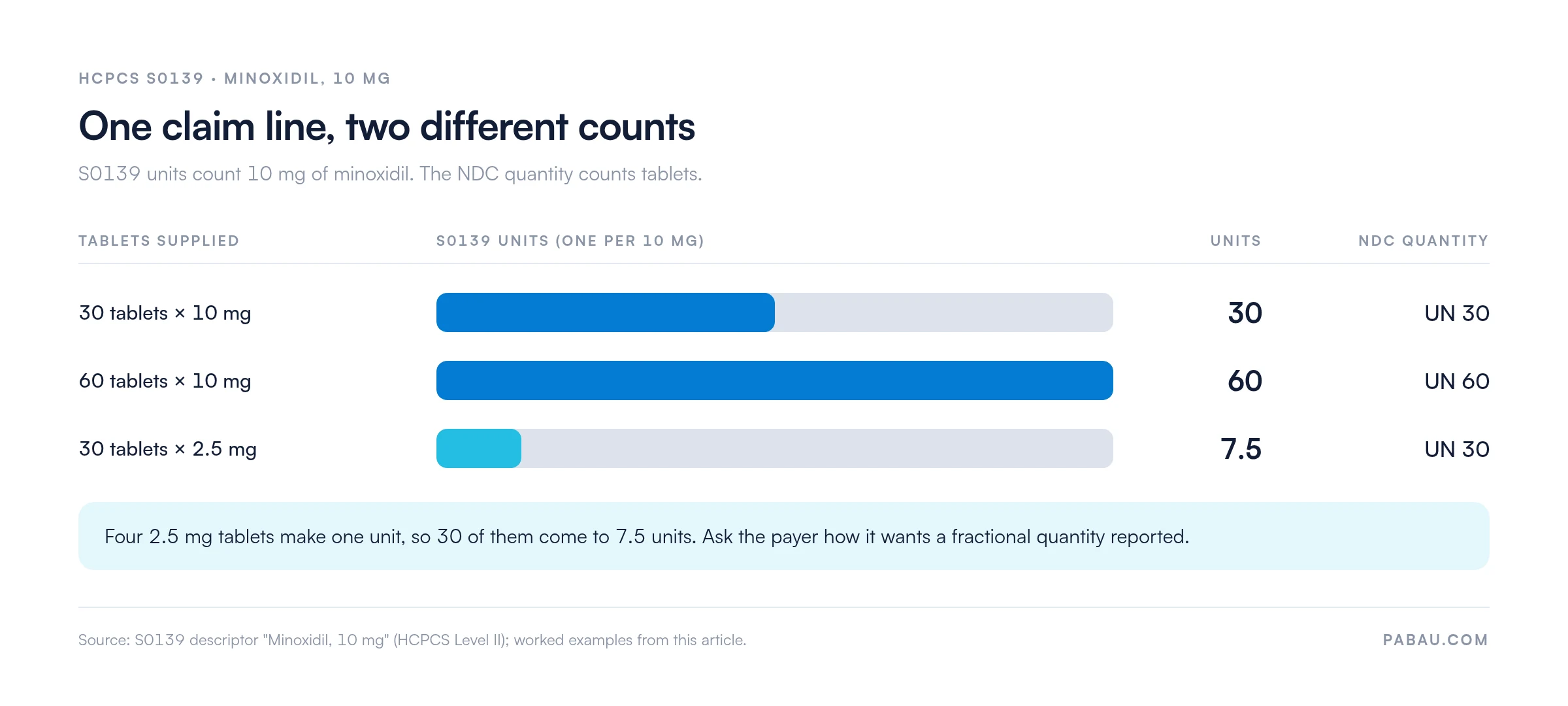
Report one unit for each 10 mg of minoxidil supplied. Thirty 10 mg tablets are 30 units, and sixty 10 mg tablets are 60 units.
Lower strengths are where unit counts go wrong. Four 2.5 mg tablets make one 10 mg unit, so 30 tablets of 2.5 mg come to 7.5 units. Ask the payer how it wants a fractional quantity reported, or whether it wants that strength billed through the pharmacy benefit.
No modifier is required on S0139 by default. JW and JZ do not apply, because they report waste from single-dose containers of separately payable Part B drugs.
Add a modifier only when a payer’s own policy asks for one. Keep that rule in the payer’s billing file so it is applied every time.
Add the National Drug Code (NDC) only where the payer requires one. When it does, enter the 11-digit NDC with the N4 qualifier, the unit qualifier UN for tablets, and the number of tablets dispensed.
Use the NDC printed on the package you dispensed. The NDC quantity and the HCPCS units are different numbers, since one counts tablets and the other counts 10 mg units. The chart below puts the two counts side by side for both tablet strengths.
Payers that accept S0139 still audit oral drug claims against the chart. Submitting a clean claim starts with each of these records in place before billing.
An auditor will compare the billed units with the dispensing record, so the two numbers have to agree. Unsupported drug claims are a compliance exposure as well as a denial risk.
There is no J-code crosswalk for S0139. A payer that rejects S-codes usually wants the prescription billed another way, often through its pharmacy benefit.
Keep a payer matrix for every oral drug code you dispense, S0139 and S0138 included. Record whether each plan accepts S-codes, wants an NDC, requires prior authorization or excludes hair loss treatment. Update it at each contract renewal.
Reimbursement for S0139 comes from the payer contract or the state Medicaid fee schedule. Medicare publishes no payment amount for it, so there is no national benchmark to quote.
Denials on S0139 come from a short list of causes. The table maps each Claim Adjustment Reason Code (CARC) to its fix. Tracking them through a denial management strategy shows which payer rules keep tripping up your team.
The full list of medical billing denial codes helps sort the rest by root cause.
Most S0139 errors start between the prescription and the claim. The prescriber writes 2.5 mg tablets, someone dispenses a bottle, and the billing desk converts tablets to units days later.
Pabau, the practice management platform we build, lets the practice record each of those steps against the patient. Prescribers send US prescriptions through DoseSpot, and the lot and expiry of the stock dispensed are recorded against the patient and the appointment.
From that same record, the billing desk sends a CMS-1500 claim through Claim.MD with Pabau’s claims management software. Eligibility checks run before the visit, and the S0139 units can be checked against the prescription and lot the practice recorded.
When a payer asks how 30 tablets became 7.5 units, the answer is already in the chart.

Record the prescription and the stock lot against the patient in Pabau, then send the S0139 claim from that same record. Your team spends less time reworking denied claims.

Billing S0139 well comes down to three decisions made before the tablets leave the practice. Confirm the payer accepts S-codes, convert the tablets to 10 mg units, and match the diagnosis to the use.
Hair loss prescriptions carry the most risk, since the doses sit below the billing unit and many plans exclude the use. Settle coverage or self-pay terms first, and the claim has little left to dispute.
Book a demo to see how Pabau carries a minoxidil prescription from the chart to a clean claim.

Need a framework for reducing claim denials across your practice? Denial management in healthcare covers how to categorize, prioritize, and appeal denials systematically.
Confused about how clearinghouse submission works? What makes a clean claim explains the data elements payers require before a claim can be adjudicated without manual review.
Looking for a broader overview of medical billing workflows? Revenue cycle management explained maps the full journey from patient registration through payment posting.
Dispensing finasteride for hair loss as well? HCPCS code S0138 covers finasteride 5 mg under the same S-code payer checks.
Billing another oral drug from the same S-code range? HCPCS code S0190 explains units, NDC reporting and prior authorization for oral mifepristone.
HCPCS code S0139 covers minoxidil, 10 mg, an oral tablet. It reports the drug a practice dispenses or supplies, counted in 10 mg units. It sits in the non-Medicare drug code range S0012–S0197.
No. S0139 carries coverage code I, so it is not payable by Medicare. Some Medicaid and commercial plans accept it, and acceptance varies by payer. A Medicare patient’s oral minoxidil usually goes through a Part D pharmacy plan.
Bill one unit for each 10 mg supplied, so thirty 10 mg tablets are 30 units. Thirty 2.5 mg tablets total 75 mg, or 7.5 units. Ask the payer how it wants a fractional quantity reported.
Add an NDC only where the payer requires one, using the N4 qualifier, the 11-digit code, UN and the tablet count. No modifier is required by default. JW and JZ never apply, because they cover single-dose containers of separately payable Part B drugs.
No. Minoxidil is taken by mouth, so there is no injection or infusion to report. A qualifying office visit on the same date is billed separately with its own E/M code.
It can, where the payer covers it. Oral minoxidil for hair loss is off-label, and many plans exclude hair loss treatment as cosmetic. Check the plan’s policy and prior authorization rules before dispensing.
No. Oral minoxidil has no J-code crosswalk. When a payer rejects S-codes, it usually wants the prescription billed another way, often through its pharmacy benefit.