CCSD code L6530: Revision femoral bypass graft
CCSD code L6530: Definition and clinical scope CCSD code L6530 carries the offic...

Last Updated: Nov 13, 2026
S0190 is the HCPCS Level II code for mifepristone, oral, 200 mg. One unit equals one 200 mg tablet, and the code covers the drug only, not misoprostol, the visit or counseling.
Medicare does not pay for S0190, because S-series codes are not valid for Medicare billing. Medicaid programs and commercial payers that cover medication abortion expect an 11-digit NDC, a REMS-certified prescriber, and prior authorization where the payer requires it.
Let Pabau's smart automation suggest the right codes, reduce claim denials, and keep your practice compliant—effortlessly.
Automate repetitive tasks and focus on what matters most—your patients.
Reduce coding errors and ensure compliance with the latest regulations.
Clean claims, fewer denials, and faster reimbursements.
Powerful insights and reporting to help your practice thrive.
HIPAA compliant SOC 2 certified GDPR-compliant Trusted by 4,000+ clinics worldwide

HCPCS code S0190 bills mifepristone, oral, 200 mg, and one unit equals one 200 mg tablet rather than the full regimen.
S codes are temporary national codes that are not valid for Medicare, so Medicaid, commercial plans and self-pay are the routes that pay.
Every S0190 claim needs an 11-digit NDC, and a missing or invalid NDC is a common cause of outpatient drug claim rejection.
Medicaid coverage depends on the state, but federally required life, rape and incest exception cases remain billable everywhere.
Pabau, the practice management platform we build, submits CMS-1500 claims through Claim.MD and tracks claim status and remittances.
HCPCS code S0190 is the Level II code for mifepristone, oral, 200 mg, billed per tablet dispensed in a physician office, practice or outpatient pharmacy. CMS’s October 2026 HCPCS file lists S0190 under that descriptor with coverage code I, not payable by Medicare. CMS publishes the HCPCS Level II file. Meanwhile, S codes are temporary national codes used mainly by Medicaid and commercial payers.
First, the quick-reference facts for S0190 are summarized below.
Specifically, the official descriptor, mifepristone, oral, 200 mg, captures exactly what S0190 bills. In other words, that is the drug itself, dispensed orally at the standard 200 mg dose. Likewise, it does not capture misoprostol, counseling, the office visit, or any procedural part of the abortion service.
Mifepristone blocks progesterone receptors and, combined with misoprostol, ends a pregnancy up to 70 days of gestational age. In addition, the FDA approved it in 2000 under a Risk Evaluation and Mitigation Strategy (REMS) program. Therefore, prescribers and dispensers must be REMS-certified before the drug can legally be prescribed or dispensed.
Moreover, REMS certification is a billing prerequisite as well as a clinical one. In fact, payers audit REMS compliance during post-payment review, and claims from uncertified providers may be subject to recoupment. As a result, coders who treat S0190 as a simple drug code can miss this part of the claim.
S0190 does not include:
S0190 reimbursement rates are set at the payer level, not by a CMS national fee schedule, because S-series codes are not valid for Medicare. As a result, the CMS Physician Fee Schedule lookup tool will not return a rate for S0190. Instead, individual Medicaid programs and commercial payer contracts set the rates.
To find your state Medicaid rate for S0190, first query the fee schedule in your state’s Medicaid management information system (MMIS). However, rates vary widely. Some states pay acquisition cost plus a dispensing fee, while others use a standard drug reimbursement formula.
Verify the current rate before billing. After all, state Medicaid agencies update fee schedules on their own timetable, separate from the CMS annual cycle.
Prior authorization for S0190 depends on the payer, so no universal rule exists. Some commercial plans require it, while others cover mifepristone under the pharmacy benefit without it. Medicaid programs in covering states generally do not require it, though exceptions exist.
Each payer type sends an S0190 claim down a different route, so four checks apply on every route.
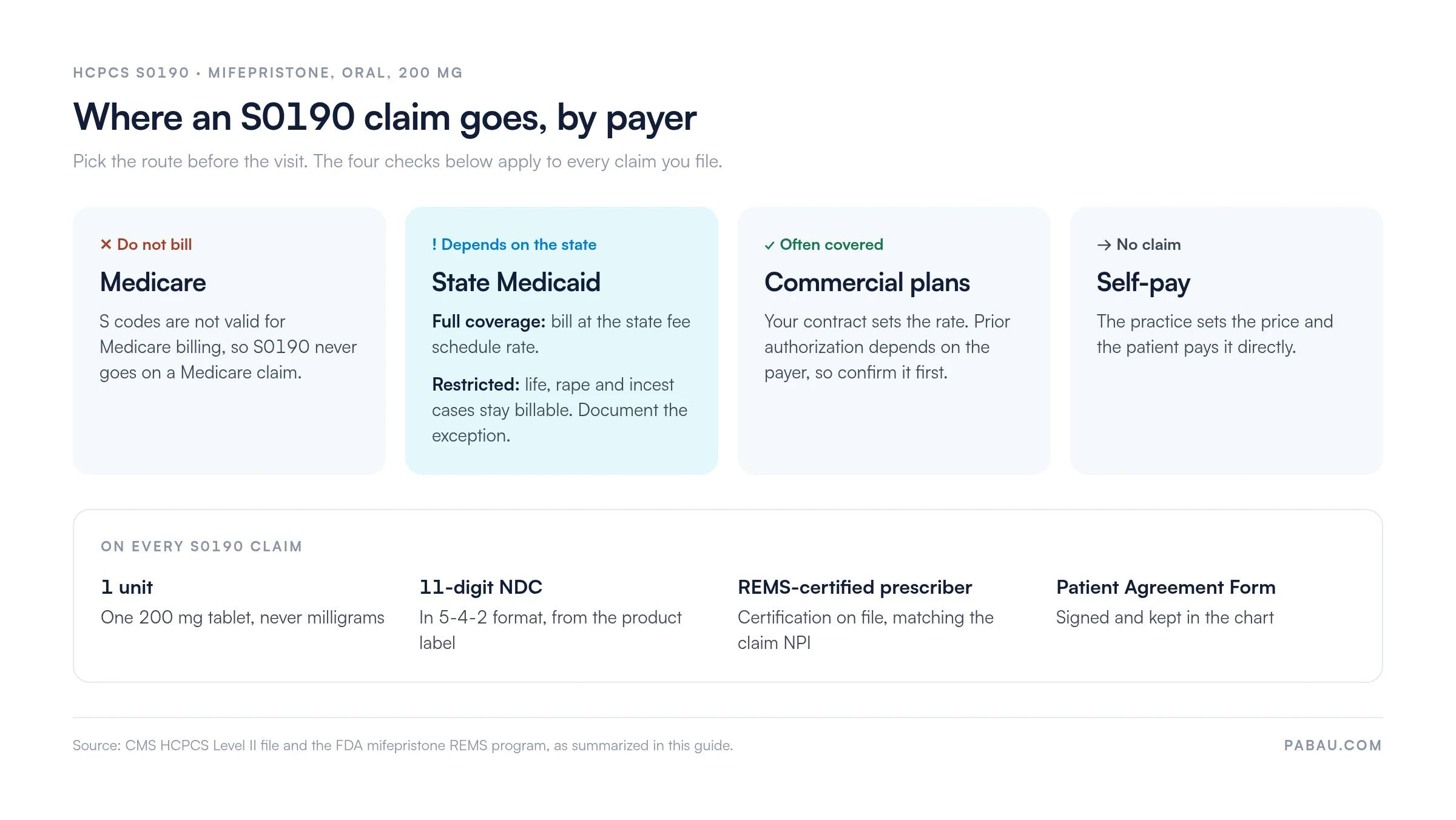
In fact, REMS certification is a universal prerequisite. Still, even where prior authorization is not required, payers may ask for proof of prescriber and dispenser REMS enrollment during claims review. Keep the following on file for every S0190 claim:
Also, payers that exclude medication abortion deny S0190 as a non-covered service, whatever the documentation shows. However, the denial code (CO-96 or CO-27) will not mention REMS. When the patient has a Medicaid plan in a restricted state, confirm coverage before the visit and document any life, rape or incest exception.
Accurate S0190 billing follows a consistent workflow. In fact, errors in units, NDC format, or place of service are the easiest rejections to correct before the claim reaches a payer adjudicator.
Two manufacturers produce mifepristone products that crosswalk to S0190. Specifically, they are Danco Laboratories (brand name Mifeprex) and GenBioPro (generic mifepristone). Both map to S0190, because the HCPCS code captures the drug and strength rather than the manufacturer.
Confirm the NDC for the product you dispense against the current FDA-approved labeling before you submit.
NDC numbers change when packaging changes. Therefore, check the NDC printed on the label against your dispense record, not a static crosswalk table.
First, no modifier is required by default. Still, append JW or JZ only where a specific payer’s policy requires it. Both are Medicare Part B single-dose-container modifiers, so they rarely fit an oral tablet billed under a non-Medicare S code. Oral minoxidil under code S0139 follows the same rule, billed in 10 mg units with no waste modifier.
Mifepristone is dispensed as a single prepackaged 200 mg tablet, so drug wastage is uncommon for a standard dispense. If a payer’s drug policy does call for JZ on all drug claims, append it to the S0190 line for that payer only.
S0190 needs no modifier by default. Before you append JW or JZ, check the payer’s drug policy, because some commercial plans reject claims that carry a modifier they do not recognize.
Also, S0190 must be linked to a supported ICD-10-CM diagnosis code on the claim. Thus, the diagnosis code documents why mifepristone was dispensed. Furthermore, payers cross-check the diagnosis against the drug code, and an unsupported combination denies automatically.
For example, Z33.2 is the primary diagnosis for an elective medication abortion billed with S0190. Confirm the diagnosis against the clinical record before coding. However, payers that restrict medication abortion coverage deny S0190 whatever the diagnosis code.
However, S0190 covers only the mifepristone tablet. Therefore, a complete medication abortion visit generates other billable services, each with its own code. As a result, knowing what each companion code captures prevents unbundling errors and missed charges.
A payer that accepts S0199 expects it in place of the itemized services, so check the contract before you build the claim. Where a payer wants itemized billing instead, the visit goes on as 99213 or 99214 and the dating scan as 76801.
Reviewing the full medical billing workflow for reproductive health services helps billing teams identify every chargeable component before the encounter. Otherwise, teams end up reconstructing charges during charge capture.
S0190 denials cluster around six predictable causes, but each one needs a different fix. Therefore, matching the remark code to the cause is faster than a generic appeal.
Also, the denial codes guide explains each claim adjustment and remark code in this table, including M119. Read the remark code first, because CO-16 alone does not say which field failed.
Systematic denial management for drug codes like S0190 catches NDC and unit errors at claim creation rather than after remittance. For example, a pre-submission check for 11-digit NDC presence and unit counts stops both errors before the claim leaves your practice.
The documentation behind an S0190 claim must show two things. First, the chart must show that mifepristone was clinically appropriate. Second, it must show that the provider was eligible to prescribe and dispense it, which post-payment audits of REMS drugs check closely.
Required documentation in the medical record:
As a result, a documentation checklist for each S0190 encounter reduces audit exposure. In addition, medical billing compliance for drug codes requires the chart and the claim line to tell the same story. Specifically, quantity, NDC, and indication must agree in both.
Audit claims quarterly against REMS enrollment records and confirm each prescriber’s certification is on file and matches the claim NPI. Claims in process for a prescriber whose certification is missing are at risk of recoupment.
State Medicaid coverage for mifepristone varies more than any other part of S0190 billing. Since Dobbs, states fall into three broad categories, and the category decides how S0190 is billed to Medicaid.
Coverage status changes as state laws are enacted, challenged, and revised. Therefore, check the AAPC HCPCS code lookup and your state Medicaid agency’s provider portal for current S0190 coverage. Never assume coverage from a prior billing cycle. Instead, verify it each January and whenever state legislation changes. Codes in the S-series can also be deleted outright, as S0162 for efalizumab was in 2009.
S0190 rework often starts outside the claim. For example, the NDC sits on a dispense log and the Patient Agreement Form in a paper file. Then the denial arrives weeks later in a separate inbox.
Instead, Pabau, the practice management platform we build, keeps those pieces on one patient record. Its remittance-tracking claims management submits CMS-1500 claims through Claim.MD and runs eligibility checks before the visit. Also, ERA remittances post back against the claim, and secondary claims go out from the same screen.
In addition, digital forms let patients sign the Patient Agreement Form before the appointment, and the signed copy stays in the chart for audits. When a payer denies an S0190 line, your billing team sees the remittance next to the visit it belongs to.

Pabau’s claims management submits CMS-1500 claims through Claim.MD and tracks status and remittances. Digital forms keep the signed REMS paperwork in the patient chart.

S0190 itself is simple to code: one unit per 200 mg tablet, with an 11-digit NDC. However, payment depends on what surrounds the code, so settle the payer route before the patient arrives.
Check whether the state Medicaid program or the commercial contract covers the drug, and whether the payer wants S0199 for the episode. Keep the REMS certification and the signed Patient Agreement Form on file, because post-payment reviews look for both.
Book a demo to see how Pabau keeps S0190 claims, signed REMS forms and remittances on one patient record.

Need a full picture of outpatient drug billing? Medical billing fundamentals covers charge capture, claim submission, and remittance workflows for outpatient practices.
Seeing S0190 denials pile up? Denial codes in medical billing explains the common CARC and remark codes and how to resolve each one.
Billing the dating ultrasound separately? CPT code 76801 covers the first-trimester pregnancy ultrasound and the documentation it needs.
Building a compliance routine for drug claims? Medical billing compliance sets out the audit, documentation, and coding controls that keep claims defensible.
HCPCS code S0190 covers mifepristone, oral, 200 mg. That is the drug itself when dispensed in a physician office, practice, or certified outpatient pharmacy. It does not cover misoprostol, the office visit, counseling, ultrasound, or any procedural part of the abortion service. Each of those services takes its own code.
Report 1 unit per 200 mg tablet dispensed. The standard medication abortion regimen uses one 200 mg mifepristone tablet, so a standard dispense is 1 unit. Never report units in milligrams, because the descriptor already sets 200 mg per unit.
No. S0190 is not valid for Medicare billing. Medicare pays for abortion services only in life-endangerment, rape and incest cases. Do not submit S0190 to Medicare.
Both FDA-approved mifepristone products map to S0190. They are Mifeprex from Danco Laboratories and generic mifepristone from GenBioPro. The HCPCS code captures the drug and strength, not the manufacturer. Confirm the 11-digit NDC on the product label before each claim, because NDC numbers change with packaging updates.