CCSD code L6530: Revision femoral bypass graft
CCSD code L6530: Definition and clinical scope CCSD code L6530 carries the offic...

Last Updated: Nov 13, 2026
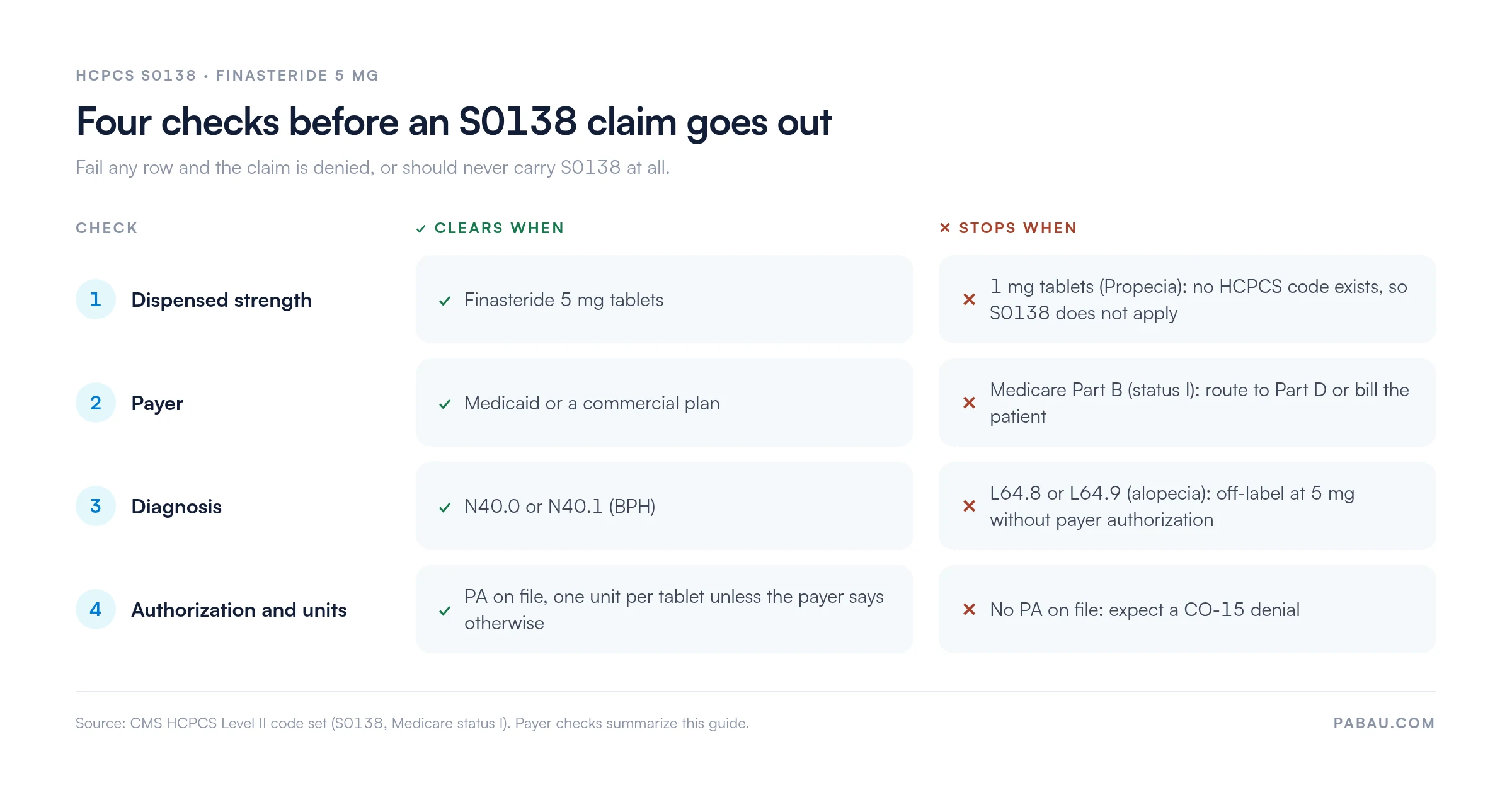
S0138 is the HCPCS Level II code for finasteride, 5 mg, billed per tablet. It is a temporary national S-code for non-Medicare payers, so Medicaid and commercial plans accept it and Medicare Part B does not.
Most claim errors with this code have one of three causes. Medicare Part B does not recognize S-codes, so a Part B claim fails. A diagnosis that does not support finasteride 5mg fails review, and so does a wrong unit quantity.
Let Pabau's smart automation suggest the right codes, reduce claim denials, and keep your practice compliant—effortlessly.
Automate repetitive tasks and focus on what matters most—your patients.
Reduce coding errors and ensure compliance with the latest regulations.
Clean claims, fewer denials, and faster reimbursements.
Powerful insights and reporting to help your practice thrive.
HIPAA compliant SOC 2 certified GDPR-compliant Trusted by 4,000+ clinics worldwide

HCPCS code S0138 covers finasteride 5mg per tablet. Propecia 1mg is not billed under it.
Medicare Part B does not pay for S-codes, so a Medicare patient reaches finasteride through a Part D pharmacy plan or self-pay.
Prior authorization is commonly required by commercial and Medicaid payers, so verify it before dispensing.
Pair S0138 with N40.0 or N40.1 for BPH, since 5mg is off-label for alopecia without payer authorization.
Pabau, the practice management platform we build, tracks the prior authorization on the patient’s case and warns when one is missing.
HCPCS code S0138 describes finasteride 5mg, billed per tablet. CMS’s October 2026 HCPCS release lists it as “Finasteride, 5 mg” with Medicare coverage code I, which means Medicare does not pay for it. S0138 sits in the S-code range of the CMS HCPCS Level II code set, the temporary national codes used by Medicaid and commercial payers. It is not a J-code, because finasteride is an oral tablet rather than an injectable drug.
S0138 covers finasteride 5mg for benign prostatic hyperplasia (BPH), alone or with doxazosin. Alopecia is FDA-approved only at 1mg. That split drives both diagnosis code selection and payer coverage. Oral minoxidil, which some hair restoration practices prescribe off-label, is billed separately under HCPCS code S0139 in 10 mg units.
Strength is the first detail to confirm on an S0138 claim. Finasteride 1mg (Propecia) has no HCPCS code and is generally not billed to insurers. A claim with S0138 and 1mg tablets is a strength mismatch. Always confirm the dispensed strength before selecting this code, and record the indication and strength when the prescription is written.
Many billers confuse S-codes with J-codes when coding drug claims. J-codes cover injectable drugs administered in clinical settings. S0138 is an oral tablet dispensed at a pharmacy or practice. That difference decides which payers accept each code type and which claim form to use. Topical drugs have S-codes too, such as code S0117 for tretinoin, which is billed per 5 grams.
Because finasteride is an oral medication, it falls outside the Medicare Part B drug benefit entirely. Part B covers drugs administered in clinical settings, while Part D covers outpatient oral medications through pharmacy plans. An S0138 claim sent to Medicare Part B is typically denied as non-covered (for example, CO-96). The same rule applies to other oral drugs in the non-Medicare S-code range, such as sildenafil 25mg under S0090.
Coverage for HCPCS code S0138 varies by payer type, and no single rule applies across all plans. Verify coverage before each dispensing episode rather than assuming a prior approval carries forward.
Commercial formulary coverage changes annually. A plan that covered finasteride on Tier 2 in 2025 may move it to Tier 3 or add a step-therapy requirement in 2026. Always confirm the patient’s current benefit year formulary before assuming prior coverage applies.
Run an eligibility and formulary check at each prescription refill, not just at intake. Payers update formulary tiers at the start of each plan year. A patient covered without restrictions in January may face a step-therapy requirement in February after their employer’s plan renews.
Prior authorization (PA) for S0138 is required by most commercial payers and many Medicaid programs, particularly for new prescriptions. The criteria differ by payer, but the documentation follows a consistent pattern. If your team is new to payer approvals, start with how the prior authorization process works from request to decision.
Common prior authorization criteria for S0138:
When submitting a PA request, include the AUA symptom score for BPH patients. Many payers use this score as an objective threshold (typically an AUA score of 8 or higher) to approve drug therapy. Submitting without it is a common reason for initial PA denial, though the drug may still be approved on appeal.
Every claim for HCPCS code S0138 must include at least one ICD-10-CM diagnosis code establishing medical necessity. The ICD-10 code must match the FDA-approved indication for the strength dispensed. A diagnosis of androgenetic alopecia paired with 5mg finasteride triggers a coverage review in most plans because the alopecia indication is for 1mg.
Check the current ICD-10-CM tabular list at the start of each billing year. Code descriptors and inclusion notes are updated annually by CMS and the National Center for Health Statistics (NCHS). An outdated code selection creates avoidable claim errors.
Billing HCPCS code S0138 correctly requires accurate unit reporting, the right claim form, and clean documentation. Before any of those matter, four checks decide whether S0138 belongs on the claim at all.
Pairing HCPCS code S0138 with accurate superbill documentation at the point of dispensing reduces downstream errors. Capture the NDC, the unit count, and the diagnosis before the claim is built, and fewer claims come back for manual correction.
S0138 claim denial patterns are predictable. The same five or six root causes recur, and each has a defined corrective action. The denial management strategies that reduce rework on code-specific claims start with identifying which denial reason code drove the rejection.
Reviewing medical billing denial codes systematically, rather than claim by claim, reveals patterns. If CO-15 (missing PA) keeps appearing on S0138 claims from one payer, the authorization step is being skipped when the prescription is written. Fix that step and the denial rate drops.
Documentation for HCPCS code S0138 claims must establish both the diagnosis and the clinical rationale for finasteride 5mg specifically. Payers audit this combination of elements, and missing any one of them gives an adjudicator grounds to deny or recoup the claim.
For BPH claims (N40.0 or N40.1), the record must include:
For androgenetic alopecia claims (L64.8 or L64.9), the record must show the diagnosis and the strength prescribed (5mg). It also needs a clinical rationale for the higher dose over the FDA-approved 1mg strength, plus explicit payer authorization for off-label use. Without the authorization reference number in the record, a retrospective audit will likely result in recoupment.
Meeting billing compliance requirements across every dispensing encounter is easier when the clinical record and the claim come from the same data source. When prescribing notes live in one platform and billing data in another, the mismatch often surfaces only when a payer audits the claim.
S0138 reimbursement has no Medicare fee schedule because CMS does not publish allowable amounts for S-codes. Reimbursement is set entirely by individual payer contracts and state Medicaid fee schedules.
Payers typically calculate allowable amounts for finasteride 5mg using one of three methods:
To find payer-specific S0138 reimbursement rates:
No single rate holds across payers and states, so quote the rate in your own contract.
Request a remittance advice report from your clearinghouse filtered for S0138 claims over the last 12 months. The electronic remittance advice (ERA) data shows what each payer paid versus billed, revealing under-reimbursed contracts worth renegotiating.
In many practices, the prescription, the authorization, and the claim sit in three different places. A refill goes out before anyone checks that the PA is still current, and the CO-15 denial arrives weeks later.
Pabau keeps those steps on one patient record. The prior authorization code, its dates, and its sessions are tracked on the patient’s case, with a warning when one is missing. In the US, Pabau’s claims software for practices sends CMS-1500 claims through Claim.MD, runs eligibility checks, and posts ERA remittances back.
The result is fewer finasteride refills dispensed without a valid authorization, and every denial traced to the record it came from. Your billing team spends its time on appeals worth winning, so you can stop re-keying the same claim.

Pabau’s billing and claims management tools help practices document HCPCS codes, track authorization status, and submit clean claims electronically. See how the workflow fits your team.

S0138 is one of the easier drug codes to get paid, because its failures are predictable. Settle the strength, the payer, and the diagnosis before the tablets leave the practice, and most denials never happen.
The trade-off worth remembering is Medicare. A Medicare patient on finasteride 5mg needs a Part D or self-pay conversation. Have it at the prescribing visit, not after a denied Part B claim.
Book a demo to see how Pabau tracks authorizations and claims for the drugs your practice dispenses.

Need a framework for reducing claim denials across all codes? Denial management in healthcare covers root-cause analysis, appeal workflows, and system-level fixes for common payer rejections.
Want to understand how drug billing fits the broader revenue cycle? Medical billing fundamentals explains the end-to-end process from encounter to payment posting.
Looking for guidance on clean claim submission? Submitting a clean claim outlines the field requirements that keep claims out of the rejection queue.
Need a ready-made PA request? Medical prior authorization form gives your team a template for the clinical case a payer reviews before approving finasteride.
HCPCS code S0138 is the billing code for finasteride 5mg, billed per tablet. It covers the drug when dispensed for an FDA-approved indication such as benign prostatic hyperplasia (BPH). It is a Level II HCPCS S-code accepted by Medicaid and commercial payers, and Medicare Part B does not accept it.
No. S0138 carries Medicare coverage code I, so Medicare Part B does not pay for it. Finasteride may be covered under a Medicare Part D pharmacy plan. That benefit runs through the Part D plan directly, not through physician office billing with an S-code.
The standard unit is per tablet. For a 30-tablet supply, bill 30 units. Some payers define the unit as a 30-day supply rather than a per-tablet count. Check the payer’s provider manual before submitting to avoid a quantity-based denial.
J-codes cover injectable drugs administered in a clinical setting and are accepted by Medicare Part B. S0138 covers an oral tablet dispensed to the patient. Finasteride is not injectable, so it cannot be billed under a J-code. Because it is oral, Medicare Part B does not cover it under any HCPCS code.
The primary diagnosis codes for S0138 are N40.1 (benign prostatic hyperplasia with lower urinary tract symptoms) and N40.0 (BPH without LUTS). For androgenetic alopecia, use L64.9, though 5mg dosing for alopecia is off-label and typically requires explicit prior authorization from the payer.
The most common reasons are a claim sent to Medicare Part B, which does not pay for S-codes, and missing prior authorization. Others are a strength mismatch, where 1mg tablets were dispensed but S0138 was billed, a diagnosis-code mismatch, and an incorrect unit quantity. Reviewing denial reason codes and fixing the upstream workflow resolves most recurring S0138 denials.