CPT Code 62284: Injection procedure for myelography
CPT Code 62284: official descriptor and procedure overview The American Medical ...

Last Updated: Oct 19, 2026
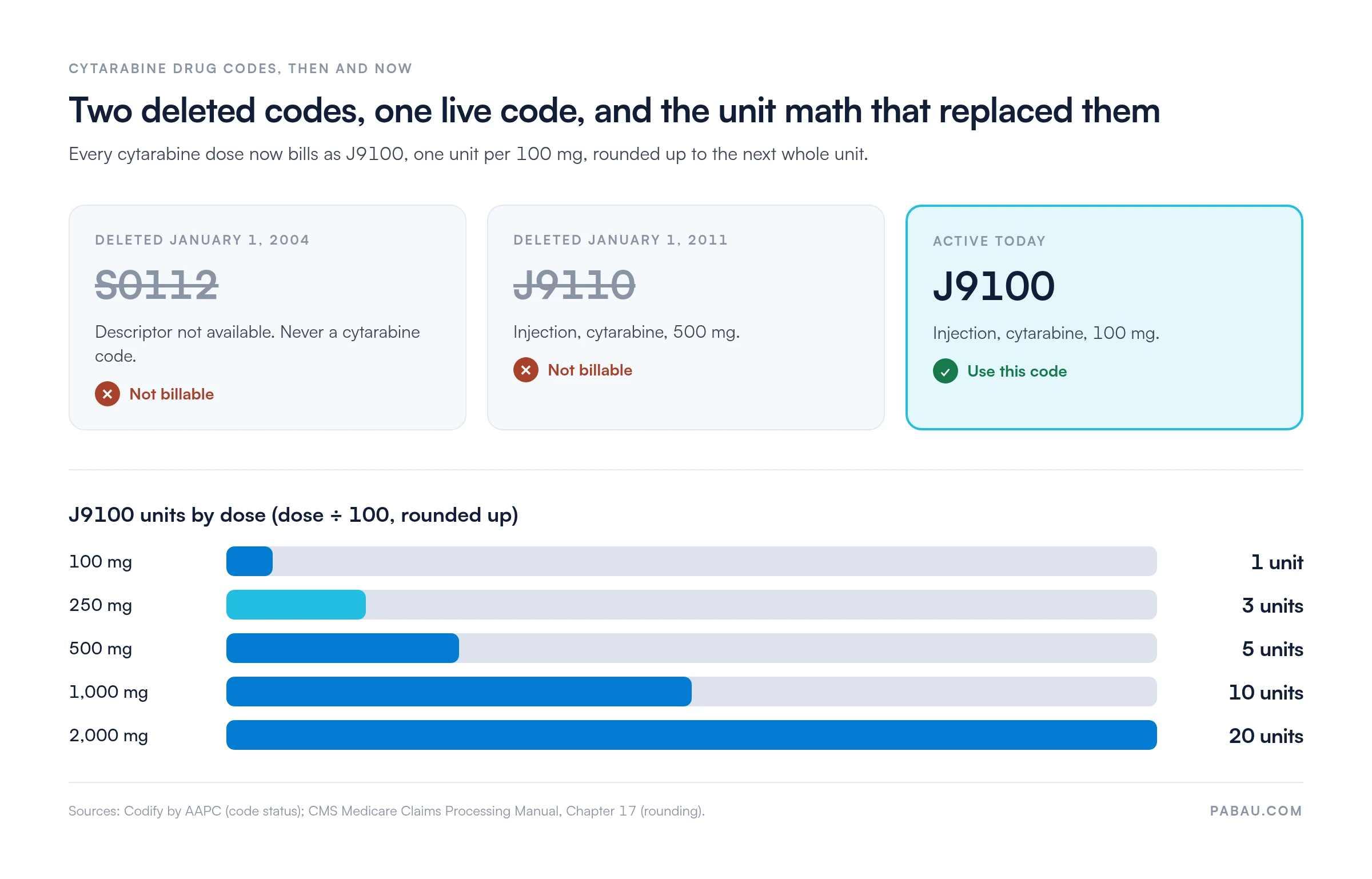
HCPCS code S0112 is a deleted Level II code, retired on January 1, 2004, with no official descriptor on file. So if a charge sheet or an older reference maps S0112 to cytarabine 500 mg, that entry is wrong. The code you need for cytarabine today is J9100, billed per 100 mg.
Getting this right matters because a deleted code gives the payer no valid line to process. The claim comes back unpaid, and your team has to fix and resubmit it. Below, we trace where the cytarabine mapping came from, work through the unit math, and end with a six-point pre-submission check.

HCPCS code S0112 was deleted effective January 1, 2004, and its official descriptor is listed as not available.
S0112 never described cytarabine, so any fee schedule or charge master that maps it to cytarabine 500 mg needs correcting.
J9100 (injection, cytarabine, 100 mg) is the active cytarabine code, and Medicare Part B generally pays it at ASP plus 6%.
J9110 once covered cytarabine 500 mg but was deleted on January 1, 2011, so larger doses bill as multiple J9100 units.
Medicare rounds a dose up to the next whole unit, so 250 mg of cytarabine bills as three units of J9100.
S0112 has no active entry in any current code lookup. Codify by AAPC lists it as deleted, effective January 1, 2004, with the long descriptor shown as “Descriptor not available.” Here’s the full record at a glance.
S-codes are temporary national codes that private payers use for items with no permanent code. Although private-sector groups maintain them, they still appear in the national HCPCS file published by the Centers for Medicare & Medicaid Services (CMS).
That means even a payer-specific meaning would leave a descriptor on file. S0112 has none, so any cytarabine mapping for it is an error.
J9100 is the only HCPCS code that describes cytarabine today. Cytarabine, also called Ara-C, is a chemotherapy drug used mainly in acute leukemia regimens. Three codes tend to turn up when people search for it, and they compare like this.
The 500 mg descriptor that older references attach to S0112 belonged to J9110, a J-code. It left the code set in 2011. Since then, J9100 has covered every cytarabine dose. The chart below lines up all three codes with the units you’d report today.
As for payment, under Medicare Part B, physician-administered drugs such as J9100 are generally paid at the average sales price plus 6%. CMS updates those ASP rates every quarter. Commercial and Medicaid plans also use J-codes for office-administered drugs, but each one sets its own payment rate and coverage policy.
Larger doses report as several J9100 units on one line, because every cytarabine claim now counts in 100 mg steps. Divide the dose in milligrams by 100. When the result isn’t a whole number, the Medicare Claims Processing Manual, Chapter 17, tells providers to round up to the next unit.
Here’s a worked example. A patient receives 2,000 mg of cytarabine in one session, so the biller reports J9100 with 20 units on a single line. Reporting four units of the old 500 mg code, J9110, would get the line rejected instead. That code hasn’t existed since 2011.
Bortezomib went the same way. HCPCS code S0115 covered a 3.5 mg vial until it was deleted, and Velcade now bills as 35 units of J9041.
A clean cytarabine claim comes down to six fields. Before you submit, confirm each one:
Where does it usually sit? Look in fee schedules, charge masters, superbills, and drug templates carried over from an older system. It can also come from a reference page that lists S0112 as cytarabine.
What if a claim already went out with it? Correct the line to J9100, recalculate the units, and resubmit through the payer’s corrected-claim process. The remittance advice will show why the original line failed, and our guide to denial codes in medical billing explains each remark.
How do you stop it coming back? Review your code lists against each HCPCS update from CMS. The annual update takes effect on January 1, and quarterly updates follow through the year. Building that review into your billing compliance routine keeps retired codes out of new claims.
Many practices still key drug codes into claims by hand or copy them from an old superbill. That habit is how a code deleted two decades ago can reach a payer today.
Practice management software like Pabau builds each claim from the patient record, so visit details carry straight across. Staff choose codes from built-in ICD-10 and HCPCS lookup libraries instead of typing them from memory. Before submission, Pabau checks that every required claim field is complete.
For US practices, the Claim.MD connection adds eligibility checks, ERA posting, and claim tracking. As a result, your team spends less time reworking claims that bounce back for avoidable entry errors. Our overview of claims management software shows how those steps fit together.

Pabau pre-fills claims from the patient record, offers ICD-10 and HCPCS code lookups, and checks required fields before submission. Your team spends less time reworking rejected claims.

The fix itself takes minutes. Search your fee schedule for S0112 and J9110, swap in J9100, and recount the units. The rework on claims that already went out takes far longer, so run that search before the next cytarabine dose is billed.
The wider lesson is about sources. A reference that invents a descriptor can cost weeks of rework. Confirm drug codes against the CMS HCPCS file before they enter your fee schedule. Book a demo to see how Pabau builds claims from the patient record and checks them before they reach the payer.

Billing the infusion as well as the drug? CPT code 96413 explains how the initial chemotherapy infusion is coded and documented.
Coding other chemotherapy drugs? HCPCS code J9070 walks through cyclophosphamide units and billing.
Getting repeated CO-16 or CO-50 remittance codes? Denial codes in medical billing covers remark code definitions and step-by-step appeal workflows.
Want to reduce compliance risk on drug claims? Billing compliance requirements outlines documentation and audit-readiness standards for specialty drug billing.
Need a guide to the full billing framework? Medical billing workflows explains how HCPCS drug codes fit into the end-to-end claims process.
The Blue Cross Blue Shield Association and AHIP maintain S-codes for private payers. CMS still publishes them in the national HCPCS Level II file, so a lookup there shows each code’s status and descriptor.
No. The national HCPCS file states that S-codes are not payable by Medicare. Some Medicaid programs and private payers use them, so check the specific plan’s policy before billing one.
For a drug drawn from a single-dose container, Medicare requires the JW modifier on a separate line for the discarded amount. When no drug is discarded, the JZ modifier goes on the claim instead. Drugs from multi-dose containers take neither modifier.
No. J9100’s descriptor names no route, so the same drug code covers IV, subcutaneous, and intrathecal doses. The route changes the administration code instead, such as CPT 96450 for chemotherapy into the central nervous system.